
Founder & Editor · Last reviewed 2026-07-08
Introduction
Galway Racecourse, known to almost everyone simply as Ballybrit, is a dual-code Flat and National Hunt turf track about 6 km northeast of Galway city in the west of Ireland. It sits in the townland of Ballybrit, just off the N6, and is owned and operated by the Galway Race Committee. The venue runs roughly 12 to 13 race days a year, but its reputation rests overwhelmingly on one week: the seven-day Summer Festival held from the last Monday in July into early August, the longest race meeting in Britain or Ireland and one of Ireland's biggest sporting and social gatherings.
The track itself is a right-handed, undulating, sharp "switchback" circuit with a steep climb in the back straight, a sharp descent into a dip before the home turn, and a stiff uphill finish that is one of the toughest anywhere. The home straight is short, which rewards horses ridden prominently and reliably produces course specialists. Galway is unusual among turf tracks in showing a measurable draw bias on the Flat, which we cover in form and betting.
The headline races are valuable handicaps rather than Group or Graded contests. Galway stages no Group 1/2/3 Flat races and no Grade 1/2/3 jumps races. Its two signature events are the Tote Galway Plate, a premier handicap chase over 2m 6½f run on the Wednesday, and the Guinness Galway Hurdle, a premier handicap hurdle over 2m run on the Thursday, or Ladies' Day. Both were worth €270,000 in 2025. The Plate dates back to the very first meeting; the Hurdle was added in 1913. You can read more in the races.
The story begins on Tuesday 17 August 1869, when the first meeting at Ballybrit, a two-day event, drew an estimated 40,000 people, with Eyre Square in the town pressed into service as a campsite. The driving force was Lord St Lawrence, then MP for Galway, alongside a committee of hunting and steeplechasing figures. The Galway Plate featured from that opening meeting, won by Absentee. From those beginnings the festival grew, extending in stages to its present seven days by 1999. More on this in history.
Recent Summer Festival attendance has run in the region of 116,000 to 126,000 across the week, with 125,997 recorded in 2025. The festival is a major betting and social occasion, though a note before you go further: nothing on these pages is betting advice, and backing favourites to starting price loses over time because of the bookmaker's built-in margin. This guide sets out the course, its races, its history and the practical detail for a visit.
In this guide
Where to Bet
Place your bets with a trusted, licensed bookmaker.

Promo code BETFRED50. New customers only. Register, deposit with a Debit Card, and place a first bet of £10+ at Evens (2.0)+ on Sports, to be settled within 7 days, to get £30 in Sports Free Bets and £20 in Bet Builder Free Bets within 24 hours of settlement. 7-day expiry. Eligibility & payment exclusions apply. Full T&Cs apply. Take Time to Think. BeGambleAware.org. 18+. Full T&Cs.

Promo code R30. New UK customers only, 18+. Register, deposit £10 or more, then place a £10 single cash bet at odds of 1/2 (1.5) or greater on any sports market (excluding Virtuals). Once the qualifying bet settles you get £30 in Free Bets (3 x £10) — the qualifying bet can win or lose. Free Bets are valid on any sports market excluding Virtuals, expire in 7 days, are non-withdrawable and must be used in full. Excluded deposit methods apply (including PayPal, Apple Pay, Skrill and NETELLER). Named bets such as Lucky 15 do not qualify. If you cash out the qualifying bet, or it is voided, you are no longer eligible for the offer. Ends 31.12.26. Full T&Cs apply. Please gamble responsibly. BeGambleAware.org. 18+. Full T&Cs.

Promo code BET40GET20. New UK customers, 18+. Register with the code and place a first bet of £40 or more at Evens (2.0) or greater. Receive 2 × £10 free bets: the first credited automatically once the qualifying bet settles, the second 24 hours later. Free bets must be placed at minimum odds of 4/1 (5.0), expire 24 hours after credit, and the free-bet stake is not returned with winnings. Debit card deposits only. Take Time to Think. BeGambleAware.org. 18+. T&Cs apply. Full T&Cs.

50% of your first-day net losses refunded as a free bet, capped at £25. New UK customers aged 18+ only. To qualify, deposit and place a first bet of £10 or more on any sport at minimum odds of evens (2.00), then place at least two further bets on different events, each worth at least 50% of your largest bet, all at evens (2.00) or greater. Losses are counted from your first settled bet until 23:59 the same day. Place a qualifying £10+ bet and you are guaranteed at least a £5 free bet. Bets placed at SP, void bets, cashed-out bets and bets struck with free bets do not count towards the offer. The free bet is credited the day after your qualifying bets settle and must be used within 7 days, after which it expires. It can be used at odds from 1/4 (1.25) up to 250/1 on singles and straight accumulators, but not on Trixie, Patent or Yankee style multiples. Free-bet stake is not returned with winnings. One offer per person, household, address, IP address and device. E-wallet deposits may not qualify, so check the cashier before depositing. Customers registered with GAMSTOP cannot claim. KYC identity verification must be completed before the free bet is credited. Take Time to Think. BeGambleAware.org. 18+. T&Cs apply. Full T&Cs.

New customers, 18+. Choose the sports bonus at sign-up, make a first deposit and receive a 100% bonus up to £50 in your Sports Bonus balance. To convert the bonus to cash, wager it 10x within 30 days. Single bets below Evens (2.00) do not qualify; accumulators do not qualify if any selection is below 1/2 (1.50). Virtual Sports, voided, cancelled, drawn, cashed-out and free-bet wagers do not count towards wagering. Only the first settled bet per event counts. Withdrawing before the wagering requirement is met forfeits the bonus balance including bonus winnings. Real-money funds are used before bonus funds. Deposits via Skrill or Neteller are not eligible. Not valid in conjunction with other promotions. Odds, bet and payment limits apply. 10bet general and promotion T&Cs apply. BeGambleAware.org. 18+. Full T&Cs.

New customers in Great Britain and Republic of Ireland, 18+. Place a £10 fixed-odds qualifying bet at minimum odds of 1/2 (1.50) — single or each-way (only the win part counts), pre-event or in-play, not cashed out early, within 28 days of opening the account. Receive up to £60 in bonuses credited over three days: 3 × £10 fixed-odds free bets (the first on settlement, then 24 and 48 hours later) plus 3 × £5 Total Goals FOOTBALL spread bets, 3 × £5 racing Winning Favourites spread bets and a £1 racing Race Index spread bet (the spread bets need a full spread-betting account). Free-bet stakes not returned with winnings; free bets valid 28 days from issue. IMPORTANT: the £5 credits are SPREAD bets — sports spread betting carries the risk that losses can exceed your stake. Sports spread-betting customers do not have Financial Ombudsman or FSCS recourse. Take Time to Think. BeGambleAware.org. 18+. T&Cs apply. Full T&Cs.

Promo code WELCOME15, entered under My Bonuses after registering. New UK customers, 18+. Place a first qualifying bet of at least £10 from your cash balance at odds of evens (2.0) or greater within 7 days of opening the account. Once the qualifying bet fully settles you receive £15 in free bets, credited as 3 x £5 tokens with set uses: one £5 accumulator free bet (minimum 4 legs, each leg at 2/5 or bigger), one £5 sports free bet (any market at evens or bigger) and one £5 Sub Cover free bet (selected football player markets at evens or bigger). Free-bet stakes are not returned with winnings. Free bets expire 7 days after they are credited. Void, cashed-out and partially cashed-out bets do not qualify. One offer per customer. Confirm the current terms on BetGoodwin's own welcome-offer page before claiming. Take Time to Think. BeGambleAware.org. 18+. T&Cs apply. Full T&Cs.

New UK customers, 18+. Minimum deposit £10. Place a £10 qualifying single at minimum odds of 1/2 (1.50), settled within 14 days. Receive £30 in free bets (stake not returned), split £20 for sportsbook use (2 x £10) and £10 for Bet Builder only (2 x £5); Bet Builder does not cover horse racing. Free bets must be accepted within 7 days and expire 7 days after acceptance. No promo code required. Best Odds Guaranteed on UK & Irish racing, subject to having staked over £25 in the previous seven days. Operated by LiveScore Betting and Gaming (Gibraltar) Ltd, UKGC 56859. Confirm the current terms on LiveScore Bet's own promotions page before claiming. Take Time to Think. BeGambleAware.org. 18+. T&Cs apply. Full T&Cs.
18+. BeGambleAware.org
The Track
The Track
Galway Racecourse at Ballybrit is a right-handed, undulating, sharp "switchback" circuit, and its layout is one of the defining features of the whole track. Every source agrees on the right-handedness, and the "switchback" description captures why the course rides the way it does: the terrain climbs, dips and rises again within a single lap, so a horse is rarely on level ground for long. The overall shape is roughly rectangular, closer to "almost rectangular" than a smooth oval, which is unusual for a British or Irish turf track and helps explain the tight, turning character that Galway is known for.
A genuine switchback
The circuit is not a flat ring. There is a steep climb in the back straight, a sharp descent into a dip as the runners approach the home turn, and then a stiff uphill finish that is regarded as one of the stiffest anywhere in Britain or Ireland. The home straight itself is short, so horses have very little room to recover once they straighten up for the line. That combination, a downhill run into a short, rising finish, is what makes Galway such a specialist's track and rewards horses that are already travelling and well placed turning in.
The exact circuit length is reported inconsistently, so we treat it as reported rather than fact. Different sources describe it as about 1 mile 2 furlongs, just over 1 mile 2 furlongs, about 1 mile 3 furlongs, "10 furlongs," and as much as 1.4 miles (2.25 km). Form analysts most commonly reach for the 10-furlong figure, while other racing guides land on "just over a mile and a quarter." No single authoritative measurement has been confirmed, so if you see a precise circumference quoted anywhere, treat it as one reading among several.
The run-in and the finish
The uphill run-in to the line is likewise reported rather than officially fixed. It is described variously as "just over two furlongs" and as "just over a furlong on the Flat to about two furlongs," with the short home straight put at "little more than a furlong." The exact official run-in figure has not been confirmed. What is consistent across the descriptions is the character of it: a stiff, rising, short finish that punishes horses ridden with too much to do.
Fences and hurdles
Galway runs both codes on turf, with no all-weather surface. On the chase course, sources report seven fences per circuit, which works out at 14 fences in the Galway Plate over two circuits. These figures are reported rather than confirmed against an official course schematic. A well-known feature is that the final two fences are positioned very close together, described by several sources as the closest two obstacles of any course in the world. They sit in the back straight on the downhill section and are followed by that long uphill run-in of over two furlongs (some sources say about two to two and a half furlongs).
The hurdle course sits on the inside of the chase course and is even sharper again. Sources report six hurdles per circuit, with the Guinness Galway Hurdle taking in nine flights over its trip. As with the chase fences, treat the per-circuit flight count as reported. Both of the headline handicaps, the Galway Plate and the Galway Hurdle, are shaped by this tight, obstacle-heavy layout.
Going
Summer Festival ground is typically good to good-to-yielding, and the course waters in dry spells to protect that. Rain frequently arrives mid-week, however, and can turn the ground yielding to soft; soft going is far from uncommon in the West of Ireland. The autumn meetings are generally run on softer ground, and on soft going stamina comes at a premium. Ground conditions matter here beyond the obvious, because they interact with the draw and pace patterns described below.
Draw and pace bias
Unusually for a turf track, Galway shows a meaningful draw bias on the Flat. Timeform's guide states that the finishing straight is short at little more than a furlong and that a low draw at 7f and 1m 100yds is a slight advantage. Geegeez analysis adds that some residual bias persists even in longer-distance handicaps on this always-leaning-in circuit, most pronounced at 1m4f, where low-drawn and pace-pressing horses have held an edge, and notes that over 7f in fields of eight or more, lower draws have been roughly twice as likely to produce a winner as higher stalls. The edge is stronger on firmer ground and weaker on yielding or soft ground, and is generally negligible over the longest Flat trips except where pace position dominates.
Running style matters as much as, or more than, the draw. The tight, turning circuit and short home straight place a high premium on being handily placed. Per Geegeez, since 2009 hold-up horses in handicaps of eight or more runners have won at just 4.18% across all distances, making Galway one of the worst Irish courses for held-up horses, while prominent racers have fared far better. The consensus is that it matters less where a horse is drawn than how it is ridden: tactical speed to race prominently is a clear asset. None of this makes betting profitable, and no draw or pace angle overcomes the bookmaker's margin over time; it simply describes how the track rides. The reliable by-product is that Galway's sharp, tricky layout produces recognised horse and jockey course specialists, a theme picked up in form and betting.
Key track facts
| Feature | Detail |
|---|---|
| Direction | Right-handed |
| Shape | Undulating "switchback," roughly rectangular |
| Codes | Dual, Flat and National Hunt (turf, no all-weather) |
| Circuit length | Reported inconsistently: about 1m2f to 1m3f, "10 furlongs" or 1.4 miles (2.25 km); not confirmed |
| Home straight | Reported as little more than a furlong |
| Run-in | Reported as just over a furlong (Flat) to about two furlongs, uphill |
| Finish | Stiff uphill climb, among the stiffest in Britain or Ireland |
| Chase fences | Reported seven per circuit (14 in the Galway Plate over two circuits) |
| Hurdle flights | Reported six per circuit (nine in the Galway Hurdle) |
| Notable feature | Final two chase fences reported as the closest two of any course in the world |
| Summer going | Typically good to good-to-yielding; can turn yielding to soft |
| Autumn going | Generally softer, stamina at a premium |
| Flat draw bias | Slight low-draw advantage at 7f and around 1m; stronger on firmer ground |
| Pace bias | Prominent racers favoured; hold-up horses win at just 4.18% (8+ runner handicaps, since 2009) |
The Course Map
Course map and layout
Galway Racecourse at Ballybrit is a compact, self-contained venue, and once you are through the gates almost everything sits within a short walk. The two grandstands, the parade ring and the enclosures cluster together along the home straight, which makes the site easy to read even on the busiest days of the festival.
The two principal stands run side by side facing the track. The Killanin Stand, also called the Main or West Stand, is the larger and newer of the pair. It opened in 2007, named after Lord Killanin, and its terrace holds around 7,000 people with seating for about 700. Next to it stands the Millennium Stand, which opened in 1999 on the site of the old Corrib Stand. The Corrib Stand itself dated from 1955 and was for years reputed to have "the longest bar in the world" before the Millennium Stand replaced it. The Millennium Stand's viewing terrace holds a larger crowd, with second-floor balcony seating for reserved ticket holders. Together these two stands form the spine of the enclosure, with their bars, restaurants and Tote facilities stacked over several floors. There is no longer a separate Corrib Stand on the map; the name survives only in the history of the site and, occasionally, in sponsor-named races. You can find more detail in enclosures and stands.
The parade ring sits within this same core area, close to the stands and the weigh-room complex. A weigh-room, media centre and administration building opened here in 2004, grouping the working heart of the racecourse near the ring where horses are saddled and paraded before each race. Accessible viewing is provided at the parade ring, just past the finishing post and on the first floor of the Killanin Stand, which gives a sense of how tightly the ring, the finish and the stands sit relative to one another. A long-planned redevelopment of the parade ring, sometimes described as a "stadium experience", has been repeatedly delayed, though Horse Racing Ireland has approved funding to redevelop the enclosure to the north of the ring.
The finish lies directly in front of the two stands at the end of a short home straight, up the racecourse's stiff uphill run-in. Because the track is a tight right-handed circuit, spectators in the Killanin and Millennium Stands look across the home turn and the finish from an elevated, close-up vantage. For the shape and gradients of the circuit itself, see the track. During the Summer Festival the racecourse largely operates as a single general-admission enclosure, so the stands, ring and finish all sit inside one connected space rather than being split across separate paddocks.
The Races
The Races
Galway's reputation rests on two of the most famous races in the Irish calendar, but it is worth being clear about what they are. Galway stages no Group 1, 2 or 3 Flat races and no Grade 1, 2 or 3 National Hunt races. Its two signature events, the Galway Plate and the Guinness Galway Hurdle, are both big-field handicaps, classified as premier (historically "Grade A") handicaps in the Irish system and carded by some media as "Grade 3 (Class 1)". That is not a knock on them. They are among the most valuable and fiercely competitive handicaps in Europe, and the handicap format, where the weights are set to bring the field together, is exactly what makes them such compelling betting and spectator races. Alongside them the Summer Festival cards a handful of Listed black-type races and a clutch of valuable Flat and jumps handicaps, but the two headline handicaps are the heart of it. For how these races sit within the week, see the festival.
The two headline handicaps
| Race | Code | Distance | Age | Field | Prize (2025) | Day |
|---|---|---|---|---|---|---|
| Tote Galway Plate | Handicap chase (National Hunt) | 2m 6f 111y (about 4,779 m), 14 fences | 4yo+ | Large, often 18 to 22 | €270,000 total, winner €162,000 | Wednesday |
| Guinness Galway Hurdle | Handicap hurdle (National Hunt) | 2m 11y (about 3,229 m), 9 hurdles | 4yo+ | Large, up to about 28 | €270,000 total, winner €162,000 | Thursday (Ladies' Day) |
The Tote Galway Plate is the older and most historic of the pair, first run at the very first Ballybrit meeting in 1869 and won by Absentee. It was run over 2m5f historically, extended to 2m6f in 1992 and to its present 2m6f111y in 2015. Tote Ireland has sponsored it since 2011, following William Hill from 2006 to 2010. It reached €300,000 in 2019.
The Guinness Galway Hurdle, added in 1913 with Red Damsel the inaugural winner, is the richest handicap hurdle in Ireland and one of the most valuable and competitive in Europe. It was contested over 1½ miles for its first six years before settling at its modern trip of about two miles. Guinness has sponsored it since 2000, and it is the centrepiece of Ladies' Day.
Galway Plate roll of honour
| Year | Winner | Trainer | Jockey | SP |
|---|---|---|---|---|
| 2025 | Western Fold | Gordon Elliott | Danny Gilligan | 11/1 |
| 2024 | Pinkerton | Noel Meade | Donagh Meyler | 20/1 |
| 2023 | Ash Tree Meadow | Gordon Elliott | Danny Gilligan | 13/2 |
| 2022 | Hewick | John "Shark" Hanlon | Jordan Gainford | 16/1 |
| 2021 | Royal Rendezvous | Willie Mullins | Paul Townend | 5/1 fav |
| 2020 | Early Doors | Joseph O'Brien | Mark Walsh | 7/1 |
| 2019 | Borice | Gordon Elliott | L P Dempsey | 9/1 |
| 2018 | Clarcam | Gordon Elliott | 33/1 | |
| 2017 | Balko Des Flos | Henry de Bromhead | 6/1 | |
| 2016 | Lord Scoundrel | Gordon Elliott | Donagh Meyler | 10/1 |
| 2015 | Shanahan's Turn | 16/1 | ||
| 2014 | Road To Riches | Noel Meade | 14/1 | |
| 2013 | Carlingford Lough | 7/2 fav | ||
| 2012 | Bob Lingo | Mark Walsh | 16/1 | |
| 2011 | Blazing Tempo | Paul Townend | 5/1 fav | |
| 2010 | Finger Onthe Pulse | 22/1 | ||
| 2009 | Ballyholland | 16/1 | ||
| 2008 | Oslot | Paul Nicholls | Ruby Walsh | 11/4 fav |
| 2005 | Ansar | Dermot Weld | ||
| 2004 | Ansar | Dermot Weld |
The full roll runs much deeper. Life Of A Lord (Aidan O'Brien) won back-to-back in 1995 and 1996, the 1995 win coming by 20 lengths and completing O'Brien's first Plate 1-2-3. Clonsheever landed back-to-back renewals in 1923 and 1924, and Tipperary Boy remains the most successful horse in the race's history with three wins (1899, 1901 and 1902). Gordon Elliott is the outright leading trainer with five wins (Lord Scoundrel 2016, Clarcam 2018, Borice 2019, Ash Tree Meadow 2023 and Western Fold 2025). Two-time winning trainers since 1988 include the connections of Life Of A Lord and Ansar, while Adrian Maguire, Ruby Walsh, Mark Walsh, Paul Townend, Donagh Meyler and Danny Gilligan have each ridden two winners in that period. The 2022 winner Hewick, a €850 purchase, went on to win the King George VI Chase.
Galway Hurdle roll of honour
| Year | Winner | Trainer | Jockey | SP |
|---|---|---|---|---|
| 2025 | Ndaawi | Gordon Elliott | Jack Kennedy | 13/2 |
| 2024 | Nurburgring | Joseph O'Brien | JJ Slevin | 13/2 |
| 2023 | Zarak The Brave | Willie Mullins | Paul Townend | 9/2 |
| 2022 | Tudor City | Tony Martin | L A McKenna | 22/1 |
| 2021 | Saldier | Willie Mullins | Patrick Mullins | 18/1 |
| 2020 | Aramon | Willie Mullins | Patrick Mullins | 7/1 |
| 2019 | Tudor City | Tony Martin | R M Power | 10/1 |
| 2018 | Sharjah | Willie Mullins | Patrick Mullins | 12/1 |
| 2017 | Tigris River | Joseph O'Brien | Barry Geraghty | 5/1 |
| 2016 | Clondaw Warrior | Willie Mullins | Ruby Walsh | 9/2 fav |
| 2015 | Quick Jack | Tony Martin | 9/2 | |
| 2014 | Thomas Edison | Tony Martin | AP McCoy | 7/2 fav |
| 2013 | Missunited | Michael Winters | R M Power | 7/1 |
| 2012 | Rebel Fitz | Michael Winters | Davy Russell | 11/2 |
| 2011 | Moon Dice | 20/1 | ||
| 2010 | Overturn | Donald McCain | 6/1 | |
| 2009 | Bahrain Storm | 20/1 | ||
| 2005 | More Rainbows | Noel Meade | 33/1 | |
| 2001 | Ansar | Dermot Weld | Paul Carberry | |
| 1996 | Mystical City | Willie Mullins |
Willie Mullins is the record-holding trainer here with six wins (Mystical City 1996, Clondaw Warrior 2016, Sharjah 2018, Aramon 2020, Saldier 2021 and Zarak The Brave 2023). Tony Martin has four (Thomas Edison 2014, Quick Jack 2015, Tudor City 2019 and 2022), and Tudor City is the only dual winner of the modern era. Patrick Mullins is the leading jockey since 1988 with three (Sharjah 2018, Aramon 2020, Saldier 2021). Overturn (2010) was the last British-trained winner, and Gordon Elliott famously had gone 0 from 35 before finally landing the race with Ndaawi in 2025. The 2025 running was awarded to Ndaawi in the stewards' room after Helvic Dream passed the post first by a head but was demoted for causing interference, a decision an IHRB Appeals Committee upheld on 13 August 2025.
The rest of the card
Beyond the two handicaps, the Festival stages several Listed races and a Grade 3 novice event or two that change year to year. The Listed Flat black-type races include the Arthur Guinness Irish EBF Corrib Fillies Stakes (7f, Thursday), won in 2024 by Raknah and in 2025 by Tropical Island, and the Ardilaun Hotel Irish EBF Oyster Stakes (1m4f), which is staged at the autumn September meeting rather than the summer week. The most valuable supporting handicaps include the Colm Quinn BMW Mile Handicap, "the Galway Mile" (€120,000 in 2025), the Connacht Hotel (Q.R.) Handicap for amateur riders, widely called Ireland's "amateur Derby", and the Irish Stallion Farms EBF "Ahonoora" Handicap over 7f on the final Sunday.
Because the Plate and Hurdle both attract far more entries than can be accommodated, the Festival also runs consolation handicaps for the horses that miss the cut, notably the Galway Blazers Handicap Chase on Friday and the Galway Tribes Handicap Hurdle on Saturday. Across all seven days, the 2025 Festival carried a total prize fund of €2,171,000 over 53 races, with a minimum value of €17,000 per race. For how the going and the sharp, uphill circuit shape these races, see form and betting. None of this should be read as a suggestion that any race or staking approach is profitable to back; large competitive handicaps are, by design, hard to predict.
Records and Stats
Records and stats
Galway's numbers are best understood through its two signature handicaps and its remarkable summer crowds, rather than through a formal record book. Unusually for a racecourse of its stature, there is no published course-wide standard-times table, so the "records" here are the leading counts and the confirmed attendance figures.
No official standard-times table
There is no authoritative, course-wide course-record or standard-times schedule for Galway. During research, none could be located from a reliable published source. Individual winning times are recorded per race (for example, the 2023 Galway Hurdle was clocked at 3m 38.80s and the 2025 running at 3m 41.00s, noted as 0.50s slow of standard), but there is no single, sanctioned table of course records across distances. Treat any figure presented as a "Galway course record" with caution, because we could not confirm one against an official source.
Leading trainers and jockeys
Galway rewards specialists, and a handful of names dominate the two big races. Dermot Weld, "The King of Ballybrit", was crowned festival leading trainer 30 times and once saddled a record 17 winners across a single festival week (in 2011, from 40 runners). Willie Mullins has held the festival leading-trainer title continuously since 2016, taking it for a tenth time in 2025. You can read more about them in the legends.
The table below sets out the leading connections for the two headline handicaps, drawn from the rolls of honour.
| Record | Holder | Detail |
|---|---|---|
| Galway Plate, leading trainer | Gordon Elliott | 5 wins (2016, 2018, 2019, 2023, 2025) |
| Galway Hurdle, leading trainer | Willie Mullins | 6 wins (1996, 2016, 2018, 2020, 2021, 2023) |
| Galway Hurdle, second trainer | Tony Martin | 4 wins (2014, 2015, 2019, 2022) |
| Galway Hurdle, leading jockey (since 1988) | Patrick Mullins | 3 wins (2018, 2020, 2021) |
| Most Galway Plate wins, a horse | Tipperary Boy | 3 wins (1899, 1901, 1902) |
| Festival leading trainer, most titles | Dermot Weld | 30 times |
| Most winners in a single festival week | Dermot Weld | 17 winners (2011) |
Among the jockeys, several riders share two Galway Plate wins each since 1988, including Adrian Maguire, Ruby Walsh, Mark Walsh, Paul Townend, Donagh Meyler and Danny Gilligan. Gordon Elliott's five Plate wins make him the outright leading trainer in that race, while his 2025 Galway Hurdle with Ndaawi ended a long drought, he had gone 0 from 35 before finally landing it.
Attendance records
The seven-day Summer Festival is one of Ireland's biggest sporting and social gatherings, and its weekly attendance is the closest thing Galway has to a headline statistic. Recent confirmed totals sit in the 116,000 to 126,000 range, well below the 150,000-plus figures repeated by some older guides, which we could not verify for recent years.
| Year | Weekly attendance | Note |
|---|---|---|
| 2025 | 125,997 | Up nearly 10,000 on 2024; Friday busiest at 26,234 |
| 2024 | 116,374 | Racing Post / The Irish Field |
| 2023 | over 122,000 | Reported as 122,367 or 122,362 |
| 2022 | over 116,000 | First full-capacity festival after Covid |
| 2017 | 137,682 | Pre-pandemic peak |
For context, the 2020 festival was cancelled and 2021 was limited to 1,000 people per day, with a full return in 2022. The single largest gathering ever held at Ballybrit was not a raceday at all: the 1979 Papal Mass drew an estimated 280,000 people.
Note that the 2023 total is reported very slightly differently across sources (122,367 in one account, 122,362 in another), so we give it as "over 122,000". For how these crowds shape the raceday experience, see the festival.
History
History
The first race meeting at Ballybrit took place on Tuesday 17 August 1869, a two-day event that drew an estimated 40,000 people to the fields northeast of Galway city. Demand for beds and space was so intense that Eyre Square in the town was pressed into service as a campsite for the visiting crowds, an early sign that a race meeting here would always be as much a civic occasion as a sporting one.
The driving force behind that inaugural fixture was Lord St Lawrence, then MP for Galway and chairman of the stewards, who is also credited with creating Punchestown. He worked alongside a committee of hunting and steeplechasing figures, among them the Marquis of Clanricarde. The course itself, originally a mile-and-a-half circuit, was laid out by the civil engineer Thomas G. Waters. The land at Ballybrit is associated with the Lynch family of Renmore; one account holds that the site was donated free of charge by Captain Wilson Lynch, though the two research runs differ slightly on the detail. The Galway Plate was a feature from that very first meeting, won by Absentee, and the Galway Hurdle joined the card in 1913 with Red Damsel as its inaugural winner. You can read more about both feature races in the races.
Organised racing in County Galway long predates Ballybrit. Horse "matches" run under King's Plate Articles are recorded in the region as far back as the mid-13th century, and a five-day meeting was held at Knockbarron near Loughrea in 1864, although some sources place that meeting a century earlier, in 1764, so the date is not settled. A "Western Plate" of the era was confined to gentlemen riders qualified at Punchestown or members of the County Galway Hunt, a reminder of racing's roots in the local hunting field.
The early decades saw the fixture steadily modernise. A hunter's course with a Punchestown-style bank was added around 1870, and the Midland and Great Western Railway aided the meeting's growth by carrying horses to and from the course free of charge, provided they had actually run. The Ussher Stables became an early powerhouse, producing seven Plate winners over a connection that ran until Harry Ussher's death in 1957. Galway also kept pace with broadcasting: the races were carried on radio for the first time in 1929, alongside the Curragh Derby, and television coverage arrived in 1963.
Perhaps the most striking part of Galway's story is how the festival stretched from two days into the longest race meeting in Britain or Ireland. Sponsorship arrived in 1959, and the meeting was extended to three days at the same time (some guides date the three-day move to 1970, but the racecourse's own history and the Connacht Hotel both give 1959, which we follow here). A fourth day was added in 1971, a fifth in 1974, a sixth in 1982, and finally a seventh in 1999. That move to seven days coincided with the opening of the Millennium Stand, which replaced the old Corrib Stand of 1955, whose pub had for years been reputed to boast "the longest bar in the world." Together they mark the point at which Galway became the sprawling seven-day gathering described in the festival.
The building programme continued into the new century. A new weigh-room, media centre and administration building opened on 29 June 2004. The most significant addition came in 2007, when the Killanin Stand, also known as the Main or West Stand, opened to replace an earlier West stand dating from 1972. Wikipedia dates the opening to 2007, though some guides cite 2009. It was opened by Taoiseach Bertie Ahern and named after Lord Killanin, a Race Committee member for more than 40 years. The stand cost about 22 million euro, of which around 10 million came in grant aid from Horse Racing Ireland, and it was built in a record 44 weeks. Its terrace can hold around 7,000 people, with seating for 700.
Much of this expansion fell under the long stewardship of John Moloney, who managed the course from January 1989 until his retirement after the 2015 festival, having succeeded Captain Luke Mullins. Across his 26 years, capital development at Ballybrit totalled more than 40 million euro, taking in the Millennium and Killanin Stands, underground car and pedestrian tunnels, and the new weigh-room, offices and media centre. He handed over to his son, Michael Moloney, who remains Chief Executive today. More recent work has included around 5 million euro of maintenance across the two stands, while a long-planned parade-ring redevelopment has been repeatedly delayed; the HRI board has since approved about 2.1 million euro for work on the enclosure to the north of the parade ring.
One day at Ballybrit stands apart from the racing entirely. On 30 September 1979, Pope John Paul II celebrated a Youth Mass at the racecourse before an estimated 280,000 people, with 77 concelebrants, 800 priests distributing communion and 4,000 stewards on hand. It remains the largest single gathering ever held at the venue, and a commemorative statue and a 25th-anniversary Mass in 2005 keep the memory alive. For the trainers, jockeys and horses who built the meeting's sporting reputation, see the legends.
The Legends
Legends of Ballybrit
Few Irish tracks are as defined by their repeat winners as Galway. Its sharp, undulating switchback of a circuit rewards horses that come back year after year, and the roll of great Ballybrit performers is really a roll of course specialists. No horse embodies that better than Ansar.
Ansar, the ultimate Galway specialist
Trained by Dermot Weld, Ansar won seven races at the Galway Festival across all three codes, three chases, three hurdles and one on the Flat, from twelve festival appearances. His Galway form figures read 311111511243. He took the Galway Hurdle in 2001 under Paul Carberry, winning a handicap hurdle earlier in the same week before landing the big one, then came back to win the Galway Plate in both 2004 and 2005. Ansar is also the most recent horse to complete the Galway Plate to Galway Hurdle double, a feat Racing Post's 2025 count reckoned only a handful of horses have ever managed. His two Plates place him among a small group of dual winners of that chase, alongside Life Of A Lord.
Life Of A Lord and the O'Brien era
Life Of A Lord won the Galway Plate back to back in 1995 and 1996, trained by Aidan O'Brien in his jumping days before the switch to his record-breaking Flat career at Ballydoyle. The 1995 win came by twenty lengths and completed O'Brien's first Plate one-two-three. Beyond Galway the horse also won the Kerry National in 1995 and the Whitbread Gold Cup in 1996. Sources differ on his ownership and on who partnered him in 1995, so those details are best treated with caution, but his place in the Plate roll of honour is not in doubt.
The great Plate horses
Galway Plate history reaches back to the very first meeting in 1869. Its most successful horse remains Tipperary Boy, winner three times in 1899, 1901 and 1902. Clonsheever took back-to-back runnings in 1923 and 1924. In the modern era, Hewick supplied one of the great stories: bought for just €850, he won the 2022 Plate at 16/1 for Shark Hanlon and went on to land the King George VI Chase and amass over £700,000 in prize money. Carlingford Lough (2013) and Balko Des Flos (2017) both used the Plate as a springboard to high-class chasing careers.
Hurdle heroes
The Guinness Galway Hurdle, run on Ladies' Day, has its own set of legends. Tudor City, trained by Tony Martin, is the only dual winner of the modern era, taking the race in 2019 and 2022 and turning up as a perennial festival competitor. Pinch Hitter won it back to back in 1982 and 1983, one of very few to manage two Galway Hurdles. Rebel Fitz won the 2012 running for Michael Winters, who followed up with Missunited in 2013 for back-to-back Hurdles from the same yard. More recently, Nurburgring took the 2024 Hurdle for Joseph O'Brien and JJ Slevin, then bid for the Plate to Hurdle double in 2025 but was pulled up in the Plate won by Western Fold. Another course specialist, One Cool Poet, is credited with winning three in a row at the festival in 2019.
Why the specialists thrive
Galway's tricky, turning layout, with its stiff uphill finish and short home straight, reliably produces horse and jockey course specialists, and proven course form is a recognised positive here. That is the thread running through every name above, from Ansar to One Cool Poet: horses that learned the place and kept coming back. The trainers and jockeys who mastered Ballybrit, chief among them Dermot Weld, the "King of Ballybrit", are covered separately alongside the festival's leading connections. For all the legends, the honest note holds: none of this makes betting profitable, and a proven course record is a form angle, not a guarantee.
The Festival
Festivals: the seven-day Galway Summer Festival, day by day
The Galway Races Summer Festival is the centrepiece of the racing year at Ballybrit and the longest race meeting in Britain or Ireland. It runs for seven days from the last Monday in July into early August. In 2026 it takes place from Monday 27 July to Sunday 2 August, dates confirmed by galwayraces.com. Across the week the festival has recently drawn crowds in the 116,000 to 126,000 range, with 125,997 attending in 2025, making it one of Ireland's biggest sporting and social gatherings. For the shape of the track those horses race over, see the track; for the marquee races themselves in more detail, see the races.
The festival carries a total prize fund of €2,171,000 across 53 races in 2025, with a minimum value of €17,000 for every race and a feature race worth at least €110,000 each day. The 2026 schedule has been advertised as roughly 49 races and "in excess of €2 million". The exact 2026 race count is not yet finalised in the published sources, so treat the figure as provisional. Each day carries its own theme and headline race, and while sponsors, race counts and off-times are liable to change year to year, the running order below reflects the 2025 and 2026 schedule.
Monday: Opening Day
The festival opens on Monday 27 July 2026 with the Connacht Hotel (Q.R.) Handicap, a valuable Flat handicap for amateur qualified riders over about 2m1f that is widely known as Ireland's "amateur Derby". The card runs to seven races under evening racing, with the first race off at around 5.05 to 5.10pm. There is an opening musical performance to set the tone for the week.
Tuesday: Tribes Tuesday
Tuesday 28 July 2026 features the Colm Quinn BMW Mile Handicap, worth €120,000 in 2025 and often called "the Galway Mile". Another seven-race evening card, it is the first of the big-money Flat handicaps that define the meeting.
Wednesday: Plate Day
Wednesday 29 July 2026 is the most historic and prestigious raceday of the week, built around the Tote Galway Plate, the headline handicap chase run over 2m6½f and worth €270,000 in 2025. Plate Day doubles as Country Music Day and is one of the two busiest days of the festival, with seven races on the card.
Thursday: Ladies' Day
Thursday 30 July 2026 is Ladies' Day, headlined by the Guinness Galway Hurdle, worth €270,000 in 2025 and the richest handicap hurdle in Ireland. Gates open earlier than on the evening days, at around 11.15am, with afternoon racing and a first race off at about 2.00 to 2.10pm across eight races. The Best Dressed Lady competition runs alongside the racing, and Ladies' Day is traditionally one of the most glamorous and heavily attended days of the week.
Friday: Most Stylish
Friday 31 July 2026 is "Friday's Fair Lady", with the Most Stylish competition and the Guinness Galway Blazers Handicap as its feature over eight races. In 2025 the Friday was the single busiest day of the entire festival, drawing 26,234 spectators.
Saturday
Saturday 1 August 2026 features the Galway Shopping Centre Handicap Hurdle, with afternoon racing over eight races. This is one of the consolation handicaps for horses that missed the cut for the Plate and Hurdle earlier in the week.
Sunday: Family Day
The festival closes on Sunday 2 August 2026 with Family Day, also billed as Mad Hatters Day, headlined by the Irish Stallion Farms EBF "Ahonoora" Handicap over eight races. Family activities and admission deals round off the seven days.
Ladies' Day (Thursday) and Plate Day (Wednesday) have long been the biggest and most glamorous occasions, though in 2025 it was the Friday that topped the daily attendances. The week is a major betting and social occasion, with roughly €1 million a day passing through the on-course betting ring. That does not make it a place to make money, and no staking system beats the bookmaker's margin over time. For how the sharp Ballybrit circuit shapes form, see form and betting.
The seven days at a glance
| Day | 2026 date | Theme | Headline race | Off-times (dossier) |
|---|---|---|---|---|
| Monday | 27 July | Opening Day | Connacht Hotel (Q.R.) Handicap | First race about 5.05 to 5.10pm |
| Tuesday | 28 July | Tribes Tuesday | Colm Quinn BMW Mile Handicap | Evening racing |
| Wednesday | 29 July | Plate Day / Country Music Day | Tote Galway Plate | Not published |
| Thursday | 30 July | Ladies' Day | Guinness Galway Hurdle | Gates about 11.15am; first race about 2.00 to 2.10pm |
| Friday | 31 July | Most Stylish | Guinness Galway Blazers Handicap | Not published |
| Saturday | 1 August | (feature day) | Galway Shopping Centre Handicap Hurdle | Afternoon racing |
| Sunday | 2 August | Family Day / Mad Hatters Day | Irish Stallion Farms EBF "Ahonoora" Handicap | Afternoon racing |
Form and Betting
Form and Betting
The single most important thing to understand about betting at Galway is that, over time, the market wins and favourites lose money to starting price. This is not an opinion, it is what the numbers show. Across 228 races run at Ballybrit between October 2023 and October 2025, backing the favourite in every race at starting price (SP) returned about minus 16.6% on level stakes, even though favourites won 30.7% of the time. Winning nearly a third of your bets sounds healthy, yet the strategy still loses, because the SP carries the bookmaker's built-in margin, the overround. No staking method, system or "back the favourite" approach turns that margin into a profit in the long run. Nothing here is a tip or advice.
Galway's markets are among the strongest and most competitive in Irish racing. The dossier's trend data records an average over-round of about 139% across the last 20 renewals of the Galway Plate, a sign of a very deep, ultra-competitive betting ring. On festival days roughly a million euro a day passes through the on-course betting ring, and 2025 on-course bookmaker turnover exceeded €7.5 million for the week. That depth of money, combined with large fields, makes the big handicaps notoriously hard to predict.
The quantitative picture
The table below summarises the honest, level-stakes figures from our own Galway dataset. Treat them as description, not prediction.
| Measure | Value | Notes |
|---|---|---|
| Races in sample | 228 | 3 Oct 2023 to 27 Oct 2025 |
| Runners | 2,928 | across Flat, Hurdle and Chase |
| Favourite SP ROI | about minus 16.6% | level stakes, to SP |
| Favourite strike rate | 30.7% | wins as share of races |
| Most common going | Yielding | 68 of 228 races, 29.8% |
| Average field size | 12.8 runners | median 13, range 3 to 22 |
A note on reading these figures. The favourite ROI carries a wide statistical range, so it is best read as "favourites have lost money here" rather than as a precise, guaranteed figure. Per-course samples are noisy. The dataset uses starting price only (there is no Betfair SP for Irish racing), and fallers and pulled-up horses settle as losses.
Going, fields and race mix
Yielding is the most common description at Galway, appearing in 68 of the 228 races (29.8%), ahead of Soft (45 races) and Good (40 races). Summer Festival ground is typically good to good-to-yielding, with the course watering in dry spells, but rain arrives often in the West of Ireland and heavier ground is far from unusual, especially at the autumn meetings covered in more detail under the festivals. Fields average 12.8 runners across the whole sample, though the marquee handicaps are far larger, often 18 to 22 in the Galway Plate and Galway Hurdle described in the races. By type, the sample splits into 117 Flat races, 70 Hurdle and 41 Chase.
Draw and running style
Unusually for a turf track, Galway shows a measurable draw bias on the Flat. In our sample, low-drawn runners won 10.1% of the time, mid-drawn 6.8% and high-drawn just 4.9%. Timeform records that a low draw is a slight advantage at 7f and around a mile, and Geegeez analysis finds some residual low-draw and pace edge even at 1m4f. The bias is stronger on faster ground and weaker on yielding or soft, which describes much of Galway's ground. Running style matters as much as the draw on this tight, sharp, uphill-finishing circuit: prominent racers are favoured, and the dossier notes that hold-up horses in 8-plus-runner handicaps have won only about 4.18% of the time since 2009, one of the worst records for held-up horses in Ireland. The track reliably produces genuine course specialists, so proven Galway form is widely treated as a positive.
Responsible gambling
Betting should be fun, never a way to make money. As the figures above show, the market is built to win over time. Only ever stake what you can comfortably afford to lose, set limits before you start, and never chase losses.
If gambling is causing you harm, free confidential help is available. Visit BeGambleAware.org or call the National Gambling Helpline on 0808 8020 133. You must be 18 or over to bet. 18+. Please gamble responsibly.
Planning a Visit
Visiting Galway Racecourse
Galway Racecourse sits at Ballybrit, about 6 km northeast of Galway city, just off the N6/M6 on the northeastern edge of the city (Eircode H91 V654). It is a compact, dual-code turf track, and for the Summer Festival in late July and early August it becomes one of Ireland's biggest sporting and social occasions. This section is a quick orientation to the practical side of a day out. The detail behind each point lives in the sections that follow, and the links below point you straight to them.
Getting there is easiest by road or by the festival shuttle. The course is roughly 3 to 6 km from the city centre, around 40 minutes from Shannon Airport and about 2 to 2.5 hours from Dublin. On the big days, on-site parking fills early, so allow around two hours before the first race if you are driving. Without a car, Bus Eireann festival shuttle buses run from the west side of Eyre Square, outside the Skeffington Arms, dropping you through the tunnel within about 50 yards of the entry. Full transport detail, fares and rail options are in getting there.
For the Summer Festival the racecourse largely operates as a single general-admission enclosure, with upgrades and hospitality available. The two main stands are the Killanin (Main/West) Stand and the Millennium Stand, both with bars, restaurants, Tote facilities and reserved seating. See enclosures and stands for the layout, and food, bars and hospitality for the restaurants, tents and food-truck options spread across the enclosure.
On dress, there is no formal or mandatory code. Smart-casual is the norm, with plenty of dressing up for Ladies' Day on the Thursday and the Friday "Most Stylish" competition. More in what to wear.
The festival draws large crowds; the 2025 week totalled 125,997, with Friday the busiest single day at 26,234. On venue scale, the confirmed figures cover the stand terraces and hospitality rather than a single total capacity, which is set out in capacity and venue hire. The course publishes an accessibility guide covering disabled parking at Entrances B and C, step-free pass gates, lifts and accessible viewing and toilets; the specifics are in accessibility.
If you are staying over, Galway city fills months ahead in Race Week, so book early. Nearby attractions and accommodation are covered in nearby. For the racing itself, see the festivals and the races.
Getting There
Getting There
Galway Racecourse sits at Ballybrit on the northeast edge of the city, just off the M6/N6, roughly 3 to 6 km from the centre (sources give figures from about 3.5 km to around 6 km northeast). The Eircode for satnav is H91 V654. Its position on the main east-west corridor makes it straightforward to reach by car, though on the biggest days of the summer festival the traffic and parking crush is the main thing to plan around.
By road
The M6 is the artery. It links Galway to Dublin via the M4, a run of roughly two hours to two hours fifteen minutes. Coming from Limerick or Shannon, take the M18 north onto the M6. From Cork, the N20/M20 runs to Limerick, then the M18 joins the M6. As a rough guide, allow about 40 minutes from Shannon Airport, about an hour from Ireland West Airport Knock, around two to two and a half hours from Dublin Airport, and about two and a half hours from Cork.
On-site parking is free at most meetings, though there may be a fee during the summer festival. Disabled parking is provided at Entrances B and C. The car parks fill early on the busiest festival days, Wednesday and Thursday, so the practical advice is to arrive about two hours before the first race if you want to park on site. For more on planning your day, see visiting.
By rail
The nearest station is Galway's Ceannt Station in the city centre, served by Irish Rail. From there it is roughly a 15-minute drive to Ballybrit, so most people take a bus or taxi, or walk if they are comfortable with the distance. Oranmore station is also nearby, but there is no dedicated shuttle service running from Oranmore to the course.
Festival buses
During the festival, Bus Éireann and Expressway shuttle buses run from the west side of Eyre Square, outside the Skeffington Arms (known locally as "the Skeff"). In 2025, fares were €8 single and €10 return for adults, €4 single and €5 return for children, and these were cash only, with no Leap card, TFI Go or card payment accepted. The buses drop off through the tunnel entrance, within about 50 yards of the course entry. Return buses start running from before the second-to-last race, with the last bus at roughly 10:30pm, and earlier on the Sunday.
Regular city routes also serve the course. The 401 (Salthill to Ballybrit/Parkmore) and the 409 stop near the Avenue, or back, entrance, though peak-time restrictions can leave passengers with a 15 to 20 minute walk. A dedicated festival park-and-ride has not operated in every recent year, although a park-and-ride scheme runs at other times of year.
By air and helicopter
The airport approach times above make Shannon and Knock the most convenient hubs, with Dublin and Cork further afield. Helicopters can land at Ballybrit if booked and pre-registered in advance. This is not a new arrangement: during the Celtic Tiger years the course saw around 2,000 helicopter landings in 2007, when a control tower with four landing pads was built.
The short version is simple. If you are driving, come early and expect the car parks to be busy by mid-afternoon on Plate and Ladies' Day. If you would rather not drive, the Eyre Square shuttle is the cleanest option, just remember to bring cash. For where to base yourself for the after-racing social scene, see nearby.
Tickets and Enclosures
Enclosures and Stands
Galway is unusual among big-name racecourses in how simple its layout is on the day. For the seven-day Summer Festival the course operates largely as a single enclosure, or general admission, with paid upgrades and hospitality available on top rather than a maze of separate rings to choose between. Once you are through the turnstiles you have the run of the enclosure, its bars, betting facilities and viewing areas, and you decide from there whether to add a reserved seat or a hospitality package. That "one ticket, one enclosure" model is a big part of why the Festival feels so sociable, and it shapes how you plan your day. For the day-by-day build-up, see the festivals.
General admission and week tickets
General admission for the Summer Festival is roughly EUR 20 to EUR 30 depending on the day, with Thursday, Ladies' Day, typically the dearest. A week-long ticket that bundles reserved Millennium Stand seating has historically been priced at around EUR 170. All of these figures are indicative only and vary by fixture and year, so treat them as a guide and check galwayraces.com for the current, confirmed pricing before you book. Concessions are part of the picture too: children 17 and under are admitted free with a paying adult, and OAP and student discounts have been offered. Annual membership and multi-day options, including a 12-day annual ticket covering the year's fixtures, are also available for regulars.
The Killanin Stand and the Millennium Stand
The enclosure is anchored by two principal stands. The Killanin Stand, also called the Main or West Stand, and the Millennium Stand between them house the course's bars, restaurants, Tote facilities, reserved seating and hospitality suites. The Killanin Stand carries a large terrace, hospitality suites, the Claddagh Restaurant and a panoramic restaurant. The Millennium Stand offers a top-floor panoramic restaurant, a reserved-seating balcony, and bars and Tote on every floor. Between them the two stands give the enclosure its viewing capacity: the Killanin terrace holds around 7,000 people with seating for about 700, while the Millennium terrace is reported to hold roughly 8,000 with balcony seating for around 2,000. Scattered through the wider enclosure you will also find multiple bars and food trucks, so you are never far from a drink or a bet wherever you position yourself.
Hospitality
Hospitality at Galway has traditionally been built around tables rather than private boxes, and it caters for around 1,300 guests across the venue. Options run from all-inclusive group Festival Packages, advertised at around EUR 35 to EUR 39 per person in recent years, up to fuller corporate packages, alongside Killanin Stand suites and the Millennium Stand's panoramic restaurant. As with admission, every one of these prices is indicative and fixture-dependent, changing from year to year and from day to day, so confirm the current rate directly with the racecourse rather than relying on a historic figure. If you are weighing a package against general admission, it is worth remembering that the big days, Plate Day on Wednesday and Ladies' Day on Thursday, are the busiest and most glamorous, and hospitality can be the more comfortable way to experience them.
Gates and timing
Turnstiles open about two hours before the first race, and the course recommends arriving at least an hour before the off, or around two hours ahead if you need to park on site. First-race times swing with the day: the early Festival cards are run in the evening with a first race around 5.05pm to 5.10pm, while Ladies' Day and the weekend switch to afternoon racing from around 2.00pm to 2.10pm. Planning your arrival around those windows, and around the peak-day crowds, makes for a far smoother day. For more on food, bars and the hospitality suites once you are inside, see food, bars and hospitality.
Food, Drink and Facilities
Food, Bars and Hospitality
Galway is as much a week-long party as it is a race meeting, and the catering and bars are built for it. Across the enclosure you will find numerous bars, a carvery, fast-food and food-truck outlets, and the Owners and Trainers Bar, all wrapped in a mardi-gras atmosphere with live music and DJs playing daily through the Summer Festival. Champagne, Guinness and Budweiser tents dot the grounds, and the whole site takes on a festival feel rather than the hushed formality of some racecourses.
The two main stands anchor the more comfortable eating and drinking. The Millennium Stand carries a panoramic restaurant on its top floor, along with a reserved-seating balcony, and there are bars and Tote facilities on every floor. It opened in 1999, replacing the old Corrib Stand, and coincided with the festival's move to seven days. The Corrib Stand's pub, incidentally, was for years reputed to have "the longest bar in the world", a small piece of Ballybrit folklore worth knowing as you settle in for a drink. The Killanin Stand, also called the Main or West Stand, houses hospitality suites, a large terrace, the Claddagh Restaurant and its own panoramic restaurant, plus Tote betting facilities. It opened in 2007 and gives you a stiff view over one of the toughest finishes in these islands. For more on how these buildings are laid out, see enclosures and stands.
Formal hospitality at Galway is provided for around 1,300 people, and traditionally it is arranged around tables rather than private boxes, which suits the sociable, mingling character of Race Week. Packages range from all-inclusive group Festival Packages, advertised at roughly €35 to €39 per person in recent years, up through Killanin Stand suites and the Millennium Stand panoramic restaurant to full corporate arrangements. As with all pricing, it is worth checking galwayraces.com for the current year, since figures move from season to season.
You do not need a hospitality package to eat and drink well, though. The general enclosure is served by food trucks and multiple bars throughout, so casual dining is easy on any admission ticket. Thursday, Ladies' Day, and Plate Day on the Wednesday are the busiest days of the week, so bars and food queues are longest then; arriving earlier in the day helps you beat the worst of it.
The festival is also a serious betting and social occasion, with roughly €1 million a day passing through the on-course betting ring. Do remember that the ring is entertainment, not an income; over time, betting to starting price carries the bookmaker's margin and loses. Come for the food, the music and the racing, and treat any bet as part of the day out rather than a plan to profit.
What to Wear
What to Wear
Galway keeps things refreshingly relaxed. There is no formal or mandatory dress code at Ballybrit, which sets it apart from many of the more buttoned-up meetings elsewhere. Smart-casual is the norm right across the week, so you can turn up comfortable and still feel entirely at home, whether you are in the Killanin Stand, the Millennium Stand or moving between the many bars and food outlets covered in food, bars and hospitality.
That said, the standard of dressing-up climbs sharply on the two biggest days. Wednesday's Plate Day and Thursday's Ladies' Day are the most glamorous of the Summer Festival, and smarter attire becomes the unspoken standard on both. Thursday is the showpiece for style, built around the Best Dressed Lady competition, with cash prizes on offer for the most eye-catching turnout. Many racegoers plan their outfits weeks in advance, and the enclosures take on a genuinely fashion-led feel.
The dressing-up does not stop on the Thursday. Friday carries its own "Most Stylish" competition, so the glamour rolls on into the second half of the week. Between them, these Thursday and Friday fashion days give Galway two set-piece style occasions rather than one, which is unusual among Irish and British courses. Friday was in fact the single busiest day of the 2025 festival, drawing a crowd of 26,234, so expect it to be lively as well as well-dressed.
For everyone else, and on the quieter days, the guidance is simple. There is no requirement for morning suits, top hats or strict enclosure rules, and no dress code will be enforced at the turnstiles. Aim for smart-casual as a safe baseline, lift it a notch if you are attending on Wednesday or Thursday, and remember that West of Ireland weather can turn. Ground is often good to good-to-yielding but rain frequently arrives mid-week, so a plan for both sunshine and a shower is sensible. Comfortable footwear also pays off on a busy festival day. For gates, timings and enclosures, see visiting.
Capacity and Venue Hire
Capacity and Venue Hire
Galway is one of Ireland's biggest sporting and social gatherings, yet it does not publish a single official total venue capacity, and the figures that are on record do not add up to one neat headline number. We think the honest approach is to lay out what has actually been confirmed, then give a clearly-labelled estimate, rather than present a false-precision official figure that does not exist.
Two separate viewing terraces have published capacities, and they come from different sources. The Killanin Stand terrace is cited at around 7,000 standing, with fixed seating for about 700. The Millennium Stand's viewing terrace is put at around 8,000, with second-floor balcony seating for roughly 2,000, a figure that traces to the stand's builder, Stewart Construction. On top of the stands, hospitality is arranged for around 1,300 guests, traditionally at tables rather than in private boxes. These are three distinct numbers describing three distinct spaces, so they should not simply be summed into a venue capacity.
| Space | Standing / terrace | Seating | Source note |
|---|---|---|---|
| Killanin Stand terrace | ~7,000 | ~700 | Confirmed both runs |
| Millennium Stand terrace | ~8,000 | ~2,000 (2nd-floor balcony) | Via Stewart Construction |
| Hospitality | n/a | ~1,300 | Tables, not private boxes |
| Total venue capacity (official) | Not published | Not published | No authoritative figure exists |
| Festival-day crowd (our estimate) | ~25,000 to 30,000 | Estimate only, see below |
Putting those confirmed spaces together with the crowd the ground clearly absorbs, a full festival day is in the region of 25,000 to 30,000 people. Treat that as an estimate, not an official capacity. It is our reading of the confirmed stand terraces (about 17,000 combined), the hospitality areas and the enclosure and lawns, anchored to the busiest confirmed recent day of 26,234 in 2025. No official maximum is published, so a range, clearly flagged as an estimate, is the honest way to put it.
For a sense of the scale these spaces absorb during the Summer Festival, the seven-day 2025 meeting drew 125,997 across the week, with Friday the single busiest day at 26,234. Recent full-capacity festivals have run in the 116,000 to 126,000 range, with the pre-pandemic peak of 137,682 in 2017. Older guides that quote "more than 150,000" reflect historic claims rather than recent confirmed counts, so treat the higher numbers with caution.
The venue's own record-holder is not a raceday at all. The 1979 Papal Mass at Ballybrit is estimated to have drawn 280,000 people, the largest single gathering ever held at the site. That one-off number shows the ground can hold a vast crowd, but it is not a guide to raceday capacity or a figure you should read across to the festival.
On the commercial side, the Killanin and Millennium Stands carry the hospitality suites, panoramic restaurants and reserved seating used for corporate and group bookings. Packages have historically ranged from all-inclusive group Festival Packages up to full corporate hire. For current availability, pricing and any private-hire options, galwayraces.com is the place to check, since sponsors, layouts and prices change year to year. For more on the layout of these areas, see enclosures and stands.
The Atmosphere and What Galway Means
Atmosphere and Culture
Few sporting occasions are woven into a city's identity the way the Galway Races are into Galway's. Known simply as "Race Week", the seven-day Summer Festival is one of Ireland's biggest sporting and social gatherings, and for the last week of July into early August the whole city shifts into what locals describe as party mode: hotels run above 95% occupancy, pubs are packed every night, and the enclosures carry a mardi-gras feel with live music and DJs daily. The racing is only half of it. Ladies' Day on Thursday and the Friday "Most Stylish" competition turn the festival into a fashion event as much as a sporting one, and the crowds reflect it, with 125,997 people passing through the gates across the week in 2025.
That social pull runs deep enough to have entered Irish literature. The festival is the subject of W. B. Yeats's poem "At Galway Races" and of an eponymous folk song, which has been recorded by The Clancy Brothers, The Chieftains and The Dubliners. In 2009 TG4 aired a comedy series, Rásaí na Gaillimhe, set during Race Week, a sign of how firmly the meeting sits in the popular imagination of the west of Ireland. The festival's cultural weight is matched by its economic one: research by UCD Smurfit Graduate School of Business established that the Races contribute more than €58 million to Galway city and the surrounding region, with over €23 million spent in the immediate locality. (That headline figure traces to a 2002 study, so it is best read as an order of magnitude rather than a current-year number.)
For over a decade, Race Week also carried a distinctly political charge. Fianna Fáil ran a fundraising tent at the festival where attendees paid up to €4,000 a table, and the "Galway tent" became a byword for the party's close ties to property developers during the Celtic Tiger years. It was abolished by leader Brian Cowen in 2008 after sustained negative publicity, but its long run at Ballybrit says a great deal about how central this meeting once was to the country's social and business networking, not just its sport.
The result is an atmosphere that is genuinely its own. This is a betting and social occasion in equal measure, with roughly €1 million a day passing through the on-course ring during the festival, yet it never feels purely commercial. It feels like a city throwing a week-long party around its racecourse. For the practical side of soaking it up, from the enclosures to the bars, see food, bars and hospitality.
Accessibility
Accessibility
Galway Racecourse publishes a dedicated Venue Accessibility page on galwayraces.com, and it covers the practical basics for wheelchair users, families with pushchairs and anyone who needs step-free access. If you are planning a visit during the Summer Festival, it is worth reading alongside the general visiting advice, because the biggest days draw huge crowds and facilities fill quickly.
Disabled parking is available at Entrance B (the Blue and Green route) and Entrance C (the Red route), both close to the racecourse entrances, though it is subject to capacity, so arriving early on the busy days is sensible. Every entrance has a pass gate alongside the turnstiles, which makes it easier for wheelchair users and pushchairs to get in, and once inside, lifts provide access to the higher levels of the stands.
For watching the racing, the course sets out accessible viewing areas at the Parade Ring, just past the finishing post, and on the first floor of the Killanin Stand. Accessible toilets are spread across the venue: on each of the Killanin Stand's four floors, on the ground floor of the Millennium Stand, near the Parade Ring, and behind the Owners and Trainers Bar. See the enclosures and stands section for how these buildings sit within the wider site.
On the medical side, there is a First Aid Room next to Entrance B, and three defibrillators are positioned around the course: on the ground floor of the Millennium Stand, on the ground floor of the Killanin Stand, and at the Administration Office by the weigh-room.
One honest caveat. The official accessibility page reviewed for this guide does not explicitly publish an assistance-dog policy, nor a carer or companion concession ticket policy. Many British and Irish racecourses offer a free or discounted ticket for a carer accompanying a disabled visitor, but Galway does not state such a policy on that page, so we cannot confirm one exists. If either matters to your visit, contact the racecourse directly on +353 (0)91 700 100 before booking rather than assuming provision is in place.
Where to Stay and Nearby
Nearby: Where to Stay and What to See
Galway city sits only a few kilometres from Ballybrit, and for most racegoers the pull is to base yourself in the centre rather than out by the track. During Race Week that comes at a premium, with city hotel occupancy running above 95 per cent, so booking months ahead is strongly advised. Peak-day tickets and accommodation both sell out well in advance, and the busiest days on course, Ladies' Day and Plate Day, are exactly when beds are hardest to find.
There is a good spread of named hotels to aim for. In and around the city you have The Galmont, the Radisson Blu, the Clayton Hotel Galway, the House Hotel, the Imperial and the Skeffington Arms, the last of these doubling as the pickup point for the festival shuttle buses covered in getting there. A little further out, The Connacht Hotel sits on the Dublin Road about 5 km away, and Oranmore Lodge lies to the east near Oranmore. Beyond the hotels, the city and its surrounds hold many guesthouses, which are often the fallback once the larger properties are full. If your priority is the after-racing social scene, staying in the city centre is the sensible choice.
The nearby attractions repay a day either side of the racing. The Latin Quarter, with its narrow streets, pubs and music, is the heart of the old city, while Eyre Square provides the central open space and transport hub. A short trip west brings you to Salthill, the seaside promenade on Galway Bay. Throughout the festival the city is effectively in party mode, with pubs packed each night and live music spilling out across the centre, so the visit tends to be as much about Galway itself as the seven days at Ballybrit.
Frequently Asked Questions
Share this article
More about this racecourse
All galway guides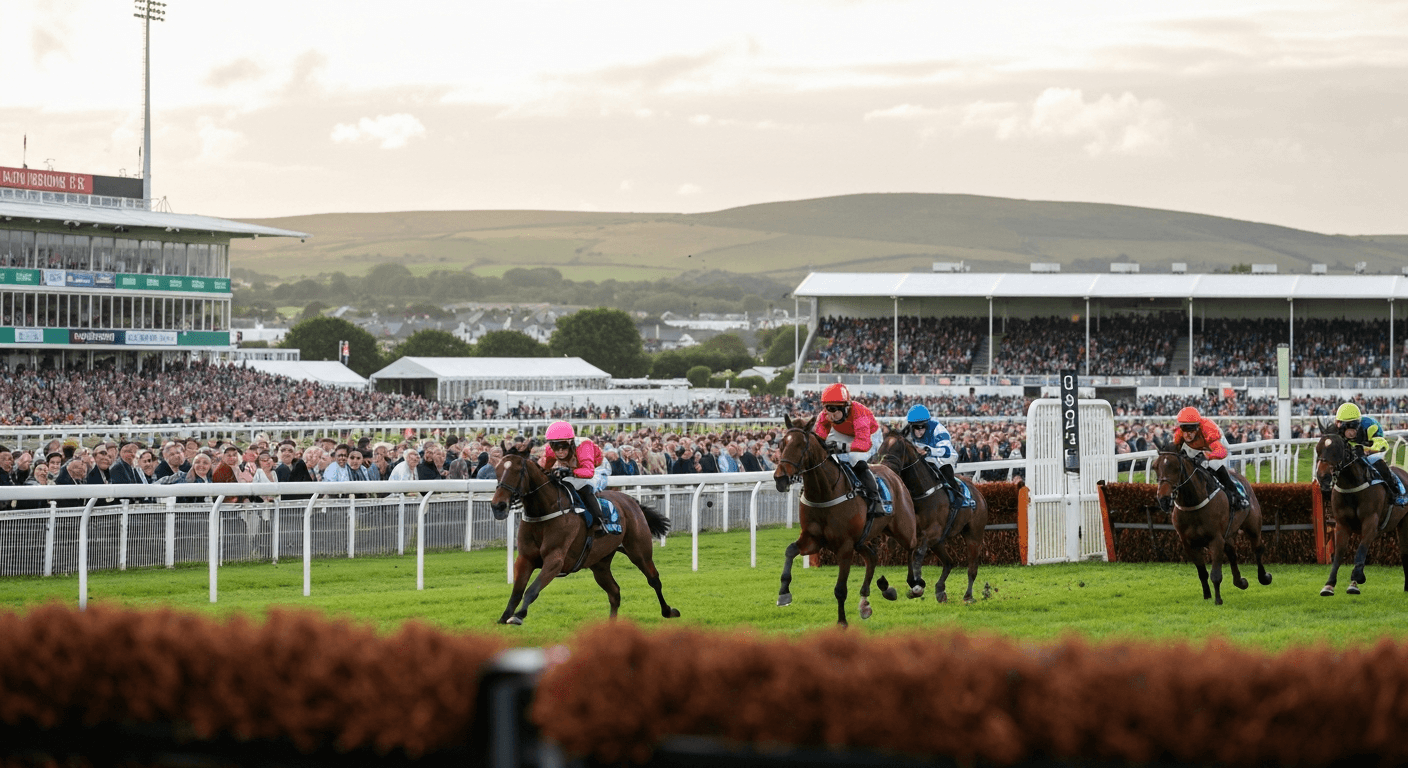
The Guinness Galway Hurdle: Race Guide
The Guinness Galway Hurdle explained: the 2m Ballybrit handicap run on Ladies' Day, its 1913 history, winners from Ansar to Ndaawi, trends and TV.
Read moreThe Galway Plate: Race Guide
The Galway Plate explained: the 2m6½f Ballybrit handicap chase, its 1869 history, great winners from Tipperary Boy to Western Fold, and how to watch.
Read moreThe History of Galway Racecourse
From the first 1869 meeting at Ballybrit to the seven-day summer festival, the Plate, the Hurdle and Dermot Weld's reign as King of Galway.
Read moreResearch the field with the AI Race Predictor
Our model publishes calibrated win-probability estimates for UK races — a second opinion to understand a race, not tips. It's open about its record: it doesn't beat the market, and we show exactly how it does.
Betting offers for Galway Festival
Work it out & learn the basics
Gamble Responsibly
Gambling should be entertaining and not seen as a way to make money. Never bet more than you can afford to lose. If you or someone you know has a gambling problem, help and support is available.