
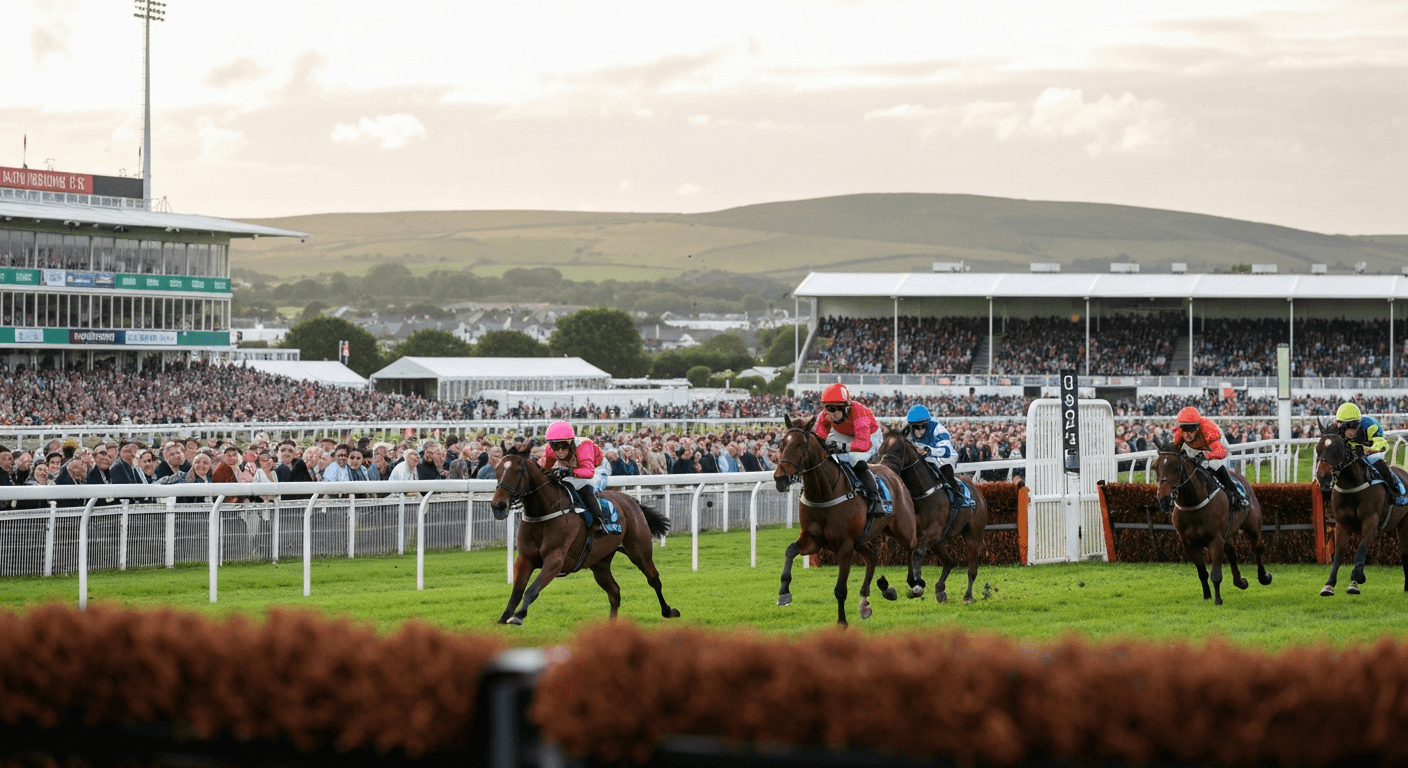
Galway Racecourse
Ballybrit's seven-day summer festival on the edge of Galway city.
Galway Racecourse sits at Ballybrit, around 6 km north-east of Galway city in Co. Galway. It is a right-handed turf track of roughly one mile and a quarter that stages both Flat and National Hunt racing. The circuit is undulating and tricky, with a sharp descent into the turn for home and an uphill run-in of just over a furlong, plus tight bends that tend to favour course specialists. Its defining event is the seven-day Galway Races Festival, run in late July and early August, one of the longest and best-attended meetings in Ireland. The festival is headlined by two of the country's most prestigious jumps prizes, the Galway Plate (a handicap chase) and the Galway Hurdle. The first meeting at Ballybrit was held in 1869.
The track
Right-handed · TurfGalway is a right-handed, sharp and undulating circuit of roughly one mile and a quarter to one mile and three furlongs. Sources describe an easy enough run for much of the way before a steep descent into a dip and a sharp bend, followed by a demanding, steeply uphill finish (the chase run-in is over two furlongs), giving the track one of the stiffest finishes in Ireland. On the chase course the last two fences sit very close together before a long run-in, making them notably tricky; the hurdles run on a tight inner course. The combination of sharp turns, the downhill-then-uphill profile and a punishing run-in tends to produce course specialists, favouring handy, well-balanced horses with stamina in reserve and previous experience of the venue, rather than one particular running style.
History
Organised racing came to Ballybrit when the first meeting was held on Tuesday 17 August 1869, a two-day fixture that reportedly drew around 40,000 people. Captain Wilson Lynch of Renmore gave the land free of charge, and the roughly mile-and-a-half course was laid out by civil engineer T. Waters. The Galway Plate dates from that inaugural meeting. The festival expanded steadily: to three days in 1959, four in 1971, five in 1974, six in 1982 and seven in 1999. Major grandstand redevelopment followed, with the Millennium Stand opening in 1999 and the Killanin Stand in 2007. Ballybrit also hosted Pope John Paul II's Mass during his 1979 visit to Ireland.
Big races and festivals
The Galway Races Summer Festival is the racecourse's defining event, running seven days from the last Monday of July into early August and attracting in excess of 150,000 spectators across the week. Its two signature races both fall midweek. The Galway Plate, a Grade A handicap steeplechase over about two miles six and a half furlongs, is run on the Wednesday and dates back to the first 1869 meeting. The Galway Hurdle, a high-value handicap hurdle over roughly two miles first run in 1913, is run on the Thursday alongside the festival's Ladies' Day, traditionally one of the busiest and most social days of the week. Together these handicaps draw large, competitive fields and are among the most prestigious summer National Hunt prizes in Ireland.
Visiting Galway
The racecourse sits at Ballybrit, around six kilometres north-east of Galway city centre near Castlegar, in County Galway in the west of Ireland. It is most easily reached by road, with the M6 and M17 to M18 motorways linking Galway to Dublin, Limerick and the wider network; festival-week shuttle buses typically run from the city. The nearest mainline rail and bus services are at Galway's Ceannt Station in the city centre, from where onward transfers reach the course. The venue's principal grandstands are the Millennium Stand and the Killanin Stand, the latter's terrace accommodating several thousand spectators. The festival is famed for its lively, carnival-like atmosphere combining racing, fashion and entertainment.
Sources: galwayraces.com, attheraces.com, en.wikipedia.org
Galway by the numbers
228 races · 2,928 runners · 2023-10-03 to 2025-10-27The favourite
Over 228 races the market favourite won 30.7%. A level stake to starting price returned -16.6% (95% CI -33.1% to +2.5%).
Over a few hundred races that figure is within noise, as the interval crosses zero. Across all Irish racing the favourite returned -13.1% to SP (95% CI -16.1% to -10.1%); backing favourites is the least-losing simple bet, never a winning one.
Going
- Yielding29.8%
- Soft19.7%
- Good17.5%
- Heavy13.2%
- Good to Yielding10.1%
- Yielding to Soft5.3%
Field size
Average 12.8 runners (median 13), ranging 3 to 22.
Draw on the Flat
Win rate by draw third across Flat races with a recorded stall.
SP only (no Betfair SP for Irish racing); horses deduped by name string; fallers and pulled-up settle as losses; favourite splits joint-favourites; to Starting Price, level stakes. ROI carries a race-bootstrapped 95% CI; small per-course samples are noisy, so treat a CI that crosses zero as no signal.
Explore Galway
In-depth guides to Galway — the track, the racing, the history and visiting.
A Day at Galway: Visitor Guide
Plan a day at Galway Races in Ballybrit: getting there, the stands, accessibility, food and bars, the best festival days, what to wear and how to watch.
Read guideBetting at Galway: A Course Guide
A betting-focused guide to Galway (Ballybrit): the tight switchback track, the draw and pace bias, the Plate and Hurdle, plus trainer and jockey angles.
Read guide
The Galway Festival: A Complete Guide
Your complete guide to the seven-day Galway Festival at Ballybrit: the day-by-day shape, the Galway Plate and Hurdle, Ladies' Day and going to Galway.
Read guideGalway Racecourse: The Complete Guide
Galway (Ballybrit) in full: the tight, undulating switchback right-hander, the seven-day summer festival day by day, the Galway Plate and Galway Hurdle with their winners, the records, tickets, travel, venue hire and how to visit.
Read guideThe Guinness Galway Hurdle: Race Guide
The Guinness Galway Hurdle explained: the 2m Ballybrit handicap run on Ladies' Day, its 1913 history, winners from Ansar to Ndaawi, trends and TV.
Read guideThe Galway Plate: Race Guide
The Galway Plate explained: the 2m6½f Ballybrit handicap chase, its 1869 history, great winners from Tipperary Boy to Western Fold, and how to watch.
Read guideThe History of Galway Racecourse
From the first 1869 meeting at Ballybrit to the seven-day summer festival, the Plate, the Hurdle and Dermot Weld's reign as King of Galway.
Read guideLatest news tagged “Galway”
Race previews, results and analysis from our Racing News feed that mention Galway.
Research the field with the AI Race Predictor
Our model publishes calibrated win-probability estimates for UK races — a second opinion to understand a race, not tips. It's open about its record: it doesn't beat the market, and we show exactly how it does.
Gamble Responsibly
Gambling should be entertaining and not seen as a way to make money. Never bet more than you can afford to lose. If you or someone you know has a gambling problem, help and support is available.
Related Irish Racecourses
Photos on this page are used under Creative Commons licences. Titles, sources and licence links for each one are on our image credits page.