
Founder & Editor · Last reviewed 2026-06-29
A week that stops the west of Ireland
For one week in late July, the population of Galway swells, the pubs of the Latin Quarter run dry by midnight, and a tight, lumpy circuit of turf on the high ground at Ballybrit becomes the busiest place in Ireland. The Galway Races are not simply a fixture on the calendar. They are a national event, a social occasion, a betting frenzy and a festival all at once, and the racing is only part of the reason 125,997 people poured through the gates across the seven days in 2025.
Galway Racecourse sits in the townland of Ballybrit, about six kilometres northeast of Galway city, just off the N6. It is a dual-code track, staging both Flat racing and National Hunt jumps on turf, and that twin identity runs right through its history. The two races everyone comes for are both handicaps rather than championship Group or Grade 1 events: the Galway Plate, a chase run on the Wednesday, and the Guinness Galway Hurdle, run on Thursday's Ladies' Day. Between them they carry a prize fund that makes the Hurdle the richest hurdle race in Ireland.
What sets Galway apart is the combination of the place and the track. The circuit is right-handed, undulating and sharp, with a switchback character that punishes any horse caught out of position, a steep climb in the back straight, a plunge into a dip, and a stiff uphill finish that is among the most testing in these islands. It rewards prominent, handy racing and tactical speed, which is why the festival's biggest handicaps, run in fields of twenty-plus, are some of the hardest puzzles in the racing year.
This is the story of how a two-day country meeting in 1869, watched by an estimated 40,000 people who camped in Eyre Square, grew into one of the largest sporting and social gatherings in Ireland. It runs from Absentee, the first Galway Plate winner, through Tipperary Boy and Ansar to Western Fold and Ndaawi, and it cannot be told without Dermot Weld, the man they call the King of Ballybrit.
This guide traces the first meeting at Ballybrit in 1869, the growth from two days to a seven-day institution, the shape of the modern course, the horses that made their name here, the people and the King of Ballybrit, the modern era and the rebuilding of the track, and answers to common questions.
Where to Bet
Place your bets with a trusted, licensed bookmaker.

Promo code BETFRED50. New customers only. Register, deposit with a Debit Card, and place a first bet of £10+ at Evens (2.0)+ on Sports, to be settled within 7 days, to get £30 in Sports Free Bets and £20 in Bet Builder Free Bets within 24 hours of settlement. 7-day expiry. Eligibility & payment exclusions apply. Full T&Cs apply. Take Time to Think. BeGambleAware.org. 18+. Full T&Cs.

Promo code R30. New UK customers only, 18+. Register, deposit £10 or more, then place a £10 single cash bet at odds of 1/2 (1.5) or greater on any sports market (excluding Virtuals). Once the qualifying bet settles you get £30 in Free Bets (3 x £10) — the qualifying bet can win or lose. Free Bets are valid on any sports market excluding Virtuals, expire in 7 days, are non-withdrawable and must be used in full. Excluded deposit methods apply (including PayPal, Apple Pay, Skrill and NETELLER). Named bets such as Lucky 15 do not qualify. If you cash out the qualifying bet, or it is voided, you are no longer eligible for the offer. Ends 31.12.26. Full T&Cs apply. Please gamble responsibly. BeGambleAware.org. 18+. Full T&Cs.

Promo code BET40GET20. New UK customers, 18+. Register with the code and place a first bet of £40 or more at Evens (2.0) or greater. Receive 2 × £10 free bets: the first credited automatically once the qualifying bet settles, the second 24 hours later. Free bets must be placed at minimum odds of 4/1 (5.0), expire 24 hours after credit, and the free-bet stake is not returned with winnings. Debit card deposits only. Take Time to Think. BeGambleAware.org. 18+. T&Cs apply. Full T&Cs.

50% of your first-day net losses refunded as a free bet, capped at £25. New UK customers aged 18+ only. To qualify, deposit and place a first bet of £10 or more on any sport at minimum odds of evens (2.00), then place at least two further bets on different events, each worth at least 50% of your largest bet, all at evens (2.00) or greater. Losses are counted from your first settled bet until 23:59 the same day. Place a qualifying £10+ bet and you are guaranteed at least a £5 free bet. Bets placed at SP, void bets, cashed-out bets and bets struck with free bets do not count towards the offer. The free bet is credited the day after your qualifying bets settle and must be used within 7 days, after which it expires. It can be used at odds from 1/4 (1.25) up to 250/1 on singles and straight accumulators, but not on Trixie, Patent or Yankee style multiples. Free-bet stake is not returned with winnings. One offer per person, household, address, IP address and device. E-wallet deposits may not qualify, so check the cashier before depositing. Customers registered with GAMSTOP cannot claim. KYC identity verification must be completed before the free bet is credited. Take Time to Think. BeGambleAware.org. 18+. T&Cs apply. Full T&Cs.

New customers, 18+. Choose the sports bonus at sign-up, make a first deposit and receive a 100% bonus up to £50 in your Sports Bonus balance. To convert the bonus to cash, wager it 10x within 30 days. Single bets below Evens (2.00) do not qualify; accumulators do not qualify if any selection is below 1/2 (1.50). Virtual Sports, voided, cancelled, drawn, cashed-out and free-bet wagers do not count towards wagering. Only the first settled bet per event counts. Withdrawing before the wagering requirement is met forfeits the bonus balance including bonus winnings. Real-money funds are used before bonus funds. Deposits via Skrill or Neteller are not eligible. Not valid in conjunction with other promotions. Odds, bet and payment limits apply. 10bet general and promotion T&Cs apply. BeGambleAware.org. 18+. Full T&Cs.

New customers in Great Britain and Republic of Ireland, 18+. Place a £10 fixed-odds qualifying bet at minimum odds of 1/2 (1.50) — single or each-way (only the win part counts), pre-event or in-play, not cashed out early, within 28 days of opening the account. Receive up to £60 in bonuses credited over three days: 3 × £10 fixed-odds free bets (the first on settlement, then 24 and 48 hours later) plus 3 × £5 Total Goals FOOTBALL spread bets, 3 × £5 racing Winning Favourites spread bets and a £1 racing Race Index spread bet (the spread bets need a full spread-betting account). Free-bet stakes not returned with winnings; free bets valid 28 days from issue. IMPORTANT: the £5 credits are SPREAD bets — sports spread betting carries the risk that losses can exceed your stake. Sports spread-betting customers do not have Financial Ombudsman or FSCS recourse. Take Time to Think. BeGambleAware.org. 18+. T&Cs apply. Full T&Cs.

Promo code WELCOME15, entered under My Bonuses after registering. New UK customers, 18+. Place a first qualifying bet of at least £10 from your cash balance at odds of evens (2.0) or greater within 7 days of opening the account. Once the qualifying bet fully settles you receive £15 in free bets, credited as 3 x £5 tokens with set uses: one £5 accumulator free bet (minimum 4 legs, each leg at 2/5 or bigger), one £5 sports free bet (any market at evens or bigger) and one £5 Sub Cover free bet (selected football player markets at evens or bigger). Free-bet stakes are not returned with winnings. Free bets expire 7 days after they are credited. Void, cashed-out and partially cashed-out bets do not qualify. One offer per customer. Confirm the current terms on BetGoodwin's own welcome-offer page before claiming. Take Time to Think. BeGambleAware.org. 18+. T&Cs apply. Full T&Cs.

New UK customers, 18+. Minimum deposit £10. Place a £10 qualifying single at minimum odds of 1/2 (1.50), settled within 14 days. Receive £30 in free bets (stake not returned), split £20 for sportsbook use (2 x £10) and £10 for Bet Builder only (2 x £5); Bet Builder does not cover horse racing. Free bets must be accepted within 7 days and expire 7 days after acceptance. No promo code required. Best Odds Guaranteed on UK & Irish racing, subject to having staked over £25 in the previous seven days. Operated by LiveScore Betting and Gaming (Gibraltar) Ltd, UKGC 56859. Confirm the current terms on LiveScore Bet's own promotions page before claiming. Take Time to Think. BeGambleAware.org. 18+. T&Cs apply. Full T&Cs.
18+. BeGambleAware.org
1869: the first meeting at Ballybrit
The first race meeting at Ballybrit took place on Tuesday 17 August 1869. It was a two-day event, and by the standards of the day it was an extraordinary success, drawing an estimated 40,000 people to the high ground above the city. The town could not hold them all. Eyre Square, the open green at the heart of Galway, was given over as a campsite for the crowds who had travelled in from across Connacht and beyond.
The men who built it
The driving force was Lord St Lawrence, then a Member of Parliament for Galway and chairman of the stewards. He worked alongside a committee of hunting and steeplechasing men, among them the Marquis of Clanricarde, who saw the appetite for a proper meeting in the west of Ireland and set about creating one. The land they chose, associated with the Lynch family of Renmore, lay on a stretch of undulating ground that would give the course its distinctive character.
The track itself was laid out by the civil engineer Thomas G. Waters, who designed the original circuit at about a mile and a half round. From the very beginning Galway was a course with personality: a rising, falling, turning circuit rather than a flat galloping oval, the kind of track that asks as much of a jockey's judgement as a horse's stamina.
The Plate from day one
The Galway Plate was a feature of that inaugural 1869 meeting, and its first winner was Absentee. From the outset the Plate was the race that mattered, the prize that horsemen wanted on their record, and it has run as the centrepiece of the Wednesday card ever since. For its first decades the Plate was a chase of two miles five furlongs, a trip that suited the bold, tough handicappers who came to define the race.
The companion feature, the Galway Hurdle, came later. It was added in 1913, with Red Damsel taking the inaugural running. For its first six years the Hurdle was contested over a mile and a half before settling into the two-mile test it remains today. Together, the Plate and the Hurdle gave the meeting its two pillars, one over fences and one over hurdles, and the rhythm of the modern festival, with Plate Day on Wednesday and the Hurdle on Thursday's Ladies' Day, was already taking shape more than a century ago.
From two days to a national institution
For most of its first century, Galway was a two-day meeting. The transformation into the seven-day festival that now dominates the Irish summer happened in deliberate stages, each one pushing the event a little further into the national consciousness.
A meeting that learned to broadcast itself
The early milestones tracked the arrival of new media. In 1929 the races were broadcast on radio for the first time, with the Galway Plate and the Curragh Derby going out over the airwaves. Sponsorship arrived in 1959, and with it the meeting extended to three days, a significant step that gave the festival room to breathe and grow. Television coverage followed in 1963, putting Ballybrit in front of a far wider audience than could ever fit on the hill. In 1969 a separate September meeting was added, broadening Galway beyond its summer week.
Adding days, building crowds
The festival lengthened steadily over the decades that followed. From three days in 1959 it grew to four days in 1971, five days in 1974, and six days in 1982. The final step came in 1999, when the meeting expanded to the full seven days it runs today, from the last Monday in July into early August. That same year the Millennium Stand opened, replacing the old Corrib Stand of 1955, a building once reputed to have had the longest bar in the world.
| Year | Festival length |
|---|---|
| 1959 | Three days |
| 1971 | Four days |
| 1974 | Five days |
| 1982 | Six days |
| 1999 | Seven days |
A national institution
By the 2000s the festival had become one of the largest sporting and social gatherings in Ireland. The numbers are enormous: 138,909 attended across the week in 2016 and 137,682 in 2017. In the years since the pandemic the totals have settled in a still vast 116,000 to 126,000 range, with 116,374 in 2024 and 125,997 in 2025, the latter up nearly 10,000 on the previous year, with Friday's crowd of 26,234 the single busiest day. Ladies' Day on Thursday and Galway Plate Day on Wednesday remain the biggest and most glamorous occasions of the week.
The festival's reach extends well beyond the racing. A 2002 study by the Marketing Department at UCD's Smurfit Graduate School of Business found the Galway Races contributed more than 58 million euro to the economy of Galway city and the surrounding region, with over 23 million euro spent in the immediate locality. The single largest gathering ever held at Ballybrit, though, was not a raceday at all: in 1979 Pope John Paul II celebrated Mass at the racecourse before an estimated 280,000 people, with 800 priests distributing communion to a crowd that dwarfed even Galway's biggest racing weeks.
The modern course: tight, undulating and right-handed
Galway is a track with a strong character, and understanding it is half the battle of reading a race there. The circuit is right-handed and undulating, a sharp switchback roughly a mile and a quarter to a mile and three furlongs round, semi-circular in shape. It climbs steeply through the back straight, drops sharply into a dip on the approach to the home turn, and then rises again to a stiff uphill finish of just over two furlongs, one of the most testing run-ins in Britain or Ireland. The home straight itself is short, little more than a furlong.
Over fences and over hurdles
The chase course carries seven fences per circuit, which means fourteen are jumped in the Galway Plate over its two laps. The last two fences are a famous feature: sited in the back straight on the descent and placed extremely close together, they are described by several sources as the closest two fences of any course in the world, and they are followed by a long run-in of over two furlongs to the line. The hurdle course sits inside the chase course and is sharper still, with six flights per circuit; the Galway Hurdle is run over nine flights across its two-mile trip.
A track that rewards position
For all that Galway is a jumps stronghold, it has an unusual quirk on the Flat: a measurable draw bias, which is rare for a turf course. Timeform's guide notes that "a low draw at 7f and 1m 100yds is a slight advantage." Geegeez analysis finds some residual edge even at a mile and a half, most pronounced for low-drawn or pace-pressing horses, with the bias stronger on faster ground and weaker on yielding or soft going.
Running style, though, matters as much as the draw. The tight, turning circuit and short home straight place a high premium on being handily placed. According to Geegeez, since 2009 hold-up horses in fields of eight or more in handicaps have won at just 4.18 per cent, one of the worst records of any Irish track for those held up, while front-runners have been far more productive. As the analysis puts it, it matters less where a horse is drawn than how it is ridden, and tactical speed to race prominently is a clear asset.
Ground and the shape of the year
The going changes with the seasons. The summer festival is typically run on good to yielding ground, with the course watering through dry spells, though rain frequently arrives mid-week and can change the complexion of the racing. The autumn meetings, by contrast, are run on softer ground. Galway stages around twelve race days a year in all: the seven-day summer festival, a two-day September meeting, and October fixtures that include a single early-month day and a three-day meeting over the last weekend of the month.
The horses that made their name at Galway
Galway is a handicap festival, which means it rarely crowns the same superstars year after year in the way a Group 1 track might. The horses who become Galway legends tend to be the tough, durable types who come back to Ballybrit again and again, and a handful have written themselves permanently into the record.
Ansar: the ultimate Galway specialist
No horse better captures what it means to be a Galway horse than Ansar, trained by Dermot Weld. He won seven races at the Galway Festival across all three codes: three chases, three hurdles and one on the Flat. He took the Galway Hurdle in 2001 under Paul Carberry, then won the Galway Plate in both 2004 and 2005, back-to-back. In doing so he became the most recent horse to complete the Galway Plate and Galway Hurdle double, a feat that, by Racing Post's 2025 count, only four horses have ever managed, the others being Blancona in 1926 and Knight Errant in 1958.
Tipperary Boy: the record holder
The most successful horse in the long history of the Galway Plate is Tipperary Boy, who won the great chase three times, in 1899, 1901 and 1902. More than a century on, no horse has matched his haul in the race.
The dual Hurdle winners
A small group of horses have managed to win the Galway Hurdle twice, which on such a competitive handicap is a real achievement. Pinch Hitter, trained by Noel Meade, won back-to-back runnings in 1982 and 1983. Michael Winters then produced two consecutive winners with Rebel Fitz in 2012 and Missunited in 2013. More recently Tudor City, trained by Tony Martin, won the Hurdle in 2019 and again in 2022, the only dual winner of the race since 1988, and a perennial festival competitor who ran at every Galway Festival from 2015.
Life Of A Lord and the Ballydoyle connection
Life Of A Lord, owned by JP McManus and ridden by Charlie Swan, won the Galway Plate back-to-back in 1995 and 1996. What makes him a footnote in a much larger story is his trainer: Aidan O'Brien, in the days before he switched to the record-breaking Flat career at Ballydoyle that would make him one of the most successful trainers in the world.
The modern names
The recent Plate roll of honour is full of horses who went on to bigger things. Hewick, trained by Shark Hanlon, won the 2022 Plate at 16/1 before going on to international Grade 1 glory. Carlingford Lough, the 2013 winner, and Balko Des Flos, who took the 2017 Plate for Henry de Bromhead, both developed into high-class chasers. Nurburgring, trained by Joseph O'Brien, won the 2024 Galway Hurdle under JJ Slevin, then attempted the Plate and Hurdle double in 2025 but was pulled up in the Plate, which fell instead to Western Fold.
The people and the King of Ballybrit
If Galway has a single defining figure, it is Dermot Weld, and any account of the festival has to begin with him.
Dermot Weld, the King of Ballybrit
Weld's connection to Galway runs deeper than any other trainer's, and the nickname stuck for good reason. He saddled his 500th career winner at the track in 2022, and his overall tally at Galway is well over 500, a figure no rival approaches. The Irish Times records that he was crowned leading trainer at the Galway summer festival on 30 occasions. Of 735 races run at Galway across a recent multi-year count, 84 were won by Weld alone.
His bond with the place began before his training career. He first won at Galway as a 15-year-old amateur rider, partnering Ticonderoga to victory in the big amateur race in 1964. Decades later he was still producing the festival's defining horses, none more so than Ansar, the seven-time festival winner and Plate and Hurdle double-scorer who became the embodiment of Weld's mastery of the track.
The trainers who chase him
Galway's modern roll of honour is dominated by a familiar group. Willie Mullins is the record-holding trainer in the Galway Hurdle with six wins, from Mystical City in 1996 through Clondaw Warrior, Sharjah, Aramon, Saldier and Zarak The Brave in 2023, and he also won the Plate with Royal Rendezvous in 2021. He was leading festival trainer for a tenth time in 2025. Gordon Elliott holds the outright record in the Galway Plate with five wins: Lord Scoundrel in 2016, Clarcam in 2018, Borice in 2019, Ash Tree Meadow in 2023 and Western Fold in 2025. The Hurdle, by contrast, long eluded him; he had gone 0 from 35 before finally landing it with Ndaawi in 2025, completing a Plate and Hurdle double in the same week.
Tony Martin is the Galway Hurdle specialist of the modern era, with four wins including the dual scorer Tudor City. Noel Meade has taken two Plates, with Road To Riches in 2014 and Pinkerton in 2024, and a clutch of Hurdles. Joseph O'Brien has become the leading Flat trainer at the track by total winners in recent years while also winning the Plate with Early Doors in 2020 and the Hurdle with Tigris River and Nurburgring.
Jockeys, owners and administrators
Patrick Mullins is the leading jockey in the Galway Hurdle since 1988, with three wins. The Galway-born Danny Gilligan has won the Plate twice, in 2023 and 2025, while Donagh Meyler took it in 2016 and again, on Pinkerton, in 2024. Among owners, JP McManus runs deep through Galway's story, from Life Of A Lord to Early Doors and countless festival runners.
Off the track, the modern festival was shaped by the Moloney family. John Moloney managed the course from January 1989 until he retired after the 2015 festival, overseeing more than 40 million euro of development. His son Michael Moloney, previously chief executive of Plumpton Racecourse in England, has run it since.
The modern era and the rebuilding of Ballybrit
The Galway of today is the product of three decades of steady, expensive building, much of it carried out without losing the festival's earthy, crowded character.
Rebuilding Ballybrit
The modern transformation runs through John Moloney's 26-year tenure from 1989 to 2015, during which capital development at the course totalled over 40 million euro. The Millennium Stand opened in 1999, replacing the old Corrib Stand of 1955 and coinciding with the move to the seven-day festival. Underground car and pedestrian tunnels, a new weigh-room, offices and a media centre followed.
The biggest single project was the Killanin Stand, the main West stand, which opened in 2007 at a cost of about 22 million euro, with 10 million euro of grant aid from Horse Racing Ireland. It was built in a record 44 weeks and opened by the Taoiseach, Bertie Ahern. It is named after Lord Killanin, a Race Committee member for more than 40 years, and its terrace can hold around 7,000 people, with seating for 700.
The work that goes on
Investment has continued into the 2020s. Around 5 million euro of maintenance has been spent on the two main stands, roughly 2 million on the Killanin and 3 million on the Millennium. A long-planned redevelopment of the parade ring, billed as a "stadium experience," has been repeatedly delayed, but HRI's board subsequently approved about 2.1 million euro for a redevelopment of the enclosure to the north of the parade ring under its Racecourse Capital Development Scheme.
Galway also faces a question few racecourses have to consider. In November 2024 An Bord Pleanála granted permission for new temporary stables and ancillary buildings, with permanence pending the Galway City Ring Road plans, because the proposed bypass would affect part of the racecourse lands.
Watching today
For those not on the hill, Galway is well covered. In the Republic of Ireland, RTÉ televises the festival across RTÉ One, RTÉ2 and the RTÉ Player, typically showing four races a day on the opening days and more as the week builds, with extensive live radio coverage in Irish on RTÉ Raidió na Gaeltachta. In the UK and Ireland, Galway appears on Racing TV, the home of all 26 Irish racecourses since they moved their media rights there on 1 January 2019. Races can also be streamed through licensed bookmaker platforms to logged-in account holders.
A closing note on the betting that is so central to the festival. The Galway ring turns over enormous sums, with Tote turnover of 5.8 million euro across the 2025 week and on-course bookmaker turnover over 7.5 million euro. None of that changes a basic, well-established fact of betting markets: backing favourites is not a profitable strategy. Over time, backing every favourite to its starting price produces a loss, because the starting price carries the bookmaker's margin. The festival's vast, twenty-runner handicaps are among the hardest puzzles in racing precisely because they resist any simple system. They are a spectacle to be enjoyed, not a formula to be solved.
Frequently Asked Questions
Share this article
More about this racecourse
All galway guides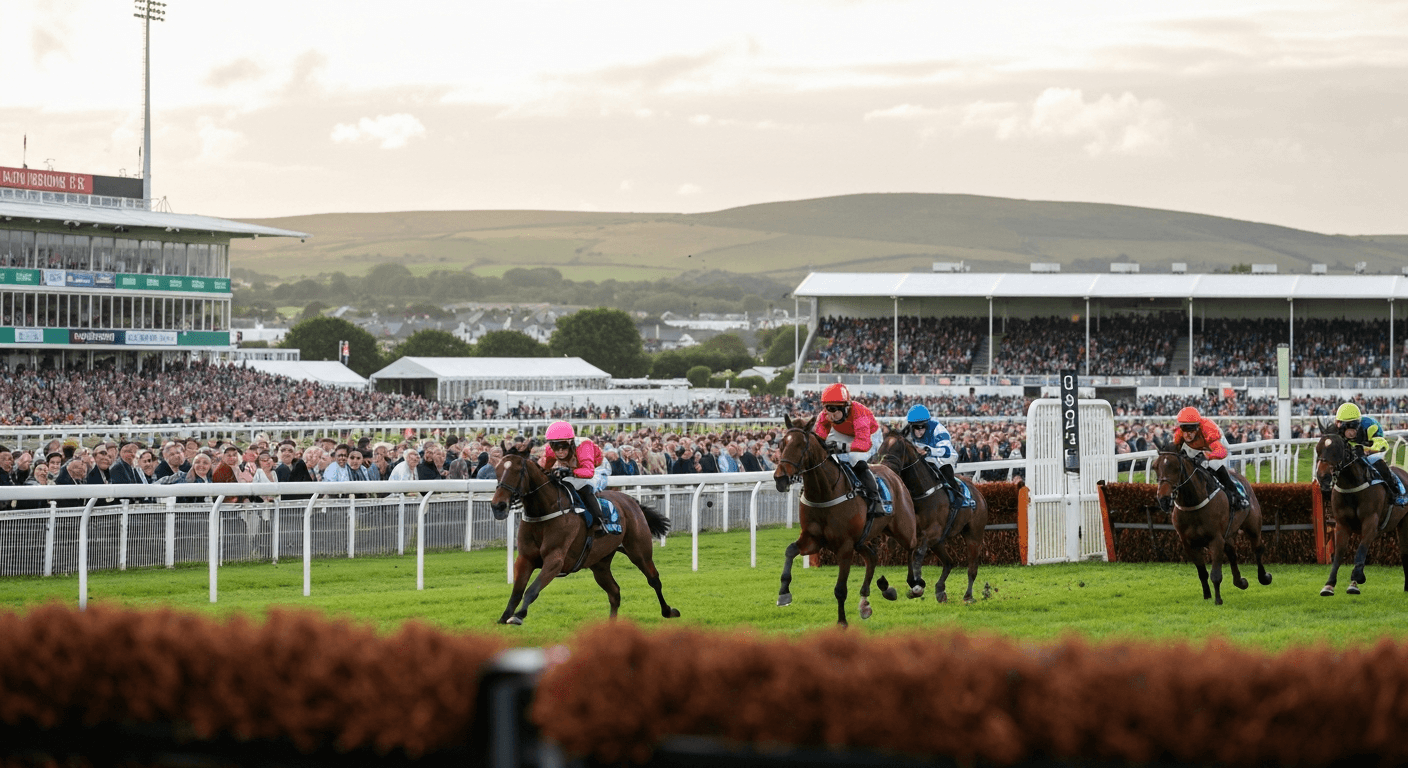
A Day at Galway: Visitor Guide
Plan a day at Galway Races in Ballybrit: getting there, the stands, accessibility, food and bars, the best festival days, what to wear and how to watch.
Read moreBetting at Galway: A Course Guide
A betting-focused guide to Galway (Ballybrit): the tight switchback track, the draw and pace bias, the Plate and Hurdle, plus trainer and jockey angles.
Read more
The Galway Festival: A Complete Guide
Your complete guide to the seven-day Galway Festival at Ballybrit: the day-by-day shape, the Galway Plate and Hurdle, Ladies' Day and going to Galway.
Read moreResearch the field with the AI Race Predictor
Our model publishes calibrated win-probability estimates for UK races — a second opinion to understand a race, not tips. It's open about its record: it doesn't beat the market, and we show exactly how it does.
Betting offers for Galway Festival
Work it out & learn the basics
Gamble Responsibly
Gambling should be entertaining and not seen as a way to make money. Never bet more than you can afford to lose. If you or someone you know has a gambling problem, help and support is available.