
Founder & Editor · Last reviewed 2026-06-29
A Wednesday Like No Other
On the last Wednesday of July, the small town of Ballybrit on the edge of Galway city swells to bursting. More than a hundred thousand people pour into the west of Ireland across seven days of racing, and the day they circle hardest is the one that carries the Galway Plate. It is not just the biggest betting heat of the week. It is the race that gave the whole festival its name and its character, and it has done so since the very first meeting in 1869.
The Plate is a handicap steeplechase run over 2 miles 6½ furlongs on a tight, right-handed, switchback circuit that punishes anything ridden out of position. It is worth €270,000 in its most recent running, with €162,000 going to the winner, which makes it one of the richest jumps handicaps in the Irish calendar. Large fields, fast ground that can turn yielding within an hour of rain, fourteen fences and a stiff uphill finish all combine to produce a contest that is famously hard to call. Field sizes of eighteen to twenty-two are normal, and the winner has come from double-figure odds more often than not in the modern era.
That difficulty is the point. The Galway Plate has never pretended to be a Grade 1 won by the best horse on the day. It is a handicap, a puzzle, a contest where the weights are designed to bring the field together and where a horse trying its luck off a low mark at 33/1 can beat a fancied favourite. The roll of honour reflects that, running from the three-time winner Tipperary Boy at the turn of the twentieth century through Life Of A Lord and Ansar to recent scorers like Hewick, Pinkerton and Western Fold.
This guide walks through the race itself, how it is run and what makes the Ballybrit circuit so awkward, the history that built it, the horses and people who turned it into a legend, where it sits in the rhythm of the festival week, and how you can watch it whether you are on the rail at Ballybrit or following from a sofa in Britain. For this year's runners and the rest of the week's card, see our Galway Festival 2026 preview.
In short, this guide covers the race itself and the Ballybrit test, the history from 1869 to the modern festival, the great winners who built the legend, Plate Day at the heart of the week, how to watch the Plate at home or in person, and answers to common questions.
Where to Bet
Place your bets with a trusted, licensed bookmaker.

Promo code BETFRED50. New customers only. Register, deposit with a Debit Card, and place a first bet of £10+ at Evens (2.0)+ on Sports, to be settled within 7 days, to get £30 in Sports Free Bets and £20 in Bet Builder Free Bets within 24 hours of settlement. 7-day expiry. Eligibility & payment exclusions apply. Full T&Cs apply. Take Time to Think. BeGambleAware.org. 18+. Full T&Cs.

Promo code R30. New UK customers only, 18+. Register, deposit £10 or more, then place a £10 single cash bet at odds of 1/2 (1.5) or greater on any sports market (excluding Virtuals). Once the qualifying bet settles you get £30 in Free Bets (3 x £10) — the qualifying bet can win or lose. Free Bets are valid on any sports market excluding Virtuals, expire in 7 days, are non-withdrawable and must be used in full. Excluded deposit methods apply (including PayPal, Apple Pay, Skrill and NETELLER). Named bets such as Lucky 15 do not qualify. If you cash out the qualifying bet, or it is voided, you are no longer eligible for the offer. Ends 31.12.26. Full T&Cs apply. Please gamble responsibly. BeGambleAware.org. 18+. Full T&Cs.

Promo code BET40GET20. New UK customers, 18+. Register with the code and place a first bet of £40 or more at Evens (2.0) or greater. Receive 2 × £10 free bets: the first credited automatically once the qualifying bet settles, the second 24 hours later. Free bets must be placed at minimum odds of 4/1 (5.0), expire 24 hours after credit, and the free-bet stake is not returned with winnings. Debit card deposits only. Take Time to Think. BeGambleAware.org. 18+. T&Cs apply. Full T&Cs.

50% of your first-day net losses refunded as a free bet, capped at £25. New UK customers aged 18+ only. To qualify, deposit and place a first bet of £10 or more on any sport at minimum odds of evens (2.00), then place at least two further bets on different events, each worth at least 50% of your largest bet, all at evens (2.00) or greater. Losses are counted from your first settled bet until 23:59 the same day. Place a qualifying £10+ bet and you are guaranteed at least a £5 free bet. Bets placed at SP, void bets, cashed-out bets and bets struck with free bets do not count towards the offer. The free bet is credited the day after your qualifying bets settle and must be used within 7 days, after which it expires. It can be used at odds from 1/4 (1.25) up to 250/1 on singles and straight accumulators, but not on Trixie, Patent or Yankee style multiples. Free-bet stake is not returned with winnings. One offer per person, household, address, IP address and device. E-wallet deposits may not qualify, so check the cashier before depositing. Customers registered with GAMSTOP cannot claim. KYC identity verification must be completed before the free bet is credited. Take Time to Think. BeGambleAware.org. 18+. T&Cs apply. Full T&Cs.

New customers, 18+. Choose the sports bonus at sign-up, make a first deposit and receive a 100% bonus up to £50 in your Sports Bonus balance. To convert the bonus to cash, wager it 10x within 30 days. Single bets below Evens (2.00) do not qualify; accumulators do not qualify if any selection is below 1/2 (1.50). Virtual Sports, voided, cancelled, drawn, cashed-out and free-bet wagers do not count towards wagering. Only the first settled bet per event counts. Withdrawing before the wagering requirement is met forfeits the bonus balance including bonus winnings. Real-money funds are used before bonus funds. Deposits via Skrill or Neteller are not eligible. Not valid in conjunction with other promotions. Odds, bet and payment limits apply. 10bet general and promotion T&Cs apply. BeGambleAware.org. 18+. Full T&Cs.

New customers in Great Britain and Republic of Ireland, 18+. Place a £10 fixed-odds qualifying bet at minimum odds of 1/2 (1.50) — single or each-way (only the win part counts), pre-event or in-play, not cashed out early, within 28 days of opening the account. Receive up to £60 in bonuses credited over three days: 3 × £10 fixed-odds free bets (the first on settlement, then 24 and 48 hours later) plus 3 × £5 Total Goals FOOTBALL spread bets, 3 × £5 racing Winning Favourites spread bets and a £1 racing Race Index spread bet (the spread bets need a full spread-betting account). Free-bet stakes not returned with winnings; free bets valid 28 days from issue. IMPORTANT: the £5 credits are SPREAD bets — sports spread betting carries the risk that losses can exceed your stake. Sports spread-betting customers do not have Financial Ombudsman or FSCS recourse. Take Time to Think. BeGambleAware.org. 18+. T&Cs apply. Full T&Cs.

Promo code WELCOME15, entered under My Bonuses after registering. New UK customers, 18+. Place a first qualifying bet of at least £10 from your cash balance at odds of evens (2.0) or greater within 7 days of opening the account. Once the qualifying bet fully settles you receive £15 in free bets, credited as 3 x £5 tokens with set uses: one £5 accumulator free bet (minimum 4 legs, each leg at 2/5 or bigger), one £5 sports free bet (any market at evens or bigger) and one £5 Sub Cover free bet (selected football player markets at evens or bigger). Free-bet stakes are not returned with winnings. Free bets expire 7 days after they are credited. Void, cashed-out and partially cashed-out bets do not qualify. One offer per customer. Confirm the current terms on BetGoodwin's own welcome-offer page before claiming. Take Time to Think. BeGambleAware.org. 18+. T&Cs apply. Full T&Cs.

New UK customers, 18+. Minimum deposit £10. Place a £10 qualifying single at minimum odds of 1/2 (1.50), settled within 14 days. Receive £30 in free bets (stake not returned), split £20 for sportsbook use (2 x £10) and £10 for Bet Builder only (2 x £5); Bet Builder does not cover horse racing. Free bets must be accepted within 7 days and expire 7 days after acceptance. No promo code required. Best Odds Guaranteed on UK & Irish racing, subject to having staked over £25 in the previous seven days. Operated by LiveScore Betting and Gaming (Gibraltar) Ltd, UKGC 56859. Confirm the current terms on LiveScore Bet's own promotions page before claiming. Take Time to Think. BeGambleAware.org. 18+. T&Cs apply. Full T&Cs.
18+. BeGambleAware.org
The Race Itself
The Tote Galway Plate is a Premier Handicap chase, the top tier of Irish handicap, classified in the Grade A bracket and carded by some media as Grade 3 (Class 1). It is open to horses aged four and upwards and is run on the Wednesday of the Summer Festival.
Distance and obstacles
The Plate is run over 2 miles 6 furlongs 111 yards, roughly 4,779 metres, with fourteen fences jumped over two circuits of the chase course. The trip is one of the things that makes the race so distinctive. It sits between the speed of a two-mile chase and the stamina of a three-miler, and because Ballybrit is so sharp it tends to be run at a strong gallop throughout, which asks both questions at once.
The chase course carries seven fences per circuit. Two of those fences are sited unusually close together on the decline in the back straight, and several sources describe them as the closest two fences of any course in the world. They come at a horse in quick succession just as the field is racing downhill towards the home turn, which leaves no room for a jumping error and rewards a horse that is travelling and metering its own stride.
The Ballybrit test
| Feature | Detail |
|---|---|
| Distance | 2m 6½f (about 4,779 m) |
| Fences | 14 over two circuits |
| Direction | Right-handed |
| Shape | Tight, undulating switchback |
| Finish | Stiff uphill run of just over two furlongs |
| Home straight | Short, little more than a furlong |
The circuit is right-handed and runs to about a mile and a quarter to a mile and three furlongs a lap, with a steep climb in the back straight, a sharp drop into a dip before the home turn, and then a stiff uphill finish of just over two furlongs that is among the toughest in Britain or Ireland. The home straight itself is short, barely more than a furlong, so a horse cannot rely on picking up a long run-in to make up ground.
All of that places a premium on position. A horse needs to jump, to travel handily and to be in the first half-dozen turning in, because the geometry of the track makes it very hard to come from the back. The going at the Summer Festival is typically good to yielding, with the course watering in dry spells, though mid-week rain in the west of Ireland is common enough that the ground can change quickly across the week.
A note on betting that holds for the Plate as for any race: it is a handicap, the field is large and competitive, and backing the favourite is not a profitable approach. Over time, backing every favourite to its starting price produces a loss, because that price already carries the bookmaker's margin. The one thing that genuinely trims that margin is a concession, and the extra places and money-back terms firms run across festival week change from race to race. Nothing in this guide is a tip.
From 1869 to the Modern Festival
The first race meeting at Ballybrit was held on Tuesday 17 August 1869. It was a two-day event that drew an estimated 40,000 people, with Eyre Square in the town pressed into service as a campsite for the crowds. The driving force was Lord St Lawrence, then MP for Galway and chairman of the stewards, who worked alongside a committee of hunting and steeplechasing figures including the Marquis of Clanricarde. The course, originally a mile-and-a-half circuit, was laid out by the civil engineer Thomas G. Waters on land associated with the Lynch family of Renmore.
A feature from day one
The Galway Plate was a feature of that very first meeting in 1869, won by a horse called Absentee. It has been the centrepiece of the week ever since. The Galway Hurdle, the festival's other great handicap and the Thursday headliner, was not added until 1913. So when people talk about the Plate as the race that built the festival, they mean it literally: the chase came first, and the rest of the programme grew up around it.
The trip has moved
The Plate has not always been run over its current distance. For most of its history it was contested over 2 miles 5 furlongs. It was extended to 2 miles 6 furlongs in 1992, and then to the present 2 miles 6½ furlongs in 2015. The change matters for anyone comparing winning times or form across the decades, because the modern Plate asks a fraction more stamina than the race the early winners tackled.
How the festival grew around it
The meeting steadily expanded over the twentieth century. The first radio broadcast of the races went out in 1929, covering the Galway Plate and the Curragh Derby. Sponsorship arrived in 1959, and with it the meeting extended to three days. Television coverage followed in 1963, and a separate September meeting was added in 1969.
From there the festival lengthened in stages: four days in 1971, five days in 1974, six days in 1982 and finally seven days in 1999, the same year the Millennium Stand opened to replace the old Corrib Stand. The Killanin Stand followed, opened by Taoiseach Bertie Ahern, built in a record 44 weeks at a cost of about €22 million with grant aid from Horse Racing Ireland, and named after Lord Killanin, a Race Committee member for more than forty years.
Through all of this the Plate held its place on the Wednesday. The sponsor has changed, from William Hill between 2006 and 2010 to Tote Ireland from 2011, and the prize money has climbed to €270,000, but the race itself has run continuously as the anchor of the week for more than 150 years.
The Great Winners
A handicap rewards the canny rather than the brilliant, so the Galway Plate roll of honour is less a list of superstars than a gallery of tough, race-fit horses and the trainers who knew how to land it. A few names stand above the rest.
Tipperary Boy, the record-holder
The most successful horse in the history of the race ran more than a century ago. Tipperary Boy won the Galway Plate three times, in 1899, 1901 and 1902, a record of consistency at the highest level of the meeting that no horse has matched since.
Life Of A Lord and the young Aidan O'Brien
In the mid-1990s the Plate went back-to-back to Life Of A Lord, trained by Aidan O'Brien, owned by JP McManus and ridden by Charlie Swan. He won in 1995 and 1996, just before O'Brien switched his focus to the record-breaking Flat career at Ballydoyle that would make him a household name. The Plate, in other words, was part of the apprenticeship of one of the greatest trainers the sport has produced.
Ansar, the king of Ballybrit's specialists
No horse is more bound up in Galway folklore than Ansar, trained by Dermot Weld. Ansar won seven races at the Galway Festival across all three codes, three chases, three hurdles and a Flat race. He took the Galway Hurdle in 2001 under Paul Carberry and then won the Galway Plate in both 2004 and 2005. That makes him the most recent horse to complete the Galway Plate and Galway Hurdle double, a feat Racing Post counts as having been managed by only a handful of horses ever, alongside Blancona in 1926 and Knight Errant in 1958.
The modern roll of honour
The last two decades have been dominated by a familiar set of yards, with Gordon Elliott the outright leading trainer of the modern era. His five wins are Lord Scoundrel (2016), Clarcam (2018), Borice (2019), Ash Tree Meadow (2023) and Western Fold (2025).
| Year | Winner | Trainer | SP |
|---|---|---|---|
| 2025 | Western Fold | Gordon Elliott | 11/1 |
| 2024 | Pinkerton | Noel Meade | 20/1 |
| 2023 | Ash Tree Meadow | Gordon Elliott | 13/2 |
| 2022 | Hewick | Shark Hanlon | 16/1 |
| 2021 | Royal Rendezvous | Willie Mullins | 5/1 fav |
| 2020 | Early Doors | Joseph O'Brien | 7/1 |
| 2019 | Borice | Gordon Elliott | 9/1 |
| 2018 | Clarcam | Gordon Elliott | 33/1 |
| 2017 | Balko Des Flos | Henry de Bromhead | 6/1 |
| 2016 | Lord Scoundrel | Gordon Elliott | 10/1 |
| 2015 | Shanahan's Turn | 16/1 | |
| 2014 | Road To Riches | Noel Meade | 14/1 |
| 2013 | Carlingford Lough | 7/2 fav | |
| 2012 | Bob Lingo | 16/1 | |
| 2011 | Blazing Tempo | 5/1 fav | |
| 2010 | Finger Onthe Pulse | 22/1 | |
| 2009 | Ballyholland | 16/1 | |
| 2008 | Oslot | Paul Nicholls | 11/4 fav |
Look down the starting prices and the nature of the race jumps out. Clarcam won at 33/1 in 2018, Pinkerton at 20/1 in 2024, Finger Onthe Pulse at 22/1 in 2010. Favourites do win, as Oslot did at 11/4 in 2008 and Carlingford Lough at 7/2 in 2013, but they are very much the exception rather than the rule.
Several of these winners went on to bigger things. Hewick won the 2022 Plate at 16/1 for the small County Carlow yard of Shark Hanlon before going on to international Grade 1 glory. Carlingford Lough (2013) and Balko Des Flos (2017) both developed into high-class chasers after their Galway days, and Road To Riches (2014) was a smart staying chaser for Noel Meade.
The leading connections tell their own story. Beyond Elliott's five, both Life Of A Lord and Ansar are double winners since 1988. Among the jockeys, Adrian Maguire, Ruby Walsh, Mark Walsh, Paul Townend, Donagh Meyler and the Galway-born Danny Gilligan have each won the race twice in that period. Gilligan, riding for Elliott, took the Plate aboard Ash Tree Meadow in 2023 and Western Fold in 2025, a hometown rider winning the biggest race in his own backyard.
Plate Day: The Heart of the Festival
The Galway Plate is run on the Wednesday, the third day of the seven-day Summer Festival, and it has long been one of the two busiest days of the week alongside Ladies' Day on the Thursday. The 2026 festival runs from Monday 27 July to Sunday 2 August, which places Plate Day on Wednesday 29 July.
A week built around two handicaps
The festival has a clear rhythm, and each day carries its own feature. The Monday opens with the Connacht Hotel Handicap, a Premier Handicap for amateur riders worth €110,000 that is widely known as Ireland's amateur Derby. The Tuesday brings the Colm Quinn BMW Mile Handicap on the Flat. Then comes the Wednesday and the Galway Plate, the chase that anchors the whole week. The Thursday, Ladies' Day, is headlined by the Guinness Galway Hurdle, the richest hurdle race in Ireland and also worth €270,000. The weekend rounds things off with the Friday and Saturday consolation handicaps and the Sunday Family Day, which features the Irish Stallion Farms EBF Ahonoora Handicap.
The Plate and the Hurdle are the twin peaks of the week, and the symmetry is deliberate. Both are Premier Handicaps, both carry the same headline prize fund, and between them they account for the two most heavily bet races of the year at Ballybrit. Winning both in the same week is rare and prized: Gordon Elliott managed it in 2025, taking the Plate with Western Fold and the Hurdle with Ndaawi.
The scale of the day
Plate Day is one of the great crowd days of Irish sport. The 2025 festival drew 125,997 people across the week, with the Friday crowd of 26,234 the single busiest day, and the Wednesday and Thursday close behind. Across the week in 2025 the Tote handled €5.8 million and on-course bookmakers turned over more than €7.5 million, with roughly €1 million a day passing through the betting ring. The festival as a whole has been valued at more than €58 million to the economy of Galway city and its region, according to a UCD Smurfit study referenced by the racecourse.
The atmosphere has a mardi-gras feel, with live music and DJs daily and the city's pubs packed each night. There is no strict dress code, with smart-casual the norm and smarter outfits on the big days, and the fashion competitions run on the Thursday and Friday. Hospitality at the track caters for around 1,300 people, traditionally at tables rather than in private boxes, centred on the Killanin and Millennium Stands. Children aged 17 and under are admitted free with a paying adult.
How to Watch the Galway Plate
The Galway Plate is one of the most widely covered races in the Irish summer, so it is easy to follow wherever you are.
On television and radio
In the Republic of Ireland, RTÉ televises the Galway Festival. It broadcasts a selection of races each day across RTÉ One and RTÉ2 and the RTÉ Player, typically four races a day on the opening days and more later in the week, with the Plate firmly among the races shown on Wednesday. RTÉ Raidió na Gaeltachta also provides extensive live coverage in Irish.
In the United Kingdom and Ireland, Galway is a Racing TV course. All 26 Irish racecourses moved their media rights to Racing TV from 1 January 2019, so the Plate is shown on Racing TV for subscribers on both sides of the Irish Sea. Galway's summer festival is not part of ITV Racing's regular Irish coverage, and no ITV broadcast of the meeting was confirmed, so do not expect to find the Plate on free-to-air television in Britain.
Streaming
Races can be streamed through the Racing TV subscription service, and also via licensed bookmaker platforms to logged-in account holders who meet the usual viewing conditions. That is the most reliable route for anyone in Britain who is not near a television showing Racing TV.
Being there
If you want to watch the Plate in person at Ballybrit, the course sits just off the M6 and N6, about 3 to 6 kilometres northeast of Galway city centre. By rail, the nearest station is Galway's Ceannt Station in the city centre, about a 15-minute drive from the course by bus or taxi. During the festival, Bus Éireann shuttle buses run from the west side of Eyre Square, outside the Skeffington Arms, dropping off through the tunnel entrance within 50 yards of the course entry; in 2025 fares were €8 single and €10 return for adults, cash only.
Turnstiles open about two hours before the first race, and the course recommends arriving at least an hour before racing starts. The track is accessible for disabled racegoers, with disabled parking at Entrances B and C, pass gates alongside the turnstiles, lifts to the upper levels, and accessible viewing at the parade ring, just past the finishing post and on the first floor of the Killanin Stand. Given how far in advance peak-day tickets and Galway accommodation sell out, booking months ahead is strongly advised if you want to be on the rail when the Plate field comes up that stiff uphill finish.
Frequently Asked Questions
Share this article
More about this racecourse
All galway guides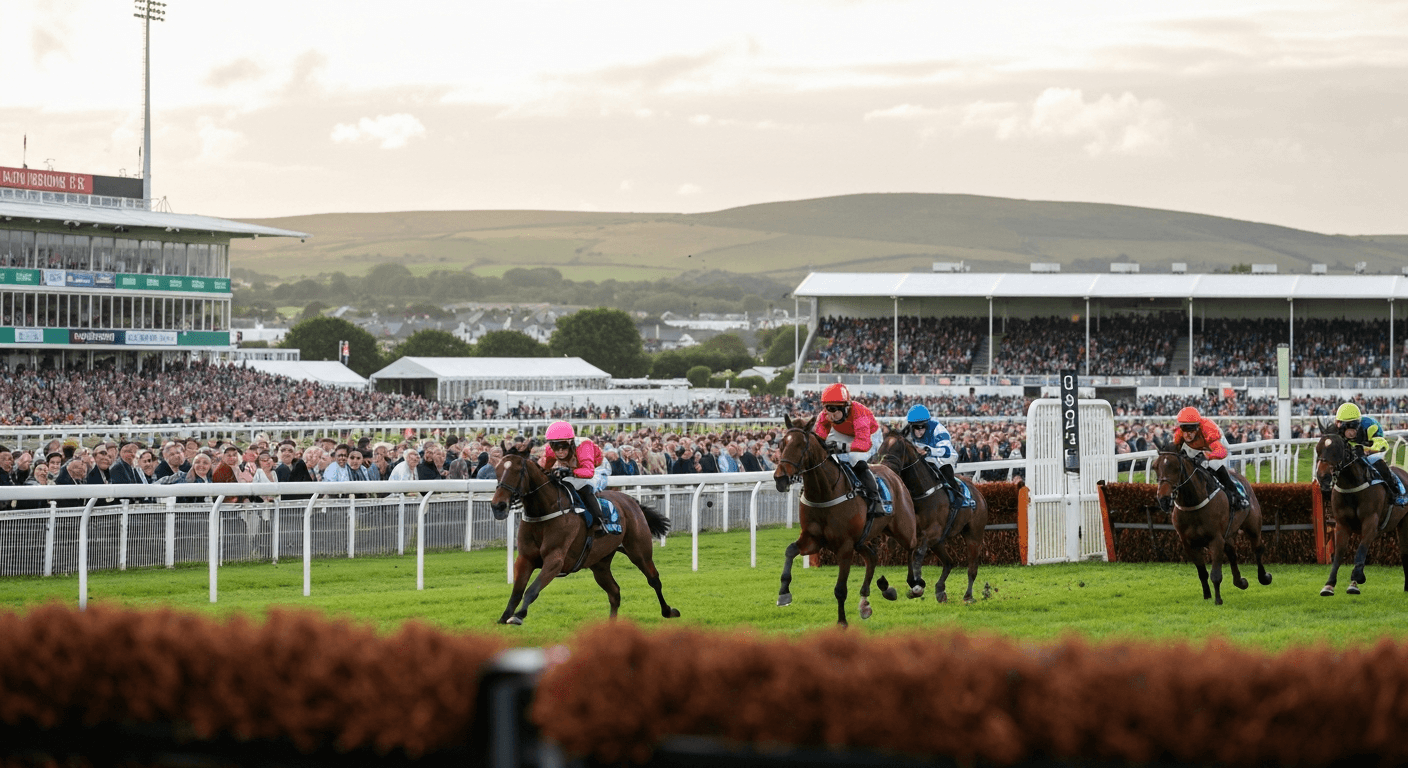
The History of Galway Racecourse
From the first 1869 meeting at Ballybrit to the seven-day summer festival, the Plate, the Hurdle and Dermot Weld's reign as King of Galway.
Read moreA Day at Galway: Visitor Guide
Plan a day at Galway Races in Ballybrit: getting there, the stands, accessibility, food and bars, the best festival days, what to wear and how to watch.
Read moreBetting at Galway: A Course Guide
A betting-focused guide to Galway (Ballybrit): the tight switchback track, the draw and pace bias, the Plate and Hurdle, plus trainer and jockey angles.
Read moreResearch the field with the AI Race Predictor
Our model publishes calibrated win-probability estimates for UK races — a second opinion to understand a race, not tips. It's open about its record: it doesn't beat the market, and we show exactly how it does.
Betting offers for Galway Festival
Work it out & learn the basics
Gamble Responsibly
Gambling should be entertaining and not seen as a way to make money. Never bet more than you can afford to lose. If you or someone you know has a gambling problem, help and support is available.