
Founder & Editor · Last reviewed 2026-07-24
Ladies' Day's Richest Prize
On the Thursday of Galway's Summer Festival, Ballybrit fills for Ladies' Day, the most glamorous afternoon of the week, and the race that anchors it is the Guinness Galway Hurdle. If the Galway Plate is the chase that gave the festival its name, the Hurdle is its twin peak: the richest handicap hurdle in Ireland and one of the most valuable and competitive in Europe.
The Hurdle is a Premier Handicap run over two miles on the tight, right-handed Ballybrit switchback, with nine flights to jump and a stiff uphill finish waiting at the end. It is open to horses aged four and upwards and was worth €270,000 in its most recent running, the same headline fund as the Plate, with €162,000 going to the winner. That prize money pulls in big, competitive fields, recently around nineteen or twenty runners and historically as many as twenty-eight, which is part of what makes the race so hard to call and such a magnet for the betting ring.
That difficulty is the whole point. The Hurdle is a handicap, a puzzle where the weights are set to bring the field together, so a well-handicapped horse trying its luck can beat a shorter-priced rival. The roll of honour reflects it, running from the Galway specialist Ansar through a run of Willie Mullins and Tony Martin winners to Ndaawi, who took the 2025 renewal for Gordon Elliott.
This guide walks through the race itself and the Ballybrit test, the history that built it from 1913, the horses and people who turned it into a Ladies' Day institution, where it sits in the rhythm of the festival week, and how to watch it whether you are on the rail at Ballybrit or following from a sofa in Britain. For this year's runners and the rest of the week's card, see our Galway Festival 2026 preview.
In short, this guide covers the race itself and the Ballybrit test, the history from 1913 to the modern festival, the great winners and the trends behind them, Ladies' Day at the heart of the week, how to watch the Hurdle at home or in person, and answers to common questions.
The Race Itself
The Guinness Galway Hurdle is a Premier Handicap hurdle, the top tier of Irish handicap, classified in the Grade A bracket and carded by some media as Grade 3 (Class 1). It is open to horses aged four and upwards and is run on the Thursday, Ladies' Day, of the Summer Festival. It is the richest handicap hurdle in Ireland and one of the most valuable and competitive in Europe.
Distance and obstacles
The Hurdle is run over two miles, or two miles and eleven yards to be exact, roughly 3,229 metres, with nine flights of hurdles to negotiate. The trip is a true two miles rather than an extended one, so speed matters, but the Ballybrit circuit is so sharp and its finish so testing that stamina is asked of a horse just as hard over the closing stages. Field sizes are large, recently around nineteen or twenty runners and historically as many as twenty-eight, which turns the race into a rough-and-tumble affair where jumping and position count for as much as raw ability. A field of that size also changes the each-way arithmetic. Standard terms on a handicap of sixteen or more runners pay a quarter of the odds on four places, and firms regularly add places on top for the big summer handicaps.
The Ballybrit test
| Feature | Detail |
|---|---|
| Distance | 2m (about 3,229 m) |
| Flights | Nine hurdles |
| Direction | Right-handed |
| Shape | Tight, undulating switchback |
| Finish | Stiff uphill run of just over two furlongs |
| Home straight | Short, little more than a furlong |
The hurdle course sits on the inside of the chase course used for the Plate, which makes it tighter and sharper still. The circuit is right-handed and runs to about a mile and a quarter to a mile and three furlongs a lap, with a steep climb in the back straight, a sharp drop into a dip before the home turn, and then a stiff uphill finish of just over two furlongs that is among the toughest in Britain or Ireland. The home straight itself is short, barely more than a furlong, so a horse cannot rely on picking up a long run-in to make up ground.
All of that places a premium on being handily placed. A horse needs to jump, to travel within itself and to be up with the pace turning in, because the geometry of the track makes it very hard to come from the back in a big field. The going at the Summer Festival is typically good to yielding, with the course watering in dry spells, though mid-week rain in the west of Ireland is common enough that the ground can change quickly across the week.
A note on betting that holds for the Hurdle as for any race: it is a competitive handicap with a large field, and backing the favourite is not a profitable approach. Over time, backing every favourite to its starting price produces a loss, because that price already carries the bookmaker's margin. Nothing in this guide is a tip.
If gambling is causing you harm, free confidential help is available. Visit BeGambleAware.org or call the National Gambling Helpline on 0808 8020 133. You must be 18 or over to bet. 18+. Please gamble responsibly.
From 1913 to the Modern Festival
The first race meeting at Ballybrit was held in August 1869, and the Galway Plate was a feature from that very first day. The Galway Hurdle came later. It was added to the programme in 1913, won that inaugural year by a horse called Red Damsel, and it grew over the following century into the Thursday headliner and the second of the festival's two great handicaps.
A different race in its early years
The Hurdle did not begin over its current trip. For its first six years it was contested over a mile and a half, a shorter test than the modern two miles, before settling at the distance that defines it today. That matters for anyone comparing form or winning times across the decades, because the early race asked rather different questions of a horse than the two-mile handicap that runners tackle now.
Guinness and graded status
The race is bound up with its long-standing sponsor. Guinness has backed the Hurdle since 2000, and the Guinness tent has become as much a part of Ladies' Day as the fashion and the racing. The race also carries premier status in the modern Irish handicap structure, having been elevated within the graded framework in 2014, which confirmed its place alongside the Plate as one of the two most valuable handicaps of the week.
How the festival grew around it
The meeting steadily expanded over the twentieth century as the Plate and, later, the Hurdle drew ever larger crowds. The first radio broadcast of the races went out in 1929, sponsorship arrived in 1959 and with it a move to three days, and television coverage followed in 1963. From there the festival lengthened in stages, reaching four days in 1971, five in 1974, six in 1982 and finally seven in 1999, the same year the Millennium Stand opened. That growth made Galway the longest race meeting in Britain or Ireland, and it handed the Hurdle its settled home on the Thursday.
Through all of it the Hurdle has held its place as the Ladies' Day centrepiece. The prize money has climbed to €270,000, level with the Plate, and the field sizes and betting turnover have grown with the festival around it, but the race itself has run as the Thursday anchor for more than a century.
The Great Winners
A handicap rewards the well-placed and the race-fit rather than the brilliant, so the Galway Hurdle roll of honour is a gallery of tough, well-handicapped horses and the trainers and jockeys who knew how to land Ladies' Day's richest prize. A few names stand above the rest.
Ansar, the king of Ballybrit's specialists
No horse is more bound up in Galway folklore than Ansar, trained by Dermot Weld. Ansar won seven races at the Galway Festival across all three codes, three chases, three hurdles and a Flat race. He took the Galway Hurdle in 2001 under Paul Carberry, having won a handicap hurdle earlier the same week, and later added the Galway Plate in both 2004 and 2005. That makes him the most recent horse to complete the rare Galway Plate and Galway Hurdle double, a feat Racing Post counts as having been managed by only a handful of horses ever.
Willie Mullins, the record-holding trainer
Willie Mullins is the outright leading trainer in the race, with six wins. His run began with Mystical City in 1996 and continued through Clondaw Warrior in 2016, Sharjah in 2018, Aramon in 2020, Saldier in 2021 and Zarak The Brave in 2023. No other yard has come close to that tally, and the Mullins operation has been the dominant force at the festival as a whole since 2016.
Tony Martin and the dual winner Tudor City
Tony Martin is the Hurdle's other modern master, with four wins to his name: Thomas Edison in 2014, Quick Jack in 2015, and Tudor City in both 2019 and 2022. Tudor City is the only dual winner of the modern era, a perennial festival competitor who came back to win it a second time three years after his first. Among the jockeys, Patrick Mullins leads the way since 1988 with three wins, aboard Sharjah in 2018, Aramon in 2020 and Saldier in 2021.
The modern roll of honour
| Year | Winner | Trainer | SP |
|---|---|---|---|
| 2025 | Ndaawi | Gordon Elliott | 13/2 |
| 2024 | Nurburgring | Joseph O'Brien | 13/2 |
| 2023 | Zarak The Brave | Willie Mullins | 9/2 |
| 2022 | Tudor City | Tony Martin | 22/1 |
| 2021 | Saldier | Willie Mullins | 18/1 |
| 2020 | Aramon | Willie Mullins | 7/1 |
| 2019 | Tudor City | Tony Martin | 10/1 |
| 2018 | Sharjah | Willie Mullins | 12/1 |
| 2017 | Tigris River | Joseph O'Brien | 5/1 |
| 2016 | Clondaw Warrior | Willie Mullins | 9/2 fav |
| 2015 | Quick Jack | Tony Martin | 9/2 |
| 2014 | Thomas Edison | Tony Martin | 7/2 fav |
| 2013 | Missunited | Michael Winters | 7/1 |
| 2012 | Rebel Fitz | Michael Winters | 11/2 |
| 2011 | Moon Dice | 20/1 | |
| 2010 | Overturn | Donald McCain | 6/1 |
| 2009 | Bahrain Storm | 20/1 |
Look down the starting prices and the nature of the race jumps out. Tudor City won at 22/1 in 2022, Moon Dice and Bahrain Storm both at 20/1, Saldier at 18/1. Favourites do win, as Clondaw Warrior did at 9/2 in 2016 and Thomas Edison at 7/2 in 2014, but they are very much the exception rather than the rule.
What the trends say
The Hurdle has firm patterns for anyone studying the form. Across the 22 renewals to 2024, analysts at Geegeez record that 21 of 22 winners were Irish-trained and 18 of 22 had finished in the first three last time out. Sixteen of the 22 were aged between five and seven, and 14 of the 22 returned at 7/1 or shorter, with only four winning favourites in that span. The concentration of talent was striking too: from 2014 to 2024 the race was won by just three yards, those of Willie Mullins, Joseph O'Brien and Tony Martin, before Gordon Elliott broke their run in 2025.
Elliott's long wait and the 2025 drama
That 2025 win was a story in itself. Gordon Elliott had gone nought from thirty-five in the Hurdle before Ndaawi, ridden by Jack Kennedy, finally landed it at 13/2. The result was decided in the stewards' room: Helvic Dream passed the post first by a head but was demoted for causing interference, handing the race to Ndaawi, and an IHRB Appeals Committee upheld the decision on 13 August 2025. Joseph O'Brien's Nurburgring, the 2024 winner, had lined up in the Plate that same week bidding for the double but was pulled up. Earlier, Michael Winters had taken the Hurdle back to back with Rebel Fitz in 2012 and Missunited in 2013, and Overturn, trained by Donald McCain, remains the last British-trained winner, successful in 2010.
Ladies' Day: The Heart of the Festival
The Galway Hurdle is run on the Thursday, the fourth day of the seven-day Summer Festival, better known across Ireland as Ladies' Day. It is one of the two busiest and most glamorous afternoons of the week, alongside Plate Day on the Wednesday. The 2026 festival runs from Monday 27 July to Sunday 2 August, which places the Hurdle on Thursday 30 July.
A week built around two handicaps
The festival has a clear rhythm, and each day carries its own feature. The Monday opens with the Connacht Hotel Handicap, a Premier Handicap for amateur riders widely known as Ireland's amateur Derby. The Tuesday brings the Colm Quinn BMW Mile Handicap on the Flat. The Wednesday is Plate Day and the Galway Plate, the chase that anchors the week. Then comes the Thursday, Ladies' Day, headlined by the Guinness Galway Hurdle. The weekend rounds things off with the Friday and Saturday handicaps and the Sunday Family Day.
The Plate and the Hurdle are the twin peaks of the week, and the symmetry is deliberate. Both are Premier Handicaps, both carry the same €270,000 headline prize fund, and between them they account for the two most heavily bet races of the year at Ballybrit. Winning both in the same week is rare and prized, and Gordon Elliott managed it in 2025, taking the Plate with Western Fold and the Hurdle with Ndaawi.
Fashion and the scale of the day
Ladies' Day is the fashion centrepiece of the festival, built around the Best Dressed Lady competition, with the Friday adding its own Most Stylish competition the following afternoon. There is no strict dress code across the week, with smart-casual the norm and smarter outfits on the big days.
Plate Day and Ladies' Day are among the great crowd days of Irish sport. The 2025 festival drew 125,997 people across the week, with the Friday crowd of 26,234 the single busiest day and the Wednesday and Thursday close behind. Across the week in 2025 the Tote handled €5.8 million and on-course bookmakers turned over more than €7.5 million, with roughly €1 million a day passing through the betting ring. The festival as a whole has been valued at more than €58 million to the economy of Galway city and its region, according to a UCD Smurfit study referenced by the racecourse. Hospitality at the track caters for around 1,300 people, traditionally at tables rather than in private boxes, and children aged 17 and under are admitted free with a paying adult.
How to Watch the Galway Hurdle
The Galway Hurdle is one of the most widely covered races in the Irish summer, and Ladies' Day is a broadcast highlight of the week, so it is easy to follow wherever you are.
On television and radio
In the Republic of Ireland, RTÉ televises the Galway Festival. It broadcasts a selection of races each day across RTÉ One and RTÉ2 and the RTÉ Player, with more races shown later in the week, and the Hurdle is firmly among the races carried on the Thursday. RTÉ Raidió na Gaeltachta also provides extensive live coverage in Irish.
In the United Kingdom and Ireland, Galway is a Racing TV course. All 26 Irish racecourses moved their media rights to Racing TV from 1 January 2019, so the Hurdle is shown on Racing TV for subscribers on both sides of the Irish Sea. Galway's summer festival is not part of ITV Racing's regular Irish coverage, and no ITV broadcast of the meeting was confirmed, so do not expect to find the Hurdle on free-to-air television in Britain.
Streaming
Races can be streamed through the Racing TV subscription service, and also via licensed bookmaker platforms to logged-in account holders who meet the usual viewing conditions. Coverage of Irish cards varies by firm, and some require a funded account or a bet on the race rather than simply being logged in. That is the most reliable route for anyone in Britain who is not near a television showing Racing TV.
Being there
If you want to watch the Hurdle in person at Ballybrit, the course sits just off the M6 and N6, about 3 to 6 kilometres northeast of Galway city centre. By rail, the nearest station is Galway's Ceannt Station in the city centre, about a 15-minute drive from the course by bus or taxi. During the festival, Bus Éireann shuttle buses run from the west side of Eyre Square, outside the Skeffington Arms, dropping off through the tunnel entrance within 50 yards of the course entry; in 2025 fares were €8 single and €10 return for adults, cash only.
Ladies' Day gates open earlier than the evening cards that open the week, at around 11.15am in 2025, with afternoon racing from about 2.00pm. The course recommends arriving at least an hour before the first race, and turnstiles open about two hours beforehand. The track is accessible for disabled racegoers, with disabled parking at Entrances B and C, pass gates alongside the turnstiles, lifts to the upper levels, and accessible viewing at the parade ring and on the first floor of the Killanin Stand. Given how far in advance peak-day tickets and Galway accommodation sell out, booking months ahead is strongly advised if you want to be on the rail when the Hurdle field comes up that stiff uphill finish.
Frequently Asked Questions
Share this article
More about this racecourse
All galway guides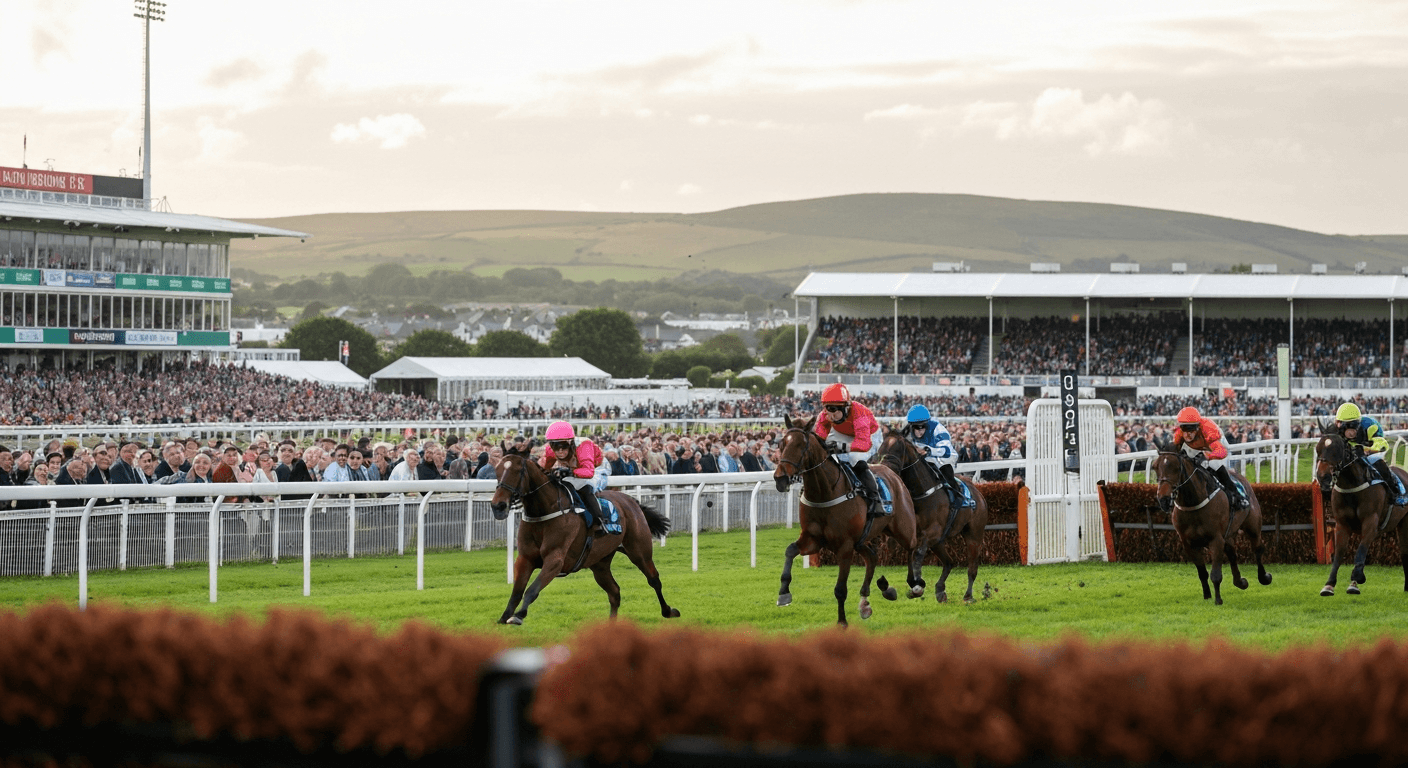
The Galway Plate: Race Guide
The Galway Plate explained: the 2m6½f Ballybrit handicap chase, its 1869 history, great winners from Tipperary Boy to Western Fold, and how to watch.
Read moreThe History of Galway Racecourse
From the first 1869 meeting at Ballybrit to the seven-day summer festival, the Plate, the Hurdle and Dermot Weld's reign as King of Galway.
Read moreA Day at Galway: Visitor Guide
Plan a day at Galway Races in Ballybrit: getting there, the stands, accessibility, food and bars, the best festival days, what to wear and how to watch.
Read moreBetting offers for Galway Festival
Gamble Responsibly
Gambling should be entertaining and not seen as a way to make money. Never bet more than you can afford to lose. If you or someone you know has a gambling problem, help and support is available.