
Founder & Editor · Last reviewed 2026-07-08
Introduction
Killarney Racecourse sits on Ross Road in Killarney, Co. Kerry, a short walk from the town centre on the edge of Killarney National Park beside Lough Leane and Ross Castle. It is a dual-code turf track, staging both Flat and National Hunt racing, with no all-weather surface. The course is owned and operated by Killarney Races, the local racing company, under General Manager Karl McCay.
It is one of very few Irish courses with multiple festivals. Around 11 to 13 race days are compressed into meetings in May, July and August plus a short October fixture, and racing is staged mostly in the evenings so visitors can sightsee by day. The July Festival is the busiest week, headed by the Lee Strand Best Dressed (Ladies) Day. For the track itself, see the track; for the fixture calendar, see festivals.
Racing in the Killarney district dates back to 1822, moving between temporary venues through the nineteenth century under patrons such as the Earl of Kenmare. The current Ross Road course opened in 1936, staging its first meeting that July. When the nearby Tralee track at Ballybeggan Park closed in 2008, Killarney survived largely on its scenery and tourism appeal. The course marked 80 years in 2016 and opened a new 54-horse stable block in 2017.
On this guide
Where to Bet
Place your bets with a trusted, licensed bookmaker.

Promo code BETFRED50. New customers only. Register, deposit with a Debit Card, and place a first bet of £10+ at Evens (2.0)+ on Sports, to be settled within 7 days, to get £30 in Sports Free Bets and £20 in Bet Builder Free Bets within 24 hours of settlement. 7-day expiry. Eligibility & payment exclusions apply. Full T&Cs apply. Take Time to Think. BeGambleAware.org. 18+. Full T&Cs.

Promo code R30. New UK customers only, 18+. Register, deposit £10 or more, then place a £10 single cash bet at odds of 1/2 (1.5) or greater on any sports market (excluding Virtuals). Once the qualifying bet settles you get £30 in Free Bets (3 x £10) — the qualifying bet can win or lose. Free Bets are valid on any sports market excluding Virtuals, expire in 7 days, are non-withdrawable and must be used in full. Excluded deposit methods apply (including PayPal, Apple Pay, Skrill and NETELLER). Named bets such as Lucky 15 do not qualify. If you cash out the qualifying bet, or it is voided, you are no longer eligible for the offer. Ends 31.12.26. Full T&Cs apply. Please gamble responsibly. BeGambleAware.org. 18+. Full T&Cs.

Promo code BET40GET20. New UK customers, 18+. Register with the code and place a first bet of £40 or more at Evens (2.0) or greater. Receive 2 × £10 free bets: the first credited automatically once the qualifying bet settles, the second 24 hours later. Free bets must be placed at minimum odds of 4/1 (5.0), expire 24 hours after credit, and the free-bet stake is not returned with winnings. Debit card deposits only. Take Time to Think. BeGambleAware.org. 18+. T&Cs apply. Full T&Cs.

50% of your first-day net losses refunded as a free bet, capped at £25. New UK customers aged 18+ only. To qualify, deposit and place a first bet of £10 or more on any sport at minimum odds of evens (2.00), then place at least two further bets on different events, each worth at least 50% of your largest bet, all at evens (2.00) or greater. Losses are counted from your first settled bet until 23:59 the same day. Place a qualifying £10+ bet and you are guaranteed at least a £5 free bet. Bets placed at SP, void bets, cashed-out bets and bets struck with free bets do not count towards the offer. The free bet is credited the day after your qualifying bets settle and must be used within 7 days, after which it expires. It can be used at odds from 1/4 (1.25) up to 250/1 on singles and straight accumulators, but not on Trixie, Patent or Yankee style multiples. Free-bet stake is not returned with winnings. One offer per person, household, address, IP address and device. E-wallet deposits may not qualify, so check the cashier before depositing. Customers registered with GAMSTOP cannot claim. KYC identity verification must be completed before the free bet is credited. Take Time to Think. BeGambleAware.org. 18+. T&Cs apply. Full T&Cs.

New customers, 18+. Choose the sports bonus at sign-up, make a first deposit and receive a 100% bonus up to £50 in your Sports Bonus balance. To convert the bonus to cash, wager it 10x within 30 days. Single bets below Evens (2.00) do not qualify; accumulators do not qualify if any selection is below 1/2 (1.50). Virtual Sports, voided, cancelled, drawn, cashed-out and free-bet wagers do not count towards wagering. Only the first settled bet per event counts. Withdrawing before the wagering requirement is met forfeits the bonus balance including bonus winnings. Real-money funds are used before bonus funds. Deposits via Skrill or Neteller are not eligible. Not valid in conjunction with other promotions. Odds, bet and payment limits apply. 10bet general and promotion T&Cs apply. BeGambleAware.org. 18+. Full T&Cs.

New customers in Great Britain and Republic of Ireland, 18+. Place a £10 fixed-odds qualifying bet at minimum odds of 1/2 (1.50) — single or each-way (only the win part counts), pre-event or in-play, not cashed out early, within 28 days of opening the account. Receive up to £60 in bonuses credited over three days: 3 × £10 fixed-odds free bets (the first on settlement, then 24 and 48 hours later) plus 3 × £5 Total Goals FOOTBALL spread bets, 3 × £5 racing Winning Favourites spread bets and a £1 racing Race Index spread bet (the spread bets need a full spread-betting account). Free-bet stakes not returned with winnings; free bets valid 28 days from issue. IMPORTANT: the £5 credits are SPREAD bets — sports spread betting carries the risk that losses can exceed your stake. Sports spread-betting customers do not have Financial Ombudsman or FSCS recourse. Take Time to Think. BeGambleAware.org. 18+. T&Cs apply. Full T&Cs.

Promo code WELCOME15, entered under My Bonuses after registering. New UK customers, 18+. Place a first qualifying bet of at least £10 from your cash balance at odds of evens (2.0) or greater within 7 days of opening the account. Once the qualifying bet fully settles you receive £15 in free bets, credited as 3 x £5 tokens with set uses: one £5 accumulator free bet (minimum 4 legs, each leg at 2/5 or bigger), one £5 sports free bet (any market at evens or bigger) and one £5 Sub Cover free bet (selected football player markets at evens or bigger). Free-bet stakes are not returned with winnings. Free bets expire 7 days after they are credited. Void, cashed-out and partially cashed-out bets do not qualify. One offer per customer. Confirm the current terms on BetGoodwin's own welcome-offer page before claiming. Take Time to Think. BeGambleAware.org. 18+. T&Cs apply. Full T&Cs.

New UK customers, 18+. Minimum deposit £10. Place a £10 qualifying single at minimum odds of 1/2 (1.50), settled within 14 days. Receive £30 in free bets (stake not returned), split £20 for sportsbook use (2 x £10) and £10 for Bet Builder only (2 x £5); Bet Builder does not cover horse racing. Free bets must be accepted within 7 days and expire 7 days after acceptance. No promo code required. Best Odds Guaranteed on UK & Irish racing, subject to having staked over £25 in the previous seven days. Operated by LiveScore Betting and Gaming (Gibraltar) Ltd, UKGC 56859. Confirm the current terms on LiveScore Bet's own promotions page before claiming. Take Time to Think. BeGambleAware.org. 18+. T&Cs apply. Full T&Cs.
18+. BeGambleAware.org
The Track
The Track
Killarney is a left-handed turf circuit measuring a little over nine furlongs round, described in various course guides as roughly 1m2f in circumference. It is a sharp, compact track rather than a galloping one, and its most distinctive feature is a notably tight bend immediately after the winning post. There is no conventional home straight in the usual sense: the final three-furlong section edges continually to the left, which makes challenging on the outside harder work than at a course with a true straight run to the line. The track is undulating in places, and all of its bends are cambered.
It is a dual-code venue, staging both Flat and National Hunt racing on the same turf with no all-weather surface. Over jumps there are six fences and five flights of hurdles to a circuit. On the Flat the minimum trip is 1m half a furlong, so no sprints are run here; other Flat distances include 1m3f, 1m4f and 1m6 and a half furlongs. For how these distances sit within the season's card, see the races; for the shape of the circuit itself, see the course map.
The run-in length is not settled in the sources. Most guides put it at around one furlong, while irishracing.com describes a run-in of three furlongs. The dossier lists this as an unresolved conflict, so we report both figures rather than assert either as fact.
On going, the ground can turn soft more quickly after rain than at many courses, which places extra emphasis on stamina. As for bias, the effect of the draw is only slight given the one-mile-plus minimum trip: a low draw carries a small advantage in bigger fields, where horses drawn wide risk being caught out on the turns, but the long left-leaning sections dilute this. Prominent racers and front-runners tend to be favoured, particularly on quicker ground, and the tight bend after the post rewards good jockeyship. These are descriptive patterns only and none implies that betting is profitable. Form and betting angles are covered in form and betting.
Confirmed track facts
| Feature | Detail |
|---|---|
| Orientation | Left-handed |
| Surface | Turf (dual-code Flat and National Hunt; no all-weather) |
| Circuit | Roughly oval, a little over nine furlongs (about 1m2f) |
| Character | Sharp, undulating, tight bend after the post; all bends cambered |
| Fences per circuit | Six |
| Hurdle flights per circuit | Five |
| Minimum Flat trip | 1m half a furlong (no sprints) |
| Other Flat distances | 1m3f, 1m4f, 1m6 and a half furlongs |
| Run-in | Reported as about 1f (most guides) or 3f (irishracing.com); unresolved |
| Draw bias | Slight; small low-draw edge in big fields |
| Pace bias | Prominent racers and front-runners favoured, especially on quicker ground |
The Course Map
Course map and layout
Killarney is a compact site on Ross Road, laid out so the main viewing and betting areas sit together on one side of the circuit. The grandstand is the focal point, with the Panoramic Restaurant occupying its top level and looking directly out over the parade ring, the jockeys and the finish. That arrangement puts the finishing line, the winner's enclosure and the principal stands within a short walk of one another, which suits the course's single-level, walk-everywhere character (see enclosures and stands).
The parade ring sits beside the grandstand, so racegoers can watch horses saddle and then move straight to the rail for the finish. Beyond the enclosures the track curves away as a left-handed oval of a little over nine furlongs, with a notably tight bend just after the winning post and a final section that edges continually left rather than running as a conventional home straight (covered in the track). Sources disagree on the run-in length, quoting either around one furlong or about three furlongs, so it is not confirmed here. Parking sits inside the track and in adjacent car parks.
The Races
The Races
Killarney is a dual-code course, and its feature programme is spread across the May, July and August festivals. It stages one graded race, a clutch of black-type Flat and jumps events, and one of the meeting's big betting heats. For how these races ride and where the draw and pace angles matter, see Form and Betting; for the meetings that hold them, see Festivals.
The graded highlight
The An Riocht Chase is the track's only graded race, a Grade 3 National Hunt contest over about 2m4½f (14 fences) run at the May Festival. It has held Grade 3 status since 2016, having previously been an ungraded conditions race. "An Ríocht" is Irish for "The Kingdom", Kerry's nickname. Its roll of honour includes Peregrine Run, Samcro and the popular grey Ballycasey. In 2026 it was run as the BoyleSports An Riocht Steeplechase, worth €55,000, and won by the 10/1 shot Senicia (trainer Vincent Laurence Halley, jockey Philip Enright) from Three Card Brag.
The big betting heat
The Killarney National, the Finbarr Slattery Memorial Killarney National Handicap Chase over about 3m2f in May, is the meeting's marquee handicap. Trainer Enda Bolger, for owner JP McManus, has dominated it, landing four runnings in a decade with Cantlow (2016), Auvergnat (2017), Shady Operator (2021) and Pride Of Place (2025, ridden by Charlie O'Dwyer).
Flat black type
The Cairn Rouge Stakes (Listed, July) is a fillies-and-mares contest over 1m100y, restricted to three-year-olds from 2025 and named after the 1980 Irish 1,000 Guineas and Champion Stakes winner. Aidan O'Brien is the leading trainer with three wins, matched by jockeys Declan McDonogh and Wayne Lordan on three each. Red Letter (Ger Lyons, Colin Keane) took the 2025 running.
The Vincent O'Brien Ruby Stakes (Listed, August) is run over 1m20y to 1m30y for three-year-olds and up, with a total prize fund of €42,500. First run at Tralee in 1997, it moved to Killarney in 2009 and gained the Vincent O'Brien title. Aidan O'Brien holds a record haul of course winners in the race.
Killarney's July maidens are also a noted launchpad: the future Epsom Derby winners Anthony Van Dyck and Lambourn both won first time out at the July Festival.
Feature-race table
| Race | Code / grade | Distance | Month | Notable recent winner |
|---|---|---|---|---|
| An Riocht Chase | NH, Grade 3 | c.2m4½f | May | Senicia (2026) |
| Killarney National | NH handicap chase | c.3m2f | May | Pride Of Place (2025) |
| Tourist Attraction Mares Hurdle | NH, Listed | 2m1f | May | n/a |
| O'Donoghue Ring Collection H'cap Chase | NH, Listed | c.2m5f | n/a | n/a |
| Cairn Rouge Stakes | Flat, Listed | 1m100y | July | Red Letter (2025) |
| Vincent O'Brien Ruby Stakes | Flat, Listed | 1m20y–1m30y | August | n/a |
| Kingdom Gold Cup | Flat, Premier Handicap | 2m1f | August | n/a |
The Kingdom Gold Cup (Kellihers Toyota Kingdom Gold Cup Handicap, Premier Handicap, 2m1f, August) rounds out the black-type list, a valuable staying handicap worth €27,000 to the winner that jumps-oriented yards such as Willie Mullins and Noel Meade target with older horses.
Records and Stats
Records and stats
Killarney is unusual for a course of its profile in that it does not publish an authoritative set of records. There is no official course-record or standard-times table by distance, and no marquee-race track record is formally catalogued. Winning times for individual runnings can be pulled from result services such as Racing Post, Sky Sports and Timeform on a race-by-race basis, but the racecourse and Horse Racing Ireland do not collate a verified record table. Treat any single "track record" quoted elsewhere with caution.
Attendance figures are similarly unpublished. Killarney draws large summer crowds, lifted by the town's standing as one of Ireland's leading tourist destinations, and the July Festival is the busiest week with Friday's Ladies Day the peak day. Even so, no verified single-day or annual attendance numbers are on the record, and the spectator capacity is not officially published either. For festival dates and the shape of each meeting, see the festivals section.
The clearer picture is in the yards and saddles. Willie Mullins has an outstanding jumps record here: per irishracing.com's course guide, over the last five seasons he achieved a 34 per cent strike rate from more than 100 runners. Enda Bolger, the cross-country specialist, is the King of the Killarney National for owner JP McManus. On the Flat, Aidan O'Brien dominates the black-type races, with jockeys Declan McDonogh, Colin Keane and Wayne Lordan all holding strong course records. The betting angles that follow from these patterns are covered in form and betting.
History
History
Organised racing in the Killarney district reaches back to 1822, when the sport was staged at a series of temporary venues around the town through the nineteenth century. Those early fixtures ran under the patronage of the local gentry, notably the Earl of Kenmare, whose family estate framed much of the land on which Killarney later grew as a tourist town.
The course that survives today, on Ross Road at the edge of Killarney National Park beside Lough Leane, opened in 1936 and staged its first meeting that July. Settling on a permanent home gave the fixture the stability the earlier itinerant meetings had lacked, and the location, a short walk from the town centre and set against the lakes and mountains, quickly became the track's defining asset.
That scenery and the town's tourism pull proved decisive to the course's long-term survival. When the nearby Tralee track at Ballybeggan Park, which had held racing since 1898, closed in 2008, Killarney absorbed the region's racing focus and continued largely on the strength of its setting and visitor appeal. Summer festivals were added across the following decades, building the multi-meeting calendar the course is known for today. You can read how those meetings are structured now in the festivals section.
The course marked its 80th anniversary in 2016 and, the following year, opened a new stable block with capacity for 54 horses, a piece of modernisation aimed at supporting its expanding fixture list. Its economic weight to the town was measured around this period: per BettingSites.org.uk, the racecourse was estimated to be worth €6.2m to Killarney at that time, a figure that excluded the €1.42m paid out in prize money.
From those beginnings the course has grown into one of the few Irish tracks with several festivals a year, and a proving ground for horses who go on to bigger things, a thread picked up in the legends section.
The Legends
Legends of Killarney
Killarney is more a launchpad than a home of resident champions. Its July maidens have a habit of introducing horses who go on to the very top: both Anthony Van Dyck, the 2019 Epsom Derby winner, and Lambourn, the 2025 Epsom Derby winner, recorded their first wins at the July Festival before reaching Classic company.
On the Flat, Aidan O'Brien's stable stars have repeatedly landed the course's two Listed prizes. His Killarney winners of the Vincent O'Brien Ruby Stakes, which moved to the course from 2009, include Poet, Steinbeck, Wild Wind, Soon, I Can Fly, So Wonderful, Horoscope and Salt Lake City. He has also taken the Cairn Rouge Stakes three times, with Palace (2014), Lovelier (2020) and Greenfinch (2024). The 2025 Cairn Rouge fell to Red Letter, a Frankel filly owned by Juddmonte and trained by Ger Lyons.
Over jumps the standout figure is Enda Bolger, the cross-country specialist, who is the King of the Killarney National for owner JP McManus. Bolger has won the meeting's big betting heat four times in a decade, with Cantlow (2016), Auvergnat (2017), Shady Operator (2021) and Pride Of Place (2025). The Grade 3 An Riocht Chase, the course's only graded race, has drawn names such as Peregrine Run, Samcro and the popular grey Ballycasey to its roll of honour.
Among the horsemen, Willie Mullins carries an outstanding record at the track, while jockeys Declan McDonogh, Colin Keane and Wayne Lordan have long been associated with its Flat cards. For the individual races these horses won, see The Races; for how these patterns shape the form picture, see Form and Betting.
The Festivals
Festivals and Signature Meetings
Killarney is one of very few Irish courses to stage multiple festivals, packing its 11 to 13 race days each year into short, concentrated bursts rather than spreading fixtures across the calendar. The result is four distinct meetings in 2026, each with its own character and feature races.
The May Festival runs across three evenings on 9, 11 and 12 May 2026, with National Hunt racing on the 9th and 11th and a Flat card on the 12th. This is the jumps showpiece. It is headlined by the Grade 3 An Riocht Chase, Killarney's only graded race, and by the Killarney National, the meeting's big betting handicap chase over about 3m2f. A family fun evening features on the Monday, and the Saturday traditionally draws a large crowd tied to the Munster GAA football final in the town. For more on these contests see The Races.
The July Festival, from Monday 13 to Friday 17 July 2026, is the busiest and best-known week of the year. It spans five days: Flat cards open the meeting from Monday to Wednesday, National Hunt takes over on Thursday and Friday, and Friday is the Lee Strand Best Dressed (Ladies) Day. Confirmed first-race times are 5:00pm on Monday, 4:35pm Tuesday, 4:55pm Wednesday and 4:30pm Thursday, with an earlier 1:32pm start on Ladies Day. The Listed Cairn Rouge Stakes and the Kingdom Gold Cup are the headline Flat races, and the July maidens have a habit of launching top careers: the future Epsom Derby winners Anthony Van Dyck and Lambourn both recorded their first wins here.
The August Festival runs over three days from 20 to 22 August 2026. The opening day carries the Listed Vincent O'Brien Ruby Stakes, and the meeting also features a Listed handicap chase and the Kingdom Gold Cup. Roses taking part in the nearby Rose of Tralee Festival often appear at this meeting, adding to the summer-evening atmosphere.
The October Festival on 4 and 5 October 2026 is a lower-key, two-day autumn finale that closes the season.
Racing at Killarney is predominantly staged in the evening, a deliberate choice that lets visitors sightsee around Killarney National Park and the Lakes by day and race by night. Gates typically open two hours before the first race, and earlier on Ladies Day. For dress advice and best-dressed details, see What to Wear.
Form and Betting
Form and betting
The market usually gets it right, and over the long run backing favourites blindly loses money to starting price. That is the honest starting point at any track, Killarney included. Our sample of 223 races here (Flat and jumps, October 2023 to May 2026) returns a level-stakes favourite ROI of +5.77%, but the 95% confidence interval runs from -11.75% to +23.18%. Because that range crosses zero, it is statistically no signal, not a winning angle: small per-course samples are noisy, and a positive-looking number here does not mean favourites turn a profit. Treat it as "the market is roughly efficient", nothing more.
| Favourites at Killarney | Value |
|---|---|
| Races in sample | 223 |
| Window | Oct 2023 to May 2026 |
| Strike rate | 42.2% |
| Level-stakes ROI to SP | +5.77% |
| 95% confidence interval | -11.75% to +23.18% |
| Reliable edge? | No (CI crosses zero) |
Beyond the favourite, the dossier's descriptive patterns line up with a sharp, mostly good-ground circuit. Field sizes are modest (average 9.8 runners, median 10, ranging from 3 to 16), so races are rarely scrambles. The going skews quick to soft: Good (26.9%) and Good to Yielding (23.8%) dominate, with Soft or Heavy under 13% combined, though the dossier notes ground can turn soft quickly after rain, which puts more onus on stamina.
The draw carries only a slight effect over the mile-plus minimum trip. Across the sample, low-drawn runners won most often, but the spread is narrow rather than decisive.
| Draw band | Runners | Win % |
|---|---|---|
| Low | 303 | 13.5 |
| Mid | 248 | 11.7 |
| High | 276 | 8.3 |
For the shape of the track that produces these numbers, see the track; for the graded and Listed races themselves, see the races.
None of the above is advice, and none of it implies profit. These are descriptive patterns from a noisy sample.
Please gamble responsibly
Betting should be fun, never a way to make money. Only stake what you can afford to lose, and never chase losses. If gambling is causing you harm, free confidential support is available at BeGambleAware.org or on the National Gambling Helpline, 0808 8020 133. You must be 18 or over to bet.
Planning a Visit
Visiting Killarney Racecourse
Killarney Racecourse sits on Ross Road, on the edge of Killarney National Park beside Lough Leane and Ross Castle, a short walk from the town centre in Co. Kerry. Most cards are run in the evening so visitors can sightsee by day, and gates typically open two hours before the first race, earlier on Ladies Day.
Getting there is straightforward. Killarney train station and bus station are each about half a mile from the track, Kerry Airport at Farranfore is around fifteen minutes' drive, and parking inside the track and in adjacent car parks is free. See Getting there for the road, rail and air detail.
For admission, the course markets a general Kingdom Pass level, a BBQ Experience and the premium Panoramic Experience, with under-14s admitted free when accompanied by an adult. The enclosures and stands section covers what each package includes.
There is no strict dress code; smart casual is encouraged, dressier for the July and August best-dressed days. Accessibility details are limited in published form, so confirm specific provisions with the course directly. For guidance see what to wear and accessibility.
Getting There
Getting there
Killarney Racecourse sits on Ross Road, on the edge of town beside Killarney National Park, which makes it one of the more easily reached tracks in Ireland. For a sense of just how close the racecourse is to the town centre, see Visiting Killarney.
By road, the course is reached via the N22 and N72, and is signposted on the approach. Drivers coming from Dublin or Cork pick up the M8 motorway before joining the national roads towards Kerry. Parking is the simple part: spaces are available inside the track itself and in adjacent car parks, and parking is free. That combination of a central location and on-site parking makes arriving by car straightforward even on the busier festival days.
Public transport is a genuine option here, which is not true of every Irish course. Killarney railway station, served by Irish Rail with trains from Dublin, Cork and Tralee, is about half a mile from the track, so an easy walk. Killarney bus station is a similar distance away, also around half a mile. Both leave you a short stroll from the entrance, and the walk takes you through or alongside the town.
For those flying in, Kerry Airport at Farranfore is roughly 15 minutes' drive from the racecourse, while Cork Airport is around 90 minutes away by road.
Because the racecourse is so close to the town centre and its hotels, many visitors staying locally simply walk in. Racing is staged mostly in the evenings so that visitors can sightsee by day, so plan your arrival with the confirmed off-times in mind. For enclosure options and what to expect once inside, see Enclosures and stands.
Tickets and Enclosures
Enclosures and stands
Killarney keeps its viewing simple. Rather than the tiered ring-and-paddock split found at some larger tracks, the course is broadly single-level around the enclosures, so a general admission ticket lets you move freely between the parade ring, the betting hall and the rail. The layout suits a compact provincial circuit where the winning post, the tight bend after it and the parade ring all sit close together.
The grandstand is the focal point. Its top level houses the Panoramic Restaurant and Corporate Suite, which looks out over the parade ring, the jockeys and the finish, and a private balcony runs off it. This is the premium vantage point on the course and is reached through the Panoramic Experience hospitality package rather than through general admission.
Admission is sold as a small set of packages rather than by named enclosure. The entry level is the Kingdom Pass or Punters Pack general admission, with the BBQ Experience and the top-tier Panoramic Experience above it. Indicative recent figures put general admission at roughly €15 to €20, a few euro more on Ladies Day, though exact 2026 prices appear only inside the online booking widget. Under-14s are admitted free with an adult, and annual membership of the Killarney Racegoers Club has been offered at around €250, covering admission to every Killarney meeting plus a guest and use of a private members' bar.
For what each package includes at the table, and the named bars and food outlets across the site, see food, bars and hospitality. For gates, parking and arrival, see getting there.
Food, Drink and Facilities
Food, bars and hospitality
Killarney's catering runs from grab-and-go stalls to a full four-course meal, all a short walk apart. The named outlets are the Panoramic Restaurant on the top level of the grandstand, which overlooks the parade ring and finish, plus two bars: the Jockeys Whip and the Jim Culloty Bar, where live entertainment carries on after the last race. Coffee shops sit inside the public racing hall, and food stalls are dotted across the site.
The premium option is the Panoramic Experience, which bundles admission, a racecard, a tipster, a four-course meal, reserved seating, table service, Tote betting, a stocked bar, a private balcony and after-racing music in the Jim Culloty Bar. There is also a mid-range BBQ Experience. Package details and enclosures are covered in enclosures and stands.
Families are catered for at designated meetings: the Maurice O'Donoghue Suite becomes a play zone with bouncy castles, discos and face painting on family evenings. The wider complex shares the Racecourse Café, Ross Golf Club, Nave Yoga and Killarney Glamping pods. For the after-racing mood, see atmosphere and culture.
What to Wear
What to Wear
Killarney keeps things relaxed. There is no strict dress code, and smart casual is encouraged rather than enforced, so most racegoers arrive in comfortable, tidy outfits suited to an Irish summer evening. Dressing a little smarter is expected in the hospitality areas, particularly the Panoramic Restaurant on the top level of the grandstand (see food, bars and hospitality).
The exception is the festival best-dressed competitions, which run at both the July and August meetings. The showpiece is the Lee Strand Best Dressed Day on the Friday of the July Festival, the meeting's Ladies Day, when the crowd dresses up in force and prizes have included VIP trips to Paris and Milan. If you are heading for that fixture, it is the one day to make an effort. For the wider festival mood, see festivals.
Capacity and Venue Hire
Capacity and venue hire
Killarney does not publish an official spectator capacity figure, and no verified single-day or annual attendance record exists. What is clear is that the course draws large summer crowds, helped by Killarney's standing as one of Ireland's leading tourist towns; the July Festival is the busiest week, with Friday's Ladies Day the peak. Any hard headcount you see quoted elsewhere should be treated as an estimate rather than an official number.
As a hire venue the racecourse markets several distinct function spaces. The Panoramic Restaurant and Corporate Suite is the flagship room, measuring 3,062 sq ft with a 3.2m ceiling, seating up to 250 guests for banqueting and opening onto a private balcony overlooking the parade ring and finish. Smaller rooms cover the rest of the range: the Glass Bar suits classroom-style sessions, the Stewards Room takes small to medium meetings of up to 20 guests, and the Press Room works for interviews or intimate gatherings. The Stable Lounge is a family-friendly space with an adjoining green area, available May to September, while the Club House can be booked for private functions after 6pm. For larger events there are outdoor options including the stable yard and the bookies' car park.
Beyond raceday, the site has hosted vintage car rallies, marathons and the international TBEX travel-bloggers conference in 2017. Bookings and pricing go through the sales office (sales@killarneyraces.ie). For hospitality on a race afternoon rather than a private hire, see food, bars and hospitality.
The Atmosphere and What Killarney Means
Atmosphere and culture
Few Irish tracks are as tightly woven into their town as Killarney. The course sits on Ross Road, a short walk from the town centre on the edge of Killarney National Park beside Lough Leane and Ross Castle, and it draws on Killarney's standing as one of Ireland's leading tourist destinations. That setting shapes the whole experience: racing is staged mostly in the evenings so visitors can sightsee by day, then head to the track for the card. Summer crowds are large, and the July Festival is the busiest week of the year.
The culture leans social and festive rather than formal. Racing runs across festivals in May, July and August plus a short October fixture, and the July and August meetings carry best-dressed competitions. The Lee Strand Best Dressed Day, on the Friday of the July Festival, is the showpiece, and Roses taking part in the nearby Rose of Tralee Festival often appear at the August meeting. Live entertainment continues after racing in the Jim Culloty Bar.
There is a strong sporting fabric to the calendar too: the May Festival's big Saturday crowd is tied to the Munster GAA football final. Local operators and trainers give the fixtures their character, from Willie Mullins and Enda Bolger over jumps to Aidan O'Brien on the Flat. For the timetable of festivals and best-dressed days see Signature festivals; for the raceday feel by area see Enclosures and stands.
Accessibility
Accessibility
Killarney publishes very little about accessibility, so plan around what the layout offers rather than a formal access statement. The enclosures sit broadly on a single level, which helps wheelchair users and anyone who finds stairs difficult, and the on-site parking runs close to the entrances (see Getting there for the free car parks inside the track). Staff will assist on request, so it is worth flagging any need at the gate on arrival.
Beyond that, the specifics are not confirmed on any official Killarney accessibility page. The racecourse does not publish details of blue-badge bays, accessible viewing areas, lift access to the grandstand and Panoramic Restaurant, accessible toilets, its assistance-dog policy, or carer and companion ticket arrangements. Because the July and August festivals draw the largest crowds, and much of the racing is staged in the evening, these are exactly the points a disabled racegoer will want nailed down before travelling.
The practical step is to contact the course directly ahead of your visit, on +353 64 66 31125 or sales@killarneyraces.ie, and confirm the provisions that matter to you rather than relying on the general description here. If you are booking hospitality, raise access needs when you reserve, since seating and balcony arrangements vary by package (see Enclosures and stands).
Where to Stay and Nearby
Nearby: where to stay and the local area
One of Killarney's great advantages is that the racecourse sits within walking distance of the town centre, which has an exceptional density of hotels. Options within a short walk include The Brehon, the Killarney Plaza Hotel and Spa and the Great Southern, while Cahernane House Hotel lies about a 15-minute stroll through the National Park. That proximity is why racing here is staged mostly in the evenings, leaving the day free to explore (see getting there for transport links).
The setting is the other draw. The course sits on the edge of Killarney National Park, beside Lough Leane and Ross Castle, so the scenery is a genuine part of the day out. Nearby attractions include Muckross House and Gardens, the Lakes of Killarney, the Gap of Dunloe and the famous Ring of Kerry touring route. Roses taking part in the nearby Rose of Tralee Festival often appear at the August meeting, tying the track into Kerry's wider summer calendar (see atmosphere and culture).
Frequently Asked Questions
Share this article
More about this racecourse
All killarney guides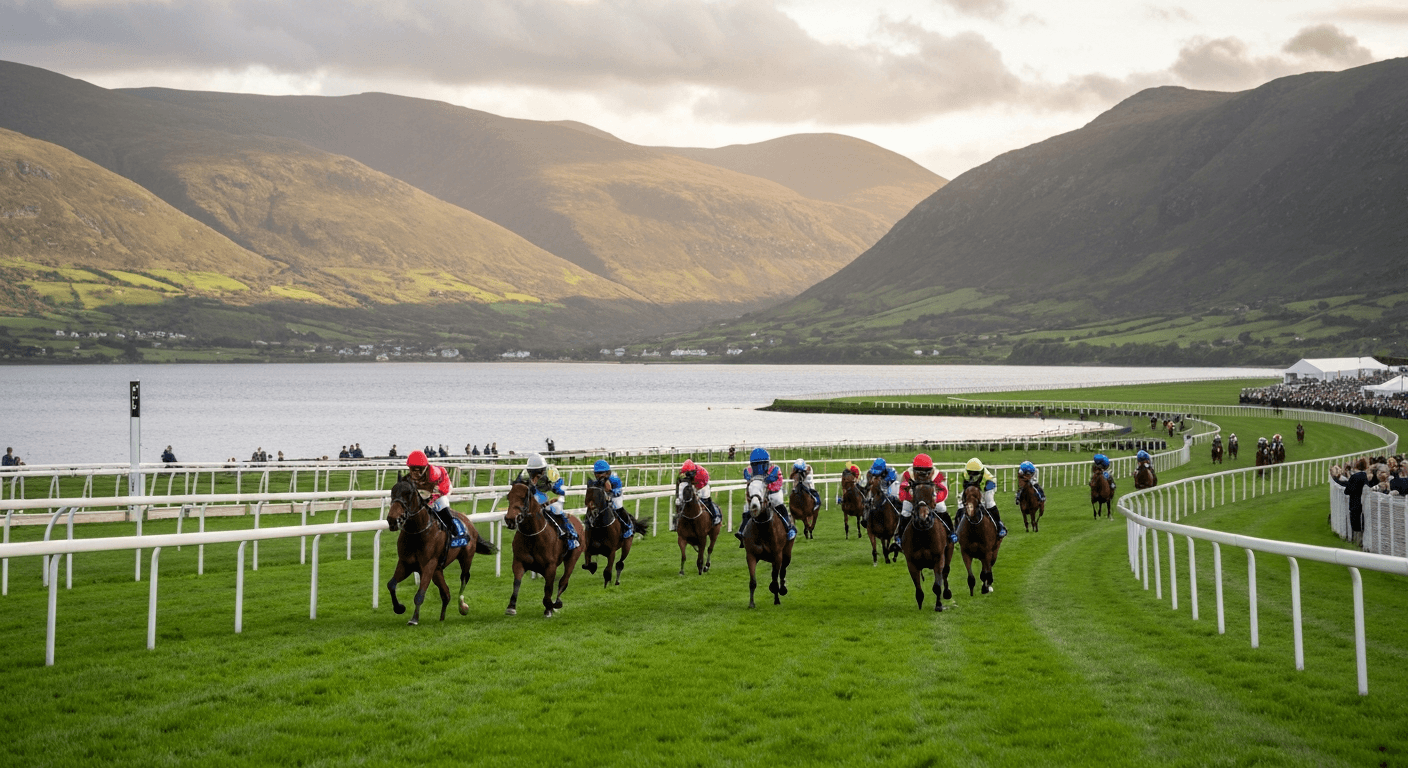
The Cairn Rouge Stakes: Killarney's Listed Feature
The Cairn Rouge Stakes explained: Killarney's one black-type race, the Listed EBF mile for three-year-old fillies run on July Festival Wednesday — its conditions, roll of honour and how it's won.
Read more
The Killarney July Racing Festival: A Complete Guide
A complete guide to Killarney's July Racing Festival: five days of summer evening racing, the Cairn Rouge Stakes, Ladies Day and how to go.
Read moreResearch the field with the AI Race Predictor
Our model publishes calibrated win-probability estimates for UK races — a second opinion to understand a race, not tips. It's open about its record: it doesn't beat the market, and we show exactly how it does.
Betting offers for Killarney July Racing Festival
Work it out & learn the basics
Gamble Responsibly
Gambling should be entertaining and not seen as a way to make money. Never bet more than you can afford to lose. If you or someone you know has a gambling problem, help and support is available.