
Founder & Editor · Last reviewed 2026-07-13
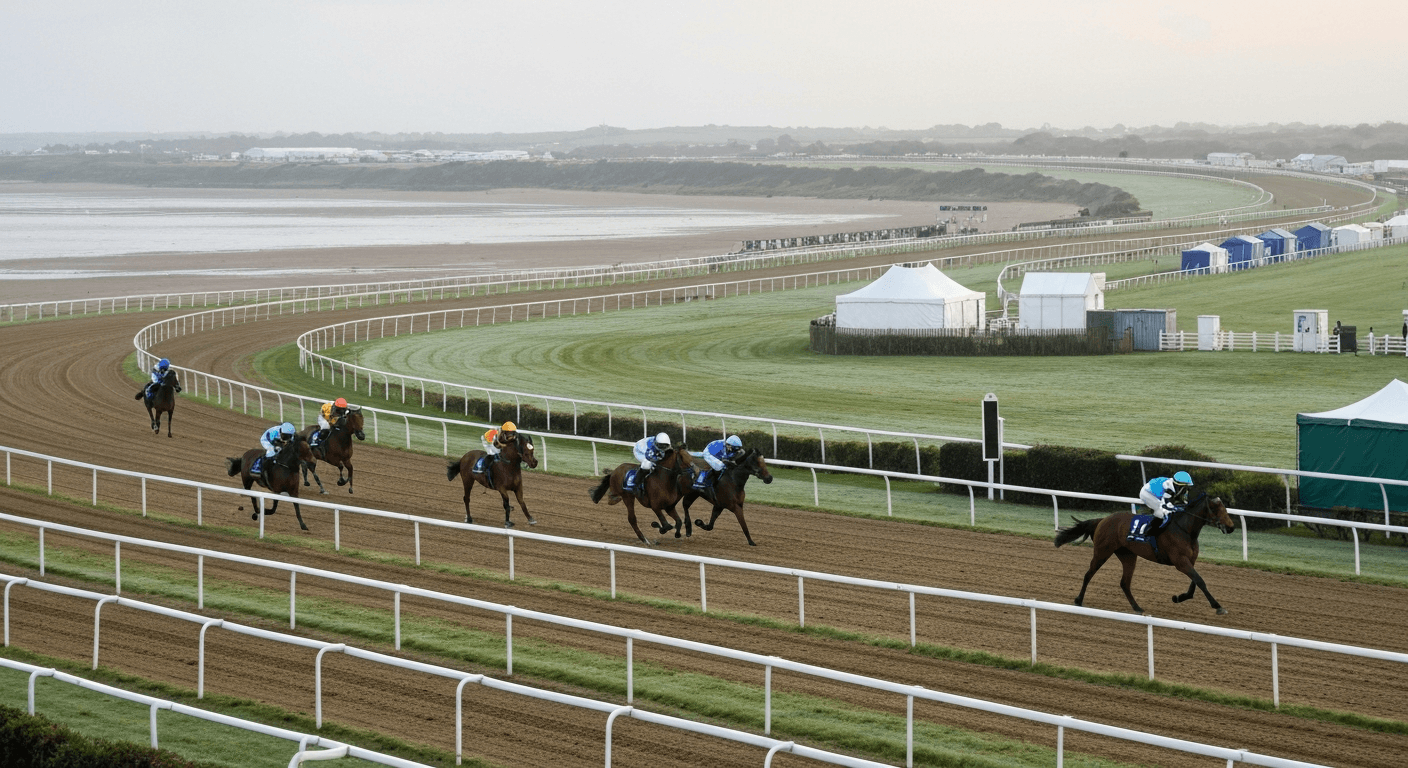
Most racecourse histories begin with a building. Laytown's begins with a tide. For one day each September, workers mark out a running track on the wet sand of the Co. Meath coast once the sea has gone out, race six times over it, and then let the water take it back. For the other 364 days of the year the course does not exist. This is the only horse race run on a beach under the Rules of Racing anywhere in Ireland or Britain, and it has been going, on and off, since 1868.
That first recorded meeting was a sideshow. The main event that day was the Boyne Regatta, a rowing competition held at high tide, and the horses were slotted in once the water receded. Racing on the strand was intermittent for the rest of the 1800s, staged only when the tides fell right, and it has survived every kind of interruption since: two world wars, a fatal accident that nearly ended it, a rained-off meeting, and a global pandemic. It runs today under Irish Horseracing Regulatory Board rules, organised by a voluntary local committee, on a temporary course with no permanent grandstand, no enclosures and no graded race.
The identity of the meeting is the beach itself, not a signature contest or a champion horse. Laytown has never produced a great winner in the way that Ascot or the Curragh has, and its best-known equine story is about a horse that refused to run at all. What it has instead is a format found nowhere else, a deep hold on the local parish, and a reform history shaped by one bad afternoon in 1994.
This article traces racing on the strand from the 1868 Boyne Regatta through the meeting's early survival, then the 1994 tragedy and the safety reforms that reshaped it. It covers the horses, including the Labaik refusal, the people who run and ride the fixture, the records and numbers such as they are on a course with no standard times, what the day is actually like as a community occasion, and Laytown today under IHRB rules, before answering common questions. Where the record is folklore rather than fact, it is flagged as such.
Racing on the Strand
The first recorded race meeting at Laytown took place in 1868, held in conjunction with the Boyne Regatta. The order of the day was set by the water. The rowing ran at high tide; once the sea pulled back and exposed the strand, the horses raced on the wet sand it left behind. In those early years the racing was the junior partner, a sideshow to the regatta rather than the main draw. This 1868 first-recorded date is agreed by the official Laytown site, Horse Racing Ireland, Wikipedia and other sources.
Racing was common on the sand
Beach racing was not unusual in Ireland at the time. Meetings were held at Baltray and at Termonfeckin, which closed around 1900, and at Milltown Malbay in Co. Clare. Laytown is the one that endured. Through the late 1800s its meetings were intermittent, staged only when the combination of tides allowed a safe, exposed strand at a workable hour. That dependence on the sea has never gone away, and it still dictates the fixture today.
The parish priest and the Delany family
A local parish priest was central to the meeting's early organisation, but the sources genuinely disagree on the detail, so this part of the story is best treated as folklore rather than settled fact. The official Laytown site records a local tradition that the original parish priest, backed by the Bishop of Meath, was opposed to the races, and that the meeting began to thrive again only after a new, supportive priest arrived in 1901. Meath County Council's tourism account tells it differently, crediting a priest with organising the first race meeting in 1876. No credible named source identifies the priest, and a name sometimes attached to him could not be verified anywhere connected to Laytown.
What is far better documented is the role of the Delany family, which runs across generations. Meath County Council credits the landowner Paddy Delaney with establishing the modern meeting as it is known today in 1901. The family thread continues into the present. In 2025 the committee member Alan Delany, who is also assistant trainer to his father Eamon, won the Pride Of Place Maiden at Laytown with Lohengrin, and noted that the family's previous winner on the strand had come in 1965, trained by his grandfather Eamon Delany and ridden by Francis Flood. Grandfather, father and son give the family an association with the meeting spanning the best part of a century.
Early colour and the wartime breaks
Laytown accumulated its share of history in these decades. Charles Stewart Parnell, the leader of the Home Rule movement, served as one of the meeting's first stewards. The 1875 card famously included a penny-farthing bicycle race alongside the horses. Racing was suspended in the final two years of the First World War and resumed in 1919, and there was a further break during the Second World War between 1942 and 1945. In 1949 the Aga Khan III and the Begum attended, a mark of how far the little strand meeting had travelled from its regatta-sideshow origins.
By the 1950s and 1960s Laytown had found a practical value beyond its own raceday. In the years before all-weather tracks existed, sand was prized for training, and trainers used the strand to prepare horses for the Galway Festival. The meeting had grown into a carnival on the beach, with traders, bookmakers and amusements set up on the sand, and it drew large crowds. That open, everything-on-the-beach format is the one the events of 1994 would bring to an end.
The 1994 Tragedy and the Reforms
If one day defines Laytown's modern history, it is 4 August 1994. During the meeting, a horse was spooked, by a small river stream on the course according to Wikipedia and several course guides, and bolted into the crowd, causing panic among the other runners. Three horses were put down as a result of their injuries. One jockey was taken to hospital and several spectators were hurt, and one of the injured riders, Micky Cleary, never rode again. A contemporary photography-history account adds that one of the loose horses, owned by Michael Smurfit and trained by Dermot Weld, unseated its rider, swam across the Boyne at Mornington and was found near Baltray. Racing Post confirms the core of it: the 1994 meeting resulted in three horses suffering fatal falls and a number of jockeys being injured. The precise date of 4 August comes from that photography-history blog rather than a mainstream news archive, so it is offered with that caveat.
The reforms that reshaped the meeting
The accident triggered a Turf Club safety review, backed by a warning from the ISPCA, and the changes that followed remade the fixture from the ground up. They took effect from the 1995 meeting:
- The old U-shaped course, which turned at Bettystown, was abolished and the track made straight.
- Race distances were cut to a straight six and seven furlongs.
- Field sizes were capped, with a maximum of around ten runners now the norm.
- Only more experienced riders may take part: apprentices claiming more than 5lb cannot ride.
- Only horses aged four and older are allowed to run.
- Headgear, meaning blinkers, hoods and cheekpieces, was banned.
- Traders, bookmakers, vehicles and betting facilities were removed from the beach.
- Spectators were moved back off the sand to watch from the adjoining elevated field, with only a small fenced area left near the winning post.
The effect was to turn a sprawling beach carnival into a tightly controlled sporting fixture. The crowd came off the sand, the racing surface was simplified to a straight line, and the runners were restricted to older, more able horses ridden by more experienced jockeys. Attendance fell after the reforms and has never returned to the carnival-era highs, but the meeting survived, which had been in genuine doubt.
Later milestones
Two further dates matter. In 2002 the meeting was abandoned after heavy rain left the sand unsafe, a washout that coincided with the withdrawal of the long-time sponsor Guinness. It prompted a set of water-management measures that are still used: organisers now dam certain areas and use tankers to draw off excess water during racing. Then in 2015 starting stalls replaced the traditional flag start, bringing the strand into line with mainstream Flat practice.
The table below sets out the meeting's defining moments.
| Year | Development |
|---|---|
| 1868 | First recorded meeting, run alongside the Boyne Regatta |
| 1875 | Card includes a penny-farthing bicycle race |
| 1901 | Landowner Paddy Delaney credited with establishing the modern meeting |
| 1949 | The Aga Khan III and the Begum attend |
| 1994 | Fatal accident: three horses put down, a jockey and spectators injured |
| 1995 | Safety reforms take effect: straight course, 6f and 7f only, crowd off the beach |
| 2002 | Meeting abandoned after heavy rain; water-management measures introduced |
| 2015 | Starting stalls replace the flag start |
| 2020 | Meeting cancelled during the COVID-19 pandemic |
| 2021 | Meeting rescheduled to 1 November; TG4 broadcasts it live for the first time |
The Horses, and the One That Refused
Laytown has no roll of great winners, and it would be dishonest to pretend otherwise. The programme is a once-a-year card of handicaps, maidens and similar contests with no Pattern, Graded or black-type race on it, so no horse builds a Laytown record the way a stayer builds one at Ascot or a miler at the Curragh. The most reliably documented modern statistic is simply that a horse called Jered Maddox, trained by David Marnane, won on the strand in both 2023 and 2024. There is no confirmed all-time record-holder: a claim that a horse named Bolero Dancer holds an unbeaten Laytown record traces only to a single betting-affiliate site and could not be corroborated in any racing database, so it is left out here.
The horse that refused
Laytown's best-known equine story is not about a winner at all. In 2016 a young horse called Labaik was sent to make his debut on the strand and simply declined to take part, refusing to race on the sand. Timeform records that he refused to leave the stalls before his trainer Gordon Elliott switched him to hurdles, and Racing Post later put it neatly: six months before bolting up in the Supreme Novices' Hurdle, Labaik decided a day out at the beach was strictly for leisure.
The punchline is what makes the story stick. That same horse went on to win the 2017 Supreme Novices' Hurdle at the Cheltenham Festival, belying odds of 25-1 to beat the well-fancied Melon by two and a quarter lengths under a 17-year-old Jack Kennedy. A future Festival winner had stood on the Laytown sand and refused to run, so the crowd there never saw him race. It captures the character of the place better than any winner's list could: a meeting quirky enough that its most famous horse is remembered for doing nothing at all.
Why no champions
The absence of a Laytown great is structural, not accidental. With a single fixture a year, small fields, modest prize money and a surface that changes every year, the strand is a place horses pass through rather than a stage that makes them. What matters at Laytown is handling the specific conditions on the day, the kickback, the firm wet sand and the tide-shaped track, not the class that builds a reputation elsewhere. The meeting's fame rests on where and how it is run, not on the animals that win it.
The People of the Strand
Laytown is a committee's meeting, not a company's. The fixture is run by the Laytown Races Committee, a voluntary local body that surveys the strand weeks ahead to pick the firmest bank, marks out the course on the morning of racing, and takes it all down again afterwards. The people, rather than any grandstand, are the institution here.
Those who run it
The committee is chaired by Joe Collins, with Jessica Cahalan as secretary and manager. Cahalan took the role in January 2023, succeeding Kevin Coleman, who had held it for 25 years before retiring at the end of 2022; his final meeting was on 8 September 2022. Some tourism pages still list Coleman, a reflection of how recent the handover is. The committee member Alan Delany carries forward the Delany family's long connection with the strand. The meeting runs under Irish Horseracing Regulatory Board rules with the sanction of Horse Racing Ireland, which announces the fixture and can cancel it, as it did for the 2020 pandemic cancellation and the 2021 rescheduling.
Chairman Collins has been clear that the beach setting does not mean a lighter touch on the racing itself. Speaking to CNN, he said the meeting is run under the same rules as the Cheltenham Gold Cup, with stewards, official starters and handicappers, and that the horses are dope-tested and identity-checked like any other fixture.
The jockeys
For a rider, a Laytown winner is one of the harder boxes to tick, simply because there are so few races a year on the strand. The official site lists champion jockeys who have won there, including Ruby Walsh, Colin Keane, Pat Smullen, Joseph O'Brien and Declan McDonogh, along with leading amateurs such as Nina Carberry, Patrick Mullins, Jamie Codd, Katie Walsh and Derek O'Connor. The scarcity of chances is exactly why the meeting features in riders' quests to complete the full set of Irish courses: Mark Enright ticked off his last Irish track at Laytown in 2021.
The trainers
Dermot Weld is a noted enthusiast for the strand, telling CNN it is exciting, different and challenging. Trainers historically associated with the meeting include Kevin Prendergast, Mick O'Toole, Tommy Stack and Michael Cunningham, while in the modern era David Marnane and Ado McGuinness have strong records, McGuinness landing a double at the 2025 meeting. The trainer Jamie Osborne is linked to Laytown through the Melbourne 10 ownership group, which buys some horses specifically to run on the strand. The racing-analysis site Geegeez notes that since 2009 no trainer has bettered the five Laytown winners apiece of Jamie Osborne and Ger Lyons, though that is a modern-window figure rather than an all-time record.
Records and Numbers
Laytown is one of the few racecourses in these islands with essentially no record book. Because it stages a single fixture a year on a beach whose surface is laid down fresh by each tide and differs slightly every time, there are no published course records or standard times to speak of. Any comparison across years would be meaningless, so none is kept. As a single indicative figure, the seven-furlong race on 4 September 2025 was recorded at 1 minute 24.47 seconds, but that is a snapshot of one running on one day's sand, not a course record.
The rest of the numbers are shaped by the reforms and the format rather than by feats of speed. Every race is run over six or seven furlongs on a straight course, fields are capped at around ten runners, and there is no Pattern, Graded or black-type prize. Prize money is modest: one source states each race carries below €10,000, though 2024 race data showing funds of €11,000 and €11,500 contradicts that hard figure, so the safe statement is simply that the money is modest and no race carries black-type.
| Measure | Detail |
|---|---|
| Published course records | None, given the once-a-year beach fixture |
| Standard times | n/a |
| Indicative time | 7f in 1m 24.47s, recorded 4 September 2025 |
| Race distances | 6f and 7f, straight course |
| Field size | Capped, around 10 runners the norm |
| Graded or black-type races | None |
| Prize money | Modest; no black-type prize |
| Leading trainers since 2009 | Jamie Osborne and Ger Lyons, five winners each (Geegeez) |
| Recent multiple winner | Jered Maddox, won in 2023 and 2024 |
A word on form, kept strictly historical. The wet, compacted sand rides firm and fast, which suits front-runners and fast-ground horses, while hold-up horses tend to fare poorly, and there is no reliable conventional draw bias given the small straight-line fields. That is description, not a betting angle. As a general and honest point, backing favourites blindly loses money to starting price over time, and no system and no policy of backing favourites is profitable over the long run.
A Community Day Out
The committee describes the day in its own words better than any guide could. Laytown, they say, is not Royal Ascot, but a surviving feature of a culture fast disappearing from these islands, as much a part of the heritage as Puck Fair and the Rose of Tralee. That sets the register. This is a parish occasion that happens to involve racehorses, not a corporate raceday that happens to be on a beach.
Most racegoers watch from an elevated grassy field above the strand, with steps cut into the dunes forming an improvised grandstand, from a small fenced area near the winning post, and from the open beach itself, where you can stand unusually close to the action. There is one permanent building, a block of toilets. Everything else, the marquees where jockeys change and horses are weighed, the parade ring, the judge's box, the bars and the bookmakers' pitches, is put up for the day and taken down again. It draws a crowd that is not otherwise a racing crowd, families and day-trippers from across Meath and beyond who come for the spectacle of horses on the sand.
The build-up has its own small traditions. An annual colouring competition for local schoolchildren has become a fixture, launched in recent years by figures such as Ruby Walsh, Paul Townend and Nina Carberry, and the strand has hosted a Pat Smullen memorial charity cycle in the champion jockey's honour. These are the details that mark Laytown as a community event rather than a commercial one.
The meeting's oddity has given it a media profile out of proportion to its size. It has its own BBC documentary, Racing the Tide, and has featured in the BBC's Coast and Countryfile, in CNN features in 2016 and 2018, and in a 2018 commemorative book, Laytown Strand Races: Celebrating 150 Years, by John Kirwan and Fiona Ahern. When the 2021 meeting was moved to 1 November, TG4 broadcast it live for the first time, presented by Seán Bán Breathnach. For a fixture that exists for a few hours a year, it has been remarkably well filmed.
Laytown Today
Laytown today is a single Flat fixture held on one day each September, of up to six races over six and seven furlongs on the sand, run under Irish Horseracing Regulatory Board rules. The complete guide to the course covers a modern visit in full; this is how the meeting is organised and where it stands now.
Built by the tide, every year
The single fact that governs everything is the tide. The strand is closed from early morning and work on the course begins; by the time the first race is due, the sea has gone out and left the exposed sand on which the track is marked. Because low water falls at a different time each year, the fixture's date and its first-race time move annually, and Laytown's off-times can sit unusually late in the day for an Irish meeting. Committee members check tide and sand patterns weeks in advance to choose the firmest bank, then pat the sand down into a racing line and mark it with white rails on the morning itself. Parts of the strand can still hold pools of seawater, which is why, since the 2002 washout, organisers dam certain areas and use tankers to draw off excess water during racing.
The course that results is straight and near-level, following only the natural curve of the bay, with no permanent rails and no draw of the kind other tracks have. This is the direct legacy of the 1995 reforms, which replaced the old U-shaped layout at Bettystown with the simple straight line used today.
Governance and funding
The meeting is run by the voluntary Laytown Races Committee under IHRB rules and with the sanction of Horse Racing Ireland, which announces the fixture and holds the power to cancel it. Admission is charged, with an adult ticket around €10, concessions for seniors and students, and accompanied under-16s free, and there is a corporate hospitality marquee package. Sponsorship supports the individual races: Guinness was a long-time backer until around 2002, and recent race titles have referenced sponsors such as Tote.ie and O'Neills.com. Prize money remains modest and there is no graded or black-type race, which keeps Laytown a fixture of character rather than prestige.
The crowd today
Horse Racing Ireland states that crowds in excess of 5,000 attend every year. A more specific figure comes from a report that the 2019 meeting reached its maximum capacity of 6,204 attendees, while accounts of the carnival era before the reforms describe 1990s crowds commonly reaching around 10,000. Attendance fell after the crowd was moved off the beach in 1995 and has not returned to those earlier highs, a deliberate trade of scale for safety. The meeting is now covered by Racing TV, which began broadcasting Irish racing in 2019. More than a century and a half after its first running as a regatta sideshow, Laytown survives as exactly what it has always been: a temporary racecourse that the sea grants for a single afternoon and then reclaims.
Frequently Asked Questions
Share this article
More about this racecourse
All laytown guides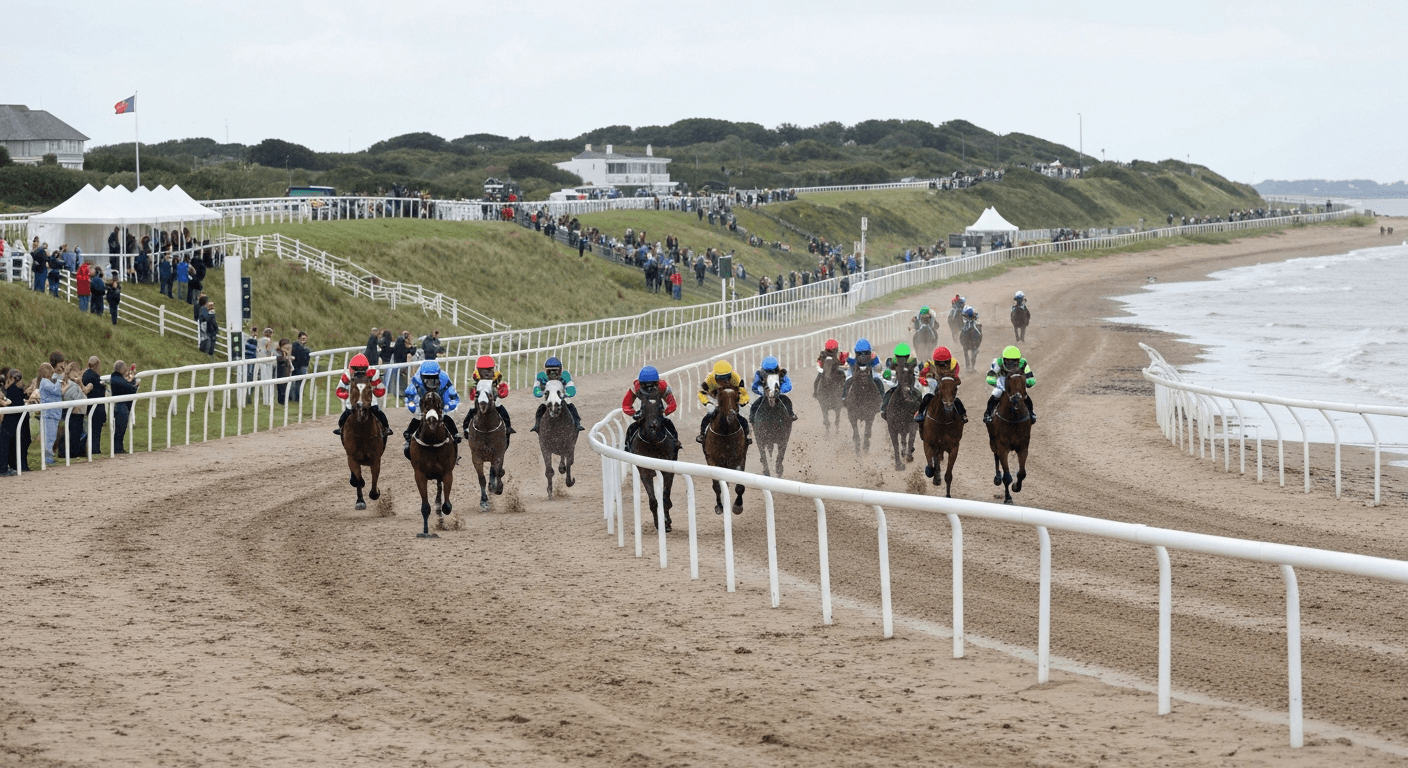
Laytown Racecourse: The Complete Guide
Laytown Racecourse guide: Europe's only beach meeting under Rules of Racing, on the Co. Meath strand each September, plus tickets, travel and how to visit.
Read more
The Laytown Strand Races: The Complete Guide
The Laytown Strand Races, the only racing under Rules run on a beach, staged one day each September on the Co. Meath sand with race times set by the tide.
Read more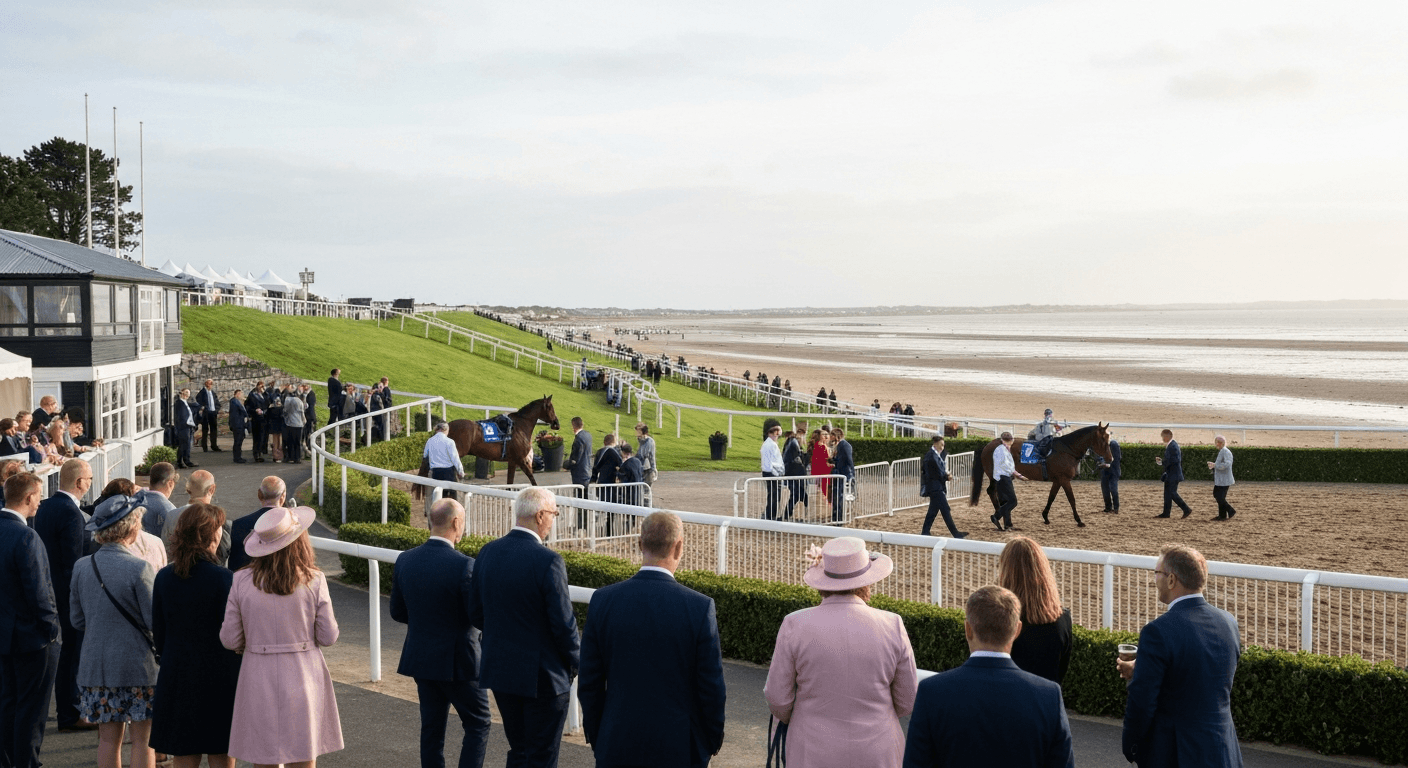
Visiting the Laytown Strand Races: What to Expect
Planning a day at the Laytown Strand Races: how to get there, what the beach meeting is actually like, tickets, what to bring and answers to common questions.
Read moreGamble Responsibly
Gambling should be entertaining and not seen as a way to make money. Never bet more than you can afford to lose. If you or someone you know has a gambling problem, help and support is available.