
Founder & Editor · Last reviewed 2026-07-08
Introduction
Leopardstown Racecourse is Dublin's only racecourse, and it is unlike any other track in Ireland. Set at Foxrock in Dublin 18, roughly 8 km (about five to six miles) south of the city centre at the foot of the Dublin Mountains, it is the only Irish course to stage both Group 1 Flat racing and Grade 1 National Hunt (jumps) racing. That dual-code standing is the thread running through everything else in this guide, from the shape of the track to the festivals that fill the calendar.
It is a turf-only, left-handed oval, and there is no all-weather strip here (Ireland's synthetic racing is at Dundalk). The going rarely reaches extremes: good natural drainage and a modern watering system make Leopardstown one of the driest tracks in the country, though heavy rain can still force change, as it did at the 2026 Dublin Racing Festival. Across a typical year the course holds 23 meetings, split into 8 National Hunt and 15 Flat fixtures per the racecourse's own figures, a rhythm that carries winter jumps racing into spring and summer Flat cards.
Top Flat and top jumps under one roof
Most great racecourses specialise. Leopardstown does not. On the Flat it stages the Group 1 Irish Champion Stakes (1m2f), first run in 1976, a race whose roll of honour includes Sea The Stars, Giant's Causeway, Golden Horn and, in 2025, Delacroix. Over jumps it stages a deep programme of Grade 1 chases and hurdles, headed by the Irish Gold Cup, the Savills Chase and the Irish Champion Hurdle. From 2026 the course carries three Flat Group 1 races (the Champion Stakes, the Matron Stakes and an upgraded Golden Fleece/Juvenile Stakes) alongside its jumps Grade 1 roster. You can read the full picture in the races and the standout performers in legends.
Built in 1888, modelled on Sandown Park
Leopardstown was built by Captain George Quin and completed in 1888. Quin, associated with the Irish Turf Club, formed the Leopardstown Race Company and bought around 200 acres at Foxrock during an economic slump, then modelled the course closely on Sandown Park in England. The chief difference is handedness: Leopardstown runs left-handed (anti-clockwise) where Sandown runs right-handed. More than 5,000 people are reported to have attended the grand opening, though early attendance figures vary and are treated with caution. The name has nothing to do with leopards; it derives from the Irish Baile na Lobhar, "town of the lepers", reflecting the area's medieval use as a leper colony. Horse Racing Ireland's predecessor body acquired the course in 1967, and it has been run within the HRI group ever since. The fuller story is told in history.
The venue has been reshaped by a redevelopment programme running to about €20 million across the mid-2010s, which added a new Pavilion, saddling area, weigh-room and second entrance. There is no published official maximum capacity; officials targeted a comfortable single-day figure of around 20,000 during that work, so any headline capacity should be read as an ESTIMATE (roughly 20,000 comfortable) rather than a confirmed limit. See capacity and venue hire for detail.
What this guide covers
Use the links below to jump to any section.
Bet on Leopardstown Racecourse
Place your bets on Leopardstown Racecourse races with a trusted bookmaker.

Promo code BETFRED50. New customers only. Register, deposit with a Debit Card, and place a first bet of £10+ at Evens (2.0)+ on Sports, to be settled within 7 days, to get £30 in Sports Free Bets and £20 in Bet Builder Free Bets within 24 hours of settlement. 7-day expiry. Eligibility & payment exclusions apply. Full T&Cs apply. Take Time to Think. BeGambleAware.org. 18+. Full T&Cs.

Promo code R30. New UK customers only, 18+. Register, deposit £10 or more, then place a £10 single cash bet at odds of 1/2 (1.5) or greater on any sports market (excluding Virtuals). Once the qualifying bet settles you get £30 in Free Bets (3 x £10) — the qualifying bet can win or lose. Free Bets are valid on any sports market excluding Virtuals, expire in 7 days, are non-withdrawable and must be used in full. Excluded deposit methods apply (including PayPal, Apple Pay, Skrill and NETELLER). Named bets such as Lucky 15 do not qualify. If you cash out the qualifying bet, or it is voided, you are no longer eligible for the offer. Ends 31.12.26. Full T&Cs apply. Please gamble responsibly. BeGambleAware.org. 18+. Full T&Cs.

Promo code BET40GET20. New UK customers, 18+. Register with the code and place a first bet of £40 or more at Evens (2.0) or greater. Receive 2 × £10 free bets: the first credited automatically once the qualifying bet settles, the second 24 hours later. Free bets must be placed at minimum odds of 4/1 (5.0), expire 24 hours after credit, and the free-bet stake is not returned with winnings. Debit card deposits only. Take Time to Think. BeGambleAware.org. 18+. T&Cs apply. Full T&Cs.

50% of your first-day net losses refunded as a free bet, capped at £25. New UK customers aged 18+ only. To qualify, deposit and place a first bet of £10 or more on any sport at minimum odds of evens (2.00), then place at least two further bets on different events, each worth at least 50% of your largest bet, all at evens (2.00) or greater. Losses are counted from your first settled bet until 23:59 the same day. Place a qualifying £10+ bet and you are guaranteed at least a £5 free bet. Bets placed at SP, void bets, cashed-out bets and bets struck with free bets do not count towards the offer. The free bet is credited the day after your qualifying bets settle and must be used within 7 days, after which it expires. It can be used at odds from 1/4 (1.25) up to 250/1 on singles and straight accumulators, but not on Trixie, Patent or Yankee style multiples. Free-bet stake is not returned with winnings. One offer per person, household, address, IP address and device. E-wallet deposits may not qualify, so check the cashier before depositing. Customers registered with GAMSTOP cannot claim. KYC identity verification must be completed before the free bet is credited. Take Time to Think. BeGambleAware.org. 18+. T&Cs apply. Full T&Cs.

New customers, 18+. Choose the sports bonus at sign-up, make a first deposit and receive a 100% bonus up to £50 in your Sports Bonus balance. To convert the bonus to cash, wager it 10x within 30 days. Single bets below Evens (2.00) do not qualify; accumulators do not qualify if any selection is below 1/2 (1.50). Virtual Sports, voided, cancelled, drawn, cashed-out and free-bet wagers do not count towards wagering. Only the first settled bet per event counts. Withdrawing before the wagering requirement is met forfeits the bonus balance including bonus winnings. Real-money funds are used before bonus funds. Deposits via Skrill or Neteller are not eligible. Not valid in conjunction with other promotions. Odds, bet and payment limits apply. 10bet general and promotion T&Cs apply. BeGambleAware.org. 18+. Full T&Cs.

New customers in Great Britain and Republic of Ireland, 18+. Place a £10 fixed-odds qualifying bet at minimum odds of 1/2 (1.50) — single or each-way (only the win part counts), pre-event or in-play, not cashed out early, within 28 days of opening the account. Receive up to £60 in bonuses credited over three days: 3 × £10 fixed-odds free bets (the first on settlement, then 24 and 48 hours later) plus 3 × £5 Total Goals FOOTBALL spread bets, 3 × £5 racing Winning Favourites spread bets and a £1 racing Race Index spread bet (the spread bets need a full spread-betting account). Free-bet stakes not returned with winnings; free bets valid 28 days from issue. IMPORTANT: the £5 credits are SPREAD bets — sports spread betting carries the risk that losses can exceed your stake. Sports spread-betting customers do not have Financial Ombudsman or FSCS recourse. Take Time to Think. BeGambleAware.org. 18+. T&Cs apply. Full T&Cs.

Promo code WELCOME15, entered under My Bonuses after registering. New UK customers, 18+. Place a first qualifying bet of at least £10 from your cash balance at odds of evens (2.0) or greater within 7 days of opening the account. Once the qualifying bet fully settles you receive £15 in free bets, credited as 3 x £5 tokens with set uses: one £5 accumulator free bet (minimum 4 legs, each leg at 2/5 or bigger), one £5 sports free bet (any market at evens or bigger) and one £5 Sub Cover free bet (selected football player markets at evens or bigger). Free-bet stakes are not returned with winnings. Free bets expire 7 days after they are credited. Void, cashed-out and partially cashed-out bets do not qualify. One offer per customer. Confirm the current terms on BetGoodwin's own welcome-offer page before claiming. Take Time to Think. BeGambleAware.org. 18+. T&Cs apply. Full T&Cs.

New UK customers, 18+. Minimum deposit £10. Place a £10 qualifying single at minimum odds of 1/2 (1.50), settled within 14 days. Receive £30 in free bets (stake not returned), split £20 for sportsbook use (2 x £10) and £10 for Bet Builder only (2 x £5); Bet Builder does not cover horse racing. Free bets must be accepted within 7 days and expire 7 days after acceptance. No promo code required. Best Odds Guaranteed on UK & Irish racing, subject to having staked over £25 in the previous seven days. Operated by LiveScore Betting and Gaming (Gibraltar) Ltd, UKGC 56859. Confirm the current terms on LiveScore Bet's own promotions page before claiming. Take Time to Think. BeGambleAware.org. 18+. T&Cs apply. Full T&Cs.
18+. BeGambleAware.org
The Track
The Track
Leopardstown is a wide, left-handed (anti-clockwise) turf oval, broadly oval to rectangular in shape, with long straights and sweeping, easy bends. It was built by Captain George Quin and modelled closely on Sandown Park in England, which it resembles in almost every respect except handedness: Sandown races right-handed, Leopardstown left. The surface is turf only. There is no all-weather strip here, so the ground is always grass, helped by a modern watering system and good natural drainage that keep extremes of going comparatively rare. Leopardstown is regarded as one of the driest tracks in Ireland.
Circuit length: what the sources say
Most authorities describe the circuit as about a mile and three-quarters, roughly 14 furlongs. At The Races calls it "a wide, left-handed oval track of around a mile and three quarters in extent," and irishracing.com gives the figure as 1 mile 6 furlongs. That is the consensus this guide follows. It is worth being straight about the detail, though: one Flat-focused guide (BettingSites.co) instead describes a "1m4f circuit," and the precise official measurement could not be confirmed during research. So treat "about 1m6f" as the widely-cited, reported figure rather than a certified, surveyed distance. The Flat course stages races from a minimum of 6 furlongs up to 2 miles.
The shape of the test
The track is largely level, but it is stiffer than its reputation suggests. There is a long, gradual uphill rise all the way up the home straight from around the final bend, and the run-in itself is about three furlongs with a slight uphill pull. There is a gentle descent from roughly the 10-furlong pole to the 8-furlong pole on the round course, then the climb to the line. At The Races puts it well, describing Leopardstown as "a stiffer track than most people give it credit for... deceptively stiff all the way up the straight." The pace often quickens a long way from home, which turns that closing rise into a genuine stamina test.
That shape suits long-striding, galloping types that stay every yard. Leopardstown also runs an inner and an outer configuration. On the Flat, the outer track has an even longer straight than the inner, while the home straight after the final bend is short, about three furlongs. Over jumps, the chase course (the outer) is regarded as easier and fairer than the inner hurdles course, which is sharper and tends to favour handier, prominently-ridden horses. If you are reading a race here, knowing which course it is run on is much of the work.
Fences and hurdles per circuit
The chase course carries 10 fences per circuit, including an open ditch. Three fences in the back straight are set close together and can catch out less accomplished chasers. The inner hurdles course has 7 flights per circuit, one of them a "cross hurdle" jumped before the home turn, which leaves just two hurdles in the final five furlongs. Individual feature races run to their own obstacle counts: the Paddy Power Irish Gold Cup (about 3 miles) is run over 17 fences, and the Goffs Irish Arkle Novice Chase (about 2m1f) over 11 fences.
Going
Because of the excellent natural drainage and modern watering, Leopardstown rarely serves up going extremes. The National Hunt season runs roughly from December to March, when festival ground is typically soft to yielding; the Flat season runs roughly April to October, with the spring Classic trials, summer Thursday-evening Group cards and the September Champions Festival usually run on good to yielding. That said, the track is not immune to weather. Heavy rain disrupted the 2026 Dublin Racing Festival, forcing the abandonment and rescheduling of the Saturday card, so "one of the driest in Ireland" is a tendency, not a guarantee.
Draw and pace
The draw bias on the Flat is minimal overall. There is no 5-furlong racing here, the minimum trip being 6 furlongs, and a low draw helps in the 6-furlong sprints because the home bend arrives quickly after the start. Over 7 furlongs and beyond that edge largely disappears: Geegeez data on handicaps over 7f since 2009 split almost evenly across low, middle and high draws. One caveat is that some valuable autumn handicaps, such as the 1m5f Petingo Handicap and the 7f Autumn Handicap on Champions Festival day, have shown a high, double-figure draw advantage in recent renewals.
Running style tends to matter more than the draw. Front-runners and prominent racers do well across both codes, and held-up horses can struggle. Per Geegeez, around 57.8% of chase winners since 2009 came from a front-running or prominent position, with the sharper hurdle course higher still, rising to about 73% in non-handicap hurdles with 8 or more runners (101 of 137 races). The front-running bias is more pronounced on soft to heavy ground. For how these tendencies feed into reading a race here, see Form and betting; for a visual sense of the layout described above, see the Course map. None of these strike rates imply that any betting approach is profitable.
| Feature | Detail (as reported) |
|---|---|
| Handedness | Left-handed (anti-clockwise) |
| Shape | Wide oval to broadly rectangular, galloping |
| Surface | Turf only (no all-weather) |
| Circuit length | About 1m6f per consensus (irishracing.com, At The Races); one guide says 1m4f; exact official figure unconfirmed |
| Model | Built by Captain George Quin, modelled on Sandown Park |
| Flat distances | 6 furlongs to 2 miles |
| Run-in | About 3 furlongs, gradual uphill rise |
| Chase fences | 10 per circuit (includes an open ditch) |
| Hurdle flights | 7 per circuit (one a "cross hurdle") |
| Irish Gold Cup | About 3m, 17 fences |
| Irish Arkle | About 2m1f, 11 fences |
| Draw (Flat) | Minimal overall; low helps in 6f sprints; near-even over 7f and up |
| Pace | Front-runners and prominent racers favoured; held-up horses struggle |
| Going | Rarely extreme (one of Ireland's driest); winter soft to yielding, summer good to yielding |
The Course Map
Course map: where everything sits
Leopardstown is laid out as a wide, left-handed turf oval, broadly oval to rectangular in shape, with the grandstand, parade ring and finish grouped together on one side and the sweeping galloping circuit wrapping away from them. Captain George Quin modelled the whole plan closely on Sandown Park in England, the chief difference being that Leopardstown runs left-handed (anti-clockwise) where Sandown turns right. If you know Sandown, the geography here will feel familiar in mirror image.
The winning post sits at the head of the home straight, in front of the main stands. That straight is short, around three furlongs after the final bend, and it climbs: the track is largely flat but rises gradually and stiffly from about the two-furlong pole all the way to the line. For a full walk of the running rail, the bends, the inner and outer courses and the fence and hurdle placings, see the track.
The stands sit along the home straight so that racegoers look down onto the finish and the run-in. The Grandstand building carries three floors of bars and restaurants, with the Premium Level (reserved seating, exclusive bars and the Circle Lounge) on the third floor. The major 2016 to 2017 redevelopment, a roughly €12 million phase within an overall project of about €20 million, reshaped this whole core of the venue. It added a new saddling area beside the parade ring, a new weigh-room building, a new administration building, a new south (second) entrance building, and the permanent marquee-style Pavilion set between the parade ring and the main entrance. That Pavilion, which houses hospitality such as Molly Malones and a viewing lawn overlooking the final bend, now anchors the walk in from the gates.
The parade ring and the new saddling area sit behind the stands, so horses are led from the paddock out towards the track, with the enclosures and the finish beyond. The 1888 Restaurant, on the second floor, overlooks the parade ring and the track. For how the enclosures, lawns and viewing areas are arranged and priced, see enclosures and stands.
The site holds more than the racing surface. An 18-hole parkland golf course, the Leopardstown Golf Centre, sits inside the track and is playable on non-race days. On-site facilities also include the Leopardstown Pavilion, restaurants and bars, and a fitness centre, and the summer "Bulmers Live at Leopardstown" concert series uses the venue.
No official published figure sets a precise spectator capacity. During the redevelopment era officials targeted a comfortable single-day figure of around 20,000 (ESTIMATE, an officials' target rather than a confirmed maximum), up from roughly 18,000 before the works.
The Races
The Races
Leopardstown is Ireland's premier dual-purpose racecourse and the only Irish track to stage both Group 1 Flat and Grade 1 jumps racing. That double billing is the heart of its identity: a September Flat festival built around a world-class middle-distance Group 1, and a winter jumps programme so dense with championship prizes that the whole Irish National Hunt season seems to funnel through Foxrock. The official marketing figure is 13 National Hunt Grade 1 races and, from 2026, three Flat Group 1s, spread across 23 meetings a year. The exact jumps Grade 1 count fluctuates as Horse Racing Ireland reshuffles the programme each season, but the marquee races below are the fixtures that define the place.
Flat Group 1s
The Royal Bahrain Irish Champion Stakes is the jewel: a Group 1 over 1m2f (2,012m) for three-year-olds and up, run on Day 1 of the September Irish Champions Festival and worth 1,250,000 euro in 2025. It began in 1976 as the Joe McGrath Memorial Stakes, spent 1984 to 1990 at Phoenix Park during redevelopment, and returned to Leopardstown under its present name in 1991. Since 2009 it has been a Breeders' Cup Challenge race, so the winner earns an automatic invitation to the Breeders' Cup Turf. Aidan O'Brien is the record trainer with 13 wins; Michael Kinane the record jockey with seven.
The Coolmore America 'Justify' Matron Stakes is a Group 1 over a mile for fillies and mares aged three and up, also on Champions Festival day. It moved from the Curragh in 2002, rose to Group 1 in 2004, and joined Irish Champions Weekend in 2014. No filly or mare has ever won it more than once. From 2026 Leopardstown gains a third Flat Group 1: the Golden Fleece / Juvenile Stakes, upgraded by the European Pattern Committee (confirmed by HRI on 24 February 2025) with its trip extended from eight furlongs to nine.
Jumps Grade 1s
The winter programme splits between the two-day Dublin Racing Festival (late January or early February) and the four-day Christmas Festival (26 to 29 December). The Dublin Racing Festival crowns the season with eight Grade 1s across the weekend. The Paddy Power Irish Gold Cup (Grade 1 chase, about 3m, 17 fences) is a key Cheltenham Gold Cup trial, first run in 1987 as the Vincent O'Brien Irish Gold Cup. The Chanelle Pharma Irish Champion Hurdle (Grade 1, about 2m), established in 1950, is the Irish equivalent of Cheltenham's Champion Hurdle. Alongside them sit the Ladbrokes Dublin Chase (about 2m1f), the Goffs Irish Arkle Novice Chase (about 2m1f, first run in 1956 and later named for Arkle, who won it in 1963), and a cluster of novice Grade 1s: the Nathaniel Lacy Novice Hurdle (about 2m6f), the Spring Juvenile Hurdle (2m), the Tattersalls Ireland Novice Hurdle (about 2m), and the Ladbrokes / Dr P.J. Moriarty Novice Chase (about 2m5f).
The Christmas Festival brings a further seven Grade 1s. The Savills Chase (3m) on 28 December is a staying-chase championship dating to 1986. It shares that day with the Jack De Bromhead Christmas Hurdle, a staying hurdle of 2m7f80y (not the shorter trip sometimes quoted). The Matheson Hurdle (2m) closes the festival on 29 December and honours Istabraq, who won it four times. Day 2 offers the Paddy's Rewards Club Chase (about 2m1f) and the Paddy Power Future Champions Novice Hurdle (2m), and St Stephen's Day stages the Racing Post Novice Chase (about 2m1f).
One trainer looms over all of it. Willie Mullins holds the record in the Irish Gold Cup (13 wins), the Irish Champion Hurdle (nine, the most in its history), the Irish Arkle (11), the Dublin Chase (eight) and the Matheson Hurdle (11). Gordon Elliott is his chief rival, particularly at Christmas. The stiff, galloping nature of the track, explained in The Track, rewards the strong stayers these staying chases and hurdles are built to find.
| Race | Code / grade | Distance | Meeting | Record trainer |
|---|---|---|---|---|
| Irish Champion Stakes | Flat Group 1 | 1m2f | Irish Champions Festival (Sep) | Aidan O'Brien (13) |
| Matron Stakes | Flat Group 1 | 1m | Irish Champions Festival (Sep) | n/a |
| Golden Fleece / Juvenile Stakes | Flat Group 1 (from 2026) | 9f | Irish Champions Festival (Sep) | n/a |
| Irish Gold Cup | NH Grade 1 chase | about 3m | Dublin Racing Festival (Feb) | Willie Mullins (13) |
| Irish Champion Hurdle | NH Grade 1 hurdle | about 2m | Dublin Racing Festival (Feb) | Willie Mullins (9) |
| Irish Arkle Novice Chase | NH Grade 1 chase | about 2m1f | Dublin Racing Festival (Feb) | Willie Mullins (11) |
| Savills Chase | NH Grade 1 chase | 3m | Christmas Festival (28 Dec) | n/a |
| Matheson Hurdle | NH Grade 1 hurdle | 2m | Christmas Festival (29 Dec) | Willie Mullins (11) |
Recent winners of the marquee races
The three flagship jumps prizes and the flagship Flat prize have been shared, in recent seasons, between a handful of stables. The table below records the winners the dossier confirms; where a horse won a race in consecutive years it is shown for each renewal.
| Year | Irish Champion Stakes | Irish Gold Cup | Irish Champion Hurdle | Savills Chase |
|---|---|---|---|---|
| 2026 | n/a | Fact To File | n/a | n/a |
| 2025 | Delacroix | Galopin Des Champs | State Man | Affordale Fury |
| 2024 | Economics | Galopin Des Champs | State Man | Galopin Des Champs |
| 2023 | Auguste Rodin | Galopin Des Champs | State Man | Galopin Des Champs |
| 2022 | Luxembourg | Conflated | Honeysuckle | Conflated |
| 2021 | St Mark's Basilica | Kemboy | Honeysuckle | Galvin |
| 2020 | Magical | Delta Work | Honeysuckle | A Plus Tard |
| 2019 | Magical | n/a | Apple's Jade | Delta Work |
A word on the betting record, because Leopardstown's Grade 1s are heavily bet. The Irish Champion Stakes has produced 12 winning favourites in its last 20 runnings, and the Irish Champion Hurdle 16 winning favourites in 22. That does not mean favourites are a route to profit. Backing favourites blindly loses money to starting price over time, and the figures here are descriptive history, not a system. The Form and Betting section covers the course's draw and pace angles in detail, and the full rolls of honour, records and dominant connections are set out in Records and Stats.
Records and Stats
Records and stats
Leopardstown is a track where records tend to be measured in wins and crowds rather than in stopwatch times, and there is a straightforward reason for that.
A note on course-record times
Published all-time course-record times by distance are the one statistic Leopardstown does not readily give up. During our research, no authoritative set of standard times or distance-by-distance track records could be verified to an official source. Where genuine standard times exist, they are held by the Irish Horseracing Regulatory Board (IHRB) and Horse Racing Ireland (HRI) rather than published as a public table, so we are not going to invent precision that is not there.
A couple of individual clock readings are on record without being confirmed as official course records. Sea The Stars won the 2009 Irish Champion Stakes over 1m2f in 2:03.90, described at the time as a quick time but never ratified as a track record. Over jumps, Romeo Coolio is reported to have run the fastest recorded time in the 2024 Paddy Power Future Champions Novice Hurdle (2m) at 3:50.90, a figure that comes from tipster data rather than an official course-record statement. Treat both as fast clockings, not benchmarks.
The win record: Famous Name's 13
The most concrete individual record at Leopardstown belongs to Famous Name, who won 13 times at the course. Trained by Dermot Weld and owned by Khalid Abdullah, every one of those wins came when he was sent off at odds of 11/10 or shorter, a run of consistency rather than value. Weld himself has saddled 483 winners at Leopardstown on the Flat, a tally no other Flat trainer approaches.
Leading trainers and jockeys by feature race
The modern honours boards are dominated by two names, Aidan O'Brien on the Flat and Willie Mullins over jumps. The table below sets out the leading trainer and jockey in Leopardstown's signature races, drawn from the roll-of-honour counts in our research.
| Race | Code | Leading trainer | Leading jockey |
|---|---|---|---|
| Irish Champion Stakes | Flat G1 | Aidan O'Brien, 13 wins | Michael Kinane, 7 wins |
| Irish Gold Cup | NH G1 | Willie Mullins, 13 wins | (not isolated) |
| Irish Champion Hurdle | NH G1 | Willie Mullins, 9 wins | Ruby Walsh, 7 wins |
| Ladbrokes Dublin Chase | NH G1 | Willie Mullins, 8 wins | Paul Townend, 4 wins |
| Irish Arkle Novice Chase | NH G1 | Willie Mullins, 11 wins | Townend / Frank Berry, 4 each |
| Matheson (December) Hurdle | NH G1 | Willie Mullins, 11 wins | (not isolated) |
Mullins's grip is such that he won all eight Grade 1s at the 2024 Dublin Racing Festival and six of eight in 2025. On the Flat, O'Brien holds the best strike rate among high-volume trainers at roughly 19.4 per cent over a decade, with Weld next at about 18.2 per cent. Among jockeys, Paul Townend is the most successful active jumps rider at the track, with more than 55 course wins cited. For the full roll of honour race by race, see The races; for the horses behind these numbers, see Legends.
Attendance records
On the crowd side the figures are firmer. The Saturday of the 2024 Dublin Racing Festival drew a record modern single-day attendance of 20,017. The four-day Christmas Festival is the busiest week of Leopardstown's year, and its 2025 aggregate of 67,202 was a record, up 7 per cent on the 62,748 who attended in 2024. The Dublin Racing Festival's biggest recent aggregate was 36,020 across the two days in 2024.
Capacity
There is no confirmed official maximum capacity. Following the 2016 to 2017 redevelopment, officials targeted a comfortable single-day capacity of around 20,000, up about 2,000 on the previous figure. Our best labelled ESTIMATE, therefore, is a comfortable working capacity of roughly 20,000, with the 20,017 record crowd of 2024 showing that ceiling being met in practice. Anything quoted more precisely than that is not something the sources support.
History
History
Leopardstown owes its existence to one man's imported blueprint. The course was built by Captain George Quin and completed in 1888, modelled closely on Sandown Park in England. Quin, previously associated with the Irish Turf Club (one account describes him as a bookkeeper for the body), founded the Leopardstown Race Company and bought roughly 200 acres of land at Foxrock during an economic slump. He copied Sandown almost detail for detail, the chief difference being handedness: Leopardstown runs left-handed where Sandown is right-handed. That English template still shapes the wide, galloping oval described in the track today.
The name has nothing to do with big cats. It derives from the Irish Baile na Lobhar, "town of the lepers", a nod to the area's medieval use as a leper colony rather than any menagerie.
The opening was, by the standards of the day, a success. According to britishracecourses.org, the track was inaugurated within six months of the project starting, "with more than 5,000 reportedly attending" the grand opening. Precise figures for that first day are unreliable, with secondary sources scattering anywhere between about 5,000 and 50,000, so the "more than 5,000" line is the safest anchor. A claim sometimes repeated in betting guides, that Leopardstown staged the first Sunday race meeting in Britain or Ireland, could not be traced to a primary source and is best treated with caution rather than stated as fact.
Royal notice came early. King Edward VII and Queen Alexandra attended a meeting in 1907. From the early 1900s the Clarke family, notably Harold and Fred Clarke, ran the course and introduced both jump and Flat racing, giving Leopardstown the dual-code character it still carries. The Second World War left its own curious footnote: in 1941 RAF pilot Hugh Verity force-landed on the racecourse, was briefly interned, and then escaped back to England.
The mid-century decades added the races that now define the place. The inaugural Irish Champion Hurdle was run in 1950 and won by Hatton's Grace, trained by Vincent O'Brien. In 1956 came the first running of the race now known as the Arkle Novice Chase, then the Milltown Novice Chase, and in 1963 the great Arkle himself won it, cementing a name that would later honour him.
The single most important structural change arrived in 1967, when the Racing Board, the Horse Racing Board of Ireland and predecessor to today's Horse Racing Ireland, acquired the course. The Clarkes, fearing that urban encroachment would eventually swallow the Foxrock land, sold for preservation, reportedly for £300,000. (One lower-quality source dates the sale to 1969, but 1967 is the consensus year across the research and is used here; the £300,000 price is separately corroborated.) After the sale the track was re-laid, re-drained, widened and given a new stand, laying the groundwork for its modern role.
Fresh fixtures followed the change of ownership. In 1971 the Leopardstown Derby Trial was created, originally the Nijinsky Stakes, and the Irish Sweeps Hurdle transferred in from Fairyhouse. The Irish Champion Stakes, now the Flat feature, was first run in 1976 as the Joe McGrath Memorial Stakes. From 1984 to 1990 that race was temporarily exiled to Phoenix Park as the Phoenix Champion Stakes while Leopardstown was redeveloped; after Phoenix Park closed in 1990, the Champion Stakes and several other races moved to Leopardstown from 1991. The Irish Gold Cup, the winter centrepiece, began in 1987 as the Vincent O'Brien Irish Gold Cup.
The twenty-first century has been an era of phased rebuilding rather than reinvention. Phase 1, costing about €3 million, refreshed bars, restaurants and racegoer facilities in 2013. In 2014 Leopardstown began hosting the Saturday of what became the Irish Champions Festival, sharing the weekend with the Curragh. Phase 2, completed for the 2015 Christmas Festival, delivered a hospitality makeover on Grandstand Level 2 and an enlarged Champions Bar. The major works came in 2016 to 2017: a roughly €12 million phase within an overall redevelopment of about €20 million, supported by a €4.7 million grant from the HRI Capital Development fund. This added a new restaurant, bar and betting areas, a new saddling area beside the parade ring, new weigh-room and administration buildings, a second entrance and the permanent marquee-style Pavilion. The stated aim was to lift comfortable daily capacity toward a target of around 20,000, though no official published maximum was confirmed, so that figure is best read as a redevelopment-era estimate rather than a hard number (see capacity and venue hire).
The rebuilt course was ready for its signature invention. In 2018 the inaugural Dublin Racing Festival combined the previously separate Irish Champion Hurdle and Irish Gold Cup cards into one two-day, eight-Grade-1 meeting. Looking ahead, a 2020s masterplan drawn up with the Land Development Agency and HRI proposes transferring about 17 acres for affordable housing, a school and a new Luas stop, with the racecourse remaining fully operational throughout.
Fittingly for a course this old, Leopardstown keeps its own Hall of Fame, honouring figures and horses including Vincent O'Brien, Tom Dreaper, Pat Taaffe, Pat Eddery, Arkle, Dawn Run, Levmoss and Nijinsky.
The Legends
Legendary horses
Leopardstown's honour boards read like a roll-call of the greats, and the horses tied most closely to the track fall into two camps: the Flat champions drawn to the Irish Champion Stakes in September, and the jumping stars who made the winter festivals their own.
On the Flat, no name resonates more than Sea The Stars. In 2009 he took the Irish Champion Stakes over 1m2f under Michael Kinane for trainer John Oxx, beating Fame And Glory by two and a half lengths, with Mastercraftsman third, in a time of 2:03.90. That run came in the middle of an unbeaten three-year-old campaign that also delivered the 2,000 Guineas, the Epsom Derby and the Prix de l'Arc de Triomphe, a sequence of Group 1 victories rarely matched in the modern era. His Leopardstown link ran deeper than that one afternoon: he had won a maiden at the course as a two-year-old the previous August. (The 2:03.90 was described as a quick time, but it is not confirmed as an official course record.)
The Irish Champion Stakes has thrown up its own dynasties. Dylan Thomas became the first horse to win it in consecutive years, taking the 2006 and 2007 runnings for Aidan O'Brien, and Magical matched that feat in 2019 and 2020, again for O'Brien. Around them the race has drawn a procession of global champions including Giant's Causeway, High Chaparral, Daylami, Fantastic Light, Golden Horn, Roaring Lion and Auguste Rodin. For more on how the race sits within the September programme, see the-races and festivals.
Over jumps, Istabraq is the horse most bound up with Leopardstown. Trained by Aidan O'Brien, owned by JP McManus and ridden by Charlie Swan, he was never beaten in ten races at the track over hurdles, winning multiple Irish Champion Hurdles across the seasons from 1998 and four runnings of the December Festival Hurdle, which was renamed the Istabraq Festival Hurdle in his honour. He went on to win three Cheltenham Champion Hurdles and died aged 32 in 2024. His Irish Champion Hurdle tally at Leopardstown is recorded variously as three or four, so the precise count is left open here.
Hurricane Fly then rewrote the record books, winning a record five consecutive Irish Champion Hurdles from 2011 to 2015 along with four December Hurdles, and going unbeaten in his Grade 1 starts at the course. Trained by Willie Mullins and ridden by Ruby Walsh, he amassed a world-record 22 Grade 1 wins in all and is commemorated with a statue at the track. The Champion Hurdle torch later passed to Honeysuckle, winner of three in a row in 2020, 2021 and 2022 for Henry de Bromhead and Rachael Blackmore, and then to State Man, who took three consecutive runnings in 2023, 2024 and 2025 for Mullins and Paul Townend, adding a run of December Hurdle wins over the same period.
The staying chases have their own royalty. Florida Pearl won a record four Irish Gold Cups, in 1999, 2000, 2001 and 2004, the last of them as a 12-year-old in his final race, and was an early flagbearer for the Mullins stable. More recently Galopin Des Champs dominated, landing the Dr P.J. Moriarty Novice Chase in 2022, three consecutive Irish Gold Cups from 2023 to 2025 and two Savills Chases in 2023 and 2024, all for Mullins and Townend, alongside back-to-back Cheltenham Gold Cups. His aura of invincibility finally slipped when he was beaten in his bid for a third Savills Chase in 2025 and a fourth Irish Gold Cup in 2026, finishing third on both occasions.
Two horses stand apart for their sheer Leopardstown longevity. Famous Name, trained by Dermot Weld for owner Khalid Abdullah, holds the course record of 13 wins, every one of them coming when sent off at odds of 11/10 or shorter, a reflection of how highly he was regarded rather than any guide to backing him at a profit. And Arkle, perhaps the greatest chaser of all, won the 1963 Milltown Novice Chase, the race later renamed the Arkle Novice Chase in his honour.
Beyond the winners' enclosure, Leopardstown's Hall of Fame preserves the wider story, honouring horses such as Dawn Run, Levmoss and Nijinsky alongside the human figures who shaped the course. For the trainers and jockeys behind these names, see records-and-stats.
The Festivals
Festivals
Leopardstown builds its year around three headline meetings, and between them they carry almost all of the course's Group 1 Flat and Grade 1 jumps racing. The winter Christmas Festival is the biggest by aggregate crowd, the Dublin Racing Festival is the sharpest for jumps quality, and the September Irish Champions Festival is Leopardstown's flagship Flat day. For the individual race histories behind these meetings, see the full graded-race roster; for how the track's stiff, galloping shape shapes results, see form and betting.
Dublin Racing Festival (late January to early February)
Created in 2018, the Dublin Racing Festival combined the previously separate Irish Champion Hurdle and Irish Gold Cup cards into one two-day meeting carrying eight Grade 1 races and over 2 million euros in prize money. It is a key Cheltenham trials fixture, and crowds approach 25,000 across the weekend (capped at 18,500 with pre-booking in 2025).
Day 1 (Saturday) is headed by the Paddy Power Irish Gold Cup, a roughly 3-mile Grade 1 chase and a recognised Cheltenham Gold Cup trial, alongside the Goffs Irish Arkle Novice Chase, the Nathaniel Lacy Novice Hurdle and the Spring Juvenile Hurdle, all Grade 1. Day 2 (Sunday) brings the Chanelle Pharma Irish Champion Hurdle, established in 1950 and the Irish equivalent of Cheltenham's Champion Hurdle, plus the Ladbrokes Dublin Chase, the Ladbrokes (Dr P.J. Moriarty) Novice Chase and the Tattersalls Ireland Novice Hurdle.
Recent Irish Gold Cups went to Galopin Des Champs (2023, 2024 and 2025, Willie Mullins and Paul Townend) before Fact To File took the 2026 running for Mullins and Mark Walsh. State Man won three consecutive Irish Champion Hurdles from 2023 to 2025. The 2026 festival was disrupted by heavy rain: the Saturday Grade 1 card, including the Irish Gold Cup, was abandoned and moved to Monday 2 February, with the Sunday card proceeding as planned.
Leopardstown Christmas Festival (26 to 29 December)
The four-day Christmas Festival runs every year from St Stephen's Day (26 December) through to 29 December and draws the biggest crowds of Leopardstown's calendar. It stages seven Grade 1 races across the four days for over 1.4 million euros in prize money, with seven-race cards daily. Aggregate attendance reached 67,202 in 2025, up from 62,748 in 2024.
Day 1 (26 December) features the Grade 1 Racing Post Novice Chase, reinstated to the programme in 2025 after a season out. Day 2 (27 December) offers the Paddy's Rewards Club Chase and the Paddy Power Future Champions Novice Hurdle, both Grade 1, plus the valuable Paddy Power Steeplechase handicap. Day 3 (28 December) is Savills Chase Day, headlined by the Savills Chase, a 3-mile Grade 1 first run in 1986, alongside the Jack De Bromhead Christmas Hurdle, a staying hurdle of 2m7f80y. Day 4 (29 December) is the Matheson (December) Hurdle Day and family day, with under-12s free and the Savills Style Awards.
Galopin Des Champs won the Savills Chase in 2023 and 2024 before Affordale Fury (Noel Meade and Sam Ewing, 7/1) took the 2025 running. On the final day of the 2025 festival, Mullins's mare Lossiemouth landed the December Hurdle, holding off Brighterdaysahead.
Irish Champions Festival (September)
The Irish Champions Festival is a two-day, two-venue event, with Leopardstown staging Day 1 (Saturday 12 September in 2026) and the Curragh Day 2. Now in its 13th year, the weekend carries over 5 million euros in prize money and six Group 1 races. Leopardstown's card is the course's biggest Flat day and a key trial for the Arc, British Champions Day and the Breeders' Cup.
The feature is the Royal Bahrain Irish Champion Stakes, a Group 1 over 1m2f worth 1.25 million euros, first run in 1976 as the Joe McGrath Memorial Stakes. Aidan O'Brien is its record trainer with 13 wins, most recently Delacroix in 2025. Alongside it runs the Coolmore America 'Justify' Matron Stakes, a Group 1 mile for fillies and mares (Fallen Angel won in 2025), the Golden Fleece / Juvenile Stakes (upgraded to Group 1 from 2026 over a new 9-furlong trip), and the Group 2 KPMG Champions Juvenile and Solonaway Stakes.
The three festivals at a glance
| Festival | Dates | Days | Grade/Group 1 races | Signature race |
|---|---|---|---|---|
| Dublin Racing Festival | Late Jan to early Feb | 2 | 8 (jumps) | Paddy Power Irish Gold Cup (G1, ~3m chase) |
| Christmas Festival | 26 to 29 December | 4 | 7 (jumps) | Savills Chase (G1, 3m chase) |
| Irish Champions Festival (Leopardstown Day 1) | Mid-September | 1 | 3 (Flat, from 2026) | Royal Bahrain Irish Champion Stakes (G1, 1m2f) |
All fixture dates and prize funds can change year to year with the HRI programme and sponsorship, so confirm current details on the official site before travelling.
Form and Betting
Form and betting angles
Start with the one number that matters most: over time, the market wins and favourites lose. Across 469 races at Leopardstown between 21 October 2023 and 18 June 2026, backing the favourite at Starting Price returned a level-stakes loss. The favourite won 33.0% of those races, a healthy strike rate, yet still handed back money because the prices on offer did not cover the losers. The measured return sits at roughly minus 16% to Starting Price, but that figure carries a wide confidence interval (about minus 27.6% to minus 2.9%), so the honest reading is not a precise percentage. It is simply this: at Leopardstown, over this sample, favourites lost money. There is no system, selection or tip in this section, only what the record shows.
The table below sets out the course profile these numbers sit inside, drawn from the same 469-race dataset.
Leopardstown by the numbers
| Measure | Value |
|---|---|
| Sample window | 21 Oct 2023 to 18 Jun 2026 |
| Races analysed | 469 (5,323 runners) |
| Favourite strike rate | 33.0% |
| Favourite ROI to SP | negative (favourites lost money; wide CI) |
| Average field size | 11.3 runners (median 10) |
| Race-type mix | 321 Flat, 94 Hurdle, 54 Chase |
| Most common going | Good (32.6% of races) |
Field sizes are competitive, averaging 11.3 runners with a median of 10 and a maximum of 28. Larger fields mean more ways for a short-priced favourite to be beaten, which is part of why the market's edge holds. The going is varied but rarely extreme: Leopardstown is one of the driest tracks in Ireland, and Good ground featured in about a third of races (32.6%), with Yielding, Soft and Heavy each appearing on a meaningful share of days. Extremes are uncommon, though heavy rain can still disrupt fixtures, as it did at the 2026 Dublin Racing Festival. For how the seasons split between Flat and jumps, see the races.
On the draw, the course's own data shows only a modest, mostly harmless effect. Low draws won 10.3% of the time in the sample, middle 9.3% and high 7.6%, so the highest stalls fared slightly worse overall. That fits the wider picture: bias is minimal, with a low draw helping mainly in the 6-furlong sprints because the home bend comes soon after the start, while over 7 furlongs and beyond the advantage largely disappears. A handful of Champions Festival handicaps, notably the 1m5f Petingo Handicap and the 7f Autumn Handicap, have favoured high, double-figure draws in some recent renewals.
Running style has historically mattered more than the draw. Front-runners and prominent racers hold a strong record across both codes: around 57.8% of chase winners since 2009 came from the front or prominent positions, rising to about 73% in non-handicap hurdles with eight or more runners, per Geegeez. The effect is stronger on soft to heavy ground, and held-up horses tend to struggle. The track itself is stiff and galloping, with a deceptively hard uphill run-in of about three furlongs that exposes non-stayers, so proven stamina is a recurring theme. More on the layout is in the track.
Course form is a genuine positive in the staying chases. Irish Gold Cup trends show 12 of the last 12 winners had run at Leopardstown before, and 9 of 12 had won there. Among high-volume handlers, Aidan O'Brien has posted the best Flat strike rate (about 19.4%) and Willie Mullins dominates the jumps fixtures (about 20.3%), but the research is explicit that neither is profitable to follow blindly.
Even the marquee races underline the point. Favourites have a strong record in some, such as 16 of 22 winning favourites in the Irish Champion Hurdle and 12 of the last 20 in the Irish Champion Stakes, yet the Savills Chase endured a poor spell for the market between 2015 and 2022, and 2025 went to 7/1 Affordale Fury. Descriptive strike rates are not a plan. Backing favourites blindly loses money to Starting Price over time, and nothing here implies that betting on any horse, favourite or otherwise, is profitable.
A note on the data: these figures use Starting Price only (there is no Betfair SP for Irish racing), horses are deduped by name, and fallers and pulled-up horses settle as losses. Small per-course samples are noisy, so a confidence interval that crosses zero should be read as no signal.
Please gamble responsibly
Betting should be entertainment, never a way to make money. The figures above show favourites lost money at Leopardstown over the sample, and no angle here changes that. Only ever stake what you can comfortably afford to lose, set limits before you start, and never chase losses. If gambling is causing you or someone you know harm, free confidential support is available from BeGambleAware at begambleaware.org or on the National Gambling Helpline, 0808 8020 133. You must be 18 or over to bet.
Planning a Visit
Visiting Leopardstown
Leopardstown sits at Foxrock, Dublin 18 (Eircode D18 C9V6), roughly 8 km, about five to six miles, south of Dublin city centre at the foot of the Dublin Mountains. It is the only racecourse in the Irish capital, and for a first-time visitor the practical picture is straightforward: it is well served by public transport, admission is affordable by big-track standards, and there is plenty to eat and drink on site. This section pulls together the anchors you will want before a day at the races. For the full detail on each, follow the cross-links below.
Getting there is easy from most directions. By road, take Exit 15 off the M50 and follow the signs, ideally parking in Car Park G, as Junction 14 and the Leopardstown Road are prone to long delays. On-site parking is free but limited, with free shuttle buses running from all car parks on race days. Without a car, the Luas Green Line runs from St Stephen's Green to Sandyford in about 20 to 22 minutes, from where it is a short walk of roughly 10 to 18 minutes, or a complimentary race-day shuttle, to the course. The nearest DART station is Blackrock, which also has a complimentary shuttle on major days, and Aircoach Route 700 links Dublin Airport, about an hour away, to the Foxrock area. Full transport detail is in getting there.
On admission, the two main options are General Admission, which covers the whole enclosure including the lower Grandstand, and Premium Level, which adds a reserved grandstand seat and access to exclusive bars and lounges. Indicative pricing from third-party guides suggests general tickets around €15 to €20 for ordinary fixtures and about €30 for Christmas Festival days, though you should confirm current prices on leopardstown.com. Under-12s are admitted free with a paying adult. See enclosures and stands for the breakdown.
For food and drink, the Grandstand carries three floors of bars and restaurants, with outlets including the premium 1888 Restaurant overlooking the parade ring, the Paddock Food Hall, the Champions Café Bar and the Leopardstown Pavilion. Hospitality packages and private suites are available at the festivals. More is covered in food, bars and hospitality.
The venue describes itself as fully accessible for wheelchair users and disabled racegoers, with most areas reachable by lift and a complimentary carer's ticket offered on request. The dress code is relaxed smart casual at all meetings.
Getting There
Getting there
Leopardstown sits in Foxrock, Dublin 18, roughly 8 km (five to six miles) south of Dublin city centre and about 14 miles, or around an hour, from Dublin Airport. Being the only racecourse in the capital, it is unusually well served by road, tram and bus, and the course lays on free shuttle buses on race days to bridge the last stretch from the nearest public-transport stops.
By road and parking
The simplest approach by car is the M50 orbital motorway. Take Exit 15 (J15) and follow the signs to the racecourse, aiming for Car Park G to sidestep the congestion that builds on the Leopardstown Road. Junction 14 is prone to long delays, so J15 is the better bet on a busy day. There are two car park entrances, one off the Leopardstown Road and one near M50 J15. On-site parking is free, though it is limited, and free shuttle buses run from all car parks to the enclosures on race days.
By Luas (Green Line)
The Luas Green Line runs from St Stephen's Green in the city centre out to Sandyford in roughly 20 to 22 minutes. Sandyford is the racecourse's designated tram stop: from there the course is a short walk, which Leopardstown puts at around 10 to 18 minutes, and a complimentary shuttle bus operates from the stop on race days. The wider area is also served by the Green Line stops at Central Park, Glencairn, The Gallops and Leopardstown Valley, but Sandyford is the one to aim for, as it is the shuttle pick-up point.
By rail, DART and bus
The nearest DART station is Blackrock, from which a complimentary shuttle bus runs on major days. During the Christmas Festival that shuttle operates on every day except Boxing Day, with priority given to Race and Rail ticket-holders, and additional services run from Heuston for the biggest festivals. The 114 bus links Blackrock DART with the racecourse and stops right at the main gate. Beyond the 114, Dublin Bus routes serving the area include the E1 and E2 (via the N11), the S8, the 118 and the 700.
From Dublin Airport
Dublin Airport is about an hour away by road. Aircoach Route 700 runs to and from both airport terminals as a 24-hour service and stops at the Clayton Hotel Leopardstown in Foxrock, which is less than a mile from the track and a practical base if you are travelling in for a festival (see nearby for accommodation).
Practical timing
On the marquee days, the Christmas Festival, the Dublin Racing Festival and the September Irish Champions Festival, arriving early pays off: crowds are large, the car parks fill and the shuttle queues lengthen as the first race approaches. The Christmas Festival gates open around 10am with the first race around noon, so allowing extra travel time is sensible. Whichever way you come, the free shuttles from the car parks and from Sandyford and Blackrock take the strain out of the final leg. For what greets you on arrival, see enclosures and stands.
Tickets and Enclosures
Enclosures and Stands
Leopardstown keeps its admission structure refreshingly simple. Rather than the maze of separate paddock, grandstand and members' enclosures found at some older tracks, the course runs on a broadly two-tier model built around a single General Enclosure and an upgraded Premium Level, with hospitality and restaurant packages sitting above those. The heart of the operation is the multi-storey Grandstand, which houses three floors of bars and restaurants and looks out over the parade ring and the sweeping run to the line.
General Enclosure
The General Enclosure, sold as General Admission, is the standard ticket and the one most racegoers buy. It gives access to the entire enclosure, including the lower Grandstand, and delivers course-wide access, so you can move between the parade ring, the betting hall, the food outlets and the rail without a further ticket. This is the flexible, walk-around option: no reserved seat, but the freedom to find your own spot along the stiff uphill finish, which is one of the best viewing lines on the course (see The Track for why that closing rise matters). For ordinary fixtures, general or grandstand adult tickets sit at roughly EUR 15 to 20 as an indicative, fixture-dependent guide; upper-level seats at those same meetings run to about EUR 30 to 50. All of these figures come from third-party guides rather than the racecourse's own live pricing, so treat them as a rough band and confirm the current rate on leopardstown.com before you book.
Premium Level
Premium Level is the paid step up. Seats sit on the third floor of the Grandstand and come with a reserved stadium-style grandstand seat, so you have a guaranteed vantage point over the track rather than having to stake out a place. The upgrade also brings exclusive bars and lounges, including access to the Circle Lounge, giving a quieter, more comfortable base away from the busiest concourses. On the biggest days this is a popular choice for those who want to be sure of a seat for the feature races. At the two-day Dublin Racing Festival the ticketing narrows to these two headline choices, General Admission and Premium Level, which makes the decision straightforward: walk-around access, or a reserved seat with lounge comfort.
What the different fixtures cost
Prices flex heavily with the fixture, and every figure below is indicative and fixture-dependent. For the Christmas Festival, adult general tickets have been quoted at around EUR 30, with about EUR 20 for students and OAPs and roughly EUR 60 for a top-tier grandstand package. Other fixtures land nearer the EUR 15 to 20 general band with upper-level seats around EUR 30 to 50. Annual membership has been cited at roughly EUR 250 for adults. Tickets are bookable online or on the day and can be printed at home, and under-12s are admitted free when accompanied by a paying adult, which makes the General Enclosure an easy, low-cost family option, especially on the Christmas Festival's family day. Race and Stay packages, which bundle accommodation, breakfast, tickets and transport, have started from about EUR 157 to 177 per guest at the festivals.
Above the standard enclosures sit the hospitality and restaurant packages, from the 1888 Restaurant and the Leopardstown Pavilion to private suites such as the Panoramic Suite, Private Suite and Circle Lounge; those are covered in Food, Bars and Hospitality. The Grandstand itself is served by lifts, with one giving access to the second and third levels and another reaching all floors, so the Premium Level and the upper hospitality areas are reachable without the stairs.
A note on scale: Leopardstown does not publish a firm official maximum capacity across its enclosures. During the redevelopment era officials targeted a comfortable single-day figure of around 20,000, up from roughly 18,000, but that is a stated target rather than a confirmed official maximum, so treat any single capacity number as an ESTIMATE. In practice the record modern crowd of 20,017, set on Dublin Racing Festival Saturday in 2024, gives a real-world sense of how many the enclosures comfortably hold on a peak day.
Food, Drink and Facilities
Food, bars and hospitality
Leopardstown's eating and drinking runs from grab-a-pint racecourse bars to full silver-service dining, most of it stacked across the three floors of the Grandstand and spilling out into the permanent Pavilion by the parade ring. On a busy festival day there is a good spread of options, so it pays to know what sits where before you arrive.
The flagship dining room is the 1888 Restaurant, a premium space on the second floor of the Grandstand that looks out over the parade ring and the track. It anchors the course's fine-dining offer and is a popular hospitality booking on the big days. Newer additions include the Woodruff restaurant, alongside longer-standing rooms such as the Silken Glider Restaurant and the Fillies Café Bar, though a few of these older-listed outlets come from historic facility listings, so it is worth checking the current line-up on the official site before you book a particular room.
For something quicker, the Paddock Food Hall gathers casual food counters under one roof, and the Sports Lounge and the Champions Café Bar (also referred to as the Champions Bar, the enlarged ground-floor bar completed in the 2015 works) handle the between-races crowd. Madigans, a pub-style bar, is a familiar name on the site for a straightforward drink.
The Leopardstown Pavilion is the course's headline event and hospitality space, a permanent marquee-style structure between the parade ring and the main entrance that was added in the major 2016 to 2017 redevelopment. Within it, Molly Malones offers a buffet overlooking the final bend, with its own viewing lawn, which puts you close to the drama of the run-in without leaving your table. The Pavilion is also fully wheelchair accessible, with an accessible toilet and baby-changing facilities.
At the top end, hospitality packages span the 1888 Restaurant, the Pavilion and a set of private suites, including the Panoramic Suite, the Private Suite and the Circle Lounge, the last of which is tied to the Premium Level ticket on the Grandstand's upper floors. These packages typically bundle a reserved space, dining and course views, and sell out early for the festivals, so book ahead rather than chance it on the day. For how these tie into ticket tiers and enclosure access, see enclosures and stands; for larger private bookings and non-raceday events, see capacity and venue hire.
During festivals there is live music daily in the festival marquee, and the summer "Bulmers Live at Leopardstown" concert series brings acts to the venue outside the core racing calendar. Note that some older on-site facilities recorded in secondary listings, such as a former nightclub, may no longer operate, so treat any long-standing published list as a guide rather than a guarantee.
What to Wear
What to wear
Leopardstown keeps things refreshingly relaxed. The dress code is smart casual at all meetings, with no strict requirements, so you will not be turned away for wearing sensible, presentable clothes. That easy-going policy is one of the course's quiet appeals: you can dress up if you want to, or keep it comfortable and practical, and either way you will fit right in. There is no formal enclosure with a stricter rule to catch you out, so the guidance below is about comfort and occasion rather than compliance.
The big difference at Leopardstown is the calendar. Two of its three signature festivals fall in the depths of the Irish winter, so plan for the weather rather than a rulebook. The four-day Christmas Festival runs from 26 to 29 December, and the Dublin Racing Festival lands on the late-January to early-February bank holiday weekend. Both are open-air affairs on a turf track at the foot of the Dublin Mountains, and both can be cold, wet and windy: the 2026 Dublin Racing Festival was so badly hit by rain that the Saturday card had to be abandoned and moved to the Monday. Warm layers, a waterproof coat and sturdy, waterproof footwear will serve you far better than anything purely for show. Winter going here is often soft to yielding, so leave the delicate shoes at home.
September's Irish Champions Festival is the day to dress up. As Leopardstown's biggest Flat fixture, headed by the Group 1 Irish Champion Stakes, it draws the smartest crowd of the year, and dressing up is actively encouraged on Ladies' Days. Think stylish rather than formal: there is still no morning-dress requirement, just an occasion that rewards a bit of effort.
Families are well catered for too. The final day of the Christmas Festival is a family day with face-painting and games, the Champions Festival runs a Moyglare Kids Zone, and under-12s go free with a paying adult, so dress the children for comfort and the weather. For where those crowds gather, see Enclosures and stands; for the bars and restaurants once you are inside, see Food, bars and hospitality.
Capacity and Venue Hire
Capacity and venue hire
Leopardstown has never published a single, official maximum spectator capacity, so any headline "capacity" figure you see quoted should be treated with care. What the racecourse has confirmed is a target, set during its major 2016 to 2017 redevelopment, of a comfortable single-day capacity of around 20,000, an increase of roughly 2,000 on the previous figure of about 18,000 (per The Irish Times). Earlier, in 2018, the track cited a "full house" working capacity of about 16,000, and by 2019 to 2020 capacity was being described as 18,000 rising to 20,000 once the redevelopment for Irish Champions Weekend was complete. The busiest days on record sit right at that ceiling: the Saturday of the 2024 Dublin Racing Festival drew a record 20,017, and a crowd of around 20,000 attended Champion Stakes day back in 2001. For the 2025 Dublin Racing Festival the course chose to cap attendance at 18,500, with all tickets pre-booked, which gives a useful sense of the comfortable managed level rather than an absolute limit.
Because no official maximum exists, the figure below is a clearly-labelled estimate derived from the confirmed comfortable target and the record attendances above, not an official capacity.
| Measure | Figure | Status |
|---|---|---|
| Comfortable single-day target | ~20,000 | Confirmed (officials' redevelopment target, Irish Times) |
| Record single-day attendance | 20,017 (2024 DRF Saturday) | Confirmed |
| 2025 DRF managed cap | 18,500 (all pre-booked) | Confirmed |
| Prior "full house" working figure | ~16,000 (2018) | Confirmed |
| Estimated practical maximum | ~20,000 to 22,000 | ESTIMATE, not an official figure |
Festival-scale demand shows how those numbers stack up across multiple days. The four-day Christmas Festival regularly exceeds 60,000 in aggregate (67,202 in 2025; 62,748 in 2024), with the busiest single day, 27 December, drawing 18,000-plus. The Dublin Racing Festival totalled 36,020 across its two days in 2024. See the festivals section for the full day-by-day breakdown.
For venue hire and functions, the redevelopment left Leopardstown with a strong roster of private spaces used for both raceday hospitality and non-raceday events. These include the Panoramic Suite, the Private Suite and the Circle Lounge on the upper Grandstand levels, the second-floor 1888 Restaurant overlooking the parade ring, and the permanent marquee-style Leopardstown Pavilion, built between the parade ring and the main entrance during the 2016 to 2017 works. Molly Malones operates at the Pavilion as a buffet space overlooking the final bend, with its own viewing lawn. The site also carries an 18-hole parkland golf course and hosts the summer "Bulmers Live at Leopardstown" concert series, both signs of a venue built for use well beyond racedays. For where these rooms sit within the buildings, see the enclosures and stands section. Current room capacities and hire rates are not published in this research, so confirm those directly with the racecourse.
The Atmosphere and What Leopardstown Means
Atmosphere and culture
Leopardstown has a character all of its own, shaped as much by where it sits as by what runs there. This is the only racecourse in the Irish capital, tucked into the leafy suburb of Foxrock in Dublin 18, roughly 8 km south of the city centre and set against the backdrop of the Dublin Mountains. That south-Dublin location gives it a distinctive dual identity: it is a genuine metropolitan racecourse, reachable on the Luas Green Line to Sandyford, yet it opens onto green space and hills rather than a townscape. The result is a venue that feels close to the city without feeling hemmed in by it, drawing a crowd that ranges from serious racing folk to Dubliners out for a day among the parkland.
That parkland is more than a setting. An 18-hole golf course, the Leopardstown Golf Centre, sits inside the track itself and is playable on non-race days, so the enclosure earns its keep between meetings as a sporting hub rather than lying idle. It is a reminder that Leopardstown is a working piece of south-Dublin life all year round, not just on the two dozen or so days when the horses run.
The venue's cultural reach stretches well beyond racing thanks to the summer "Bulmers Live at Leopardstown" concert series, which pairs an evening card with live music on the lawns. Over the years the bill has featured acts such as Horslips, The Human League, Johnny Marr and The Boomtown Rats, turning warm-weather Thursday-style evenings into a mix of racing and gig that pulls in people who might never otherwise walk through the gates. It is one of the ways the course has stitched itself into Dublin's wider entertainment calendar.
On a raceday the feel shifts with the season. The winter festivals bring a hardy, knowledgeable jumps crowd wrapped up against the cold, while the September Flat day and the summer evenings have a lighter, more social air. Live music plays daily in the festival marquee during the big meetings, and outlets such as Madigans pub and the various bars and food halls keep the atmosphere sociable between races. Family provision is woven in too: the final day of the Christmas Festival is a dedicated family day with face-painting and games, and under-12s are admitted free with a paying adult across fixtures. For a sense of how the enclosures and hospitality shape that day, see Enclosures and stands and Food, bars and hospitality. It all adds up to a course that wears its big-race prestige lightly, welcoming and unpretentious as often as it is grand.
Accessibility
Accessibility
Leopardstown describes itself as fully accessible for wheelchair users and disabled racegoers, with most areas of the venue reachable via a number of lifts. This information is drawn from the racecourse's own venue accessibility page, and it is worth ringing ahead on the number below so the team can plan for your visit properly.
Two lifts serve the main buildings. One sits outside the racing hall and reaches the second and third levels of the Grandstand, taking you up to the Panoramic Suite, the Private Suite and the Circle Lounge. A second lift inside the main Grandstand building serves all floors, including the 1888 Restaurant and the Leopardstown Lounge, so the premium dining rooms covered in our food, bars and hospitality section are reachable without stairs. Ramps are provided to access many of the viewing stands, and the course asks that you email in advance so it can accommodate visitors as fully as possible. One practical caution: the Grandstand has some steep steps, though railings are provided throughout.
Wheelchair users and patrons with a disability may bring a carer or companion free of charge. A complimentary General Admission ticket is offered for the carer, arranged by contacting the office on +353 (0)1 289 0500 or by email before the meeting. Disabled parking is available, along with a drop-off point at the main entrance, which helps if you are arriving by car rather than using the transport options in getting there.
Accessible toilets are spread across the site: in the Tote Hall downstairs, to the left of the Tote counters; on the third floor near the ramp before the Larkspur Bar; another by the Circle Lounge; one in the converted area opposite the Racing Hall; one behind the winners' suite; and one in the Leopardstown Pavilion, which is fully wheelchair accessible and also offers baby-changing facilities.
Two honest gaps to flag. Leopardstown's published accessibility page did not, at the time of our research, set out any specific sensory-room provision, and it carried no formal assistance-dog policy. If either matters to your visit, contact the racecourse directly to confirm the current position rather than assuming from this guide.
Where to Stay and Nearby
Nearby: where to stay and what to do
Leopardstown sits at Foxrock, Dublin 18, roughly 8 km south of Dublin city centre at the foot of the Dublin Mountains, so racegoers have the choice of staying on the doorstep in the leafy south-Dublin suburbs or basing themselves in the city for the evening.
The closest hotel is the Clayton Hotel Leopardstown, at Central Park in Sandyford, less than a mile from the track and well served by public transport (the Aircoach Route 700 from Dublin Airport stops right outside). It is popular with racegoers and tends to sell out early, so on festival days book well ahead. Beyond it, there are hotels dotted through Foxrock, Stillorgan and Sandyford, all within a short hop of the course, plus options along the Dún Laoghaire seafront, including the Royal Marine Hotel in Dún Laoghaire itself. If you would rather have the whole trip arranged in one go, the racecourse's Race & Stay packages bundle accommodation, breakfast, tickets and transport, starting from around €157 to €177 per guest at the festivals (see the tickets and enclosures section for the full ticketing picture).
For nightlife and a wider choice of restaurants and bars, central Dublin is about 20 minutes away, and the Luas Green Line from Sandyford runs straight into St Stephen's Green, making it easy to race in the afternoon and head into town in the evening without needing a car. Getting between the suburbs, the city and the course is genuinely straightforward, and the getting there section covers the Luas, DART shuttle, bus and road routes in detail.
The Dún Laoghaire seafront, with its Victorian piers and coastal walks, is an easy add-on for anyone building a longer stay around a race day rather than just travelling in and out.
Frequently Asked Questions
Share this article
More about this racecourse
All leopardstown guides
The History of Leopardstown
From Captain Quin's 1888 Sandown copy to Ireland's only dual Group 1 and Grade 1 track. The full story of Leopardstown racecourse.
Read more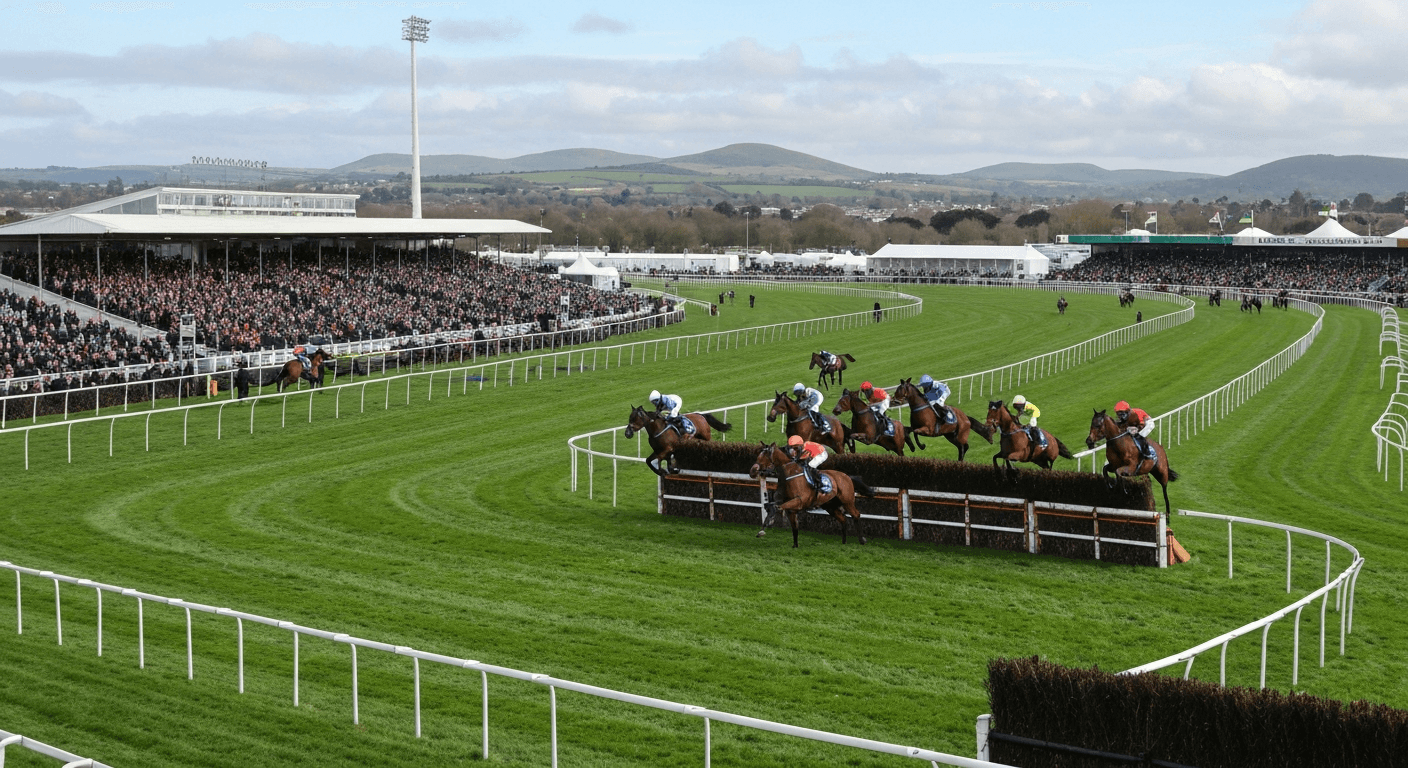
The Irish Champion Stakes: Race Guide
A full guide to the Irish Champion Stakes, Leopardstown's Group 1 mile-and-a-quarter championship: history, great winners and where it sits in the autumn.
Read moreA Day at Leopardstown: Visitor Guide
Plan a day at Leopardstown, Dublin's dual-code racecourse: getting there by Luas, the stands, food and bars, the big festivals and first-visit tips.
Read morePhotos on this page are used under Creative Commons licences. Titles, sources and licence links for each one are on our image credits page.
Research the field with the AI Race Predictor
Our model publishes calibrated win-probability estimates for UK races — a second opinion to understand a race, not tips. It's open about its record: it doesn't beat the market, and we show exactly how it does.
Work it out & learn the basics
Gamble Responsibly
Gambling should be entertaining and not seen as a way to make money. Never bet more than you can afford to lose. If you or someone you know has a gambling problem, help and support is available.