
Founder & Editor · Last reviewed 2026-06-29
The home of Irish jumps racing
When the jumps season has emptied itself out at the Cheltenham Festival and the Grand National meeting at Aintree, it comes to County Kildare to settle the last arguments. Punchestown is where the National Hunt year ends, and it ends loudly. Set in a natural amphitheatre at the foothills of the Dublin and Wicklow Mountains, near Naas, the course is the home of Irish jumps racing and the stage for its championship finale. The five-day Punchestown Festival in late April and early May is the climax of the European National Hunt season, the meeting at which the trainers' title is decided and the horses who shone in March either confirm their class or get found out.
This is not a track that dabbles in the Flat. Punchestown runs jumps under rules at its main fixtures, plus point-to-point racing, and it staged a rare one-off Flat card in September 2025 that only underlined how unusual that was. Across the season, which runs from September through to June, the course holds around 17 to 20 fixtures, building towards the spring Festival that everything else points at.
The racing here is old. The Kildare Hunt Club, which still owns the land, has organised racing in the area since the 1820s and staged a steeplechase at Punchestown from 1837. The first official two-day fixture, billed as the Kildare and National Hunt Steeplechases, took place on 1 and 2 April 1850, run off in what the records call a perfect hurricane of wind and rain with no stand and a rough course. The Prince and Princess of Wales came in 1868, by which time crowds had grown to around 40,000. The scale has only grown since: the 2025 Festival set an all-time record aggregate attendance of 136,651 over five days.
For anyone studying the form, Punchestown rewards a particular kind of horse and a particular kind of homework. The track is stiff, galloping and right-handed, with a climbing run-in that asks hard questions of stamina. It also has the only cross-country banks course in Ireland. This guide walks through what the course asks of a horse, how the going and the festival schedule shape the racing, the trainer and jockey angles that recur, and the honest arithmetic of backing favourites. It contains no tips.
This guide covers what the stiff, galloping track asks of a horse, the unique cross-country banks course, the going patterns and the clock, how Festival week is built around twelve Grade 1s, the recurring trainer and jockey angles, the honest maths of the favourite and the form figures, and answers to common questions.
Where to Bet
Place your bets with a trusted, licensed bookmaker.

Promo code BETFRED50. New customers only. Register, deposit with a Debit Card, and place a first bet of £10+ at Evens (2.0)+ on Sports, to be settled within 7 days, to get £30 in Sports Free Bets and £20 in Bet Builder Free Bets within 24 hours of settlement. 7-day expiry. Eligibility & payment exclusions apply. Full T&Cs apply. Take Time to Think. BeGambleAware.org. 18+. Full T&Cs.

Promo code R30. New UK customers only, 18+. Register, deposit £10 or more, then place a £10 single cash bet at odds of 1/2 (1.5) or greater on any sports market (excluding Virtuals). Once the qualifying bet settles you get £30 in Free Bets (3 x £10) — the qualifying bet can win or lose. Free Bets are valid on any sports market excluding Virtuals, expire in 7 days, are non-withdrawable and must be used in full. Excluded deposit methods apply (including PayPal, Apple Pay, Skrill and NETELLER). Named bets such as Lucky 15 do not qualify. If you cash out the qualifying bet, or it is voided, you are no longer eligible for the offer. Ends 31.12.26. Full T&Cs apply. Please gamble responsibly. BeGambleAware.org. 18+. Full T&Cs.

Promo code BET40GET20. New UK customers, 18+. Register with the code and place a first bet of £40 or more at Evens (2.0) or greater. Receive 2 × £10 free bets: the first credited automatically once the qualifying bet settles, the second 24 hours later. Free bets must be placed at minimum odds of 4/1 (5.0), expire 24 hours after credit, and the free-bet stake is not returned with winnings. Debit card deposits only. Take Time to Think. BeGambleAware.org. 18+. T&Cs apply. Full T&Cs.

50% of your first-day net losses refunded as a free bet, capped at £25. New UK customers aged 18+ only. To qualify, deposit and place a first bet of £10 or more on any sport at minimum odds of evens (2.00), then place at least two further bets on different events, each worth at least 50% of your largest bet, all at evens (2.00) or greater. Losses are counted from your first settled bet until 23:59 the same day. Place a qualifying £10+ bet and you are guaranteed at least a £5 free bet. Bets placed at SP, void bets, cashed-out bets and bets struck with free bets do not count towards the offer. The free bet is credited the day after your qualifying bets settle and must be used within 7 days, after which it expires. It can be used at odds from 1/4 (1.25) up to 250/1 on singles and straight accumulators, but not on Trixie, Patent or Yankee style multiples. Free-bet stake is not returned with winnings. One offer per person, household, address, IP address and device. E-wallet deposits may not qualify, so check the cashier before depositing. Customers registered with GAMSTOP cannot claim. KYC identity verification must be completed before the free bet is credited. Take Time to Think. BeGambleAware.org. 18+. T&Cs apply. Full T&Cs.

New customers, 18+. Choose the sports bonus at sign-up, make a first deposit and receive a 100% bonus up to £50 in your Sports Bonus balance. To convert the bonus to cash, wager it 10x within 30 days. Single bets below Evens (2.00) do not qualify; accumulators do not qualify if any selection is below 1/2 (1.50). Virtual Sports, voided, cancelled, drawn, cashed-out and free-bet wagers do not count towards wagering. Only the first settled bet per event counts. Withdrawing before the wagering requirement is met forfeits the bonus balance including bonus winnings. Real-money funds are used before bonus funds. Deposits via Skrill or Neteller are not eligible. Not valid in conjunction with other promotions. Odds, bet and payment limits apply. 10bet general and promotion T&Cs apply. BeGambleAware.org. 18+. Full T&Cs.

New customers in Great Britain and Republic of Ireland, 18+. Place a £10 fixed-odds qualifying bet at minimum odds of 1/2 (1.50) — single or each-way (only the win part counts), pre-event or in-play, not cashed out early, within 28 days of opening the account. Receive up to £60 in bonuses credited over three days: 3 × £10 fixed-odds free bets (the first on settlement, then 24 and 48 hours later) plus 3 × £5 Total Goals FOOTBALL spread bets, 3 × £5 racing Winning Favourites spread bets and a £1 racing Race Index spread bet (the spread bets need a full spread-betting account). Free-bet stakes not returned with winnings; free bets valid 28 days from issue. IMPORTANT: the £5 credits are SPREAD bets — sports spread betting carries the risk that losses can exceed your stake. Sports spread-betting customers do not have Financial Ombudsman or FSCS recourse. Take Time to Think. BeGambleAware.org. 18+. T&Cs apply. Full T&Cs.

Promo code WELCOME15, entered under My Bonuses after registering. New UK customers, 18+. Place a first qualifying bet of at least £10 from your cash balance at odds of evens (2.0) or greater within 7 days of opening the account. Once the qualifying bet fully settles you receive £15 in free bets, credited as 3 x £5 tokens with set uses: one £5 accumulator free bet (minimum 4 legs, each leg at 2/5 or bigger), one £5 sports free bet (any market at evens or bigger) and one £5 Sub Cover free bet (selected football player markets at evens or bigger). Free-bet stakes are not returned with winnings. Free bets expire 7 days after they are credited. Void, cashed-out and partially cashed-out bets do not qualify. One offer per customer. Confirm the current terms on BetGoodwin's own welcome-offer page before claiming. Take Time to Think. BeGambleAware.org. 18+. T&Cs apply. Full T&Cs.

New UK customers, 18+. Minimum deposit £10. Place a £10 qualifying single at minimum odds of 1/2 (1.50), settled within 14 days. Receive £30 in free bets (stake not returned), split £20 for sportsbook use (2 x £10) and £10 for Bet Builder only (2 x £5); Bet Builder does not cover horse racing. Free bets must be accepted within 7 days and expire 7 days after acceptance. No promo code required. Best Odds Guaranteed on UK & Irish racing, subject to having staked over £25 in the previous seven days. Operated by LiveScore Betting and Gaming (Gibraltar) Ltd, UKGC 56859. Confirm the current terms on LiveScore Bet's own promotions page before claiming. Take Time to Think. BeGambleAware.org. 18+. T&Cs apply. Full T&Cs.
18+. BeGambleAware.org
What the stiff, galloping track asks
Punchestown is a right-handed, undulating, galloping oval, and those words matter when you are reading a race. The course is widely regarded as fair but testing. It does not catch horses out with sharp turns or freak cambers; instead it rewards sound jumping and stamina, and it asks for both right to the line. The defining feature is the finish. The ground climbs through the final five furlongs to the winning post, so a horse that is travelling sweetly turning in can still be swallowed up by something staying on more strongly up the hill.
The chase course
The steeplechase track is a two-mile right-handed oval. By the count used in the At The Races and bet365 course guides there are 11 fences on the two-mile chase circuit, and those fences are not considered unduly stiff. That last point is worth holding onto. Punchestown is not Aintree; the obstacles themselves are not the main obstacle. What the course tests is the application of those jumps under pressure over a stamina-sapping trip, and track knowledge is often cited as an advantage to jockeys who know exactly when to ask their horse to lengthen for the climb.
The hurdle course
The hurdle course sits inside the chase track and is described as one mile six furlongs round. It has some tight bends to negotiate before a long run-in. The combination of those bends and the lengthy, climbing straight means a hurdler needs to be both nimble enough to keep its position through the turns and strong enough to sustain its effort once the field straightens up. Horses that jump fluently and conserve energy through the middle part of the race tend to have more left for the part that decides it.
A fair, honest test
The phrase that recurs in descriptions of Punchestown is that it is a fair track. Plenty of courses suit a particular running style or a lucky pitch; Punchestown is generally agreed to give the best horse every chance to prove it is the best horse. The flip side, for a punter, is that excuses are harder to find here. A beaten favourite at Punchestown was usually beaten on merit rather than by the track, which makes the form that comes out of the Festival some of the most reliable jumps form of the season. None of that, of course, tells you which horse will win the next race.
The banks: Ireland's only cross-country test
There is one thing at Punchestown you will not find anywhere else among Ireland's racecourses: the banks. The cross-country banks course is a long, twisting circuit run over a mixture of banks, stone walls, brush fences, grass banks and hurdles, and it is jumped in both directions, turning both left and right-handed. It is a different discipline from the rest of the card, closer to hunting than to championship racing, and it produces specialists who barely run anywhere else. The famous historic double-bank had a first ditch, known as the grip, reported at 6ft 6in wide and 3ft deep, which gives some idea of what these horses are being asked to pop.
The La Touche Cup
The banks course is the home of the Mongey Communications La Touche Cup, run over about four miles one furlong, one of the longest and most distinctive races in Ireland. It is a handicap, not a Grade 1, and it rewards a very particular type: a bold, accurate, brave jumper with bottomless stamina and experience over this kind of obstacle. Form over conventional fences tells you almost nothing here; form over the banks tells you a great deal.
The numbers behind the race are dominated by one name. Enda Bolger, the trainer known as the Banks King, has won the La Touche Cup a record 15 times. He trained Risk Of Thunder, owned by the actor Sean Connery, to a record seven wins between 1995 and 2002 (the race was not run in 2001). Bolger's other winners include Garde Champetre, L'Ami, Spot Thedifference, Quantitativeeasing and Auvergnat, who won in 2018. More recently, Busselton won back-to-back runnings, in 2025 when trained by Joseph O'Brien and again in 2026 when trained by Bolger himself, ridden by Darragh O'Keeffe at 7/2, the latter being Bolger's 15th success in the race.
Reading the banks
For a punter, the lesson of the banks is specialisation. The horses that win here tend to be proven banks performers, often from a small pool of yards that target the discipline, with Bolger's the obvious one. A glittering record over park fences does not transfer automatically. As with everything at Punchestown, recognising that a race is its own puzzle is the start of understanding it, not a route to a profitable bet.
Going patterns, pace and the clock
Ground is the first thing to check on any jumps card, and Punchestown's calendar gives it a strong seasonal shape. The Festival falls in late April and early May, the back end of the jumps season, when the ground at most Irish tracks is drying out. Festival going is typically on the faster side: good, good to yielding, or yielding. In 2026 the ground was reported as yielding on both courses after watering, with the chase ground riding good on the Friday. Winter and early-season fixtures, by contrast, are run on softer ground, so a horse's record at one Punchestown meeting is not always a guide to how it will handle another.
What the going does to the race
Spring ground at Punchestown tends to put the emphasis on class and speed at the obstacles rather than on pure mud-larking stamina, but the climbing run-in never lets stamina off the hook entirely. The result is a meeting that asks for a blend: enough pace to be competitive on quickening ground, enough stamina to see out a stiff finish. The staying races on day three, in particular, place a premium on getting home up the hill.
Pace and running style
Punchestown does not hand the race to one running style. In 2026 several Festival winners made all or raced prominently. Eachtotheirown bowled along in front in the PRL Champion Novice Hurdle, and Wilful set the pace in a Champion Hurdle. Yet hold-up horses won too: Gaelic Warrior was settled off the pace before powering clear in the Gold Cup. The honest position is that the long, climbing run-in rewards a sustained finishing effort, but there is no reliable, published evidence of a systematic front-running or hold-up bias that you could turn into a betting angle. Where a horse races in the field is one factor among many, not a shortcut.
On the clock
Punchestown does not publish the kind of consolidated course-record and standard-time table you sometimes see at Flat tracks, and Irish jumps courses rarely do. Individual winning times are recorded race by race, and they are published on Racing TV, Sporting Life, At The Races and irishracing.com. For reference, the 2026 Boodles Champion Hurdle was timed at 3 minutes 57.00 seconds on yielding ground over two miles. Time figures can be useful context, but on jumps ground that changes with watering and weather they are read alongside the going, not in isolation.
Festival week: five days, twelve Grade 1s
The Punchestown Festival is the busiest week of Grade 1 racing in the European jumps calendar after Cheltenham and Aintree. Across five days it stages 12 Grade 1 races, and it is where the Irish trainers' championship is settled. In 2026 the meeting ran from Tuesday 28 April to Saturday 2 May. It traditionally opens on the last Tuesday of April. The 2025 Festival was worth €3.5 million across 40 races and set a record five-day attendance of 136,651.
How the week is built
Each day is anchored by a championship feature, with the supporting Grade 1s spread across the card.
| Day | Feature Grade 1 | Other Grade 1s |
|---|---|---|
| Tue (Day 1) | William Hill Champion Chase (2m) | PRL Champion Novice Hurdle; Dooley Insurance Champion Novice Chase |
| Wed (Day 2) | Ladbrokes Punchestown Gold Cup (3m1f) | Channor Real Estate Novice Hurdle; Champion I.N.H. Flat Race |
| Thu (Day 3) | Ladbrokes Champion Stayers Hurdle | Barberstown Castle Novice Chase (plus the La Touche Cup over the banks) |
| Fri (Day 4, Ladies Day) | Boodles Champion Hurdle (2m) | Alanna Homes Champion Novice Hurdle |
| Sat (Day 5, Family Day) | SBK Irish EBF Mares Champion Hurdle | Ballymore Champion Four Year Old Hurdle |
The Gold Cup is the centrepiece chase. Worth around €300,000 in recent years, it was introduced in its current form in 1999, and its sponsors have run from Heineken through Diageo, Tote, Bibby and, since 2017, Ladbrokes Coral. The Boodles Champion Hurdle on Ladies Day is the two-mile hurdling championship, also worth around €300,000, and Ladies Day is the biggest crowd of the week: the record rose to 43,572 for the 2026 running, the day Lossiemouth won at 2/7.
Small fields and big fields
Festival betting at Punchestown means two very different kinds of race. The marquee Grade 1s are often short, select affairs; the 2026 Champion Chase and Gold Cup each had only five runners. These are class tests where a small number of high-quality horses sort themselves out, and the market is usually tight. Alongside them sit large, competitive handicaps, including handicap hurdles of 24 runners, where the puzzle is the opposite: a wide-open field, a wide range of prices and far more ways to be wrong. Knowing which kind of race you are looking at changes how you read it.
A festival, not just a race meeting
Off the track, the Festival is one of the largest sporting and social gatherings in Ireland. There is a Bollinger Best Dressed competition across the first four days, a shopping village of Irish designers, milliners and jewellers, live music, the Goffs Punchestown Sale held in the winner's enclosure, and the long-running Punchestown charity race for the Kidney Research Fund, which was in its 34th year in 2025 and closing on €2 million raised. CEO Conor O'Neill put the economic impact at over €70 million in April 2026. The atmosphere is part of the point, but it changes nothing about the maths of betting.
Trainer and jockey angles
No discussion of Punchestown form gets very far before it reaches Willie Mullins. The trainer dominates the Festival to a degree no rival matches, and the record bears it out across every championship division.
Mullins, and then daylight
Mullins is the leading trainer in the Punchestown Gold Cup with eight wins, from Florida Pearl in 2002 through Sir Des Champs, Boston Bob, Bellshill, Kemboy, Allaho and Galopin Des Champs to Gaelic Warrior in 2026. He is the leading trainer in the Boodles Champion Hurdle with 11 wins, a tally that includes State Man's hat-trick of 2023, 2024 and 2025 and Lossiemouth in 2026. He is the leading trainer in the Champion Chase too. The 2025/26 season was the high-water mark: his stable won the Champion Hurdle, Champion Chase and Gold Cup at both Cheltenham and Punchestown in the same season. At the 2026 Festival he reclaimed the Irish trainers' championship, having sealed an earlier title at Punchestown the year before.
His stable jockey, Paul Townend, is the rider most often in the right place. In 2026 alone Townend won four Festival Grade 1s for the yard: Il Etait Temps in the Champion Chase, Gaelic Warrior in the Gold Cup, King Rasko Grey in a novice hurdle and Lossiemouth in the Champion Hurdle. Townend also leads recent riding records in the Champion Chase, with wins on Golden Silver, Un De Sceaux, Chacun Pour Soi, Energumene (twice) and Il Etait Temps.
The chasing pack
Mullins is dominant, not unopposed. Gordon Elliott is the principal challenger and came into the 2026 Festival actually leading the trainers' table before being overhauled; he still landed Grade 1s with Western Fold in the Dooley Insurance Champion Novice Chase and With Nolimit in the bumper. Henry de Bromhead trained Bob Olinger to an emotional Champion Stayers Hurdle in 2026, the horse's fifth Grade 1 and final race. Harry Derham took his first Grade 1 as a trainer with Le Frimeur. Among the older names, Jessica Harrington has four Punchestown Champion Hurdles to her name, with Moscow Flyer, Macs Joy, Jezki and Supasundae, and visiting British yards have struck too: Paul Nicholls won the 2021 Gold Cup with Clan Des Obeaux and Nicky Henderson the 2019 Champion Hurdle with Buveur D'Air.
In the saddle, the historic benchmark is Ruby Walsh, the leading jockey since 1999 in both the Gold Cup and the Champion Hurdle with six wins apiece; his final career winner was Kemboy in the 2019 Gold Cup. On the banks, Enda Bolger and his riders are the angle, as his 15 La Touche Cups attest.
What the dominance means, and does not
That Mullins and Townend win a large share of the Festival is a documented fact, and it is sensible context when you read a race. It is not, by itself, a betting system. The market knows all of it. Mullins runners are routinely sent off at the front of the betting precisely because of this record, which means their winning chance is already priced in. A dominant yard does not create value; it removes it.
The favourite, the form figures and the honest maths
Punchestown produces some of the most dependable form lines of the jumps season, partly because the track is fair and partly because the best horses turn up. That reliability tempts a particular conclusion: if the form is this trustworthy and the favourites this good, surely backing them pays. It does not, and it is worth being clear about why.
The favourites that did win
Recent Festivals have certainly seen short-priced favourites oblige. In 2026, Lossiemouth won the Boodles Champion Hurdle at 2/7, Gaelic Warrior took the Gold Cup at 5/6, Il Etait Temps the Champion Chase at 8/11, and King Rasko Grey a novice hurdle at 8/13. Trends pages note that favourites have a strong record in specific races such as the Champion Hurdle. All of that is true, and none of it makes favourite-backing profitable.
The figures the other way
The same Festival is littered with results that punish a blind favourite strategy. In 2026, Eachtotheirown won the PRL Champion Novice Hurdle at 16/1, Western Fold the Dooley Insurance Champion Novice Chase at 18/1, Le Frimeur the Channor Real Estate Novice Hurdle at 18/1, and With Nolimit the bumper at 14/1. In the Champion Stayers Hurdle, Bob Olinger won at 4/1 with the favourite, Teahupoo, only third. In the Mares Champion Hurdle, Place De La Nation won at 10/1 with the 8/11 favourite Wodhooh back in third. Even in a meeting where the biggest names delivered, the longer-priced winners came thick and fast.
The honest maths
Here is the point that no run of short-priced winners can change. Backing favourites loses money to starting price over time. Every starting price has the bookmaker's margin, the over-round, built into it, so the prices across a race add up to more than 100 per cent of true probability. Over a large enough sample that margin is exactly what you lose. A favourite winning at 2/7 does not break this; it is already accounted for in how often favourites win and how little they pay when they do. The same is true of every simple system you could build from the angles in this guide: backing all Mullins runners, backing the shortest price, backing the course specialist. Each has been absorbed into the market price.
That is not a reason to avoid Punchestown. It is one of the great racecourses, the fair, stiff, climbing test where the best jumpers settle the season, and the form it throws up is as good as any in the sport. It is simply a reason to be honest about what betting is. This guide is a course guide, not a tipping service. It does not tell you to back, lay or bet on anything, and no horse or system on it can be presented as a profitable wager.
Frequently Asked Questions
Share this article
More about this racecourse
All punchestown guides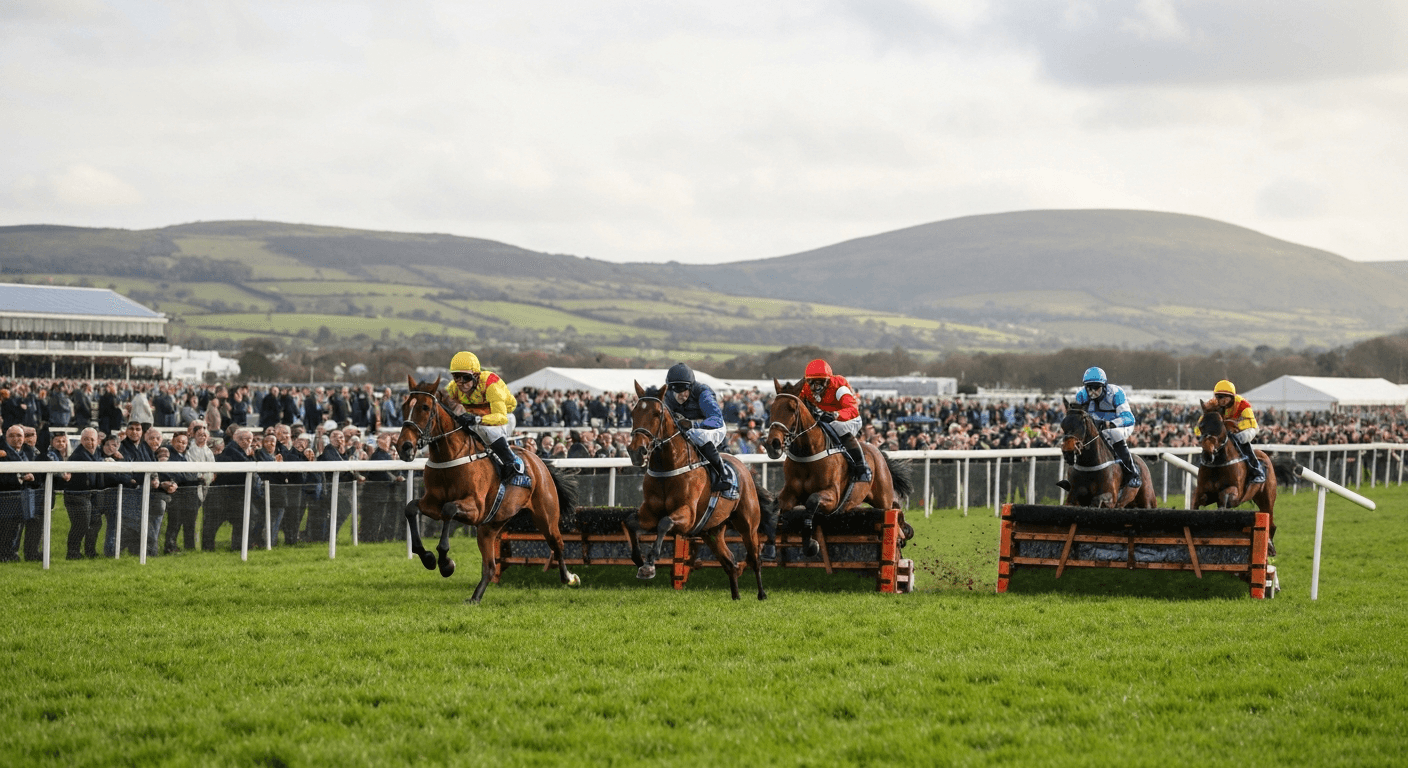
The Punchestown Festival: A Complete Guide
The complete guide to the Punchestown Festival in County Kildare: the five-day shape, the 12 Grade 1s, the La Touche Cup and going to the races.
Read more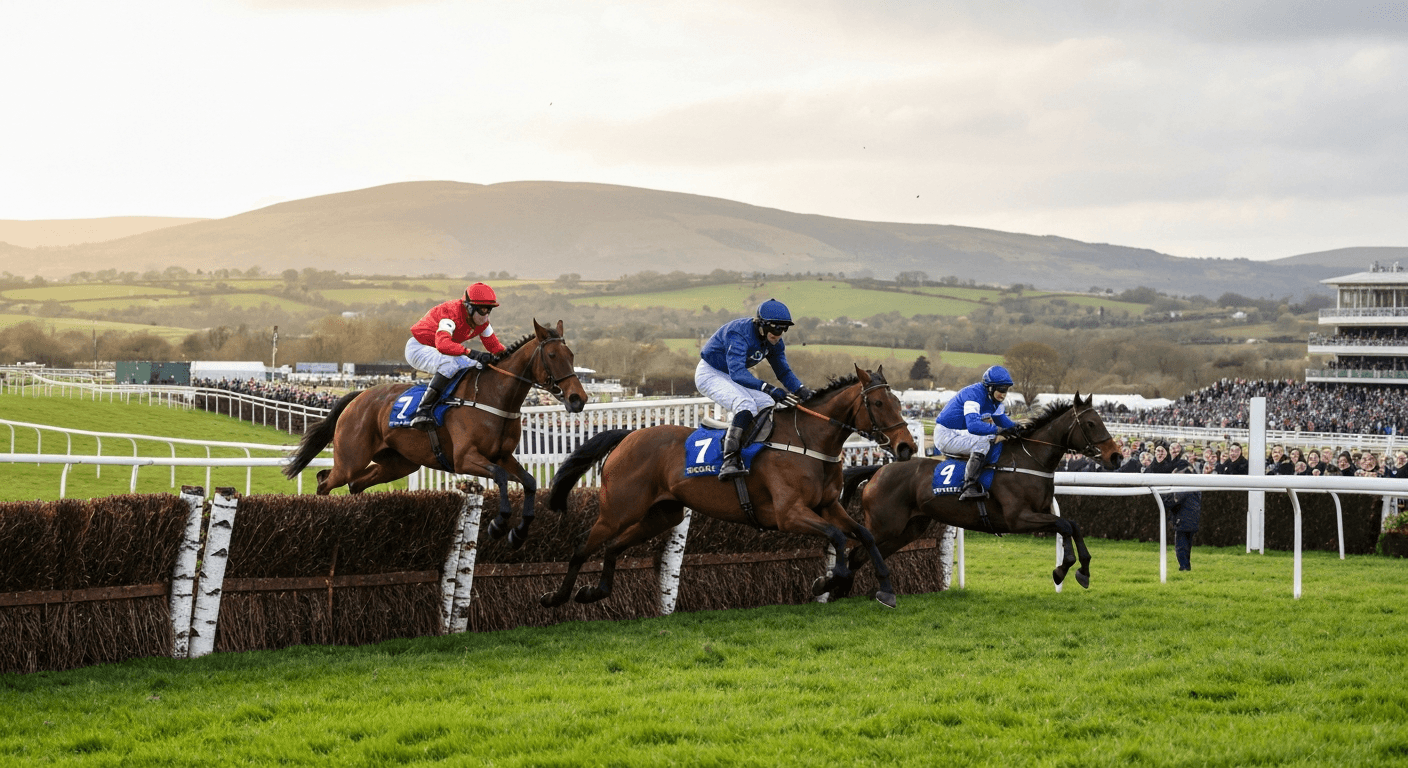
Punchestown Racecourse: The Complete Guide
Punchestown (Co. Kildare) in full: Ireland's National Hunt headquarters and the season-closing five-day festival, the Grade 1 championship races with their winners, the famous cross-country banks course, tickets, travel, venue hire and how to visit.
Read moreThe History of Punchestown
How a hunt club meeting near Naas grew into the home of Irish jumps racing and the Festival that ends the National Hunt season.
Read moreResearch the field with the AI Race Predictor
Our model publishes calibrated win-probability estimates for UK races — a second opinion to understand a race, not tips. It's open about its record: it doesn't beat the market, and we show exactly how it does.
Work it out & learn the basics
Gamble Responsibly
Gambling should be entertaining and not seen as a way to make money. Never bet more than you can afford to lose. If you or someone you know has a gambling problem, help and support is available.