
Founder & Editor · Last reviewed 2026-03-02
Kempton Park has been a fixture of British racing for nearly a century and a half. From its origins as a Victorian commercial enterprise to its current status as the home of Boxing Day racing, this course in suburban Surrey has weathered two world wars, financial crises, a serious threat of demolition, and wholesale reinvention. It has come through each episode as a more important venue than it was before.
The story of Kempton is not one of unbroken grandeur. Unlike Ascot or Newmarket, places that carry centuries of royal patronage and establishment prestige, Kempton has always been a working racecourse. It earned its reputation through the quality of its racing, the loyalty of its racegoers and, above all, through one race: the King George VI Chase, which has done more to define this venue than any other single event in its history.
But the history runs considerably deeper than one race on one day of the year. Kempton has hosted flat racing of solid quality across more than a century, served as a wartime military depot on two occasions, survived a public campaign to demolish it and sell the land for housing, and transformed itself from a traditional turf venue into one of Britain's busiest all-weather operations. Each chapter reshaped the place, sometimes dramatically.
The Victorian founders who laid out the track on the Thames meadows in 1878 would barely recognise the modern venue. The Polytrack all-weather circuit, the floodlit evening meetings, the digital betting infrastructure: none of it would compute for Samuel Schwind and his contemporaries. What they would recognise is the pull of the place on Boxing Day, when crowds still pack the stands to watch the best chasers in training settle their autumn arguments over three miles of Surrey turf. Some things don't change.
This is the full history of Kempton Park: how it began, what shaped it, who defined it, and why the racing world fought to keep it when the bulldozers were promised.
Victorian Founding and Early Years (1878–1900)
Victorian Founding and Early Years (1878–1900)
Kempton Park owes its existence to Samuel Howard Schwind, an entrepreneur who spotted commercial potential in the flat Thames meadowlands between Sunbury and Hampton. In 1878, he established the racecourse on agricultural land that had previously formed part of Kempton Manor, a modest Surrey estate from which the course takes its name. The first meeting was held on 18 July 1878, a flat fixture that drew a respectable crowd from London and the surrounding towns.
The timing was shrewd. The late Victorian era saw an explosion of interest in horse racing across all classes of society. Newmarket and Ascot catered for the aristocracy and the established racing crowd, but there was a growing market of middle-class Londoners looking for accessible sporting entertainment. Kempton was positioned to serve exactly that market. The Thames riverside was already a leisure destination. Hampton Court Palace sat just a few miles upstream, and pleasure boats, riverside pubs, and cricket grounds were all drawing city day-trippers. Adding a racecourse to the mix made sense.
The key was the railway. Trains from London Waterloo could reach the Sunbury area in under an hour, and the construction of a dedicated branch line that would eventually deliver a Kempton Park station made the course accessible in a way that few country venues could match. Ordinary Londoners, clerks, tradespeople, factory workers on a bank holiday, could afford the fare and the entrance fee and spend a day at the races without it being a once-in-a-decade event. That accessibility was built into Kempton's identity from the start, and it remains there today.
The early years were devoted entirely to flat racing. The course was laid out as a right-handed circuit on level ground, and it quickly found its place in the southern calendar as a useful, well-run venue. It wasn't challenging the top tier: Epsom, Ascot, Goodwood and Newmarket held that ground. But it attracted decent fields and offered competitive sport. The Jubilee Handicap, inaugurated in the 1880s, became one of the course's earliest prestige flat races and pulled quality horses into Surrey for several seasons.
Schwind's founding philosophy was clear from the outset: Kempton was designed as a leisure destination, not an exclusive gathering point for the landed gentry. The facilities included a proper grandstand, public enclosures, refreshment areas, and well-maintained grounds. The racing card was constructed with entertainment in mind. If you brought your family to Kempton on a summer afternoon, you were meant to have a good day out, not feel like an interloper at somebody else's garden party. This was a significant break from the culture of the older southern courses, and it gave Kempton a distinct character that shaped how its racegoers thought about the place.
By the late 1880s, the racecourse had grown into a well-established part of the racing calendar. A series of facility improvements had been made, attendances were healthy, and the course had begun experimenting with National Hunt racing, introducing jumping fixtures to supplement the flat programme. This dual-purpose approach was not the norm among British racecourses of the period, which typically specialised in one code. That early decision to run both codes would eventually make Kempton's reputation in a way the founders almost certainly didn't anticipate.
The Imperial Cup, established as a prestigious hurdle race, began attracting top hurdlers to Kempton. The Kempton Park Gold Cup gave the flat programme a valuable prize to build around. Neither race would ultimately define the course in the way the King George VI Chase later would, but they signalled that Kempton was serious about offering quality racing across both codes, and that the management was willing to invest in making it happen.
The Victorian era closed with Kempton in decent health. The financials were sound, the crowds were coming, and the course had established a clear identity: London's accessible racecourse, the place where the metropolitan middle class went racing. The aristocracy preferred Ascot and Epsom. The serious flat-racing money was at Newmarket. Kempton belonged to everyone else, and it wore that identity without embarrassment.
Why this period mattered: The Victorian founders made three decisions that shaped everything that followed. They chose an accessible suburban site served by rail. They built for middle-class entertainment rather than upper-class exclusivity. And they committed to running both codes of racing. Each of those choices echoed forward through the next century and a half.
Edwardian Development, Wartime, and the King George's Birth (1900–1945)
Edwardian Development, Wartime, and the King George's Birth (1900–1945)
The Edwardian era brought Kempton into a more settled phase of existence. The company ownership model that ran the course had proven stable, and the fixture list expanded to meet growing demand. London was a city of nearly seven million people by 1910, and the racecourse trade catered to a substantial slice of that population's appetite for outdoor sport. The proximity to Hampton Court and the riverside meant that a day at Kempton could be packaged as a real day out, not just a racing trip, and the management was astute enough to exploit that positioning.
Flat racing at Kempton continued to develop through the early twentieth century. The course attracted runners from the leading southern yards and several of the better northern operations, and the card quality improved as the prize money grew. It remained a useful venue rather than a premier one. The cup races at Ascot and Epsom were still the markers of flat quality at its highest level, but Kempton carved out a solid reputation for fair, well-organised racing on a track that horses and trainers both liked.
The Boxing Day jumps fixture was growing in popularity during this period, and the management recognised that winter crowds had a distinct character from the summer flat racegoers. Jump racing fans were a hardier, more partisan audience. They came back year after year for the same horses, followed trainers and jockeys as closely as they followed the form book, and were willing to stand on an open terrace in December in a way that a summer flat crowd might not be. Building a Boxing Day meeting into a real occasion made commercial sense, and it had the added advantage of filling the calendar during what would otherwise be a quiet period.
The First World War brought racing to a near-standstill across Britain. Kempton was requisitioned for military use in 1915; the site became a depot and training area for troops preparing to be deployed to the Western Front. Racing did not resume there until after the armistice. The physical toll on the facilities was considerable, and the immediate post-war years required significant work to restore the course to a standard fit for racing.
The interwar period was competitive. Multiple courses operated within the London catchment area: Sandown, Windsor, Epsom and others were all chasing the same metropolitan racegoing public, and Kempton had to work hard to differentiate its offering. The quality of the flat card held up reasonably well, and the jumps programme continued to attract a loyal following, but the management knew that the course needed a signature event to anchor its position in the calendar.
The answer came on 26 December 1937. The King George VI Chase was run for the first time at Kempton Park, named in honour of the monarch who had been crowned the previous year following his brother's abdication. The race was established as a three-mile steeplechase, Grade 1 in status, run on Boxing Day. The concept was straightforward: a mid-season championship for the country's best staying chasers, giving the jumps season a major reference point between the autumn opening and the spring festivals at Cheltenham and Aintree.
The logic behind Boxing Day was sound. British families traditionally spent the day at home or at sporting events, and placing a prestige race on that date gave Kempton a guaranteed audience that no amount of summer fixtures could replicate. The post-Christmas period was a quiet one for most sports, and a quality jumps race in the week between Christmas and New Year filled a real gap in the sporting calendar. The King George was designed to occupy that space permanently.
It did. The race was immediately popular, and its timing within the season proved shrewd. Horses who had run well in the early autumn, at Sandown, Cheltenham, or Haydock, would target the King George as their first major championship test. Horses with Cheltenham Gold Cup aspirations would use it as a key trial. The Boxing Day date meant it was never going to clash with the big spring festivals, and its proximity to Christmas gave it the kind of cultural backdrop that keeps a race in the public consciousness regardless of its competitive merits.
The Second World War ended the King George before it had properly found its feet. Racing at Kempton was suspended in 1940, and the course was again requisitioned for military use. The racing years from 1940 to 1945 were lost entirely, and the post-war period would require Kempton to rebuild its profile from scratch. But the King George VI Chase had been planted in the calendar. When racing returned, it came back too.
Why this period mattered: The interwar years produced Kempton's defining innovation. Without the King George VI Chase, established in 1937, the course's story would look very different. The race gave Kempton a permanent claim on the national jumps calendar at a time when its flat programme faced serious competition. Arkle, Desert Orchid, Kauto Star: all of it flows from that one decision in 1937.
Desert Orchid and the King George VI Chase (1945–1991)
Desert Orchid and the King George VI Chase (1945–1991)
The King George VI Chase returned after the war with a simple job to do: establish itself as one of jump racing's most important races. Over the following four decades, it did exactly that, and the horses who won it became the benchmark by which all top staying chasers were measured.
The post-war years produced a succession of quality King George winners. Cottage Rake, trained in Ireland by Vincent O'Brien, won the race in 1948. Mandarin, one of the toughest and most admired chasers of the 1950s and early 1960s, won it twice. Mill House, the talented but ultimately ill-fated rival of Arkle, won the 1963 renewal before being beaten by the Irish horse the following year. The King George was already establishing a pattern: the very best horses competed in it, and the result usually reflected the form book honestly. It was not, in racing terminology, a race that threw up flukes.
Arkle's visit to Kempton on 27 December 1965 is one of the most discussed passages in jumps racing history. The Duchess of Westminster's horse, trained by Tom Dreaper in Ireland, was at the peak of his extraordinary powers. He had won the Cheltenham Gold Cup in 1964, 1965, and would win it again in 1966. His record over fences was almost without precedent, and when he arrived at Kempton for the 1965 King George, the field he faced knew they were racing for second place.
He won by 20 lengths. The manner of the victory was as striking as the margin. Arkle travelled through the race with the ease of a horse in a schooling session, jumping precisely and economically, never appearing to be extended. His rivals were top-class chasers. They were simply in a different category from the animal they were racing against. The 1965 King George stands as perhaps the most complete demonstration of Arkle's superiority over the British and Irish chasing fields of his era.
The race continued to attract outstanding winners through the 1970s and into the 1980s. Wayward Lad, trained by Monica Dickinson in Yorkshire, dominated for a spell that is sometimes overlooked in the shadow of what came after him. He won the King George in 1982, 1983 and 1985: three wins from three starts in the race. He was the perfect Kempton horse: a smooth traveller who could handle the flat, right-handed circuit and find extra when pressed. His consistency was exceptional, and his King George treble should rank among the great exploits in the race's history.
Then Desert Orchid arrived, and the King George became something else entirely.
The grey who changed everything
Desert Orchid was a grey horse trained by David Elsworth, bred in Shropshire, owned by Richard Burridge and his family. He was not the most classical-looking chaser. He was front-running, bold at his fences, and exciting to watch in a way that made him unlike any racehorse the British public had engaged with for decades. He was also exceptionally good, and the King George VI Chase became the stage on which he showed it most clearly.
His first win in the race came on Boxing Day 1986. He won from the front, as was his habit, taking the field along at a pace that suited him and finding his rivals unable to match his reserves in the closing stages. It was an impressive performance, though the racing world had not yet fully understood what it was watching.
Two years later, in 1988, he won it again. By this point, Desert Orchid had become famous well beyond the racing world. The grey horse that the general public could identify at a glance, the front-runner whose jumping was so bold and accurate that it made steeplechasing look simple. The 1988 King George confirmed him as the outstanding chaser in training.
The 1989 Cheltenham Gold Cup is often cited as the peak of his career. He won it on desperately soft ground at Cheltenham, conditions that should have been against a front-running, right-handed specialist, and the performance resonated across the country in a way that few horse racing results achieve. But for Kempton, it is the 1989 Boxing Day that sits at the heart of the course's story.
Boxing Day at Kempton. 26 December 1989. Desert Orchid comes out of the parade ring, grey coat bright in the December light, and the stands begin to buzz before the race is even underway. He jumps the first, the second, takes it up going to the third. Three miles of Surrey turf ahead. The crowd already knows the script. He wins his third King George, ears pricked at the line, and nobody who was there quite forgets the noise.
The fourth King George, won in 1990, was the one that sealed his record. Four wins in the race had no precedent. Wayward Lad's treble had been considered exceptional; Desert Orchid went one better in a race that had defeated plenty of outstanding horses. The significance of the fourth win was understood in real time by the crowd at Kempton, who gave him a reception that those who witnessed it still describe as something out of the ordinary.
Desert Orchid's four King George wins between 1986 and 1990 are not merely a list of results. They converted the Boxing Day meeting from an important jumps fixture into a national event. Television audiences for the race grew with each of his victories. Families who had never previously followed racing knew his name and his colour and his style. He brought people to Kempton who would not otherwise have come, and many of them stayed.
The legacy of that era at Kempton is the relationship between the course and its racegoers. The Boxing Day crowds who come now are the children and grandchildren of people who watched Desert Orchid. The King George is a family fixture for many of them, the sort of tradition that persists across generations precisely because the early experiences were so vivid. For a fuller account of his Kempton record and what it meant, see the Desert Orchid at Kempton article.
Why this era mattered: Desert Orchid turned Kempton Park's Boxing Day meeting into a national institution. Before him, it was an important jumps fixture. After his four wins, it was the event that millions of people who barely followed racing knew about. That cultural weight is the foundation of Kempton's modern identity.
The All-Weather Transformation and Kauto Star's Era (1990s–2017)
The All-Weather Transformation (1990s–2006)
The 1990s brought a different kind of change to Kempton Park. The National Hunt programme remained the most visible and prestigious part of the fixture list, anchored by the King George, but the flat racing landscape was shifting underneath it. Weather-related abandonments were costing racecourses revenue they could not easily recover, and the success of all-weather racing at Lingfield Park was prompting serious discussions across the sport about whether artificial surfaces were the future for British winter flat racing.
Kempton was in the middle of this debate. The flat turf course was aging, and the economics of running a busy flat programme on turf that was vulnerable to frost, waterlogging and drought were becoming increasingly difficult to justify. The Jockey Club, which had taken over ownership of the course, was looking at options.
The solution came in 2006, when Kempton installed a Polytrack all-weather surface to replace the turf flat circuit. It was one of the most significant infrastructure decisions made at any British racecourse in the modern era. The jump course, including the turf on which the King George is run, was kept entirely separate and untouched. But the flat racing at Kempton would henceforth be conducted on an artificial surface, unaffected by weather conditions and capable of operating year-round.
The decision was not universally popular at the time. Flat racing purists had a legitimate attachment to turf, and there were honest questions about whether Polytrack racing would produce the same quality of sport. Some argued that the different surface characteristics favoured different types of horses and skewed form in ways that were hard to interpret. Others simply preferred the look and feel of horses racing on grass.
But the commercial logic held. Within a few years of the Polytrack installation, Kempton was operating one of the busiest flat racing programmes in the country. Evening meetings under floodlights attracted a steady crowd of regulars. Winter afternoon cards that would previously have been vulnerable to abandonment ran without incident. Trainers appreciated the reliable surface. They could plan their horses' programmes with greater certainty, and the Polytrack was generally considered fair and well-maintained. Kempton's income from flat racing stabilised and grew.
The all-weather programme also created a new audience at Kempton. The evening crowd at a Polytrack meeting is different from the Boxing Day crowd at the King George: younger, more casual, more interested in the betting than the breeding. But both audiences matter to a racecourse trying to pay its bills and maintain its facilities, and Kempton succeeded in serving both simultaneously.
Kauto Star's Five King George Wins (2006–2011)
Just as the all-weather transformation was settling in, the King George VI Chase produced its most extraordinary sequence of results. Kauto Star, trained by Paul Nicholls at Ditcheat in Somerset, arrived at Kempton for the 2006 Boxing Day meeting as the outstanding chaser of his generation. He left having written the first entry in what would become the longest chapter in the race's history.
Kauto Star was trained by Nicholls, owned by Clive Smith, and ridden through most of his career by Ruby Walsh. He was a supremely talented horse with an unusual combination of jumping ability, pace and stamina. He could win over two miles and over three. He could handle soft ground at Cheltenham and the flat Kempton circuit equally well. He was, in racing terms, an exceptional specimen: a horse who made other top-class chasers look ordinary.
His first King George win in 2006 was a statement of intent. He was still a young horse, but the manner of his victory left no doubt about his class. He won his second in 2007, confirming that the 2006 result was no fluke. The 2008 win came in the same year as his first Cheltenham Gold Cup victory, making him only the third horse to win both races in the same season. By 2009, his four wins had drawn direct comparison to Desert Orchid's record.
Then came 2010 and Long Run. Ridden by Sam Waley-Cohen, Long Run was a younger horse with exceptional jumping ability and the pace to match. He beat Kauto Star at Kempton that year and appeared to signal a changing of the guard. The racing world assumed that Kauto Star's King George days were behind him. He was ten years old. Long Run was the future.
The 2011 renewal provided one of the most discussed results in the history of the race. Kauto Star, eleven years old and with many observers questioning whether he retained his very best form, lined up again at Kempton on Boxing Day. Ruby Walsh was back in the saddle. The favourite, this time, was not Kauto Star.
He won. He won by a length and three-quarters from Silviniaco Conti, with Long Run back in third. Walsh had ridden him with patience, allowing the horse to find his rhythm before pressing him in the home straight. The performance itself was not the domination of previous years. This was a hard-fought win from a veteran horse who needed everything to go right. What made it extraordinary was the context. A horse who had been written off returning to win the race that defined his career at the age of eleven.
The Kempton crowd's reaction has been described by those who were there as the loudest they could remember at the course. People who had watched Kauto Star through his entire career were watching what they suspected would be his final great performance in a race he had made his own. The reception when he passed the post was immediate and sustained, the kind of noise that comes from a crowd who understand the weight of what they've just seen.
Five wins in the King George VI Chase. Desert Orchid's four had stood as the record since 1990. Kauto Star bettered it with the most emotional of the five victories. His record in the race remains the mark that every subsequent Boxing Day favourite has been measured against. For the full King George record, results and context, our King George VI Chase guide has the complete rundown.
Why this period mattered: Kauto Star's five wins gave the King George a new historical benchmark and reinforced Kempton's position as the venue that produced the sport's most talked-about moments. The 2011 race in particular drew in people who had not followed racing closely for years. A sequence like that doesn't happen by accident. It requires a great horse, a great race, and a course that can do justice to both.
The Redevelopment Controversy (2017)
In January 2017, the Jockey Club issued a statement that few people in racing were expecting. Kempton Park was to close. The land, 236 acres of Thames Valley real estate in Sunbury-on-Thames with planning permission for residential development worth an estimated £100 million, would be sold. The proceeds would fund investment in Cheltenham racecourse, principally a new grandstand and improved facilities. The King George VI Chase would be moved to Sandown Park.
The reaction was swift and substantial. Racing fans launched campaigns to save the course. Prominent trainers, former jockeys and racing administrators who had made their names at Kempton spoke publicly against the closure. The press coverage was extensive, and the volume of correspondence generated by the announcement, from racegoers, local residents and people who had never previously engaged publicly with racing politics, was far beyond what the Jockey Club had anticipated.
The arguments against closure were several. The King George VI Chase belonged at Kempton. Moving it to Sandown would be possible in practical terms, but the race had been run at Kempton every year since 1937 (bar the wartime suspension), and the connection between the race and the course was not a trivial marketing point. It was historical identity that took decades to build and cannot be recreated somewhere else. The Boxing Day atmosphere at Kempton, the specific combination of the sharp flat track and the Surrey setting and the festive crowd, was not a transferable commodity.
There was also the matter of the all-weather programme. Kempton's Polytrack operation was by 2017 one of the most professionally run and heavily used in the country. Dozens of meetings per year depended on it. Trainers who used Kempton regularly for their horses' winter flat campaigns would face significant disruption. The infrastructure investment of the 2006 conversion would be written off.
The practical case against closure was strengthened by a wider argument about what racecourses are for. Several commentators pointed out that the Jockey Club's proposal treated Kempton as a commercial asset to be liquidated in order to fund improvements elsewhere in the portfolio. The counter-argument was that racecourses are not just revenue streams. They are places that have accumulated sporting history, community connection and emotional weight over generations. Selling Kempton for housing was not like selling a field. It was ending something that had been built over 139 years.
After sustained public pressure and a lengthy review process, the Jockey Club announced in 2020 that the closure plan would not proceed. Kempton Park would remain open. The specific reasons for the reversal included the complexity of obtaining planning permission for the proposed development, the level of opposition from the racing community, and a reassessment of the financial projections. Whatever the precise weight given to each factor, the outcome was that the course survived.
The 2017 episode is now part of Kempton's story in a way that no one would have chosen. But it demonstrated something that the course's owners perhaps needed to understand more clearly: Kempton matters to a lot of people who never appear in the attendance figures. Former racegoers, people who watched the King George on television as children, punters who backed their first winner there decades ago: they all felt the threat of closure personally and responded to it. That depth of connection is rare, and it tells you something real about what the course has meant across its history.
Why this moment mattered: The 2017 controversy revealed that Kempton's value to British racing was not fully captured by its financial contribution to the Jockey Club's balance sheet. The racing community's response made the case for keeping the course open more effectively than any business plan could have done.
Modern Kempton, Legacy, and FAQ
Modern Kempton and Its Place in British Racing
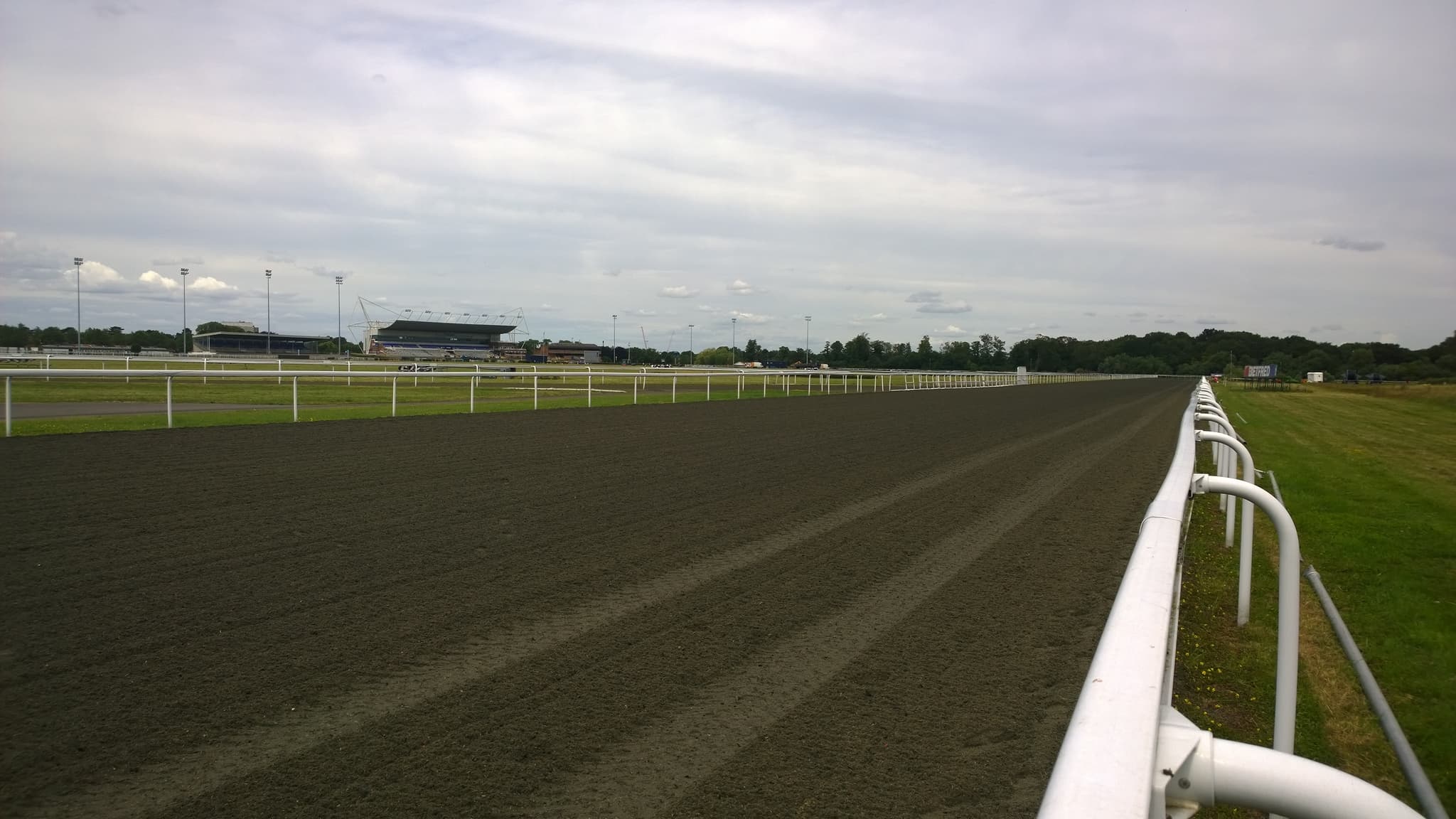
Kempton today operates as a dual-surface venue with a busier fixture list than at any point in its history. The Polytrack all-weather circuit runs flat meetings from October through to the spring and beyond, providing year-round racing that generates consistent revenue and supplies the fixture list that British flat racing depends on during the winter months. The turf jumps course handles the National Hunt programme and the Boxing Day showpiece, keeping the grass circuit in the shape that the King George requires.
The AW Championships Finals Day, typically held at Kempton in April, has grown into a significant end-of-season event for the all-weather flat programme. The winter all-weather season produces a series of qualifiers and minor championships, and Finals Day brings the best of those together in a single card that has acquired real prestige within the flat racing calendar. It is a different kind of occasion from the King George: the atmosphere is warmer, the crowd smaller, the racing more technical. But it signals how seriously Kempton takes the all-weather programme that was once its controversial gamble.
The King George VI Chase remains the centre of everything. Each Boxing Day, the best staying chasers in training take their turn on the three-mile turf circuit, and the race continues to serve as the mid-season championship it was designed to be in 1937. The horses who win it now join a list that includes Arkle, Desert Orchid, and Kauto Star. That is an unusual distinction for any racecourse to offer.
The Christmas racing meeting more broadly has grown in the decades since Desert Orchid built its audience. The Christmas Hurdle, run on the same card as the King George, has been won by several outstanding hurdlers over the years and provides a second major prize to attract the best two-mile hurdlers in training. The full Christmas racing week at Kempton is now a multi-day event that draws the course's biggest attendances of the year; a detailed guide is available in our Christmas racing at Kempton article.
The venue's position in the wider London racing market has not changed much from the Victorian conception. Kempton is still the accessible suburban course, forty minutes from Waterloo, the place where the city's racing public can spend an afternoon or evening without it requiring a major expedition. The evening Polytrack meetings draw regulars who know the all-weather form well and use Kempton as their local course in a way that the grander venues further from London simply cannot replicate.
Facilities have been modernised incrementally. The original Victorian grandstand is long gone, replaced with more practical structures that serve the modern racegoer. The betting halls, the food offering and the viewing areas have all been updated over successive investment programmes. The course is not the most glamorous in the country, and it doesn't claim to be. What it offers is well-run racing in a location that works, and that has been a consistent strength across nearly 150 years.
The 2017 closure scare left a mark. The Jockey Club subsequently committed to investment at Kempton as part of the settlement of the controversy, and several facility improvements were announced and delivered in the years following the plan's abandonment. Whether those improvements would have come without the threat of closure is one of the unanswerable questions of recent racing politics.
What is clear is that Kempton Park enters its second 150 years as a more firmly established fixture of British racing than it was before the 2017 episode. The public campaign that saved the course made its importance visible to commercial, political and sporting audiences who had perhaps not fully appreciated it before. That visibility has value.
For the full picture of what the course offers today, including facilities, form guide and what to expect on race day, see our complete guide to Kempton Park.
Key Takeaways from Kempton's History
Kempton Park's story has several consistent threads. It was built for accessibility when exclusivity was the norm at major racecourses. It chose to run both codes of racing when specialisation was the convention. It established the King George VI Chase on Boxing Day, a date that locked it into the national calendar permanently. It survived two world wars, financial strain and a real threat of demolition.
The horses who defined it were not accidents. Arkle winning by 20 lengths in 1965, Desert Orchid's four King Georges from 1986 to 1990, Kauto Star's five wins and his extraordinary 2011 return: they were drawn to Kempton because the King George is worth winning. A race becomes worth winning when the best horses enter it, and they enter it because the race has meaning. That meaning was built in 1937 and has been reinforced by every great King George winner since.
The course's modest suburban setting is part of the point, not a limitation to apologise for. Kempton is not intimidating. It is not expensive to reach or difficult to navigate. It fits into the day of an ordinary racegoer in a way that Ascot Gold Cup day or Cheltenham Festival cannot. That accessibility has always been its greatest commercial asset, and the Boxing Day crowd, a cross-section of British racing life from seasoned professionals to occasional visitors who come once a year for the King George, reflects what Kempton was built to be from the very beginning.
Frequently Asked Questions
When was Kempton Park Racecourse established?
Kempton Park opened on 18 July 1878. The course was founded by Samuel Howard Schwind on land forming part of Kempton Manor, a Surrey estate near Sunbury-on-Thames. The first fixture was a flat meeting, and the course was designed from the outset to serve the London racegoing public through its convenient rail connections from Waterloo. It has been in continuous use, barring wartime requisitions during both world wars, ever since.
When was the King George VI Chase first run?
The King George VI Chase was first run on 26 December 1937 at Kempton Park. The race was named in honour of King George VI, who had become monarch in 1936 following his brother's abdication. It was established as a Grade 1 steeplechase over three miles run on Boxing Day, a date chosen to anchor the race in the mid-season jumps calendar and exploit the natural sports audience that the post-Christmas period generates. The wartime suspension from 1940 to 1945 interrupted the sequence, but the race resumed after the war and has been run at Kempton every Boxing Day since.
How many times did Desert Orchid win the King George VI Chase?
Desert Orchid won the King George VI Chase four times: in 1986, 1988, 1989 and 1990. Trained by David Elsworth and owned by the Burridge family, he was a front-running grey chaser who became one of the most widely recognised racehorses in British sporting history. His four wins at Kempton turned the Boxing Day meeting into a national event and established a record that stood until Kauto Star broke it in 2011. The 1990 win was his fourth and final King George; he was ten years old at the time.
How many times did Kauto Star win the King George VI Chase?
Kauto Star won the King George VI Chase five times: in 2006, 2007, 2008, 2009 and 2011. Trained by Paul Nicholls and ridden predominantly by Ruby Walsh, he remains the record holder for wins in the race. His 2011 victory was the most celebrated of the five. He was eleven years old, had been beaten in the 2010 renewal by Long Run, and had been widely written off as a spent force. He won by a length and three-quarters. The reception from the Kempton crowd that afternoon is regularly cited by those who attended as the loudest they can remember at the course.
Why was Kempton Park nearly demolished?
In January 2017, the Jockey Club announced a proposal to close Kempton Park and sell the 236-acre site for residential development. The projected proceeds of approximately £100 million were intended to fund improvements to Cheltenham racecourse. The plan also envisaged relocating the King George VI Chase to Sandown Park. The announcement triggered a sustained public campaign against closure, with racing fans, trainers, former jockeys and prominent industry figures arguing that the course's history and the King George's identity were inseparable from the Kempton site. After a prolonged review, the Jockey Club confirmed in 2020 that the closure plan would not proceed and that Kempton would remain open.
What is Kempton's all-weather racing history?
Kempton installed a Polytrack all-weather surface in 2006, replacing the turf flat circuit while retaining the separate jumps turf course. The installation was part of a wider shift in British flat racing towards all-weather venues that could operate year-round without weather-related abandonments. Kempton's Polytrack operation became one of the most active in the country, hosting dozens of flat meetings per year including popular evening fixtures. The AW Championships Finals Day, held at Kempton in April, serves as the season finale for the winter all-weather flat programme.
Share this article
More about this racecourse
All Kempton Park guides
Desert Orchid: 4 King George Wins & Kempton Park Legend
Discover Desert Orchid's record four King George VI Chase victories at Kempton Park, his famous grey coat, and why he remains Britain's most beloved steeplechaser.
Read more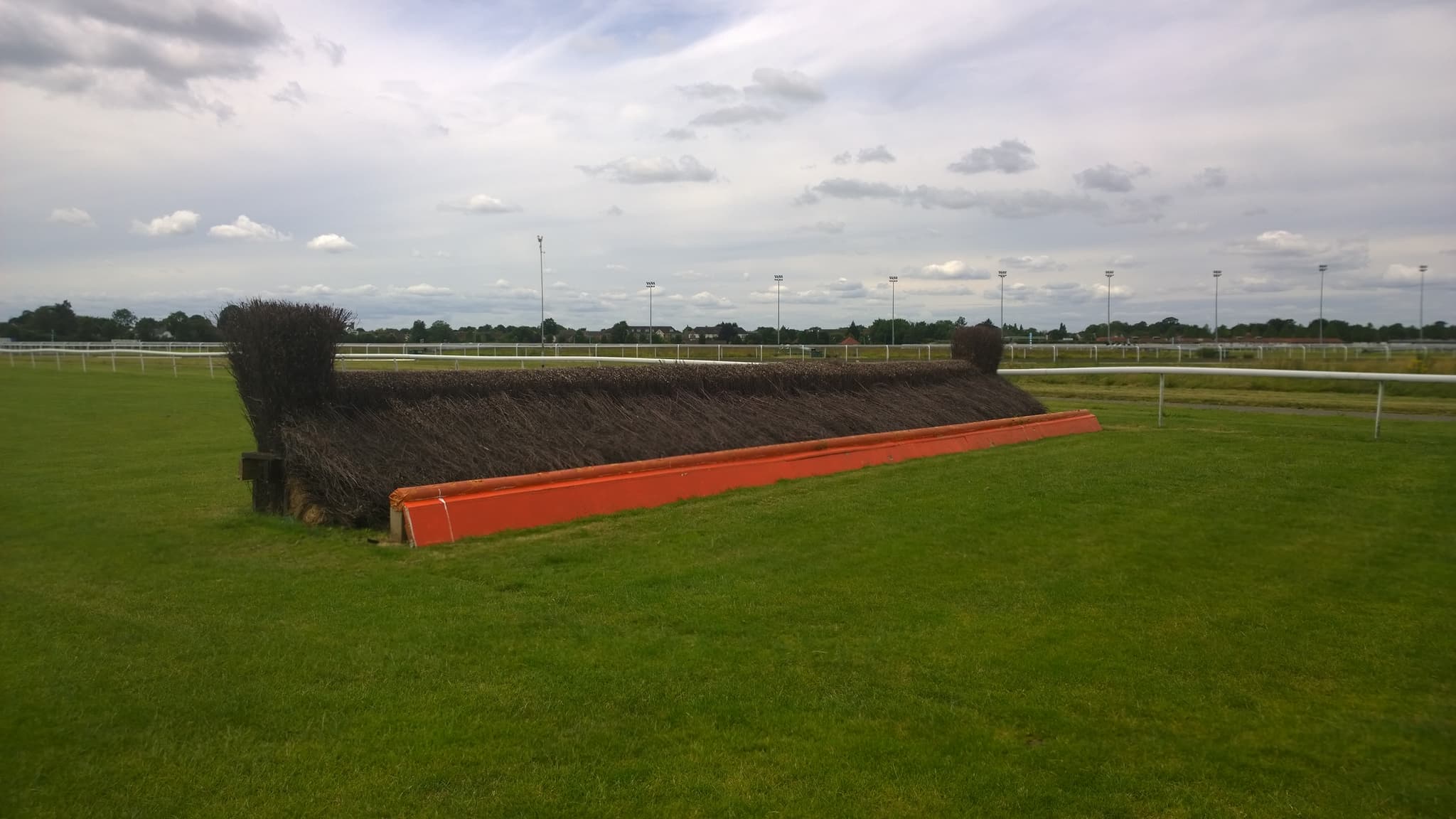
King George VI Chase Day at Kempton: The Complete Guide
Your complete guide to Boxing Day at Kempton Park — home of the King George VI Chase, the mid-season championship for staying chasers. Racing card, atmosphere, tickets, travel and betting guide.
Read more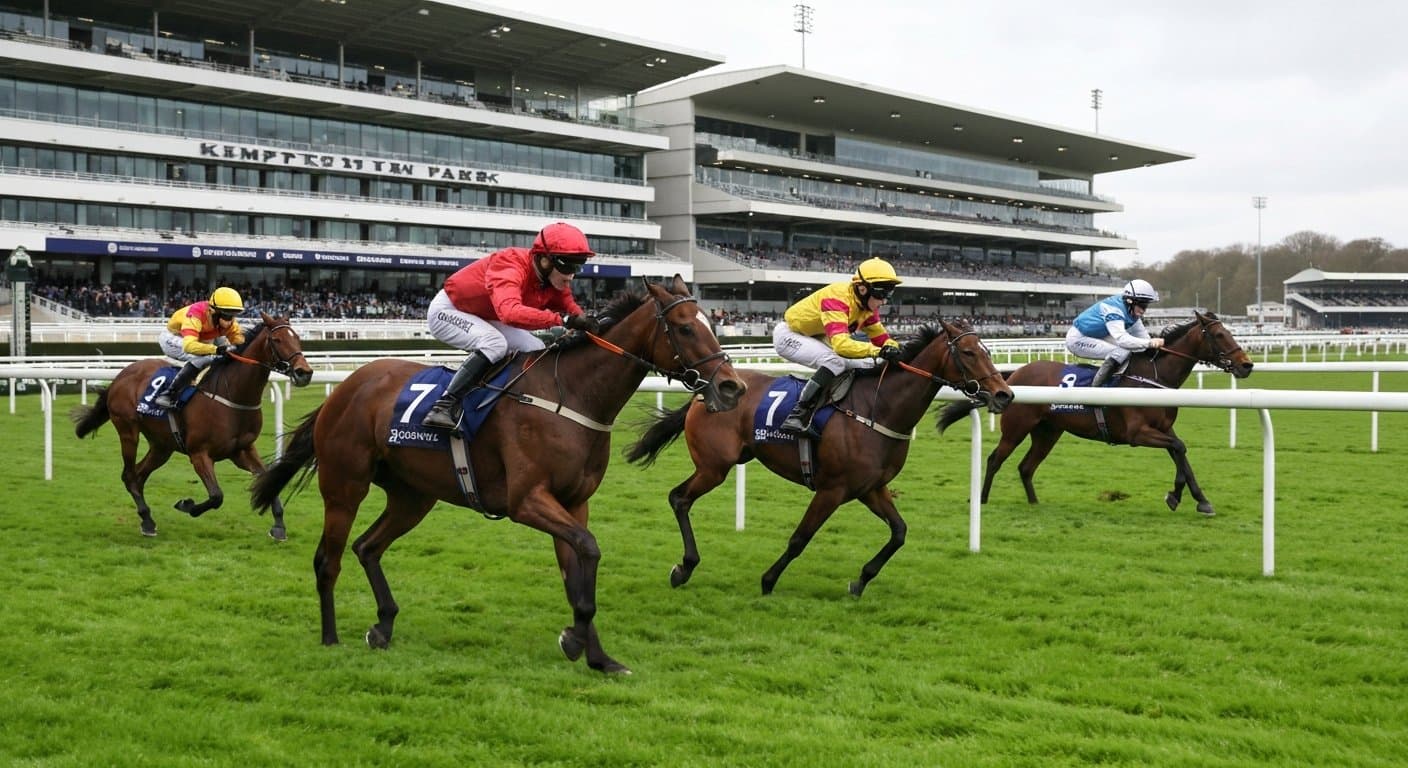
The King George VI Chase: Complete Guide
Everything you need to know about the King George VI Chase — Boxing Day's showpiece race at Kempton Park, from history to betting angles.
Read morePhotos on this page are used under Creative Commons licences. Titles, sources and licence links for each one are on our image credits page.
Betting offers for Kempton Park
Gamble Responsibly
Gambling should be entertaining and not seen as a way to make money. Never bet more than you can afford to lose. If you or someone you know has a gambling problem, help and support is available.