
Founder & Editor · Last reviewed 2026-07-13
Most racecourse histories run in a straight line from a founding meeting to the present day. Dundalk's does not. The track you can visit today, Ireland's only floodlit all-weather Flat course, only opened in August 2007. Yet horses have raced on this patch of ground at Dowdallshill, just north of Dundalk town in Co. Louth, since 1889. In between sits a demolition, a merger with a greyhound company, and a complete rebuild that cost around 35 million euro.
That break in the middle is the whole story. The original Dundalk was a turf course used mainly for National Hunt racing, and it closed in 2001. What replaced it is a different kind of venue altogether: a Polytrack oval built over the old circuit, with a greyhound track laid inside it, making Dundalk the only place in Europe where horses and dogs race at the same stadium. The identity here is not one great horse or one famous Classic. It is a format, a surface and a purpose, keeping Flat racing going through the Irish winter when turf tracks are frozen or waterlogged off.
Because of that, Dundalk's past reads less like a roll of honour and more like the story of how a small border-country track reinvented itself. The horses matter, and there is a genuine course specialist worth telling you about, but the real thread is the ground itself and the people who decided to rebuild it.
This article covers the turf course at Dowdallshill, the merger and all-weather rebuild, the horses that made their name here, the people who run and ride at the track, the records and stats, the feel of a Friday night under lights, Dundalk today, and answers to common questions.
The Turf Course at Dowdallshill
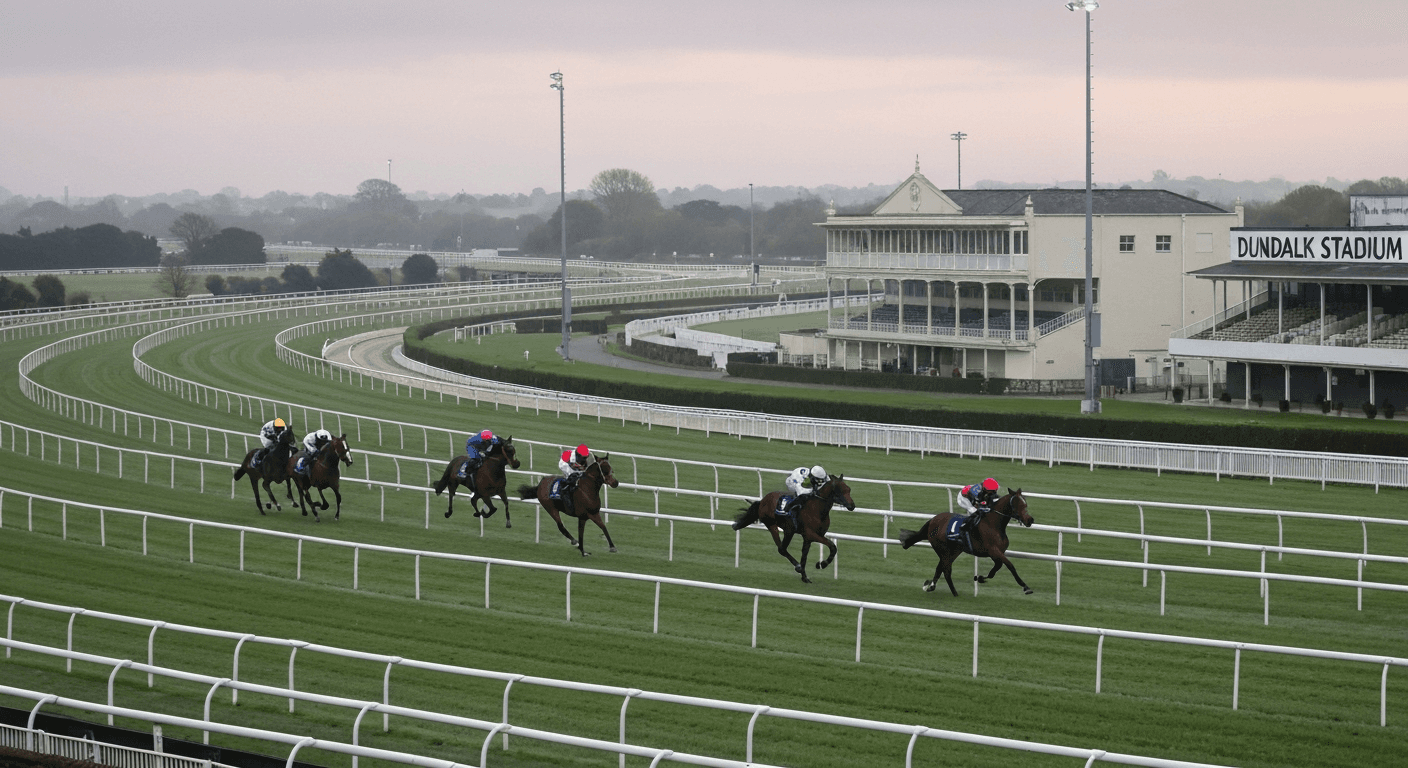
Horse racing at Dundalk dates to 1889, on a turf track at Dowdallshill on the northern edge of the town. For more than a century this was a conventional grass course, used predominantly for National Hunt racing rather than the Flat action the venue is known for now. It was a country meeting close to the border with Northern Ireland, roughly five kilometres south of the line, in a corner of Co. Louth that sits on the main road between Dublin and Belfast.
The turf course ran on that ground until 2001, when it closed. That closure was not the end of racing at Dundalk, but it drew a firm line under the first chapter. Everything the modern track is built on, the Polytrack oval and the floodlights, sits over the footprint of that old grass circuit rather than on a fresh site.
The Greyhound Strand
Dundalk's history has two strands that eventually became one, and the second is greyhound racing. Dogs first ran in the town in 1930, at the Ramparts stadium, run by the Dundealgan Greyhound Racing Company. The Ramparts was a circuit dating from that era, and for the best part of seventy years the horses at Dowdallshill and the greyhounds at the Ramparts were separate operations in the same town.
Greyhound racing at the old Ramparts stadium closed on 20 November 2000. Its story matters here because the people behind it went on to shape the rebuilt racecourse. The Martin family were long associated with Dundalk greyhound racing: Paddy Martin was the founding director of the Ramparts, later succeeded by his brother Jimmy, and then by Jim Martin Jr, who would become the driving force behind the merged venue.
Two Companies, One Idea
By the late 1990s both codes were looking at their future in the town. In late 1996 the greyhound management, Jim Martin Jr along with Gerry Kerley and Hugh McGahan, met the horse-racing management to discuss a merger. The logic was straightforward. Rather than run two ageing, single-purpose venues, the two companies could pool their ground and build one modern stadium capable of staging both sports.
That conversation set the direction for everything that followed. It led, in 1999, to the merger of Dundalk Race Company PLC and Dundealgan Greyhound Racing Company Limited into a single operator, Dundalk Racing (1999) Ltd. That new company had the mandate and the site to build a combined horse-and-greyhound stadium over the old turf course, with a greyhound track laid inside the main circuit. The milestones section picks up the build itself, the money spent and the grades the new track earned. What the origins come down to is simpler: an old grass course and an old dog track, in the same border town, deciding to become one thing.
The Merger and the All-Weather Rebuild
The rebuild of Dundalk happened in stages, and the dogs came first. The new greyhound stadium officially opened on 29 November 2003, at a cost of around 11 million euro. Minister John O'Donoghue performed the honours, and CEO Jim Martin gave thanks to Bord na gCon chairman Paschal Taggart, whose redevelopment of Shelbourne Park in Dublin had been the model for what Dundalk was trying to build.
The horse track followed four years later. The all-weather circuit officially opened on 26 August 2007, at a further cost of about 24 million euro, and it staged Ireland's first all-weather meeting on Polytrack. Polytrack is a wax-coated synthetic surface, a mix of silica sand, synthetic fibres, plastics and rubber. It is emphatically not turf, and the old grass course that had closed in 2001 was not coming back. Taken together, the greyhound stadium and the horse track, the total redevelopment is put at around 35 million euro.
That gave Dundalk something no other Irish course had: a floodlit, sound surface that could stage Flat racing through the winter, whatever the weather did to the turf tracks. It also made Dundalk the only combined horse-and-greyhound venue in Europe, with the dogs racing on a track inside the main horse circuit.
Earning Black Type
A new surface was one thing. Earning races worth travelling for was another, and this is where the two feature races come in, both with grade histories that are worth getting right.
The Diamond Stakes moved to Dundalk in 2008. It had a long history elsewhere before that, but at Dundalk it made a piece of Irish racing history in 2009 when it was promoted to Group 3, becoming Ireland's first non-turf Group race. It held that status until 2022, when it was downgraded back to Listed, the grade it carries today, run over 1 mile 2 furlongs and 150 yards.
The Mercury Stakes travelled the other way. First run at Dundalk in 2008 as a Listed sprint over 5 furlongs, it was upgraded from Listed to Group 3 for 2018, and that upgrade means the Mercury is now the highest-class race the track stages. So the two features crossed over: the Diamond came up in 2009 and back down in 2022, while the Mercury went up in 2018 and stayed there.
The Track Refined
The Polytrack itself was not left alone after 2007. A cutaway rail was introduced in December 2013, and the surface was refurbished in July 2015 to reduce kickback, both changes aimed at making the track ride more fairly. These are small engineering milestones rather than grand openings, but they are part of how the modern course settled into the reliable winter circuit it is now.
| Year | Milestone |
|---|---|
| 1889 | Turf racing begins at Dowdallshill |
| 2000 | Old Ramparts greyhound stadium closes |
| 2001 | Original turf course closes |
| 2003 | New greyhound stadium opens (about 11m euro) |
| 2007 | All-weather Polytrack horse track opens (about 24m euro), Ireland's first all-weather meeting |
| 2008 | Mercury Stakes and Diamond Stakes first run at Dundalk |
| 2009 | Diamond Stakes promoted to Group 3, Ireland's first non-turf Group race |
| 2013 | Cutaway rail introduced |
| 2015 | Polytrack surface refurbished to cut kickback |
| 2018 | Mercury Stakes upgraded to Group 3 |
| 2022 | Diamond Stakes downgraded back to Listed |
The Horses
Dundalk does not have a single defining champion, and it would be dishonest to pretend otherwise. The track is too young, and its purpose is too much about volume winter racing, for one horse to stand over it the way a Classic hero stands over an older course. What it does have is a genuine course specialist, plus a run of good Flat horses who passed through on their way to bigger days.
Togoville, the Course Specialist
The one horse whose name belongs to Dundalk above any other is Togoville. He holds the all-time course record with a reported 14 wins at the track, trained latterly by Anthony McCann. The record books put his exact Dundalk figures at 14 wins from 56 runs, with 14 of his 16 career victories coming here.
His first Dundalk win is dated to 5 December 2014, and notably he did not win at any other track after that. The grey ran on into old age, and in February 2021 he won three times in a fortnight aged 11 to stretch his course record to 14, before being retired later that year. Fourteen wins at one track is the kind of number that only a horse who truly loves a surface can put together, and it is the closest thing Dundalk has to a legend of its own.
Togoville also has a place in a sadder story. He provided champion jockey Pat Smullen with his final winning ride at Dundalk. That win came on 16 March 2018, when Togoville beat the 100-rated Primo Uomo by half a length in a four-runner conditions race. Smullen, a nine-time champion, died in September 2020, and the people section returns to his connection with the track.
Good Horses Passing Through
Beyond Togoville, Dundalk's horse honours are mostly about quality that moved on. The Diamond Stakes roll of honour includes two subsequent multiple Group 1 winners in particular: Aidan O'Brien's Mastercraftsman, who won the Diamond in 2009, and Declaration Of War, who won it in 2012 for the same stable before developing into a dual Group 1 winner the following year. The 2009 Mastercraftsman win carried extra weight because it came in the year the Diamond first became a Group race, and it was used as a Breeders' Cup prep.
Dundalk has also served as a first-win venue for horses who went on to the top level. Several subsequent Group 1 performers recorded their first career win here, including Caravaggio, Winter and Skitter Scatter, using the all-weather as a starting point before turf glory elsewhere.
The honest way to hold all this together is the way the track itself does. A handful of course specialists rack up wins because they suit the Polytrack, and a stream of better horses use Dundalk as a stepping stone. Other multiple course winners named on the record include Shake The Bucket, He's Our Music, Reckless Lad, Six Silver Lane and Sharjah, each reported on nine wins, with Grey Danube reaching six. None of them is a household name. That is the point. Dundalk is a working track, and its horses are working horses.
The People
If the horses at Dundalk are mostly working horses, the people are the more interesting story, because the track exists at all because of a handful of them.
Jim Martin and the Martin Family
The central figure is Jim Martin, the CEO who led the venue through its all-weather era and has won a Horse Racing Ireland racecourse award. The Martin name runs right through Dundalk's two strands. The family were long associated with Dundalk greyhound racing at the old Ramparts: Paddy Martin was the founding director there, later succeeded by his brother Jimmy, and then by Jim Martin Jr. It was Jim Martin Jr who, in late 1996, was among the greyhound managers who opened merger talks with the horse-racing side, and it was Jim Martin who thanked Bord na gCon chairman Paschal Taggart when the new stadium opened. The reinvention of Dundalk is, in large part, a family project.
Trainers and Jockeys
On the track, two names dominate the modern record. Mick Halford has trained more winners at Dundalk than anyone else, with a reported 121 winners from 715 runners, making him the leading trainer at the course. Aidan O'Brien is the other big training presence, with a high strike rate of around 22 per cent from his runners and eight Diamond Stakes wins to his name across the race's turf and Dundalk eras.
The leading jockey of the modern era is Colin Keane. Course statistics credit him with 121 winners from 719 rides, and he rode 115 winners across 2015 to 2019 alone, more than 40 clear of any other rider in that spell. Ronan Whelan and Shane Foley are other high-volume course riders, the kind of names that fill Dundalk's Friday-night results through the winter. Adrian Murray was the standout trainer at the track in 2025.
Pat Smullen
Dundalk holds a particular place in the story of Pat Smullen, the nine-time Irish champion jockey. He rode both his first and his last winners at the track, and his last winning ride there came aboard the course specialist Togoville in March 2018. Smullen died in September 2020, and the track ran the Mercury Stakes in his memory that autumn. For a venue that trades in everyday winter racing rather than grand occasions, that connection to one of Irish racing's most respected figures is a genuine point of pride.
Records and Stats
Dundalk's all-weather figures are unusually consistent from meeting to meeting, which is one of the reasons the surface earned its winter role. The times a horse runs on Polytrack vary far less than times on turf, where the going swings from firm to heavy. That said, a single authoritative published course-record table was not found from the course or from Horse Racing Ireland, so the times below are best read as indicative fast times rather than official records.
| Reference point | Detail |
|---|---|
| Course-record table | Not published; times are consistent but no official record set is confirmed |
| 5-furlong marker | 2025 Mercury Stakes run in 58.57s |
| 1m2f150y marker | 2025 Diamond Stakes run in 2m 11.61s |
| 1-mile marker | Cooley Fillies Stakes 2020 run in 1m 35.38s |
Leading Figures at the Track
The win counts here are course-bound and match the people section. Mick Halford is the leading trainer with a reported 121 winners from 715 runners. Colin Keane is the leading jockey of the modern era, credited with 121 winners from 719 rides. Aidan O'Brien has the highest strike rate among the big yards at around 22 per cent, and eight Diamond Stakes wins across the race's history. Among horses, Togoville's reported 14 wins is the all-time course record, four clear of the group of nine-time winners behind him.
A Note on the Draw
The most quoted statistical quirk at Dundalk is not a record time but a draw bias. Low draws are favoured, and the advantage is strongest over 5 and 6 furlongs, where runners meet a bend soon after the start. Over 7 furlongs the bias is only slight, and over a mile there is barely any edge. This is course description rather than a betting angle. As a general and honest point, no policy of backing favourites, and no betting system, is profitable over the long run; the draw pattern is a feature of the track, not a way to beat it.
Friday Nights Under Lights
The thing that makes Dundalk feel different from any other Irish course has nothing to do with grand history and everything to do with a Friday night in January. This is a floodlit venue, and its identity is built on floodlit Friday-night racing through the Irish winter, when most of the country's turf tracks are shut.
The format is the culture. Fridays are dual race nights: the horses run under the lights on the Polytrack oval, and then the greyhounds race on the sand track inside the same circuit, the only such combination anywhere in Europe. Doors open about an hour before the first horse race, the horse card runs through the evening, and the dogs follow, with the last greyhound race at around 10.20pm and music often carrying on afterwards. You can watch two sports and a band on the same ticket, which is not something any turf course can offer.
The setting helps. The three-storey grandstand looks out over both tracks, and the trackside View Restaurant on an upper floor takes in the finish and, beyond it, the Cooley Mountains. The venue leans into being more than a racecourse, hosting weddings, birthdays, conferences and concerts alongside the racing, which is part of how a winter-heavy operation keeps the lights on and the crowds coming.
The racing itself sets the tone too. Dundalk cards are typically big-field, competitive handicaps and maidens rather than uniformly high-class contests, and nearly all of Ireland's leading Flat trainers use the venue through the winter to keep horses ticking over. That gives a Friday night at Dundalk a particular character: not the once-a-year glamour of a festival, but a reliable, busy, well-run evening of racing that the Irish Flat programme genuinely depends on. Two nights a year raise the class, when the Diamond Stakes card in September and the Mercury Stakes card in October bring the black-type quality, but the everyday winter night is the real Dundalk.
Dundalk Today
The modern Dundalk is the product of the roughly 35 million euro spent rebuilding it, and the figures behind that total are worth reporting in full rather than rounding into a single headline. The greyhound stadium opened in 2003 at a cost of around 11 million euro. The all-weather horse track followed in 2007 at a further cost of about 24 million euro. Together they make up the 35 million euro redevelopment that turned two ageing single-purpose venues into one dual-code stadium.
Ownership and Governance
The course is operated by Dundalk Racing (1999) Ltd, the company formed in 1999 by the merger of Dundalk Race Company PLC and Dundealgan Greyhound Racing Company Limited. CEO Jim Martin has led it through the all-weather era. One business database names Leo McCauley as chairman, but that has not been confirmed from an authoritative racing source, so it is best treated as unverified rather than stated as fact.
The Track Today
Dundalk is a left-handed Polytrack oval of about 1 mile 2 furlongs, with a run-in of roughly two and a half furlongs, a 5-furlong chute that joins the home bend, and a 1-mile start in a chute at the top of the back straight. The surface rides on the fast side, broadly like good to firm going on turf, which means horses that need soft ground are not always suited here. The cutaway rail added in 2013 and the surface refurbishment in 2015 were both aimed at making the track fairer and cutting down kickback.
Horse Racing Ireland's official course page puts Dundalk at 43 fixtures across the year, and describes it as especially busy in the winter, staging Flat racing weekly from late October to mid-March. That winter programme is anchored by the Winter Series, a run of handicaps that culminates in a season-ending awards day; the 2026 finale was held on Friday 20 March, built around a set of 15,000 euro handicaps restricted to horses that had run at Dundalk through the winter. This finale is distinct from the higher-class black-type night around the Diamond and Mercury Stakes, which is the strongest fixture in pure racing-quality terms.
Reach and Backing
Dundalk's Friday-evening fixtures have become a staple of Racing TV, which began broadcasting Irish racing in 2019 when the media rights covering Ireland's racecourses passed to Racecourse Media Group and SIS. On the commercial side, Bar One Racing was the headline sponsor for the 2025/26 season and of both the Diamond and Mercury Stakes.
For all its success as a winter workhorse, Dundalk remains a young course still defining itself. Its value to Irish racing is clear and specific: it is the one all-weather Flat track in the country, the place that keeps the sport running when the frost and the rain close everything else. The complete guide covers how to visit and what to expect on the night.
Frequently Asked Questions
Share this article
More about this racecourse
All dundalk guides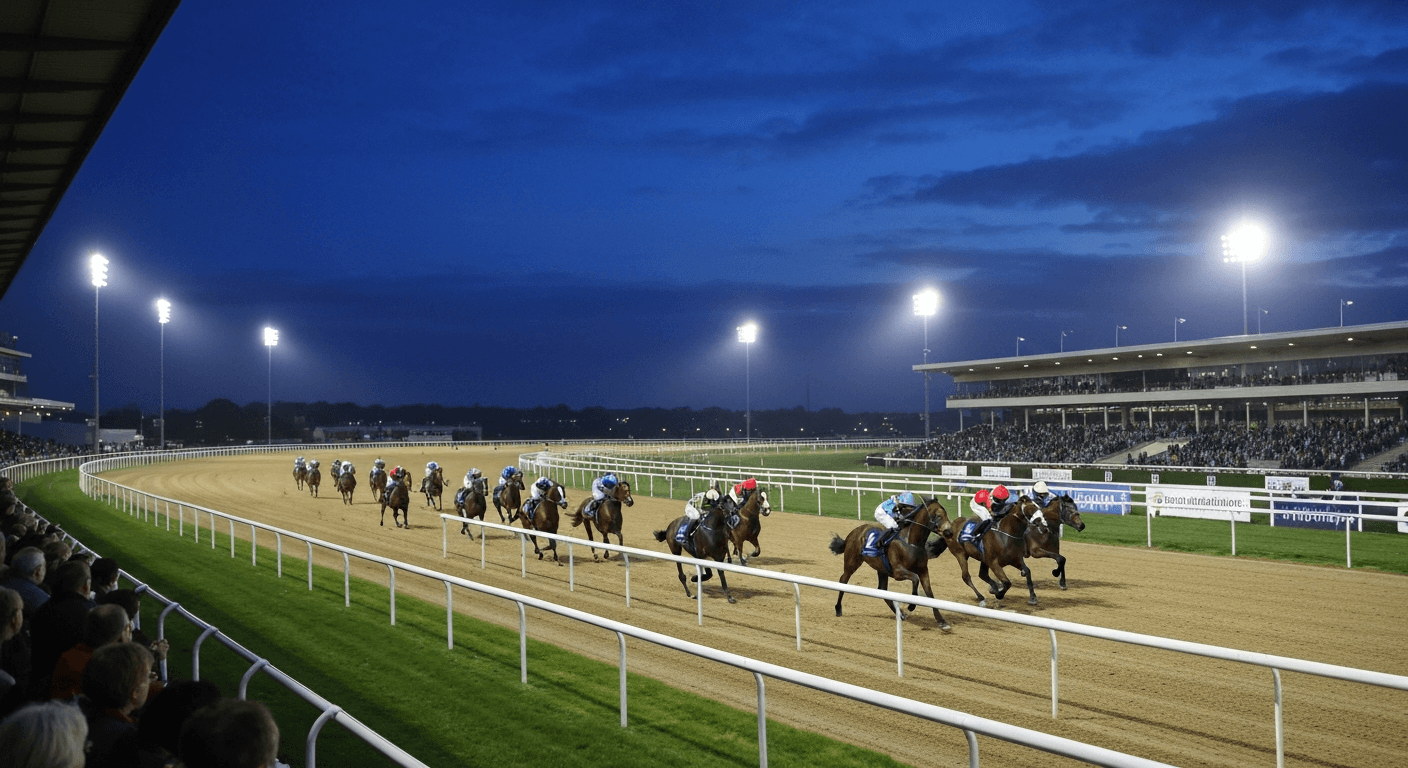
Dundalk Racecourse: The Complete Guide
Dundalk Racecourse, Ireland's only floodlit all-weather Flat track in Co. Louth, home of the Mercury and Diamond Stakes, plus tickets, travel and how to visit.
Read more
Mercury Stakes Night at Dundalk: The Complete Guide
A complete guide to the Group 3 Mercury Stakes, Dundalk's highest-class race, the floodlit Friday nights it headlines in late October, and the Listed Diamond Stakes.
Read moreDundalk: Ireland's Floodlit All-Weather Home
How Dundalk became the Republic's only floodlit all-weather Flat track and Europe's only combined horse-and-greyhound venue, racing on Friday nights.
Read moreGamble Responsibly
Gambling should be entertaining and not seen as a way to make money. Never bet more than you can afford to lose. If you or someone you know has a gambling problem, help and support is available.