
Founder & Editor · Last reviewed 2026-06-29
A field in Meath that became Easter Monday
On Easter Monday, while most of Ireland is finishing off the chocolate eggs and arguing about the weather, tens of thousands of people point their cars towards a stretch of grass near Ratoath in County Meath. They are going to Fairyhouse, and they are going for one race above all the others: the Irish Grand National, run since 1870 and woven so tightly into the Dublin holiday calendar that the meeting has been nicknamed the "Dubs' Day Out" for the Dublin crowds it draws.
Fairyhouse is not just the venue for a single famous race. It is a working, dual-code racecourse owned by Horse Racing Ireland, staging around 20 to 21 fixtures a season, the great majority of them over jumps with a handful of Flat cards in spring and summer. It sits on the R155, about three kilometres off the M3 and roughly 23 kilometres north-west of Dublin city centre, close enough to the airport that visiting horses and travelling supporters can be on-course inside half an hour. The address is plain enough: Fairyhouse Road, Ballybin, Ratoath, Co. Meath, eircode A85 XK30. What grows out of that plain address is anything but plain.
The story of Fairyhouse is really three stories layered on top of one another. There is the hunting story, because the course began life in 1848 as a point-to-point run by the Ward Union Hunt, and the gallop only became a permanent racecourse over the following decade. There is the championship story, because the Irish Grand National turned a local fixture into the centrepiece of the Irish steeplechasing year, drawing in the names that define the sport: Arkle, Brown Lad, Desert Orchid, Tom Dreaper, Pat Taaffe. And there is the modern story, of a course that passed into state hands in 2007, was rebuilt and re-sponsored, and now anchors two festivals at opposite ends of the National Hunt season.
This is a history of all three. It runs from an 1848 hunt point-to-point to a 30-runner handicap worth half a million euros, and it explains how a field in Meath became one of the few dates the whole country keeps in its head.
This guide covers the origins of the course, the making of the Dubs' Day Out, the modern track fence by fence, the horses that made Fairyhouse, the people behind the National and the modern HRI era, and finishes with answers to common questions.
Where to Bet
Place your bets with a trusted, licensed bookmaker.

Promo code BETFRED50. New customers only. Register, deposit with a Debit Card, and place a first bet of £10+ at Evens (2.0)+ on Sports, to be settled within 7 days, to get £30 in Sports Free Bets and £20 in Bet Builder Free Bets within 24 hours of settlement. 7-day expiry. Eligibility & payment exclusions apply. Full T&Cs apply. Take Time to Think. BeGambleAware.org. 18+. Full T&Cs.

Promo code R30. New UK customers only, 18+. Register, deposit £10 or more, then place a £10 single cash bet at odds of 1/2 (1.5) or greater on any sports market (excluding Virtuals). Once the qualifying bet settles you get £30 in Free Bets (3 x £10) — the qualifying bet can win or lose. Free Bets are valid on any sports market excluding Virtuals, expire in 7 days, are non-withdrawable and must be used in full. Excluded deposit methods apply (including PayPal, Apple Pay, Skrill and NETELLER). Named bets such as Lucky 15 do not qualify. If you cash out the qualifying bet, or it is voided, you are no longer eligible for the offer. Ends 31.12.26. Full T&Cs apply. Please gamble responsibly. BeGambleAware.org. 18+. Full T&Cs.

Promo code BET40GET20. New UK customers, 18+. Register with the code and place a first bet of £40 or more at Evens (2.0) or greater. Receive 2 × £10 free bets: the first credited automatically once the qualifying bet settles, the second 24 hours later. Free bets must be placed at minimum odds of 4/1 (5.0), expire 24 hours after credit, and the free-bet stake is not returned with winnings. Debit card deposits only. Take Time to Think. BeGambleAware.org. 18+. T&Cs apply. Full T&Cs.

50% of your first-day net losses refunded as a free bet, capped at £25. New UK customers aged 18+ only. To qualify, deposit and place a first bet of £10 or more on any sport at minimum odds of evens (2.00), then place at least two further bets on different events, each worth at least 50% of your largest bet, all at evens (2.00) or greater. Losses are counted from your first settled bet until 23:59 the same day. Place a qualifying £10+ bet and you are guaranteed at least a £5 free bet. Bets placed at SP, void bets, cashed-out bets and bets struck with free bets do not count towards the offer. The free bet is credited the day after your qualifying bets settle and must be used within 7 days, after which it expires. It can be used at odds from 1/4 (1.25) up to 250/1 on singles and straight accumulators, but not on Trixie, Patent or Yankee style multiples. Free-bet stake is not returned with winnings. One offer per person, household, address, IP address and device. E-wallet deposits may not qualify, so check the cashier before depositing. Customers registered with GAMSTOP cannot claim. KYC identity verification must be completed before the free bet is credited. Take Time to Think. BeGambleAware.org. 18+. T&Cs apply. Full T&Cs.

New customers, 18+. Choose the sports bonus at sign-up, make a first deposit and receive a 100% bonus up to £50 in your Sports Bonus balance. To convert the bonus to cash, wager it 10x within 30 days. Single bets below Evens (2.00) do not qualify; accumulators do not qualify if any selection is below 1/2 (1.50). Virtual Sports, voided, cancelled, drawn, cashed-out and free-bet wagers do not count towards wagering. Only the first settled bet per event counts. Withdrawing before the wagering requirement is met forfeits the bonus balance including bonus winnings. Real-money funds are used before bonus funds. Deposits via Skrill or Neteller are not eligible. Not valid in conjunction with other promotions. Odds, bet and payment limits apply. 10bet general and promotion T&Cs apply. BeGambleAware.org. 18+. Full T&Cs.

New customers in Great Britain and Republic of Ireland, 18+. Place a £10 fixed-odds qualifying bet at minimum odds of 1/2 (1.50) — single or each-way (only the win part counts), pre-event or in-play, not cashed out early, within 28 days of opening the account. Receive up to £60 in bonuses credited over three days: 3 × £10 fixed-odds free bets (the first on settlement, then 24 and 48 hours later) plus 3 × £5 Total Goals FOOTBALL spread bets, 3 × £5 racing Winning Favourites spread bets and a £1 racing Race Index spread bet (the spread bets need a full spread-betting account). Free-bet stakes not returned with winnings; free bets valid 28 days from issue. IMPORTANT: the £5 credits are SPREAD bets — sports spread betting carries the risk that losses can exceed your stake. Sports spread-betting customers do not have Financial Ombudsman or FSCS recourse. Take Time to Think. BeGambleAware.org. 18+. T&Cs apply. Full T&Cs.

Promo code WELCOME15, entered under My Bonuses after registering. New UK customers, 18+. Place a first qualifying bet of at least £10 from your cash balance at odds of evens (2.0) or greater within 7 days of opening the account. Once the qualifying bet fully settles you receive £15 in free bets, credited as 3 x £5 tokens with set uses: one £5 accumulator free bet (minimum 4 legs, each leg at 2/5 or bigger), one £5 sports free bet (any market at evens or bigger) and one £5 Sub Cover free bet (selected football player markets at evens or bigger). Free-bet stakes are not returned with winnings. Free bets expire 7 days after they are credited. Void, cashed-out and partially cashed-out bets do not qualify. One offer per customer. Confirm the current terms on BetGoodwin's own welcome-offer page before claiming. Take Time to Think. BeGambleAware.org. 18+. T&Cs apply. Full T&Cs.

New UK customers, 18+. Minimum deposit £10. Place a £10 qualifying single at minimum odds of 1/2 (1.50), settled within 14 days. Receive £30 in free bets (stake not returned), split £20 for sportsbook use (2 x £10) and £10 for Bet Builder only (2 x £5); Bet Builder does not cover horse racing. Free bets must be accepted within 7 days and expire 7 days after acceptance. No promo code required. Best Odds Guaranteed on UK & Irish racing, subject to having staked over £25 in the previous seven days. Operated by LiveScore Betting and Gaming (Gibraltar) Ltd, UKGC 56859. Confirm the current terms on LiveScore Bet's own promotions page before claiming. Take Time to Think. BeGambleAware.org. 18+. T&Cs apply. Full T&Cs.
18+. BeGambleAware.org
From the Ward Union Hunt to Sir Robert Peel
Fairyhouse owes its existence to the hunting field. The first meeting on the present site was a point-to-point staged by the Ward Union Hunt in 1848, the kind of cross-country contest between hunters that was the seedbed of Irish steeplechasing. The Ward Union was a recognised pack, and the gallop it used near Ratoath proved good enough that, within about a decade, the venue had developed from an occasional hunt fixture into a full National Hunt racecourse. For decades afterwards the course continued to host Fingal and Ward Union point-to-points alongside its rules racing, a thread that ran right through its history: the last Ward Union fixture at the venue was held as recently as 1995, and point-to-pointing returned to the inner course in 2014.
The first Irish Grand National, 1870
The race that made the place arrived in 1870. The first Irish Grand National was run at Fairyhouse that year and was won by a horse called Sir Robert Peel, whose connections collected 167 sovereigns for the victory. It was the right race in the right place at the right moment. The wider Irish steeplechasing framework was being formalised around the same time: some accounts trace the National Hunt steeplechase tradition to the Curragh before it settled at Fairyhouse, and the Irish National Hunt Steeplechase Committee had been formed in 1869, the year before the inaugural National. From that first running the Irish Grand National quickly became the country's most valuable and prestigious steeplechase, a status it has never really surrendered.
The early race was not quite the race we know today. It was run over three miles four furlongs rather than the modern three miles five, a distance that only changed in 1991. But the essential shape was already in place: a long, gruelling handicap chase over a stiff right-handed circuit, run at Easter, open to the staying chasers of the day and decided as much by stamina and the state of the ground as by class.
Winners who outgrew the race
Even in its earliest decades the National threw up horses that mattered. Scots Grey won it twice, in 1872 and 1875. The Gift took back-to-back runnings in 1883 and 1884. And in 1904 the race was won by Ascetic's Silver, who went on to win the Aintree Grand National in 1906, an early sign of a pattern that would repeat for more than a century: Fairyhouse as a proving ground for horses good enough to win Nationals on both sides of the Irish Sea. By the time the new century turned, the Easter Monday fixture was already a fixed point in the Irish sporting year, and the course around it was being shaped to match the size of the occasion.
The making of the Dubs' Day Out
If the nineteenth century gave Fairyhouse its race, the twentieth century gave it its identity. The Easter Monday fixture became a Dublin institution, drawing in city crowds in numbers that earned the meeting its enduring nickname, the "Dubs' Day Out." For a bank-holiday population looking for somewhere to go, a half-hour drive north-west to a big handicap chase became part of the routine of the Irish Easter, and the National sat at the centre of it.
The Dreaper era
The single biggest factor in cementing the Irish Grand National's status was a trainer from nearby. Tom Dreaper turned the race into something close to a family possession. His first National winner was Prince Regent in 1942, a horse who went on to win the 1946 Cheltenham Gold Cup, and the connection between Fairyhouse and the very best staying chasers in training was set from there. Dreaper's roll of honour in the race is extraordinary: ten winners in all, including a run of seven in a row from 1960 to 1966, taking in Olympia (1960), Fortria (1961), Kerforo (1962), Last Link (1963), Arkle (1964), Splash (1965) and Flyingbolt (1966). No other trainer has dominated a major handicap quite like that.
The Dreaper grip did not loosen with Tom. His son Jim Dreaper added four more Irish Grand Nationals, starting with Colebridge in 1974 and continuing with the three wins of Brown Lad in 1975, 1976 and 1978. Between father and son, the Dreaper stable trained 14 Irish Grand National winners, a record that frames the whole middle of the twentieth century at Fairyhouse.
Two festivals, not one
Over time the course built out a second showpiece to balance the spring centrepiece. The Easter Festival grew into a three-day meeting built around Irish Grand National Day, while a separate Winter Festival was developed as Ireland's premier pre-Christmas jumps meeting in late November or early December. The Grade 1 races that anchor each festival were largely established in the modern form we know in 1994: the Hatton's Grace Hurdle, named after the three-time Champion Hurdle winner trained by Vincent O'Brien, and the Drinmore Novice Chase among them.
Sponsorship followed the prestige. The Irish Grand National carried a long association with Irish Distillers through the Powers and Jameson whiskey brands up to 2010, one of the longest commercial relationships in Irish racing, before Ladbrokes took over from 2011 to 2013 and BoyleSports came on board in 2014. The Winter Festival is sponsored by BAR 1 Betting, formerly Bar One Racing, whose involvement with the course dates back to the Royal Bond in 2006 and deepened in 2008 with the Drinmore and the Hatton's Grace. By the time these deals were in place, Fairyhouse had two distinct identities in the calendar: the great spring handicap, and the autumn championship trials that feed Cheltenham, Punchestown and Aintree.
The modern course, fence by fence
To understand why certain horses win at Fairyhouse and others find it unforgiving, you have to understand the shape of the track. Fairyhouse is a right-handed, clockwise turf circuit, broadly square or oblong, and generally described as wide and galloping. It is turf only; there is no all-weather surface here. The circumference is about one mile six furlongs, with several sources giving one mile six and a half, which is why the course is so often summed up as "about a mile and three-quarters round."
Climbs, descents and a short run-in
It is not a flat track in any sense. There is a steady climb on the far side away from the stands up to the highest point, a rise known as Ballyhack, followed by a descent down the back straight before the finish. The home straight runs about two and a half to three furlongs and is slightly uphill. The detail that decides races, though, is the run-in: from the last fence on the chase course it is relatively short, around a furlong, which means a horse cannot afford to be too far back at the final obstacle despite the climb to the line. There is little time to make up ground.
The chase course carries eleven fences to a circuit and is widely regarded as among the stiffest in Ireland. The inner hurdle course has seven flights to a circuit. The Irish Grand National itself, run over about three miles five furlongs, involves two full circuits and 24 fences, a relentless test of jumping and stamina. The inner point-to-point track, which returned to use in 2014, sits inside the rules course, is just over a mile round with five fences, and is sharper than the main circuit.
How the track rides
For all its stiffness, Fairyhouse has a reputation as a fair galloping course with few hard-luck stories. Over jumps, winners come both from the front and from off the pace, though front-runners hold a solid record in the larger-field handicap chases, helped by that short run-in. On the Flat, the short run after the final bend favours prominently ridden horses, and over the sprint trips of six and seven furlongs a low draw is generally considered a slight advantage, though analysts stress that pace from the stalls matters more than the draw and that a slow-starting, hold-up horse drawn low can be trapped on the rail.
Ground is the other great variable. Fairyhouse can be heavily affected by wet weather, and its winter and early-spring meetings frequently produce soft or heavy going. For the 2024 Easter Festival the ground was officially heavy, and the course cut maximum fields in non-graded races to 20 from 25 to protect the going for the feature races. The toll that testing ground can take is best shown by the 2025 Irish Grand National: 30 runners set out and only 15 completed the course. There is no published all-time course-record board at Fairyhouse, and winning times vary so widely with the going that cross-era comparison means little; as an illustration, the 2025 National was run in 8 minutes 11.80 seconds on soft-to-heavy ground.
The horses that made Fairyhouse
A racecourse is remembered through its horses, and Fairyhouse has a roll of honour that runs from the greatest chaser who ever lived to a 150/1 outsider on a closed-doors afternoon.
Arkle
Arkle is widely regarded as the greatest steeplechaser of all time and remains the highest-rated chaser by Timeform. He won the Irish Grand National in 1964, carrying 12st under Pat Taaffe for Tom Dreaper, on a career that also delivered three Cheltenham Gold Cups between 1964 and 1966. He had already announced himself at the course by winning the 1963 Power's Gold Cup, the race that has since run under the Ryanair and WillowWarm banners. For all his Cheltenham fame, Fairyhouse can fairly claim a share of Arkle's story.
Brown Lad
If Arkle is the greatest name, Brown Lad is the great course specialist. He is the only three-time winner of the Irish Grand National, taking the race in 1975, 1976 and 1978 for Jim Dreaper, and carried 12st 2lb to victory in two of those wins. No horse has done more in the race that defines the venue, and he stands as its most celebrated specialist.
Flyingbolt and Prince Regent
Two more Dreaper-trained chasers fill out the golden age. Flyingbolt, Arkle's stablemate, is rated by Timeform as the second-best chaser of all time and won the 1966 Irish Grand National. Prince Regent, the 1942 winner, went on to land the 1946 Cheltenham Gold Cup, the horse who began the whole Dreaper dynasty at the course.
Desert Orchid
The grey came to Meath in 1990 and produced one of the most memorable performances in the race's history, winning the Irish Grand National under top weight, ridden by Richard Dunwoody for David Elsworth. A top-weight winner is a rare thing in a handicap of this severity; Flashing Steel, who carried 12st in 1995, was the last to manage it.
The Aintree double acts
Fairyhouse has a long habit of producing horses good enough to win the Aintree Grand National too. Bobbyjo won the Irish National in 1998, trained by Tommy Carberry and ridden by his son Paul, then won at Aintree in 1999; a Fairyhouse function room and the Bobbyjo Chase are both named after him. Numbersixvalverde followed the same path, winning at Fairyhouse in 2005 for Martin Brassil and Ruby Walsh before taking Aintree in 2006. More recently I Am Maximus won the 2023 Irish Grand National for Willie Mullins and Paul Townend, owned by JP McManus, and went on to the 2024 Aintree Grand National, having also landed the 2023 Drinmore and 2024 Bobbyjo Chase at the course. Tiger Roll, the dual Aintree hero, won the Irish National in both 2018 and 2019.
The hurdling greats
The Hatton's Grace Hurdle has been won by some of the finest hurdlers in training. Istabraq won it in 1997 and 1998 for Aidan O'Brien on his way to three Champion Hurdles. Limestone Lad (1999, 2001, 2002) and Solerina (2003, 2004, 2005) each took it three times, as did Apple's Jade for Gordon Elliott from 2016 to 2018 and Honeysuckle for Henry de Bromhead from 2019 to 2021, the latter ridden throughout by Rachael Blackmore. Teahupoo then matched the feat with wins in 2022, 2023 and 2025 for Elliott, ending Honeysuckle's unbeaten run in 2022. Honeysuckle's standing at the course is marked by the Easter Sunday mares' Grade 1 now run in her name.
The longshots
For all the champions, the National is a handicap, and handicaps spring surprises. In 2021, run behind closed doors during the pandemic, Freewheelin Dylan won at 150/1 for Dermot McLoughlin and Ricky Doyle, the longest-priced winner in the history of the race. It is a useful reminder of what kind of contest this is.
| Horse | Fairyhouse highlight |
|---|---|
| Arkle | Irish Grand National 1964 (12st); 1963 Power's Gold Cup |
| Brown Lad | Irish Grand National 1975, 1976, 1978 (only three-time winner) |
| Flyingbolt | Irish Grand National 1966 |
| Desert Orchid | Irish Grand National 1990 (top weight) |
| Bobbyjo | Irish Grand National 1998, then 1999 Aintree |
| I Am Maximus | Irish Grand National 2023, then 2024 Aintree |
| Honeysuckle | Hatton's Grace Hurdle 2019, 2020, 2021 |
| Teahupoo | Hatton's Grace Hurdle 2022, 2023, 2025 |
The trainers, jockeys and families behind the National
Behind every great Fairyhouse horse stands a trainer, a jockey or a racing family, and the Irish Grand National in particular has been shaped by a small number of names across the generations.
The Dreapers
Tom Dreaper is the most successful trainer in the history of the Irish Grand National, with ten wins. Beginning with Prince Regent in 1942, he assembled a record that includes the celebrated seven-in-a-row sequence from 1960 to 1966: Olympia, Fortria, Kerforo, Last Link, Arkle, Splash and Flyingbolt. His son Jim Dreaper added four more, including all three of Brown Lad's victories, so that the Dreaper family alone accounts for 14 winners of the race. It is difficult to overstate what that means for one yard in a single handicap.
Pat Taaffe and the great jockeys
Pat Taaffe is the leading rider in the race's history, with six wins, including Royal Approach (1954), Umm (1955), Zonda (1959), Fortria (1961), Arkle (1964) and Flyingbolt (1966). His name is forever linked with Arkle. Among more recent riders, Ruby Walsh and Martin Molony each won the National three times; Walsh's victories came aboard Commanche Court (2000), Numbersixvalverde (2005) and Burrows Saint (2019).
The Carberry and Walsh families
Few families are woven as tightly into the National as the Carberrys. Tommy Carberry won the race as both a jockey and, in 1998, as the trainer of Bobbyjo, ridden by his son Paul. Paul, Philip and Nina Carberry have all won the race as riders. The course also has a strong record of female winning jockeys: Ann Ferris was the first, on Bentom Boy in 1984; Nina Carberry won on Organisedconfusion in 2011; and Katie Walsh took the 2015 running on Thunder And Roses.
The modern powerhouses
The two trainers who dominate Irish jumps racing today both have their names on the Fairyhouse honours boards. Willie Mullins has won the Irish Grand National with Burrows Saint in 2019 and I Am Maximus in 2023, and his stable has been close to unbeatable in the Honeysuckle Mares Novice Hurdle, winning it with Augusta Kate, Laurina, Brandy Love, Ashroe Diamond, Jade de Grugy and Aurora Vega among others, and features heavily on the WillowWarm Gold Cup roll of honour. Gordon Elliott is the other modern force: he won the National with General Principle in 2018 and with Tiger Roll in both 2018 and 2019, and is the leading trainer in the Drinmore Novice Chase with nine wins and a dominant figure in the Hatton's Grace through Apple's Jade and Teahupoo. Jack Kennedy, his stable jockey, has won the Hatton's Grace five times.
The administrators
A racecourse also needs people to run it. Peter Roe was general manager from 2010 until his final raceday in late March 2025, having first joined Fairyhouse as assistant manager in 1997 and managed Tipperary before returning to Meath. He moved into the new role of Head of Racing for HRI Racecourses, overseeing Leopardstown, Fairyhouse, Navan and Tipperary, and nominated Fairyhouse's HRI Racecourse of the Year award in December 2024 as his personal highlight. He had succeeded a line that included Dick Sheil, manager from 1999 to 2006, and Caroline Gray, who took over from October 2007. John Sheridan was appointed Roe's successor as general manager in 2025, joining from Vodafone Ireland.
HRI, redevelopment and the modern era
The modern history of Fairyhouse is a story of modernisation, ownership change and rising prize money, played out around the two festivals that now anchor its calendar.
The 1999 rebuild
The most visible change to the venue came at the end of the twentieth century. In 1999 the new Powers Gold Label Stand was opened and the Jameson Stand was refurbished and reopened, modernising the course and giving it the two main grandstands it works from today. Horse Racing Ireland describes this as a key modernisation of the venue, and the track foreman Noel Fanning recalled the 1999 stands as "a huge, great, adjustment to Fairyhouse." The redevelopment sometimes referred to as happening "around 2000" appears to be the same 1999 project rather than a separate one.
Into state hands
The ownership of the course changed in 2007. Fairyhouse had previously been owned and operated by Fairyhouse Club Ltd, but after financial difficulties it passed to Horse Racing Ireland, and it is now run through HRI's subsidiary HRI Racecourses Ltd, the same arm that operates Leopardstown, Navan and Tipperary. That change brought the course into the structure that governs Irish racing today, with Paul Dermody as CEO of HRI Racecourses and Suzanne Eade as CEO of Horse Racing Ireland.
Bigger prizes, bigger reach
The race at the heart of it all kept growing. In 2017 the Irish Grand National fund was nearly doubled to around half a million euros. By 2026, HRI's official facts put the total fund at €500,000 with €275,000 going to the winner, run over about three miles five furlongs for horses aged five and older, with the field capped at a maximum of 30 runners. The Easter Festival as a whole now carries over €1.25 million in prize money across its three days, with Style Day on the Saturday, Family Fun Day and the Grade 1 WillowWarm Gold Cup and Honeysuckle Mares Novice Hurdle on Easter Sunday, and the National on the Monday.
The race's reach extends well beyond the on-course crowd, which numbers in the tens of thousands across the Easter Festival. The 2025 Irish Grand National, won by Haiti Couleurs for the Pembrokeshire trainer Rebecca Curtis and jockey Sean Bowen, drew a peak television audience of 333,000 on RTÉ, Ireland's national broadcaster, which carries the race on terrestrial television and the RTÉ Player. Fairyhouse is also a Racing TV course, with Racecourse Media Group's Racing TV holding the exclusive media rights to broadcast from all Irish racecourses. A field in Meath that began as a hunt meeting in 1848 now reaches a third of a million homes on a single Monday afternoon. The history is still being written, but the shape of it has held remarkably firm: stiff fences, testing ground, a short run-in, and one race every Easter that the whole country keeps in its head.
A note on betting
The Irish Grand National is a 30-runner handicap run over a marathon trip on often testing ground, and its history shows just how open it can be: from short-priced winners like the 6/1 favourite Burrows Saint in 2019 to Freewheelin Dylan at 150/1 in 2021. Recent trends describe winners that were Irish-trained, aged nine or younger, carrying 10st 13lb or less and proven over at least three miles, but these are descriptions of the past, not predictions. Over time, backing favourites loses money to starting price, and handicap favourites in particular have underperformed market expectations. No bet type, selection or favourite is profitable as a rule, and anyone betting should treat it as entertainment rather than income. For more on how the meeting works in practice, see our Fairyhouse betting guide.
Frequently Asked Questions
Share this article
More about this racecourse
All fairyhouse guides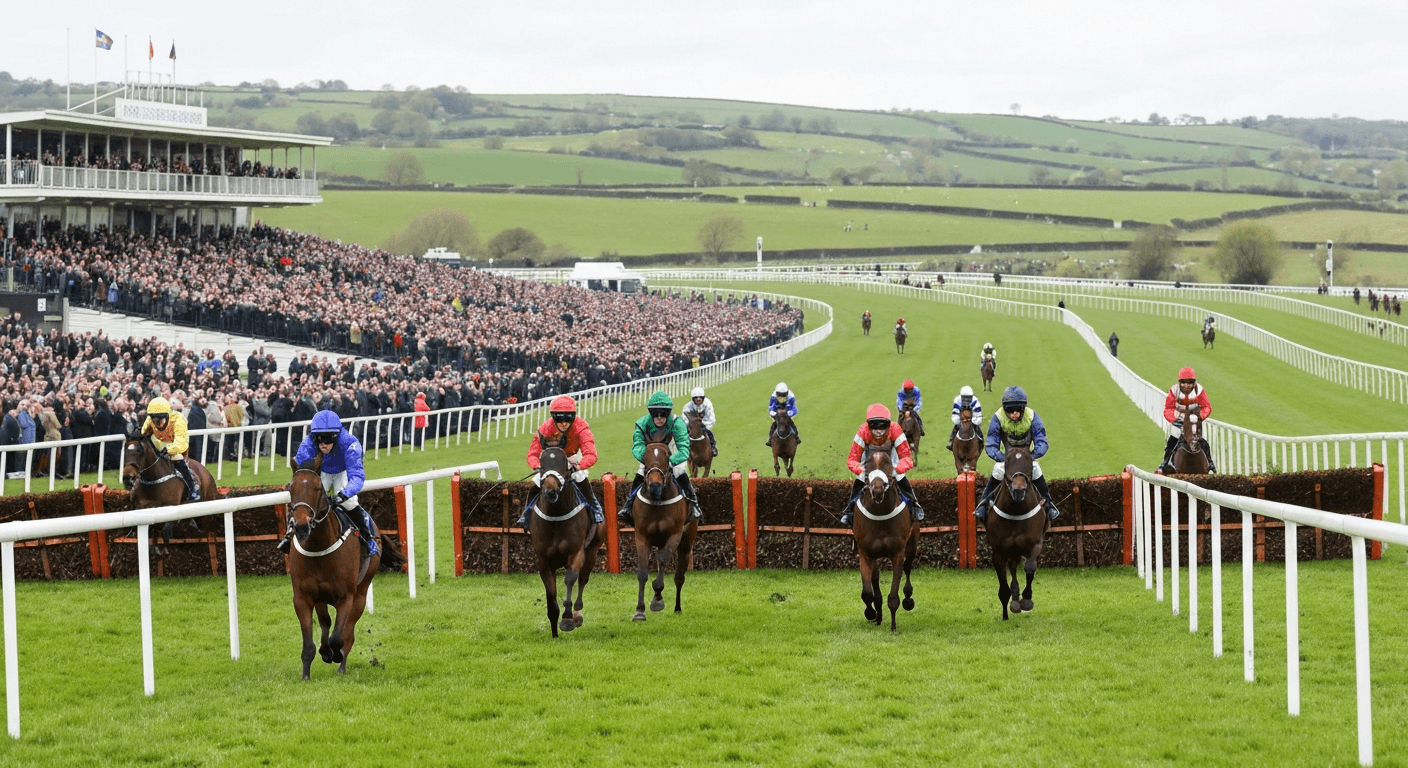
The Irish Grand National: Race Guide
A full guide to the Irish Grand National at Fairyhouse on Easter Monday: the handicap chase, its 1870 origins, great winners and how to watch.
Read moreA Day at Fairyhouse: Visitor Guide
Plan a day at Fairyhouse in Co. Meath: getting there from Dublin, enclosures, accessibility, food, the best days, dress code and how to watch.
Read more
Betting at Fairyhouse: A Course Guide
A factual betting and form guide to Fairyhouse, home of the Irish Grand National: the galloping jumps track, going, festivals, trainers and favourites.
Read morePhotos on this page are used under Creative Commons licences. Titles, sources and licence links for each one are on our image credits page.
Research the field with the AI Race Predictor
Our model publishes calibrated win-probability estimates for UK races — a second opinion to understand a race, not tips. It's open about its record: it doesn't beat the market, and we show exactly how it does.
Work it out & learn the basics
Gamble Responsibly
Gambling should be entertaining and not seen as a way to make money. Never bet more than you can afford to lose. If you or someone you know has a gambling problem, help and support is available.