Founder & Editor · Last reviewed 2026-06-29
The home of Irish jumps racing
Every spring, when Cheltenham and Aintree have come and gone and the rest of the jumps world is winding down, the season has one last word to say. It says it at Punchestown, in a natural amphitheatre at the foot of the Dublin and Wicklow Mountains, where the best horses in Ireland and Britain gather for five days to settle the arguments the festivals before them could not.
Punchestown is the home of Irish National Hunt racing. The course sits in the parish of Eadestown, near Naas in County Kildare, between the R410 and R411, about 40km from the centre of Dublin. The site runs to roughly 450 acres: a 200-acre racecourse, 100 acres of car parking and 150 acres of green pasture. It is a right-handed, undulating oval that climbs hard through the final five furlongs, a track that asks horses to jump cleanly and to stay, and asks jockeys to know exactly where the ground rises against them.
It is also a place with one feature found nowhere else in the country. Punchestown has the only cross-country banks course in Ireland, a long and twisting circuit over banks, stone walls, brush fences and grass banks, jumped in both directions. The banks are older than the modern grandstands, older than the championship races, older than the idea of a five-day festival. They are where the story starts.
This is an account of how a two-day hunt club meeting, first run in a hurricane of wind and rain in 1850, became the venue that closes the European jumps season. It takes in the horses that wrote their names into the place, from Hurricane Fly's four straight Champion Hurdles to the banks specialist Risk Of Thunder, owned by Sean Connery, and the people who built it, from the Kildare Hunt Club to Willie Mullins. The numbers below are all drawn from the record. None of it is a betting tip, and none of it is a promise that any horse or any system makes money.
This guide traces the origins of the course and its banks tradition, the growth of the Festival, the move to championship status, the legendary horses and legendary people who shaped it, and the modern era and redevelopment, before closing with answers to common questions.
Origins and the banks tradition
Racing in Kildare grew out of hunting, and at Punchestown the connection has never been broken. The land and the racecourse are still owned by the Kildare Hunt Club, a body documented as far back as 1752, when a members' rule book was written that survives today in the National Library. Organised racing under the Club is recorded from 1824, and the Club staged a steeplechase at Punchestown from 1837. Long before there was a grandstand or a sponsor, there were riders setting off across country, over the banks and ditches that the hunt knew well.
The first meeting
The first formal race meeting of the Kildare Hunt Club at Punchestown took place on 1 and 2 April 1850. It was billed as "The Kildare and National Hunt Steeplechases", run on a proposal from the 3rd Marquis of Drogheda. The opening day was a brutal introduction. There was no stand house, the course was poorly kept, and the meeting was held in what one account called a "perfect hurricane" of wind and rain. Despite that beginning, the meeting took hold.
A two-day annual spring meeting was established by 1854, and a wooden grandstand was built in time to shelter the growing crowds. By 1861 the fixture had been reorganised, again under the title "The Kildare and National Hunt Steeplechases", and Punchestown was becoming a fixed point in the Irish sporting calendar.
The banks
What set Punchestown apart from the start was its terrain. The cross-country banks course is the only one of its kind in Ireland, a long, twisting circuit over a mixture of banks, stone walls, brush fences, grass banks and hurdles, turning both left and right-handed as it goes. The famous historic double-bank had a first ditch, known as the "grip", reported at 6ft 6in wide and 3ft deep. It is a test of jumping nerve and accuracy that has almost nothing in common with a conventional steeplechase.
The banks are still raced over today. They are the home of the La Touche Cup, run at the Festival over about 4m1f, one of the longest and most distinctive races in Ireland. The race is bound up with one trainer above all others, Enda Bolger, the "Banks King", whose record there is told later in this piece. Where modern jumps tracks have smoothed and standardised their obstacles, Punchestown has kept the old, awkward, hunting-bred challenge alive.
A royal stamp
The meeting's standing was confirmed early. The April fixture was included in the itinerary of the Prince and Princess of Wales during their 1868 visit to Ireland. By then the crowd had grown to around 40,000, with an estimated 5,000 travelling out by train from Dublin alone. Punchestown's own materials note that the course has been "known for its wonderful friendly welcome" since 1875. Crowds in excess of 40,000 had been attending since the 1860s, a scale that marked Punchestown out as a national occasion rather than a local hunt fixture, long before the modern Festival existed.
The growth of the Festival
For most of its life Punchestown was a celebrated spring meeting rather than the championship climax it is now. The twentieth century brought interruptions that mark the wider history of Ireland. Meetings were suspended in 1919 and 1920 because of the unrest during the War of Independence, then resumed in 1921. They were cancelled again in 1941 and 1943 during the Emergency, the Irish name for the Second World War years, before resuming in 1944.
A meeting in trouble
By the turn of the millennium the racecourse was in serious financial difficulty. Punchestown was losing more than €400,000 a year when, in 2002, Horse Racing Ireland, the statutory body for the sport, stepped in to manage it. HRI appointed Dick O'Sullivan, a former executive of the Kerry Group, as general manager. The intervention worked. The business was turned around, recording a profit of €370,000 in 2004. The course also received significant State funding, reported at €23 million in connection with redevelopment, alongside borrowings secured against the Kildare Hunt Club's leases that became the subject of an internal dispute in the mid-2000s.
Four days become five
Under O'Sullivan the Festival grew in both length and ambition. It was extended from four days to five, the prize fund climbed past €3 million, and attendance records were broken again and again. The Festival had always sat late in the season, traditionally beginning on the last Tuesday of April, but it now took on a clear identity. It became the established climax of the European National Hunt season, the meeting that follows Cheltenham and Aintree and gives horses a final, often decisive, chance to confirm or overturn what those festivals suggested.
The crowds tell the story of that growth. The 2025 Festival set an all-time record aggregate attendance of 136,651 across the five days, up 15.5% on the 118,318 of 2024. Ladies Day, the Friday, is traditionally the biggest single day; it drew 42,138 in 2025 and then a record 43,572 in 2026 for the Boodles Champion Hurdle. Those figures are the modern echo of the 40,000 who came in the 1860s.
The scale extends well beyond the racing. In 2025 the course catered for 17,000 hospitality guests from 806 companies, and its bars poured an estimated 132,000 pints over the five days. CEO Conor O'Neill put the Festival's economic impact at over €70 million in April 2026, and County Kildare Chamber separately estimates the meeting is worth in excess of €100 million each year to the Kildare economy. A two-day hunt fixture had become one of the largest sporting and social gatherings in the country.
The move to championship status
What turns a big spring meeting into a championship is the quality of its races, and Punchestown now stages a concentration of top-level National Hunt racing matched almost nowhere else. The Festival carries twelve Grade 1 races across its five days, the heaviest cluster of championship contests in the Irish jumps calendar.
The twelve Grade 1s
The modern shape of the meeting took form around 1999, when several of its centrepiece races were introduced or reconstituted in their current championship form. The Ladbrokes Punchestown Gold Cup, a Grade 1 chase over about 3m1f, was introduced in 1999, replacing a novices-only race, and now runs as the feature of day two. The William Hill Champion Chase, the two-mile championship chase that opens the meeting on day one, became a conditions race in 1999. The Boodles Champion Hurdle, the two-mile hurdling championship run on Ladies Day, was introduced in its current form in 1999 as well, with the minimum age later lowered from five to four in 2009.
The day-by-day structure is built around these features:
| Day | Headline Grade 1 | Other Grade 1s |
|---|---|---|
| Tuesday | William Hill Champion Chase | PRL Champion Novice Hurdle, Dooley Insurance Champion Novice Chase |
| Wednesday | Ladbrokes Punchestown Gold Cup | Channor Real Estate Novice Hurdle, Champion I.N.H. Flat Race |
| Thursday | Ladbrokes Champion Stayers Hurdle | Barberstown Castle Novice Chase |
| Friday (Ladies Day) | Boodles Champion Hurdle | Alanna Homes Champion Novice Hurdle |
| Saturday (Family Day) | SBK Irish EBF Mares Champion Hurdle | Ballymore Champion Four Year Old Hurdle |
Thursday also stages the La Touche Cup over the banks, and Wednesday hosts the Champion I.N.H. Flat Race for the Conyngham Cup, the championship bumper.
Built over time
Not every championship arrived at once. The staying hurdle on day three, now the Ladbrokes Champion Stayers Hurdle, was formerly the World Series Hurdle. The staying novice hurdle on day two, now the Channor Real Estate Group Novice Hurdle, was historically the Irish Daily Mirror Novice Hurdle, and it climbed the grades step by step, rising from Grade 3 in 2009 to Grade 2 in 2010 and to Grade 1 in 2011. The 2001 season, disrupted by the foot-and-mouth outbreak, saw some Irish fixtures relocated, with that year's Gold Cup run at Fairyhouse and the Champion Hurdle at Leopardstown.
The sponsorship has changed hands many times. The Gold Cup alone has run as the Heineken Gold Cup, then under Diageo, Tote Ireland, Bibby Financial Services and, since 2017, Ladbrokes Coral. What has held steady through all of it is the meeting's purpose. By the close of the Festival, the season's championship questions in the two-mile chase, the staying chase, the two-mile hurdle and the staying hurdle have all been answered on the same patch of Kildare turf.
Legendary horses
A championship meeting is remembered through its horses, and Punchestown has hosted some of the finest jumpers of the modern era. Several built records here that may stand for a long time.
Hurricane Fly
No horse owns a Punchestown race quite like Hurricane Fly owns the Champion Hurdle. Trained by Willie Mullins, he won it four years in a row, in 2010, 2011, 2012 and 2013, a record sequence in the race. Across his career he won a then-record 22 Grade 1 races.
Istabraq
The triple Cheltenham Champion Hurdler won the inaugural modern Punchestown Champion Hurdle in 1999, connecting the new championship era to one of the greatest hurdlers Ireland has produced. He later spent his retirement at JP McManus's Martinstown Stud, where one of his companions was the banks specialist Risk Of Thunder.
State Man and Lossiemouth
The two-mile hurdle has stayed in Mullins hands in recent seasons. State Man won the Champion Hurdle three years running, in 2023, 2024 and 2025. He was followed in 2026 by Lossiemouth, who had already won the Champion Four Year Old Hurdle in 2023 and who took the Boodles Champion Hurdle by five lengths under Paul Townend for her 11th Grade 1, completing the Cheltenham and Punchestown Champion Hurdle double. She has been unbeaten at the track. Faugheen, in 2015, and Honeysuckle, in 2021, are among the others to have won the race in the same year as their Cheltenham equivalent.
Florida Pearl, Beef Or Salmon and the Gold Cup line
The Gold Cup roll reaches back across the modern era. Florida Pearl won it in 2002, one of Willie Mullins's early big-race flagbearers. Beef Or Salmon, trained by Michael Hourigan, took the Heineken Gold Cup in 2006, a top Irish chaser of his time. Neptune Collonges became the first dual winner in 2007 and 2008, ridden by Ruby Walsh. Kemboy won the 2019 running, and in doing so gave Ruby Walsh the final winner of his riding career. Galopin Des Champs won in 2025 after finishing runner-up in the two previous years, and in 2026 Gaelic Warrior took it by 26 lengths to complete the Cheltenham and Punchestown Gold Cup double.
It is worth setting one persistent error straight. Kauto Star is often, and wrongly, linked to a Punchestown Gold Cup win. He ran in the race but did not win it; he was pulled up, notably in 2011, the year Follow The Plan won. He should not be counted among Punchestown's winners.
The two-mile chasers
The William Hill Champion Chase has drawn the best around. Sizing Europe and Un De Sceaux were both dual winners, Un De Sceaux taking the race in 2018 and 2019. Big Zeb, Master Minded and the brilliant Sprinter Sacre all feature on its roll, as does Chacun Pour Soi in 2021. Energumene became another dual winner, in 2022 and 2023, and bowed out after finishing third in the 2026 running, which Il Etait Temps won.
Quevega and the stayers
In the staying hurdle, Quevega stands apart, a four-time winner of the race in its World Series Hurdle days, including consecutive runnings from 2010 to 2013. The 2026 edition produced one of the meeting's most emotional results, Bob Olinger winning on the final start of his career for his fifth Grade 1, retired immediately afterwards at the age of 11.
Risk Of Thunder
The banks course has its own legend. Risk Of Thunder, owned by the actor Sean Connery and trained by Enda Bolger, won the La Touche Cup a record seven times between 1995 and 2002, in a span where the race was not run in 2001. He retired to JP McManus's Martinstown Stud, where he was a companion to Istabraq, and lived to the age of 27. No horse better captures what makes Punchestown different from every other track in Ireland.
Legendary people
Behind the horses stand the trainers, jockeys, owners and administrators who shaped Punchestown into what it is.
Willie Mullins
No figure dominates the Festival like Willie Mullins. He is the leading trainer in the Punchestown Gold Cup, with eight wins from Florida Pearl in 2002 through Sir Des Champs, Boston Bob, Bellshill, Kemboy, Allaho, Galopin Des Champs and Gaelic Warrior. He is the leading trainer in the Champion Hurdle, with eleven wins, including State Man's hat-trick and Lossiemouth in 2026. He led the trainers across the meeting again in 2025/26, a season in which his stable won the Champion Hurdle, Champion Chase and Gold Cup at both Cheltenham and Punchestown, and he reclaimed the Irish trainers' championship at the 2026 Festival, his 19th title.
The riders
Ruby Walsh is the record Festival rider. Since 1999 he has been the leading jockey in both the Punchestown Gold Cup, with six wins, and the Champion Hurdle, also with six. The final winner of his career came at the meeting, Kemboy in the 2019 Gold Cup. The torch passed to Paul Townend, Mullins's stable jockey, who in 2026 alone rode Il Etait Temps, Gaelic Warrior, King Rasko Grey and Lossiemouth to Grade 1 wins. Townend's six victories in the Champion Chase, on Golden Silver, Un De Sceaux, Chacun Pour Soi, Energumene twice and Il Etait Temps, are the leading modern haul in that race. Reaching further back, Pat Taaffe won the historic earlier version of the Champion Chase five times as a jockey.
The challengers and the British raiders
Mullins has rarely had the field to himself. Gordon Elliott is his principal rival, and came into the 2026 Festival leading the trainers' table before being overhauled, winning Grade 1s that week with Western Fold and With Nolimit. Jessica Harrington has four Champion Hurdle wins to her name, with Moscow Flyer in 2001, Macs Joy in 2006, Jezki in 2014 and Supasundae in 2018. Henry de Bromhead trained Bob Olinger to his emotional 2026 Stayers Hurdle win. British trainers have struck too: Paul Nicholls won the 2021 Gold Cup with Clan Des Obeaux, and Nicky Henderson won the Champion Hurdle with Buveur D'Air in 2019.
The Banks King
The cross-country course has its own master. Enda Bolger, the "Banks King", has won the La Touche Cup a record fifteen times. He trained Risk Of Thunder to his seven wins between 1995 and 2002, and his other winners include Garde Champetre, L'Ami, Spot Thedifference, Quantitativeeasing and Auvergnat in 2018. Busselton won back-to-back runnings in 2025, then trained by Joseph O'Brien, and 2026, by which time the horse was with Bolger, ridden by Darragh O'Keeffe, for Bolger's 15th success in the race.
Owners and administrators
In the owners' ranks, JP McManus is the champion figure, collecting a sixth successive Champion Owner trophy at the 2025 Festival, his 23rd in total. Rich and Susannah Ricci own both Lossiemouth and Gaelic Warrior, and Gigginstown House Stud, the operation of Michael O'Leary, owned Place De La Nation, the 2026 Mares Champion Hurdle winner. Off the track, the administrators who steadied and grew the course matter too: Dick O'Sullivan, general manager from 2003 until his retirement after 16 years, and Conor O'Neill, the former Limerick manager who became CEO in June 2018, with Richie Galway as long-serving racing manager.
The modern era and redevelopment
The Punchestown that hosts the modern Festival looks very different from the field that staged that storm-lashed first meeting in 1850. A £9 million redevelopment in 1998 delivered modern facilities, including restaurants, bars and a shopping village, and the years since have added the infrastructure that a five-day championship demands. The course is run today through Blackhall Racing Company, with the land still owned by the Kildare Hunt Club and HRI closely involved in its management and financing since the 2002 rescue.
A meeting on the calendar
Punchestown is busy well beyond its showpiece week. The racecourse hosts around 20 race days from September through to the spring Festival, exclusively National Hunt at its main fixtures, with point-to-point racing alongside. Its Premier, or Winter, Festival in November is anchored by a Grade 1 double, the Unibet Morgiana Hurdle and the John Durkan Memorial Punchestown Chase. In November 2025 the Morgiana went to Lossiemouth and the John Durkan to Gaelic Warrior, who edged Fact To File in a dramatic finish, a preview of the form both would carry into the spring. The course even staged a one-off Flat fixture on 16 September 2025, an unusual departure for a track that is overwhelmingly about jumping.
A day out and how to watch
The Festival has become a fixture of the social calendar as much as the sporting one. Ladies Day on the Friday is the biggest draw, with the Bollinger Best Dressed Competition running across the first four days and reaching its grand final there. There is no formal dress code, though smart wear is the norm in the hospitality pavilions. The shopping village, live music, the Goffs Punchestown Sale in the winner's enclosure and the long-running Punchestown Kidney Research Fund charity race, in its 34th year in 2025 and on target to pass €2,000,000 raised, fill out the days around the racing.
Getting there is straightforward. The course is about an hour from Dublin, just off the N7/M7 near Naas, with the Eircode W91 VCX4 for sat-nav. Irish Rail runs from Heuston Station to Sallins, with shuttle buses to the course during the Festival, and free on-site parking is advertised at a capacity of up to 17,000 cars. For those watching from home, RTÉ shows the Festival free-to-air in the Republic of Ireland, on RTÉ2 and the RTÉ Player through the week and on RTÉ One on the Saturday. In the UK and for dedicated coverage it is a Racing TV course, as all Irish racing has been since the move to Racing TV that was secured by a media-rights deal running to at least 2029.
The same questions, the same hill
For all the redevelopment and the record crowds, the essential thing about Punchestown has not changed. The track still runs right-handed and undulating, still climbs against the horses through the last five furlongs, and still tests stamina and jumping above all. The banks course still twists over its old obstacles. A short word on betting is worth keeping in mind: backing favourites loses money to starting price over time, and although marquee Punchestown races have been won by short-priced favourites such as Lossiemouth at 2/7 and Gaelic Warrior at 5/6 in 2026, that is not evidence that any system turns a profit. The bookmaker's margin built into the prices sees to that. What Punchestown offers is not a tip. It is the place where the National Hunt season comes to be decided, on the same Kildare hill it has used for the best part of two centuries.
Frequently Asked Questions
Share this article
More about this racecourse
All punchestown guides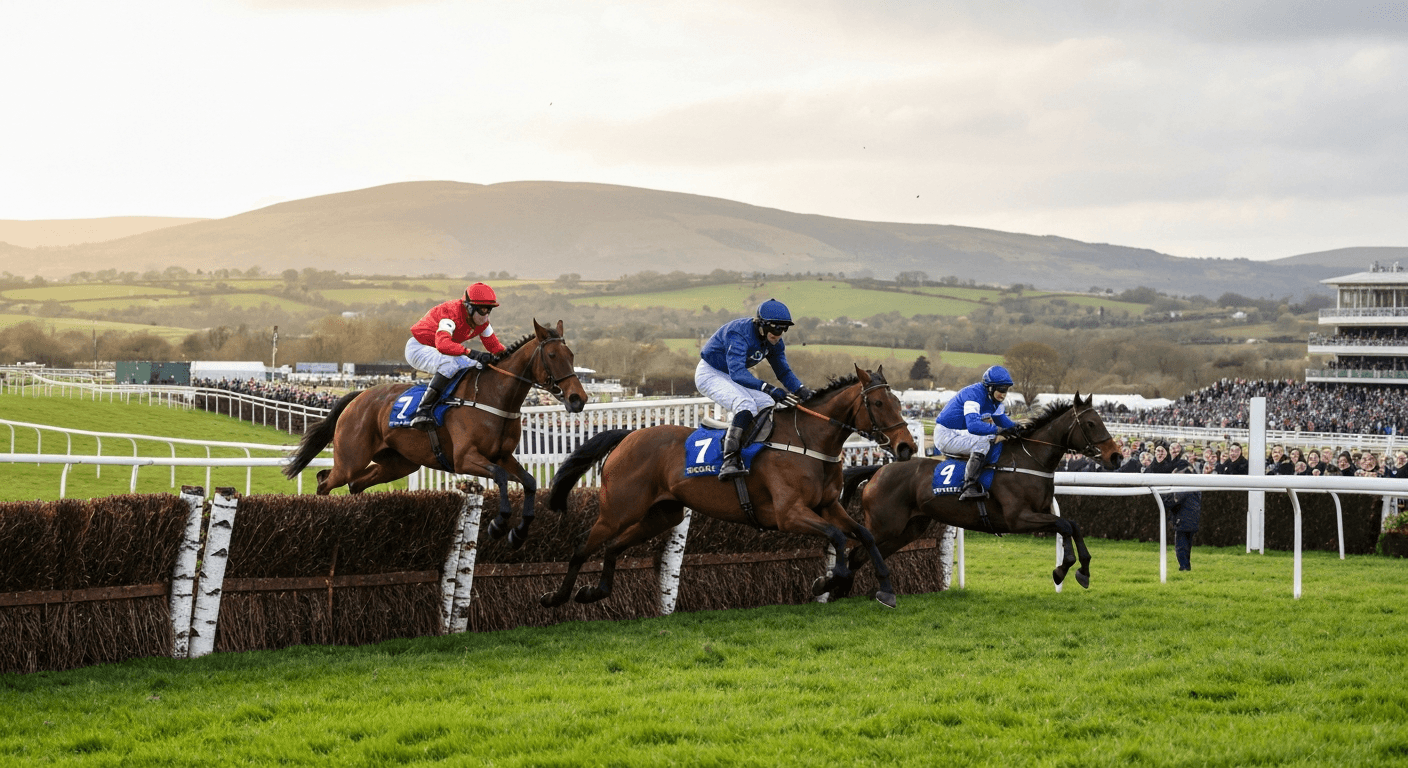
The Punchestown Gold Cup: Race Guide
A guide to the Punchestown Gold Cup, the Grade 1 chase that crowns Ireland's jumps season: its distance, history, great winners and place in the Festival.
Read moreA Day at Punchestown: Visitor Guide
Plan a day at Punchestown, Ireland's National Hunt HQ in Co. Kildare: getting there, enclosures, accessibility, food, the Festival, dress and how to watch.
Read moreBetting at Punchestown: A Course Guide
How Punchestown's stiff right-handed jumps track, banks course and spring Festival shape the betting, with trainer and jockey angles and an honest look at the favourite.
Read moreGamble Responsibly
Gambling should be entertaining and not seen as a way to make money. Never bet more than you can afford to lose. If you or someone you know has a gambling problem, help and support is available.