
Founder & Editor · Last reviewed 2026-05-31
The 2026 edition has been run. Next: Royal Ascot 2027, Tuesday 15 to Saturday 19 June 2027.
Royal AscotStablebet model (pre-race estimated win chances)
Royal Ascot 17:00 · Royal Hunt Cup (Heritage Handicap) · Class 2 · 1m
Pre-race estimate. Published 17 June 2026, before the off. This is what the model made of the race beforehand, kept as a record. It was never published as a tip.
The model rated Godwinson its most likely winner at 5%, ahead of Thunder Run (5%) and Henlein (4%). It read as a competitive, open race with no dominant runner.
| Horse | SP | Model chance | Market | vs Market |
|---|---|---|---|---|
| Godwinson George Bass / J Channon | 34.00 | 5.1% | 1.8% | Market 3.2pp longer |
| Thunder Run C Lee / K R Burke | 21.00 | 4.8% | 3.0% | Market 1.8pp longer |
| Henlein K Stott / K A Ryan | 51.00 | 4.0% | 1.2% | Market 2.8pp longer |
| Linwood J P Spencer / R Hannon | 11.00 | 3.8% | 5.7% | Market 1.9pp shorter |
| One Smack Mac Saffie Osborne / J A Osborne | 67.00 | 3.8% | 0.9% | Market 2.9pp longer |
| Jagged Edge Colin Keane / Stephen Thorne | 15.00 | 3.7% | 4.2% | In line with market |
| Indalo Ray Dawson / R Varian | 8.00 | 3.6% | 7.8% | Market 4.2pp shorter |
| Chibitty S M Levey / D M Simcock | 51.00 | 3.6% | 1.2% | Market 2.4pp longer |
| Urban Lion Edward Greatrex / J Channon | 34.00 | 3.6% | 1.8% | Market 1.7pp longer |
| Classic P J Dobbs / R Hannon | 11.00 | 3.5% | 5.7% | Market 2.2pp shorter |
| Fifth Column W Buick / J & T Gosden | 13.00 | 3.5% | 4.8% | Market 1.3pp shorter |
| Archivist James McDonald / H Al Jehani | 9.00 | 3.5% | 6.9% | Market 3.5pp shorter |
| Shout Jack Callan / S & E Crisford | 15.00 | 3.4% | 4.2% | Market 0.8pp shorter |
| Mister Winston Oisin Murphy / A M Balding | 15.00 | 3.3% | 4.2% | Market 0.8pp shorter |
| Excellent Believe Toby Moore / J Channon | 26.00 | 3.3% | 2.4% | Market 0.9pp longer |
| Ebt's Guard Lewis Edmunds / W Muir & C Grassick | 26.00 | 3.3% | 2.4% | Market 0.9pp longer |
| Cerulean Bay D Tudhope / D O'Meara | 21.00 | 3.2% | 3.0% | In line with market |
| No Retreat Billy Loughnane / George Scott | 26.00 | 3.1% | 2.4% | Market 0.7pp longer |
| Ozat Cieren Fallon / Ian Williams | 67.00 | 3.1% | 0.9% | Market 2.2pp longer |
| Swing Vote S De Sousa / S & E Crisford | 51.00 | 3.1% | 1.2% | Market 1.8pp longer |
| War Socks D Egan / N Petersen | 67.00 | 2.9% | 0.9% | Market 2.0pp longer |
| Witch Hunter Joe Leavy / R Hannon | 51.00 | 2.9% | 1.2% | Market 1.7pp longer |
| Holloway Boy Jack Nicholls / K R Burke | 17.00 | 2.8% | 3.7% | Market 0.8pp shorter |
| Erzindjan R L Moore / T Kent | 13.00 | 2.8% | 4.8% | Market 2.0pp shorter |
| La Botte Mark Zahra / Harry Eustace | 9.00 | 2.8% | 6.9% | Market 4.1pp shorter |
| Rogue Diplomat Harry Davies / James Owen | 17.00 | 2.8% | 3.7% | Market 0.9pp shorter |
| Scoville Tom Marquand / W J Haggas | 9.00 | 2.7% | 6.9% | Market 4.2pp shorter |
| Blue Rc H Crouch / J Tate | 34.00 | 2.6% | 1.8% | Market 0.8pp longer |
| Checkandchallenge Rossa Ryan / W J Knight | 21.00 | 2.6% | 3.0% | In line with market |
| Skukuza C Soumillon / E A L Dunlop | 51.00 | 2.4% | 1.2% | Market 1.2pp longer |
These were the model's estimated win chances going into the race, not tips. The model is calibrated to real results (when it says 25%, about 25% win) but it does not beat the market, so read it as an independent second opinion on the race. See how accurate it is →
This race has been run. See the Royal Ascot 2026 results for the finishing order and starting prices. What follows is kept as it was written before the race, so anything it lists as not confirmed was still open when it was written and was not revisited afterwards.
Royal Hunt Cup 2026 Preview: Royal Ascot's Cavalry Charge of a Mile
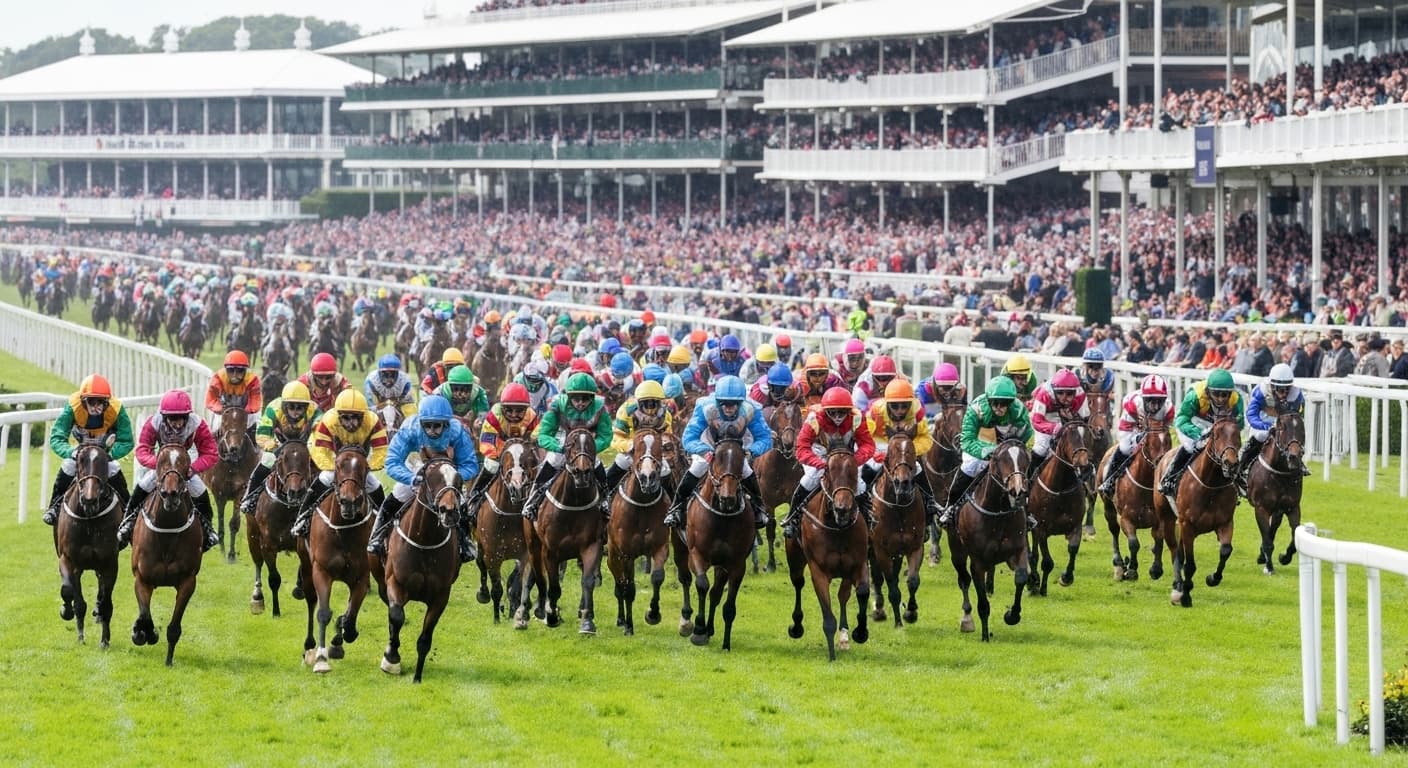
Thirty horses thunder up Ascot's straight mile, a kaleidoscope of silks spread across the full width of the track, and somewhere inside that wall of horseflesh (perhaps on the stands' rail, perhaps on the far side) the winner of the Royal Hunt Cup is being driven home. It is, alongside the Wokingham, the most furiously competitive cavalry charge of the Royal Meeting, and for handicap punters it is the puzzle of the week.
The 2026 renewal is scheduled for Wednesday 17 June at 17:00 BST, the traditional centrepiece of day two at Royal Ascot, sandwiched between the Queen Mary and the Group 1 Prince of Wales's Stakes.
Race essentials at a glance
- Date / Time: Wednesday 17 June 2026, 17:00 BST
- Course: Ascot (Straight Mile)
- Distance: 1 mile
- Grade / Class: Heritage Handicap, Class 2
- Eligibility: Three-year-olds and upwards
- Prize fund: £175,000 guaranteed (2026); £90,195 to the winning connections in 2025 (William Hill News, Racingbetter)
- Field size: Maximum 30 runners: typically 28–30 in recent renewals
First run in 1843 with Knight of the Whistle the inaugural winner (Wikipedia), the Royal Hunt Cup has been contested over the straight mile since 1865 and ranks among the most historic and prestigious heritage handicaps on the British Flat calendar. It pre-dates the Prince of Wales's Stakes on the same card by more than a century and has accumulated a roll of honour studded with names that later went on to bigger things on the international stage.
The race is the natural target for the second-season improving miler: typically a four-year-old who has shown promise on the all-weather or in spring conditions handicaps and is now ready to step up under a serious weight. Eight of the last ten winners have come from established big-yard handicap operations (Godolphin/Saeed bin Suroor, Charlie Hills, John Gosden, Mark Johnston, Ralph Beckett, Amanda Perrett), and every winner of the last decade has been aged either four or five: no three-year-olds, no veterans.
For previewers, three questions matter above all: which side of the track will the dominant pace group form on; which yards have a live four-year-old at the top of their handicap; and how does the weather forecast for Wednesday afternoon affect the going? Get those right, and the 30-runner cavalry charge becomes a touch less daunting.
Where to Bet
Place your bets with a trusted, licensed bookmaker.

Promo code BETFRED50. New customers only. Register, deposit with a Debit Card, and place a first bet of £10+ at Evens (2.0)+ on Sports, to be settled within 7 days, to get £30 in Sports Free Bets and £20 in Bet Builder Free Bets within 24 hours of settlement. 7-day expiry. Eligibility & payment exclusions apply. Full T&Cs apply. Take Time to Think. BeGambleAware.org. 18+. Full T&Cs.

Promo code R30. New UK customers only, 18+. Register, deposit £10 or more, then place a £10 single cash bet at odds of 1/2 (1.5) or greater on any sports market (excluding Virtuals). Once the qualifying bet settles you get £30 in Free Bets (3 x £10) — the qualifying bet can win or lose. Free Bets are valid on any sports market excluding Virtuals, expire in 7 days, are non-withdrawable and must be used in full. Excluded deposit methods apply (including PayPal, Apple Pay, Skrill and NETELLER). Named bets such as Lucky 15 do not qualify. If you cash out the qualifying bet, or it is voided, you are no longer eligible for the offer. Ends 31.12.26. Full T&Cs apply. Please gamble responsibly. BeGambleAware.org. 18+. Full T&Cs.

Promo code BET40GET20. New UK customers, 18+. Register with the code and place a first bet of £40 or more at Evens (2.0) or greater. Receive 2 × £10 free bets: the first credited automatically once the qualifying bet settles, the second 24 hours later. Free bets must be placed at minimum odds of 4/1 (5.0), expire 24 hours after credit, and the free-bet stake is not returned with winnings. Debit card deposits only. Take Time to Think. BeGambleAware.org. 18+. T&Cs apply. Full T&Cs.

50% of your first-day net losses refunded as a free bet, capped at £25. New UK customers aged 18+ only. To qualify, deposit and place a first bet of £10 or more on any sport at minimum odds of evens (2.00), then place at least two further bets on different events, each worth at least 50% of your largest bet, all at evens (2.00) or greater. Losses are counted from your first settled bet until 23:59 the same day. Place a qualifying £10+ bet and you are guaranteed at least a £5 free bet. Bets placed at SP, void bets, cashed-out bets and bets struck with free bets do not count towards the offer. The free bet is credited the day after your qualifying bets settle and must be used within 7 days, after which it expires. It can be used at odds from 1/4 (1.25) up to 250/1 on singles and straight accumulators, but not on Trixie, Patent or Yankee style multiples. Free-bet stake is not returned with winnings. One offer per person, household, address, IP address and device. E-wallet deposits may not qualify, so check the cashier before depositing. Customers registered with GAMSTOP cannot claim. KYC identity verification must be completed before the free bet is credited. Take Time to Think. BeGambleAware.org. 18+. T&Cs apply. Full T&Cs.

New customers, 18+. Choose the sports bonus at sign-up, make a first deposit and receive a 100% bonus up to £50 in your Sports Bonus balance. To convert the bonus to cash, wager it 10x within 30 days. Single bets below Evens (2.00) do not qualify; accumulators do not qualify if any selection is below 1/2 (1.50). Virtual Sports, voided, cancelled, drawn, cashed-out and free-bet wagers do not count towards wagering. Only the first settled bet per event counts. Withdrawing before the wagering requirement is met forfeits the bonus balance including bonus winnings. Real-money funds are used before bonus funds. Deposits via Skrill or Neteller are not eligible. Not valid in conjunction with other promotions. Odds, bet and payment limits apply. 10bet general and promotion T&Cs apply. BeGambleAware.org. 18+. Full T&Cs.

New customers in Great Britain and Republic of Ireland, 18+. Place a £10 fixed-odds qualifying bet at minimum odds of 1/2 (1.50) — single or each-way (only the win part counts), pre-event or in-play, not cashed out early, within 28 days of opening the account. Receive up to £60 in bonuses credited over three days: 3 × £10 fixed-odds free bets (the first on settlement, then 24 and 48 hours later) plus 3 × £5 Total Goals FOOTBALL spread bets and 3 × £5 racing Winning Favourites spread bets, with a £1 racing Race Index spread bet as an extra on top. The spread bets need a full spread-betting account, opened within 28 days of the fixed-odds account and subject to Spreadex's eligibility and appropriateness checks. Free-bet stakes not returned with winnings; free bets valid 28 days from issue. IMPORTANT: the £5 credits are SPREAD bets — sports spread betting carries the risk that losses can exceed your stake. Sports spread-betting customers do not have Financial Ombudsman or FSCS recourse. Take Time to Think. BeGambleAware.org. 18+. T&Cs apply. Full T&Cs.

Promo code WELCOME15, entered under My Bonuses after registering. New UK customers, 18+. Place a first qualifying bet of at least £10 from your cash balance at odds of evens (2.0) or greater within 7 days of opening the account. Once the qualifying bet fully settles you receive £15 in free bets, credited as 3 x £5 tokens with set uses: one £5 accumulator free bet (minimum 4 legs, each leg at 2/5 or bigger), one £5 sports free bet (any market at evens or bigger) and one £5 Sub Cover free bet (selected football player markets at evens or bigger). Free-bet stakes are not returned with winnings. Free bets expire 7 days after they are credited. Void, cashed-out and partially cashed-out bets do not qualify. One offer per customer. Confirm the current terms on BetGoodwin's own welcome-offer page before claiming. Take Time to Think. BeGambleAware.org. 18+. T&Cs apply. Full T&Cs.

New UK customers, 18+. Minimum deposit £10. Place a £10 qualifying single on sports (excluding virtuals) at minimum odds of 1/2 (1.50), settled within 14 days. Deposit-method exclusions apply. Receive £30 in free bets (stake not returned), split £20 for sportsbook use (2 x £10) and £10 for Bet Builder only (2 x £5); Bet Builder does not cover horse racing. Free bets must be accepted within 7 days and expire 7 days after acceptance. No promo code required. Best Odds Guaranteed on UK & Irish racing, subject to having staked over £25 in the previous seven days. Operated by LiveScore Betting and Gaming (Gibraltar) Ltd, UKGC 56859. Confirm the current terms on LiveScore Bet's own promotions page before claiming. Take Time to Think. BeGambleAware.org. 18+. T&Cs apply. Full T&Cs.
18+. BeGambleAware.org
The Race: Course, Distance, Draw and Heritage
The Royal Hunt Cup is, in many respects, a race defined as much by its geography as its conditions. Understanding Ascot's straight mile (and how a 30-runner field is forced to use it) is the single most important piece of preview work a punter can do.
Course and distance: what the straight mile demands
The Royal Hunt Cup is run on Ascot's Straight Mile, a one-mile chute that joins the round course at the elbow approximately 2.5 furlongs from the finish (Ascot.com via Racingbetter). The track has a distinctive shape: a downhill section through the middle that allows horses to build into a smooth, fluid gallop, followed by a stiff, sustained rising finish from the dip up to the post. It is, in short, a true galloping test rather than a sprint dressed up as a mile.
That topography rewards a particular type of horse: a true, out-and-out miler who stays every yard of the trip under pressure and can find an extra gear up the rising ground when the leaders begin to tire. Riders who try to ride a 7-furlong race and hit the front too soon are frequently swallowed up inside the final furlong: Ascot's hill is unforgiving on the front-running speedster who has spent his pace too early.
Quick ground (fast to good) is the ideal surface. Soft ground saps the marathoners and historically the race has thrown up surprise results when conditions have ridden much slower than the early-season form suggested.
Draw bias: the heart of the puzzle
With 28–30 horses spread across the full width of the track, the Royal Hunt Cup typically splits into two distinct groups within the first furlong (Racing Post, ascotracesbetting.com). A stands'-side group races down the near rail; a far-side group races down the far rail; and the side that secures the better tempo and the inside rail line late in the race is, in most renewals, the side from which the winner emerges.
The historic statistical bias has favoured high draws (stalls 20-plus on the far side), but the live picture from 2021 to 2025 is more nuanced. Recent winning draws:
- 2025: stall 32 (high)
- 2024: stall 20 (high)
- 2023: stall 7 (low / stands'-side)
- 2022: stall 15 (middle)
- 2021: stall 4 (low / stands'-side)
The takeaway for previewers is to abandon the simple "back the high draws" heuristic and instead study where the likely front-runners are drawn, identify which side will get the stronger pace, and play accordingly. Horses trapped in the middle berths with no obvious group to join are typically the ones who finish wide of the action without ever having had a chance.
Recent winning template
A composite portrait of the modern Royal Hunt Cup winner: a four- or five-year-old, carrying 9-0 to 9-5, officially rated 95 to 103, trained by a top-tier British or Irish handicap operation, drawn into the dominant pace group on the day, with a recent prep run showing he is on the upgrade: often a win or a close-up effort within his last three to five starts. The SP range covers 11/2 to 22/1: short enough to suggest the market does narrow the search even in a 30-runner heat, wide enough to mean each-way punters are rarely outright priced out.
Race format and weights
The Royal Hunt Cup is a Class 2 handicap with a maximum field of 30 runners (Heritage Handicap status protects its place in the calendar and its prize-money guarantee). Eligibility is three-year-olds and upwards, although three-year-olds have not won this decade and historically struggle to handle the weight-for-age handicap framework against established older milers. Top weight is typically 9-12 to 10-0; bottom weight after long-handicap rises usually settles around 8-6 to 8-9.
Heritage and tradition
The Royal Hunt Cup was first run in 1843, with Knight of the Whistle the inaugural winner (Wikipedia). It has been contested over one mile since 1865 (Wikipedia, Ascot.com via Racingbetter), making it one of the longest continuously-run Flat handicaps in the British calendar. Its position on day two of Royal Ascot (Wednesday afternoon, immediately before the Prince of Wales's Stakes) gives it a unique status: serious enough to attract top handicap firepower from Newmarket, Lambourn, Manton and Tipperary, festive enough to draw a vast crowd betting heavily, and competitive enough that Frankie Dettori, Jim Crowley, Oisin Murphy and Ryan Moore have all featured prominently on its honours board in recent decades.
The race takes its name from the Royal Hunt (a nod to Ascot's origins as a royal racecourse) and the cup itself remains one of the most coveted handicap prizes a British or Irish trainer can win. For owners, it is a Royal Ascot winner; for the betting public, it is the punting puzzle of the week.
Trends and Stats: The Five-Trend Scorecard
The Royal Hunt Cup is famously hard to crack, but a decade of results does show clear patterns. The five trends below have produced consistent strike rates across the last ten renewals and are the foundation of any responsible preview scorecard.
The five-trend scorecard (last 10 winners)
1. Aged 4 or 5: 10/10 (100%)
Every winner from 2015 to 2024 has been either a four-year-old (8 winners) or a five-year-old (2 winners: Afaak 2019, Wild Tiger 2024). No three-year-old, no six-year-old and no seven-year-old-plus has won this decade. The race is the natural target for the established improving miler in his second or third season under a handicap mark: wait for him, and ignore the precocious sprinter-trained-up-to-a-mile three-year-olds the market sometimes pushes.
2. Starting price 25/1 or shorter: 10/10 (100%)
The market does narrow the search. The maximum recent winning SP was 25/1 (Zhui Feng 2017), and seven of the last 10 winners went off at 18/1 or shorter. Despite 30-runner fields tempting punters into big-priced spread plays, 50/1+ outsiders simply don't win this race in the modern era. Anchor each-way selections at the shorter end of the market.
3. Carried 9-0 or more: 7/10 (70%)
Seven of the last ten winners carried at least 9-00 in weight. The Royal Hunt Cup is a Class 2 contest with a wide weight scale, and big-yard handicappers tend to weigh up well-treated horses near the top of the handicap rather than chasing rises with light-weighted improvers. Bottom-of-the-handicap chancers struggle to make the weight tell on Ascot's stiff finish.
4. Big-yard handicap specialist: 8/10 (80%)
Eight of the last ten winners came from elite British and Irish operations with proven Royal Ascot handicap firepower: Saeed bin Suroor (2x), Charlie Hills (2x), John Gosden, Mark Johnston, Ralph Beckett and Amanda Perrett. The small-yard surprises, David Marnane (Settle For Bay 2018) and Michael Halford (Portage 2016), are the exception, not the rule. Lean towards yards with a track record of placing horses precisely for this race.
5. Drawn into the dominant pace group: approx 7/10
Royal Hunt Cup winners tend to be drawn either high (stalls 20-plus, far-side rail) or low single-figures on the stands' side. Recent winning draws: 2025 stall 32, 2024 stall 20, 2023 stall 7, 2022 stall 15, 2021 stall 4. The historic bias has been towards high numbers but the live read since 2021 is "pick the right group". Trapped middle-berth horses without a clear group to join are the most consistently underperforming bracket.
Last 10 winners: quick-reference table
| Year | Winner | Trainer | SP |
|---|---|---|---|
| 2024 | Wild Tiger | Saeed bin Suroor | 11/2 JF |
| 2023 | Jimi Hendrix | Ralph Beckett | 22/1 |
| 2022 | Dark Shift | Charlie Hills | 13/2 |
| 2021 | Real World | Saeed bin Suroor | 18/1 |
| 2020 | Dark Vision | Mark Johnston | 15/2 |
| 2019 | Afaak | Charlie Hills | 20/1 |
| 2018 | Settle For Bay | David Marnane | 16/1 |
| 2017 | Zhui Feng | Amanda Perrett | 25/1 |
| 2016 | Portage | Michael Halford | 10/1 |
| 2015 | GM Hopkins | John Gosden | 8/1 |
Source: cross-verified across Racing Post / Ascot.com / OLBG historical records (cross_verified_2_sources for all rows).
What the trends are really telling you
The strongest single composite trend, the one that captures most of the winners, is a four- or five-year-old, carrying 9-0 or more, trained by a top-tier handicap yard, drawn into the dominant pace group, going off at an SP between 11/2 and 22/1. That description fits seven or eight of the last ten winners.
The two outliers from that template (Zhui Feng 2017, 25/1, Amanda Perrett; Settle For Bay 2018, 16/1, David Marnane) were both four-year-olds carrying around 9-0; they just came from yards outside the top tier. The age and weight pillars are the most reliable; the trainer and draw pillars introduce useful prioritisation but should not be treated as absolute filters.
The Field: Dominant Yards, Profile Patterns and Trial Routes
The Royal Hunt Cup field is built over months rather than weeks. The yards that target this race typically begin pencilling in candidates in March, place them carefully in spring handicaps to protect or even improve their marks, and arrive at Royal Ascot with a horse who has run two or three preparation races since the turn of the year. Below is an evergreen guide to the operations, profiles and prep routes that have shaped the modern era, to be combined with declarations-day analysis once the 2026 field is confirmed.
Dominant historical yards
A small group of operations has produced the bulk of recent winners and remains the first place to look on declarations day.
Godolphin / Saeed bin Suroor: Two of the last four winners (Real World 2021, Wild Tiger 2024). Godolphin has a longstanding affinity with the Royal Hunt Cup; Suroor in particular targets the race with second-season improvers who have spent the winter on the Meydan all-weather and arrive at Royal Ascot fresh and improving on official marks that frequently look generous.
Charlie Hills (Lambourn): Two of the last six winners (Afaak 2019, Dark Shift 2022). Hills's yard places mile handicappers with skill; a Hills runner with a recent Newbury or Sandown spring win on his card is always worth a second look here.
John Gosden / John & Thady Gosden: GM Hopkins (2015) was a textbook Gosden Royal Hunt Cup winner: a four-year-old miler with a couple of placed efforts in the spring, weighted up but not over-faced, and ridden patiently in a wide draw. The yard does not target the race every year, but when it does the runner is invariably well-treated.
Ralph Beckett (Kimpton Down): Jimi Hendrix (2023) at 22/1 was Beckett's first Royal Hunt Cup but characteristic of the yard's patient mile handicap strategy: a four-year-old improving through the spring, ridden with restraint and produced late under a strong finish.
Mark Johnston / Charlie & Mark Johnston: Dark Vision (2020) was a Group-class three-year-old dropped back into handicap company at four with a useful weight allowance. The Johnston operation is a perennial Royal Ascot handicap force across multiple distances.
Other yards with strong cases at declaration time when they hold a credible runner include Charlie Appleby (Godolphin's second string), Roger Varian (who won the 2025 renewal with My Cloud), William Haggas, Andrew Balding, Sir Michael Stoute and Aidan O'Brien when the Ballydoyle handicap project produces a four-year-old miler.
Profile patterns: the typical winning runner
Combining the trends piece with deeper field analysis, the typical Royal Hunt Cup winner displays a consistent profile across several dimensions:
- Age: 4-year-old (8/10) or 5-year-old (2/10). Never 3yo, never 6yo+.
- Weight carried: 9-0 to 9-5 most commonly; 70% carry 9-0 or more.
- Official rating: typically 95 to 103 at time of running. Below 90 has struggled; above 105 is a rare top-weight winner.
- Distance preference: pure miler that has won or been placed previously over a stiff mile rather than 7f sprinter stepping up.
- Going: good or fast-good. Out-and-out soft-ground specialists have struggled when conditions ride slow.
- Form profile: at least one win or close-up effort within the last 3-5 starts; not a horse returning cold from layoff without a prep.
Typical trial routes
The 2026 Royal Hunt Cup field will be drawn from horses who have run, or are scheduled to run, in the following preparatory pattern:
- Lincoln Handicap (Doncaster, late March): historically a key trial for older mile handicappers; Royal Hunt Cup contenders frequently appear here even if outside their ideal trip (1m straight at Doncaster is similar to Ascot's straight mile in shape).
- Spring Mile (Doncaster Lincoln Trial Day): the consolation Lincoln, often producing improvers who go on to bigger things.
- bet365 Mile (Sandown, late April): a Group-class mile contest that occasionally produces a top-weight Royal Hunt Cup runner.
- Victoria Cup (Ascot Spring Meeting, early May): staged over Ascot's straight 7f. Horses who run with credit in the Victoria Cup at 7f frequently step up successfully to the mile here.
- Heritage handicaps at the Dante meeting (York, mid-May): the strong-galloping milers who finish placed here often progress to the Royal Hunt Cup with a small weight rise.
- All-weather Listed and Conditions races (Lingfield, Newcastle, Kempton, March-April): Godolphin / Suroor in particular frequently uses this route to bring horses to peak fitness for Royal Ascot.
What to watch on declarations day
Specific 2026 runners, official ratings, jockey bookings and draw positions will be confirmed at the five-day and 24-hour declaration stages. Key items for the day-of-race preview update:
- Final field size (will it max out at 30?)
- Top-weight identity and weight carried
- Which Godolphin / Suroor candidate fronts up
- Which Hills runner has been declared and his draw
- Which side of the track the speed is drawn on (review front-running types in stalls 1-5 vs 25-30)
- Going report (any rain in the 48 hours before raceday)
- Each-way market shape: 1/5 odds, extra-place specials, NRNB cover
A trends-led scorecard built off this evergreen field guide, updated with declaration-day inputs, gives the strongest base for a final selection in what remains one of the most competitive handicaps of the British calendar year.
Betting Approach: Each-Way Maths for the Cavalry Charge
The Royal Hunt Cup is, mathematically, the kind of race for which the each-way bet was designed. With 28–30 runners and a competitive market that frequently runs to 11/2 favourites and 33/1 outsiders, the place portion of an each-way stake carries real standalone value, and bookmakers' extra-place specials can move the expected-value dial decisively.
Place fractions in 25-30-runner heritage handicaps
The standard place terms for a 28-runner-plus handicap are 1/4 odds on the first four places under the Tattersalls Rule. For example, a horse going off at 14/1 each-way places at 14/4 (or 7/2), meaning a £10 each-way bet (£20 total) returns a guaranteed £45 (£35 profit on the place portion plus the £10 stake) if the horse finishes anywhere from second to fourth.
A handful of larger online operators offer enhanced terms on Royal Ascot heritage handicaps:
- 1/5 odds, first five places is increasingly common as a baseline upgrade.
- Extra-place specials (paying six, seven or eight places) appear on the Royal Hunt Cup and Wokingham every year from several operators, frequently announced 48-72 hours before the race.
The key principle for previewers and punters alike: a single extra place changes each-way expected value significantly. Paying six places rather than four, at the same fractional terms, can raise the implied each-way break-even price on a 16/1 selection from roughly 9/2 to about 7/2, a clear structural edge before any judgement on form is applied.
Each-way calculator: Royal Hunt Cup example
The widget below is set to a representative Royal Hunt Cup price (14/1 each-way), a £10 stake and a 1/5 fraction: the most generous standard fraction commonly offered. Adjust the inputs to model your own selections at any price, stake or fraction:
Royal Hunt Cup each-way
Total stake
£20.00
If wins
£188.00
If places only
£38.00
Using the trends scorecard
A trends-based scorecard is the foundation of any responsible Royal Hunt Cup selection. Working from the five trends in the previous section, a simple framework for evaluating each runner on declarations day:
- +1 point for aged 4 or 5
- +1 point for top-six in the market (broadly, SP shorter than 18/1 implied)
- +1 point for carrying 9-0 or more
- +1 point for being trained by an established big-yard handicap operation
- +1 point for being drawn into the group projected to get the stronger pace (high if pace is far-side; low single-figures if pace is stands'-side)
Horses scoring 4 or 5 out of 5 are the strongest each-way candidates. Horses scoring 3 are credible each-way long-shots if the price is generous. Anything scoring 2 or below is typically not worth backing in a 30-runner handicap of this competitiveness.
Where extra-place specials matter most
In a 30-runner field with a likely big-priced winner, the place portion of an each-way bet is often the more reliable source of returns. Two place returns over a Royal Ascot week at the kind of prices the Royal Hunt Cup throws up (14/1, 16/1, 20/1) can offset several unsuccessful win plays and produce a positive net result for the festival as a whole.
That makes extra-place specials a serious structural advantage and one of the few areas where shopping multiple operators for a single race materially improves a punter's expected return. The standard four places is the floor; five, six or seven places is where the maths becomes really attractive.
Defer the 2026 picks
Specific 2026 selections are not made in this evergreen piece. The Royal Hunt Cup is too dependent on declarations-day inputs (the final field size, top-weight identity, going report, draw groupings and any late market moves) for an off-the-shelf tip months in advance to add value. The trends framework and each-way maths above are the durable analytic foundation; combine them with the day-of-race form study and the most generous extra-place terms available in the market to build the final selection.
Responsible note: Use small stakes, BeGambleAware.org.
Frequently Asked Questions
Share this article
Betting offers for Royal Ascot
Work it out & learn the basics
Gamble Responsibly
Gambling should be entertaining and not seen as a way to make money. Never bet more than you can afford to lose. If you or someone you know has a gambling problem, help and support is available.