
Founder & Editor · Last reviewed 2026-03-02
Introduction
Taunton is the heart of Somerset jumps racing, and for one straightforward reason: Paul Nicholls trains 12 miles away at Ditcheat. His dominance at this track is unlike any other trainer-course relationship in British racing. He wins 30 or more races at Taunton in a typical season. He prepares horses specifically for the track. His retained jockeys know every fence. When he sends a horse to Taunton, particularly a novice having its first or second start over obstacles, it usually means something.
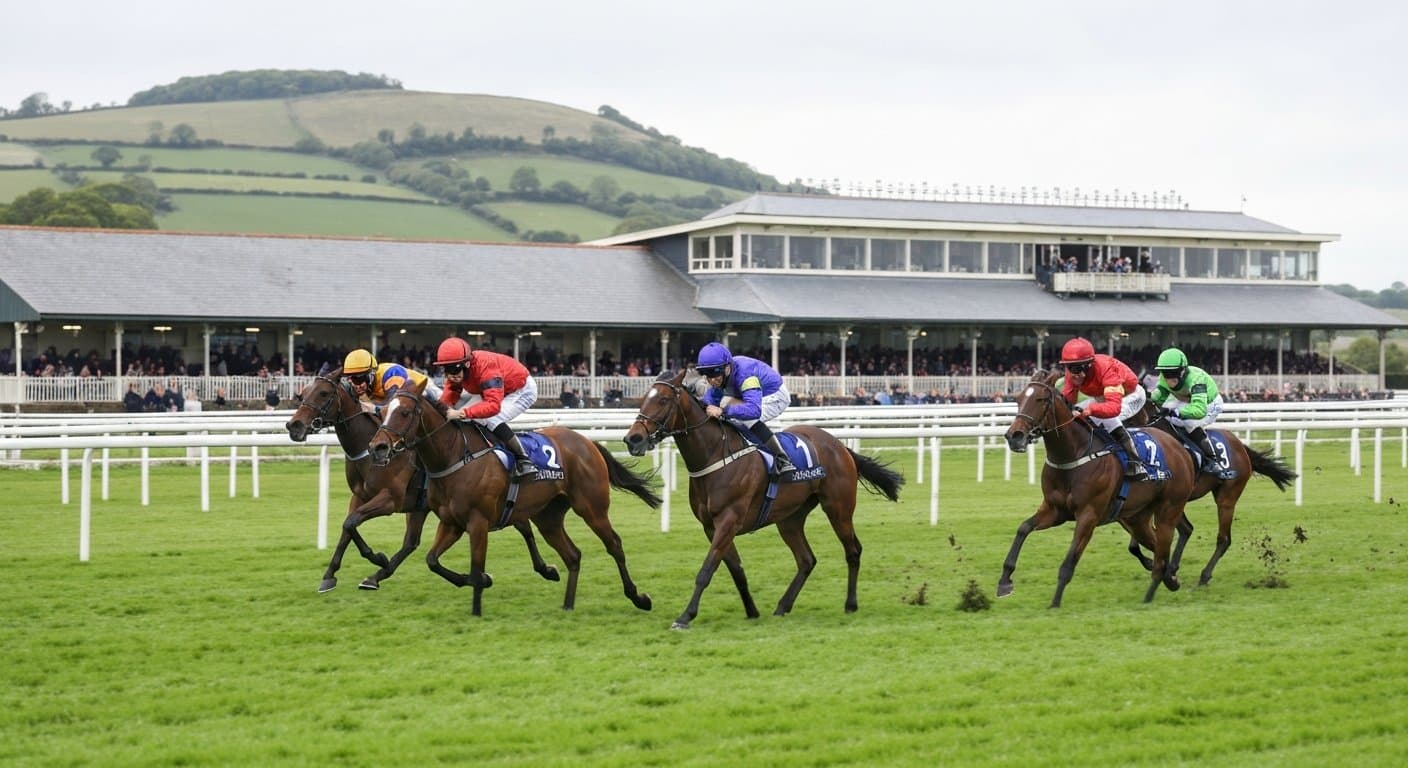
The racecourse itself is a right-handed, flat oval of approximately one mile four furlongs. There are no dramatic undulations, no severe climbs, no unusual fences. Taunton is designed to be a fair, honest test of jumping, and it succeeds. For novice chasers and hurdlers, that's precisely what's needed: a track where learning the job isn't complicated by terrain. Many of the horses that go on to Festival glory first showed their ability at Taunton in October or November.
Philip Hobbs trains just outside Minehead in north Somerset, roughly 25 miles from the track. David Pipe at Nicholashayne in Devon is 35 miles south. The three most powerful West Country yards together account for a large proportion of the Taunton card on any given day. Understanding which of their runners are seriously intended, which are educational outings, and which are carrying the confidence of the whole yard is where the betting edge lies.
There is no "Taunton Festival", and no such race as the "Donn McClean Gold Cup" exists: Taunton's fixture list is a series of individually named racedays rather than a branded multi-day meeting. The course's real signature race is the Byerley Stud Mares' Novices' Hurdle, a Listed conditions hurdle for novice mares run every 30 December over approximately two miles and half a furlong: the single best betting day of the Taunton season for the reasons any high-quality, well-run field provides.
Quick reference: when Taunton works for you
- Nicholls sends a well-regarded novice with Cobden or Bowen aboard
- The horse has course form and the going matches what it handles
- A Hobbs or Pipe runner is priced higher than 4/1 with recent winning form
- It's a novice chase at Taunton between November and January: use as a Cheltenham Festival form reference
- The going is soft/heavy and the horse has specific credentials for that ground
When to walk away
- A horse's entire form base is at Cheltenham or Ascot: better-quality horses often below par at Taunton on less demanding fences
- The market is short, Nicholls' name is attached, but the horse is a maiden making a debut: educational outings don't always win
- The going has dried to good or good to firm and the horse's form is exclusively on soft
This guide covers track characteristics, going and conditions, key trainers and jockeys, strategies, and key races.
Bet on Taunton
Place your bets on Taunton races with a trusted bookmaker.

Promo code BETFRED50. New customers only. Register, deposit with a Debit Card, and place a first bet of £10+ at Evens (2.0)+ on Sports, to be settled within 7 days, to get £30 in Sports Free Bets and £20 in Bet Builder Free Bets within 24 hours of settlement. 7-day expiry. Eligibility & payment exclusions apply. Full T&Cs apply. Take Time to Think. BeGambleAware.org. 18+. Full T&Cs.

Promo code R30. New UK customers only, 18+. Register, deposit £10 or more, then place a £10 single cash bet at odds of 1/2 (1.5) or greater on any sports market (excluding Virtuals). Once the qualifying bet settles you get £30 in Free Bets (3 x £10) — the qualifying bet can win or lose. Free Bets are valid on any sports market excluding Virtuals, expire in 7 days, are non-withdrawable and must be used in full. Excluded deposit methods apply (including PayPal, Apple Pay, Skrill and NETELLER). Named bets such as Lucky 15 do not qualify. If you cash out the qualifying bet, or it is voided, you are no longer eligible for the offer. Ends 31.12.26. Full T&Cs apply. Please gamble responsibly. BeGambleAware.org. 18+. Full T&Cs.

Promo code BET40GET20. New UK customers, 18+. Register with the code and place a first bet of £40 or more at Evens (2.0) or greater. Receive 2 × £10 free bets: the first credited automatically once the qualifying bet settles, the second 24 hours later. Free bets must be placed at minimum odds of 4/1 (5.0), expire 24 hours after credit, and the free-bet stake is not returned with winnings. Debit card deposits only. Take Time to Think. BeGambleAware.org. 18+. T&Cs apply. Full T&Cs.

50% of your first-day net losses refunded as a free bet, capped at £25. New UK customers aged 18+ only. To qualify, deposit and place a first bet of £10 or more on any sport at minimum odds of evens (2.00), then place at least two further bets on different events, each worth at least 50% of your largest bet, all at evens (2.00) or greater. Losses are counted from your first settled bet until 23:59 the same day. Place a qualifying £10+ bet and you are guaranteed at least a £5 free bet. Bets placed at SP, void bets, cashed-out bets and bets struck with free bets do not count towards the offer. The free bet is credited the day after your qualifying bets settle and must be used within 7 days, after which it expires. It can be used at odds from 1/4 (1.25) up to 250/1 on singles and straight accumulators, but not on Trixie, Patent or Yankee style multiples. Free-bet stake is not returned with winnings. One offer per person, household, address, IP address and device. E-wallet deposits may not qualify, so check the cashier before depositing. Customers registered with GAMSTOP cannot claim. KYC identity verification must be completed before the free bet is credited. Take Time to Think. BeGambleAware.org. 18+. T&Cs apply. Full T&Cs.

New customers, 18+. Choose the sports bonus at sign-up, make a first deposit and receive a 100% bonus up to £50 in your Sports Bonus balance. To convert the bonus to cash, wager it 10x within 30 days. Single bets below Evens (2.00) do not qualify; accumulators do not qualify if any selection is below 1/2 (1.50). Virtual Sports, voided, cancelled, drawn, cashed-out and free-bet wagers do not count towards wagering. Only the first settled bet per event counts. Withdrawing before the wagering requirement is met forfeits the bonus balance including bonus winnings. Real-money funds are used before bonus funds. Deposits via Skrill or Neteller are not eligible. Not valid in conjunction with other promotions. Odds, bet and payment limits apply. 10bet general and promotion T&Cs apply. BeGambleAware.org. 18+. Full T&Cs.

New customers in Great Britain and Republic of Ireland, 18+. Place a £10 fixed-odds qualifying bet at minimum odds of 1/2 (1.50) — single or each-way (only the win part counts), pre-event or in-play, not cashed out early, within 28 days of opening the account. Receive up to £60 in bonuses credited over three days: 3 × £10 fixed-odds free bets (the first on settlement, then 24 and 48 hours later) plus 3 × £5 Total Goals FOOTBALL spread bets and 3 × £5 racing Winning Favourites spread bets, with a £1 racing Race Index spread bet as an extra on top. The spread bets need a full spread-betting account, opened within 28 days of the fixed-odds account and subject to Spreadex's eligibility and appropriateness checks. Free-bet stakes not returned with winnings; free bets valid 28 days from issue. IMPORTANT: the £5 credits are SPREAD bets — sports spread betting carries the risk that losses can exceed your stake. Sports spread-betting customers do not have Financial Ombudsman or FSCS recourse. Take Time to Think. BeGambleAware.org. 18+. T&Cs apply. Full T&Cs.

Promo code WELCOME15, entered under My Bonuses after registering. New UK customers, 18+. Place a first qualifying bet of at least £10 from your cash balance at odds of evens (2.0) or greater within 7 days of opening the account. Once the qualifying bet fully settles you receive £15 in free bets, credited as 3 x £5 tokens with set uses: one £5 accumulator free bet (minimum 4 legs, each leg at 2/5 or bigger), one £5 sports free bet (any market at evens or bigger) and one £5 Sub Cover free bet (selected football player markets at evens or bigger). Free-bet stakes are not returned with winnings. Free bets expire 7 days after they are credited. Void, cashed-out and partially cashed-out bets do not qualify. One offer per customer. Confirm the current terms on BetGoodwin's own welcome-offer page before claiming. Take Time to Think. BeGambleAware.org. 18+. T&Cs apply. Full T&Cs.

New UK customers, 18+. Minimum deposit £10. Place a £10 qualifying single on sports (excluding virtuals) at minimum odds of 1/2 (1.50), settled within 14 days. Deposit-method exclusions apply. Receive £30 in free bets (stake not returned), split £20 for sportsbook use (2 x £10) and £10 for Bet Builder only (2 x £5); Bet Builder does not cover horse racing. Free bets must be accepted within 7 days and expire 7 days after acceptance. No promo code required. Best Odds Guaranteed on UK & Irish racing, subject to having staked over £25 in the previous seven days. Operated by LiveScore Betting and Gaming (Gibraltar) Ltd, UKGC 56859. Confirm the current terms on LiveScore Bet's own promotions page before claiming. Take Time to Think. BeGambleAware.org. 18+. T&Cs apply. Full T&Cs.
18+. BeGambleAware.org
Track Characteristics
The Layout
Taunton's track is a right-handed oval of approximately one mile four furlongs. The course is flat — there are no significant undulations, no climbs, no descents that would significantly alter the race pattern. The home straight is about two furlongs, and there are gentle bends connecting it to the back straight. It's a track designed to let horses race without fighting the terrain, and that's exactly what it does.
This matters for form analysis. At Cheltenham or Exeter, an uphill finish or a sharp descent can dramatically affect results. At Taunton, the horse's raw ability and jumping technique are exposed more directly. A horse that jumps well, travels smoothly, and stays the trip will usually win. One that doesn't jump cleanly will be found out on the flat, fair course with nowhere to hide.
Galloping Types and Fluent Jumpers
The flat, right-handed oval suits horses that like to stride out. Long-striding gallopers — horses that find their rhythm and maintain it — are well served here. Sharp, nippy types that excel at tight, undulating courses don't have the same advantage; there's no sharp turn for them to demonstrate their agility.
Fluent jumpers consistently outperform at Taunton. In chases particularly, a horse that can jump fluidly and maintain its stride between obstacles avoids the momentum-breaking interruptions that affect less accurate jumpers. Nicholls' stable has historically produced excellent jumping chasers, and that's one of the reasons his dominance at Taunton is so pronounced — he sends horses here that are specifically prepared to jump and gallop efficiently.
Chase vs Hurdles
Both the chase course and the hurdle course follow the right-handed oval. The fences in chases are well-constructed — no drop fences or unusual obstacles — and the hurdles are properly positioned with fair sight lines. Taunton is an excellent novice course for both disciplines: the layout is forgiving enough for horses learning the job, but honest enough to sort out those that aren't good enough.
For betting, novice chases at Taunton carry particular significance. The form from these races works out reliably. Horses that win novice chases here in November, December, or January frequently appear at the Cheltenham Festival in the Arkle, RSA Chase, or National Hunt Chase. Use the form from early-season Taunton novice chases as a building block for your Festival assessments.
Stamina and the Flat Finish
Because there's no hill to drain reserves, Taunton can occasionally flatter horses that lack the deepest stamina. A horse that gets by over two miles at Taunton might struggle over the same distance at Exeter or Cheltenham. When you're using Taunton form as a reference for a tougher track, apply a modest discount for the lack of terrain challenge.
In the longer races — two miles four furlongs and above, particularly in heavy ground — this caveat diminishes. Heavy going adds a degree of physical difficulty regardless of the terrain, and stamina still counts.
Form Transfer Guide
| Good preparation for Taunton | Less reliable preparation |
|---|---|
| Exeter (West Country, fair fences) | Cheltenham (uphill, sharper fences) |
| Wincanton (similar geography, similar profile) | Ascot (Grade 1 fences, different demands) |
| Newton Abbot (West Country NH) | Haydock (soft ground heavy demands) |
| Plumpton (southern NH, honest) | Aintree (Grand National fences, different character) |
For a full overview of the course, see the Taunton complete guide.
Going & Conditions
Going at Taunton
Taunton sits in the Vale of Taunton Deane, surrounded by the Quantock Hills to the north and the Somerset Levels to the east. The location gives it a mild, damp West Country climate. From October through March, the heart of the NH season, the going is frequently soft or heavy. Somerset is not a dry county in winter, and the racecourse drainage, while adequate, doesn't produce the fast ground that some southern NH courses manage even in poor weather.
This means that Taunton is fundamentally a soft-ground course for most of its season. Horses that have demonstrated they can handle testing ground (specifically, horses with wins or good placed efforts on soft or heavy) are the bedrock of Taunton betting. A horse with exclusively good-ground form arriving at a December Taunton meeting on heavy ground is a significant risk, regardless of any other positive attributes.
Seasonal Going Profile
October–November: Soft to good to soft is typical for the season opener. The ground is coming off summer, so it rarely starts very heavy, but rain in October softens things quickly. If the autumn has been wet, expect soft by the second meeting.
December–January: This is the heavy-ground window. When Taunton is at its most testing, the going is heavy and stays that way through successive meetings. The Byerley Stud Mares' Novices' Hurdle meeting on 30 December often runs on heavy ground. Factor this into your preparation.
February–March: Spring usually produces a drying trend. Good to soft becomes more common, and by late March or April (if late-season meetings are scheduled) the ground can approach good. Horses that have been running all winter on heavy sometimes relax and improve when the going eases slightly: look for the going-change angle.
Summer (if applicable): Taunton occasionally stages a point-to-point or charity event in summer, but it's not a regular summer NH venue. Its natural season is autumn to spring.
How Going Affects Race Dynamics
On soft ground, the pace at Taunton tends to be moderate from the start. Nobody wants to go fast and tire their horse before the going has taken its toll. This suits prominent racers and front-runners who can bowl along at a sustainable gallop. It's less beneficial for closers: a horse that needs a fast pace to generate its finish rarely gets one on soft ground at Taunton.
On heavy ground specifically, stamina becomes the dominant factor. Horses that stay strongly in testing conditions, that keep galloping when others stop, are the type to back. Nicholls has consistently produced exactly these horses: Ditcheat-trained animals that are fit, relentless, and accustomed to Somerset winters.
No Draw (Jumps Only)
Taunton is an exclusively National Hunt venue. There's no flat programme, no stalls, no draw. All horses start from the same point relative to the first fence or hurdle. Positioning in the race, whether a horse settles in the first three, behind the leaders, or at the back, depends on the jockey and the horse's natural running style, not the draw.
Weather Monitoring
The Atlantic weather systems that produce most of Somerset's rainfall can arrive quickly. A meeting declared on good to soft can be running on soft or heavy within 24 hours if a band of rain passes through. Monitor the going updates in the 48 hours before a race if you're betting in advance. The Taunton racecourse website posts daily going reports during the racing season. Trainers regularly withdraw horses when the ground changes from what they need: if you've backed something on good to soft form and the going goes heavy overnight, expect a withdrawal.
Key Trainers & Jockeys
Trainers
Paul Nicholls (Ditcheat, Somerset)
There is no trainer-course relationship in British racing quite like Nicholls at Taunton. He is based 12 miles away at Manor Farm Stables in Ditcheat, and the racecourse is in effect his local track. He wins 30 or more races at Taunton in most seasons, a figure that reflects both his volume of horses and his specific preparation for this venue. His horses are fit when they arrive here. His jockeys know every fence. When he sends a well-regarded horse to Taunton, particularly for a novice chase in November or December, the entry is almost never casual.
The betting angle with Nicholls at Taunton has more than one layer to it. His shorter-priced horses (those at 1/2 to 6/4) are known to the market. The value lies at 2/1 to 4/1, where a horse from his yard is expected to win but isn't heavily odds-on. In that price range, if the horse has course form or has shown its jumping credentials in training runs, the price consistently represents the real chance.
A specific pattern to watch: Nicholls novice chasers having their second run over fences, priced 2/1 to 5/1, on soft or heavy ground. This is a recurring profile for Nicholls Taunton winners that go on to target the Cheltenham Festival.
Philip Hobbs (Minehead, Somerset)
Hobbs is the second significant local power. His record at Taunton consistently outperforms his national strike rate, and he has won races here with horses at bigger prices than Nicholls' runners typically attract. His specialty is hurdlers and novice chasers: horses in the developmental phase of their NH career. When Hobbs has a runner at Taunton at 4/1 or bigger with Richard Johnson (historically) or a top conditional jockey aboard, it warrants attention.
Hobbs retired in 2022; his successor yards (including his son Tom Hobbs taking over some horses) have continued targeting Taunton, but the dominance is less marked. Watch for the current stable identity to establish its own Taunton record.
David Pipe (Nicholashayne, Devon)
Pipe is 35 miles south at Nicholashayne in Devon. His operation is strong with staying handicap hurdlers and chasers: the type that suits Taunton's flat, fair track in testing ground. He regularly targets the mid-season handicap programme at Taunton, and his runners at 5/1+ in two-mile-plus handicap hurdles deserve consideration when the going is soft. Tom Scudamore rides most of his runners.
Victor Dartnall (Langford Budville, Somerset)
Dartnall trains a small string in Somerset and is one of the most consistent small-yard performers at Taunton. He's not a name that excites bookmakers, and his runners can trade at generous prices relative to their actual chance. When Dartnall has a horse specifically entered at Taunton, not just a make-weight entry on a busy card, it's worth a look.
Jockeys
Harry Cobden
Cobden is Nicholls' retained first jockey. When Cobden is on a Nicholls horse at Taunton, it means Nicholls has specifically placed his best jockey on this run. That's a signal in itself. Cobden knows the course extremely well (he has ridden hundreds of winners here), and his judgment on when to commit up the straight is honed by that experience. On any Nicholls horse Cobden rides at Taunton at 5/1 or below, the position is clearly identified as a serious one.
Sean Bowen
Bowen rides for multiple yards at Taunton and is consistent. He picks up rides from Hobbs' successor yards, smaller West Country operations, and visiting trainers. His Taunton record is solid.
Rex Dingle and James Best
Both are conditional/junior jockeys with strong West Country bases. They ride for smaller yards at Taunton and can produce winners at big prices. Dingle in particular has a good Taunton record relative to his overall profile. A booking from a small yard for either of these two can indicate the trainer fancies their chance quietly.
Betting Strategies
Nicholls Novices — Second Run Over Fences
The single most consistent betting pattern at Taunton is Paul Nicholls sending a novice chaser for its second run over fences. These horses have already had the educational first run — they've jumped fences in public, they know what they're doing, and Nicholls has assessed whether they're ready to perform. The second run is often when they deliver.
The signal is clearest when: the horse won or ran well on the first chase start, Cobden or Bowen is booked, the price is 2/1 to 5/1, and the going suits. At that profile, the hit rate is high enough that routine backing is profitable over a season. The market doesn't fully contract because Nicholls sends large numbers of horses to Taunton and some of those are plainly not ready to win — so the full pattern isn't obvious in individual race assessments.
Course Form with Going Match
The flat, honest track at Taunton means course form transfers cleanly. Unlike Exeter or Cheltenham, where terrain can produce flukes in either direction, a horse that won at Taunton last January on heavy ground has demonstrated it can handle this track on this going. When the same conditions repeat, that evidence is worth trusting.
The going match is the critical additional filter. Course form on good to soft does not transfer reliably to heavy ground at Taunton — the going changes the race character significantly enough that it's almost a different test. Match the going as well as the track, and the course-form filter becomes truly useful.
Cheltenham Prep Horses — Back Them Hard
Every January and February, trainers use Taunton as the final sharpener before the Cheltenham Festival. A horse heading to the Arkle, RSA Chase, Stayers' Hurdle, or Champion Hurdle might have its last run at Taunton six weeks before the Festival. These horses try hard — they're not having an educational outing, they're getting a fitness run before the biggest day of their year.
The market often underestimates these runners because bettors think "Taunton is just a prep race." It is, but a horse that is Cheltenham-bound from a top yard doesn't run below its best at Taunton. Back the Cheltenham-prep horses seriously in the period January 15 through February 15. The prize money at Taunton is irrelevant to the trainer's motivation — they want a clear, comfortable performance, and the horse is asked for near its best.
Hobbs/Pipe Value at 4/1+
Both Hobbs and Pipe tend to be underestimated in the market relative to Nicholls. Their runners at Taunton — particularly in staying handicap hurdles and novice chases — consistently outperform their price. The practical rule: when either yard has a runner at 4/1 or bigger with recent winning form (within 35 days) on soft or heavy ground, consider it. At 6/1 or bigger, with course form added to those criteria, the case becomes strong.
This isn't about betting Hobbs or Pipe blindly — it's about recognising that the market gives too much weight to Nicholls' overall volume and slightly underprices the competition.
Novice Chase Form as Festival Reference
Taunton novice chases in November to January are reliable form guides for the Cheltenham Festival. The flat, honest track sorts out horses by their actual ability and jumping quality rather than by how well they handle unusual terrain. A horse that wins a Taunton novice chase decisively, jumping fluently throughout, has demonstrated Festival-quality credentials.
Build a log of Taunton novice chase winners from October through January each season. Check their entries in February. When one of them appears in the Arkle or RSA Chase betting at 10/1 or bigger, you have context that most bettors don't: this horse won a Taunton novice chase by jumping well, and the market hasn't yet fully priced in that form.
To compare place terms and each-way promotions across the major bookmakers, see our best bookmakers for horse racing guide.
Key Races to Bet On
There Is No Donn McClean Gold Cup, and No Taunton Festival
This section previously described a "Donn McClean Gold Cup" (a handicap chase over two miles four to six furlongs, run in January or February as part of a two-day "Taunton Festival") complete with an each-way price range and a claim about which trainers dominate it. None of that is real. Taunton has no branded multi-day festival, and no race by that name has ever been run, at Taunton or anywhere else.
The Byerley Stud Mares' Novices' Hurdle
Taunton's actual feature is the Byerley Stud Mares' Novices' Hurdle, a Listed conditions hurdle for novice mares over approximately two miles and half a furlong, run every 30 December, a single day rather than a multi-day meeting.
The race is almost always run on soft or heavy ground given the time of year, and that filters the field effectively: horses that arrive with only good-ground form rarely feature. The flat course means jumping quality and stamina are exposed directly, with no terrain providing assistance or excuses. We are not publishing an each-way price range or a trainer-dominance claim for this specific race, since the ones that used to stand here were built for a race that never existed.
For the correction in full and what is actually known of the race, see the festival guide.
November–December Novice Chases
The early-season novice chases at Taunton, from late October through December, are among the most useful form references in the NH calendar. Horses making their chase debut at Taunton, or having their second run over fences here, often give the clearest indication of their potential. The flat, honest course means that a smooth, decisive win indicates real quality rather than a course quirk.
Track these races carefully. A horse that wins a two-mile novice chase at Taunton in November by five lengths, jumping fluently throughout, is a Festival candidate. By the time it reappears at Cheltenham in March, the Taunton form will have been confirmed or denied by subsequent runs.
Handicap Hurdles: Mid-Season Value
Taunton stages competitive handicap hurdles throughout the season, and these races are often underreported compared to the novice events. Mid-season handicap hurdles in December and January (fields of 10 to 15 runners, soft ground, small markets) can produce value when a horse with relevant form has been overlooked. Pipe's operation is particularly strong in this category: his handicap hurdlers often arrive at Taunton in good form from Devon, unheralded in the betting.
Spring End-of-Season Fixtures
March and April Taunton fixtures, when the going dries slightly, can produce surprising results. Horses that have been running consistently all winter in soft ground occasionally improve sharply when conditions ease: the going change releases their ability. Watch for horses that have been placed repeatedly in heavy conditions at Taunton or Exeter suddenly finding a win when the ground eases in late March.
Taunton runs around 18 fixtures a season from October to May, and the complete guide lists every one against its typical going and crowd size.
Share this article
More about this racecourse
All Taunton guides
Taunton Racecourse: Complete Guide
Taunton Racecourse: West Country jumping at the foot of the Quantocks, the Byerley Stud Mares' Novices' Hurdle, and novice chasers from local yards.
Read more
A Day Out at Taunton Racecourse
A day at Taunton — getting there, what to wear, enclosures, food and drink, and insider tips for West Country jumping at the foot of the Quantocks.
Read more
Byerley Stud Mares' Novices' Hurdle Guide
There is no Taunton Festival. Taunton's real feature race is the Byerley Stud Mares' Novices' Hurdle, a Listed contest run every 30 December.
Read morePhotos on this page are used under Creative Commons licences. Titles, sources and licence links for each one are on our image credits page.
Research the field with the AI Race Predictor
Our model publishes calibrated win-probability estimates for UK races — a second opinion to understand a race, not tips. It's open about its record: it doesn't beat the market, and we show exactly how it does.
Work it out & learn the basics
Gamble Responsibly
Gambling should be entertaining and not seen as a way to make money. Never bet more than you can afford to lose. If you or someone you know has a gambling problem, help and support is available.