
Founder & Editor · Last reviewed 2026-06-30
Naas, the nursery of champions on the edge of Kildare
Drive south-west out of Dublin, leave the M7 at exit 9, and within five minutes you are at a racecourse that has launched more champions than its modest size has any right to. Naas, on the eastern edge of its namesake town in Co. Kildare, is not the biggest track in Ireland and it does not pretend to be. It is a boutique course where you can stand in front of the grandstand and watch every yard of the circuit, and yet it markets itself, with some justification, as the "Nursery of Champions".
The claim rests on horses, not slogans. By the racecourse's own centenary reckoning, the winners of 31 Aintree Grand Nationals, 28 Cheltenham Gold Cups and eight King George VI Chases have raced at Naas at some stage of their education. Arkle himself, the highest-rated steeplechaser in Timeform history, recorded the second win of his career here in March 1962, taking a two-mile handicap hurdle under Pat Taaffe at 2/1. Envoi Allen and Bob Olinger used the track as a springboard to the Cheltenham Festival. On the level, Alpha Centauri, Sky Lantern, Mother Earth and Porta Fortuna all won here as two-year-old fillies before becoming top-flight performers.
What makes Naas worth a betting guide of its own is its dual-code character and its role as a stepping-stone. This is a left-handed, galloping turf circuit with a long, stiff, uphill home straight, run under both Flat and National Hunt rules across roughly 20 fixtures a year. On the Flat it is one of Ireland's most important Classic and Royal Ascot trial venues. Over jumps it stages the Grade 1 Lawlor's of Naas Novice Hurdle, the first Grade 1 of the Irish jumps season, run in early January and registered as the Slaney Novice Hurdle.
The point of the pages that follow is to set out, in plain terms, what the track actually asks of a horse, how the draw and the going behave, how Naas form reads into the bigger meetings, and which yards and riders do best here. None of it is a tip. It is context, so that when you look at a Naas card you understand what you are looking at.
This guide covers what the galloping track asks, reading the draw on the Flat, going patterns and the matter of times, the trial angle into the big races, the trainer and jockey angles, favourites and the honest picture, and answers to common questions.
Where to Bet
Place your bets with a trusted, licensed bookmaker.

Promo code BETFRED50. New customers only. Register, deposit with a Debit Card, and place a first bet of £10+ at Evens (2.0)+ on Sports, to be settled within 7 days, to get £30 in Sports Free Bets and £20 in Bet Builder Free Bets within 24 hours of settlement. 7-day expiry. Eligibility & payment exclusions apply. Full T&Cs apply. Take Time to Think. BeGambleAware.org. 18+. Full T&Cs.

Promo code R30. New UK customers only, 18+. Register, deposit £10 or more, then place a £10 single cash bet at odds of 1/2 (1.5) or greater on any sports market (excluding Virtuals). Once the qualifying bet settles you get £30 in Free Bets (3 x £10) — the qualifying bet can win or lose. Free Bets are valid on any sports market excluding Virtuals, expire in 7 days, are non-withdrawable and must be used in full. Excluded deposit methods apply (including PayPal, Apple Pay, Skrill and NETELLER). Named bets such as Lucky 15 do not qualify. If you cash out the qualifying bet, or it is voided, you are no longer eligible for the offer. Ends 31.12.26. Full T&Cs apply. Please gamble responsibly. BeGambleAware.org. 18+. Full T&Cs.

Promo code BET40GET20. New UK customers, 18+. Register with the code and place a first bet of £40 or more at Evens (2.0) or greater. Receive 2 × £10 free bets: the first credited automatically once the qualifying bet settles, the second 24 hours later. Free bets must be placed at minimum odds of 4/1 (5.0), expire 24 hours after credit, and the free-bet stake is not returned with winnings. Debit card deposits only. Take Time to Think. BeGambleAware.org. 18+. T&Cs apply. Full T&Cs.

50% of your first-day net losses refunded as a free bet, capped at £25. New UK customers aged 18+ only. To qualify, deposit and place a first bet of £10 or more on any sport at minimum odds of evens (2.00), then place at least two further bets on different events, each worth at least 50% of your largest bet, all at evens (2.00) or greater. Losses are counted from your first settled bet until 23:59 the same day. Place a qualifying £10+ bet and you are guaranteed at least a £5 free bet. Bets placed at SP, void bets, cashed-out bets and bets struck with free bets do not count towards the offer. The free bet is credited the day after your qualifying bets settle and must be used within 7 days, after which it expires. It can be used at odds from 1/4 (1.25) up to 250/1 on singles and straight accumulators, but not on Trixie, Patent or Yankee style multiples. Free-bet stake is not returned with winnings. One offer per person, household, address, IP address and device. E-wallet deposits may not qualify, so check the cashier before depositing. Customers registered with GAMSTOP cannot claim. KYC identity verification must be completed before the free bet is credited. Take Time to Think. BeGambleAware.org. 18+. T&Cs apply. Full T&Cs.

New customers, 18+. Choose the sports bonus at sign-up, make a first deposit and receive a 100% bonus up to £50 in your Sports Bonus balance. To convert the bonus to cash, wager it 10x within 30 days. Single bets below Evens (2.00) do not qualify; accumulators do not qualify if any selection is below 1/2 (1.50). Virtual Sports, voided, cancelled, drawn, cashed-out and free-bet wagers do not count towards wagering. Only the first settled bet per event counts. Withdrawing before the wagering requirement is met forfeits the bonus balance including bonus winnings. Real-money funds are used before bonus funds. Deposits via Skrill or Neteller are not eligible. Not valid in conjunction with other promotions. Odds, bet and payment limits apply. 10bet general and promotion T&Cs apply. BeGambleAware.org. 18+. Full T&Cs.

New customers in Great Britain and Republic of Ireland, 18+. Place a £10 fixed-odds qualifying bet at minimum odds of 1/2 (1.50) — single or each-way (only the win part counts), pre-event or in-play, not cashed out early, within 28 days of opening the account. Receive up to £60 in bonuses credited over three days: 3 × £10 fixed-odds free bets (the first on settlement, then 24 and 48 hours later) plus 3 × £5 Total Goals FOOTBALL spread bets, 3 × £5 racing Winning Favourites spread bets and a £1 racing Race Index spread bet (the spread bets need a full spread-betting account). Free-bet stakes not returned with winnings; free bets valid 28 days from issue. IMPORTANT: the £5 credits are SPREAD bets — sports spread betting carries the risk that losses can exceed your stake. Sports spread-betting customers do not have Financial Ombudsman or FSCS recourse. Take Time to Think. BeGambleAware.org. 18+. T&Cs apply. Full T&Cs.

Promo code WELCOME15, entered under My Bonuses after registering. New UK customers, 18+. Place a first qualifying bet of at least £10 from your cash balance at odds of evens (2.0) or greater within 7 days of opening the account. Once the qualifying bet fully settles you receive £15 in free bets, credited as 3 x £5 tokens with set uses: one £5 accumulator free bet (minimum 4 legs, each leg at 2/5 or bigger), one £5 sports free bet (any market at evens or bigger) and one £5 Sub Cover free bet (selected football player markets at evens or bigger). Free-bet stakes are not returned with winnings. Free bets expire 7 days after they are credited. Void, cashed-out and partially cashed-out bets do not qualify. One offer per customer. Confirm the current terms on BetGoodwin's own welcome-offer page before claiming. Take Time to Think. BeGambleAware.org. 18+. T&Cs apply. Full T&Cs.

New UK customers, 18+. Minimum deposit £10. Place a £10 qualifying single at minimum odds of 1/2 (1.50), settled within 14 days. Receive £30 in free bets (stake not returned), split £20 for sportsbook use (2 x £10) and £10 for Bet Builder only (2 x £5); Bet Builder does not cover horse racing. Free bets must be accepted within 7 days and expire 7 days after acceptance. No promo code required. Best Odds Guaranteed on UK & Irish racing, subject to having staked over £25 in the previous seven days. Operated by LiveScore Betting and Gaming (Gibraltar) Ltd, UKGC 56859. Confirm the current terms on LiveScore Bet's own promotions page before claiming. Take Time to Think. BeGambleAware.org. 18+. T&Cs apply. Full T&Cs.
18+. BeGambleAware.org
What the galloping track asks, Flat and jumps
Naas is a left-handed turf oval of roughly a mile and a half round, and the single most important thing to understand about it is the finish. The home straight runs for about four furlongs and climbs uphill all the way to the line. That long, rising run-in turns the track into a genuine test of stamina under both codes, and it shapes almost every betting angle that follows.
A galloping track, not a sharp one
Because the circuit is broadly oval with sweeping turns and a long straight, Naas is a galloping track. It suits the long-striding, relentless sort of horse that can get into a rhythm and keep finding up the hill, rather than the nimble, quick-from-the-bend type that thrives at tighter, sharper venues. The course has minor undulations, though levelling work flattened out ridges in the first three furlongs of the home straight to make the surface fairer. A horse that is well within its stamina range here, or that wants further still, has a clear structural advantage over one that is being asked to last home at the very edge of its trip.
That stamina emphasis is why a sound judgement of pace matters so much. Get the early fractions wrong on a track where the last four furlongs are uphill and you pay for it heavily in the final hundred yards.
The sprint and the longer starts
There is a straight course for the minimum trips: a two-furlong chute joins the home straight so that five- and six-furlong races can be run on a straight line. Over seven furlongs and a mile, runners start from a separate chute at the top of the course, with a long run down to the home turn. That long approach gives jockeys time to organise their position before the bend, which is part of the reason the draw matters far less at those trips than over the sprint distances.
What the jumps track asks
Both jumps codes use the same left-handed circuit. The chase course sits on the outside and the hurdles course on the inner, which makes the hurdles track fractionally sharper of the two. The chase course has eight fences per circuit, including two open ditches, with the final two fences in the home straight and a short run-in. The fences are described as stiff but fair, and Naas typically records one of the lowest faller rates in Irish racing, so this is not a track where jumping carnage routinely reshapes a race.
The uphill finish bites hardest over jumps. Out-and-out hold-up horses have a poor record here, and that is most pronounced over hurdles, where waiting tactics across all distances have shown a very low strike rate. Racing handy or prominently, then staying on strongly up the hill, is the profile that wins most often. Front-runners and prominent racers are favoured at most trips, on the Flat as well as over obstacles. The lesson is consistent across the card: a horse must be fully proven at the trip, or beyond it, to cope with what the last four furlongs demand.
Reading the draw on the Flat
The draw at Naas is a modest, ground-dependent factor rather than a decisive one, and it only really comes into play over the sprint trips. It is worth understanding what the bias is and, just as importantly, what it is not.
Where the draw can matter
Over five furlongs, which produces relatively few races here, and over six furlongs, low-drawn runners have historically held a slight edge. Part of that is geometry: as the straight course narrows, runners tend to congregate towards the middle, and a low draw can make it easier to get a tow into that central group early.
The ground complicates the picture, and this is the part most worth carrying into a card. In soft or heavy going the field often tacks across towards the stands rail, where the ground can ride a touch better, and that movement can hand the advantage to higher-drawn horses. On faster ground the low-drawn bias reasserts itself. So the same stalls position is not worth the same thing on every day, and the going report is part of reading the draw, not separate from it.
Where it largely does not
Over seven furlongs and a mile the draw is of little importance. Those races start from the top chute with a long run to the home turn, and that lengthy approach gives every runner time to find a position before it matters. By the time the field reaches the straight, where the horse is drawn no longer reflects where it is racing.
Hold the bias loosely
Two cautions are worth stating plainly. First, the effect is not strong even at its sharpest. Some recent-season data suggests medium-to-high stalls have fared perfectly well over the sprint trips, which tells you the edge is slight and shifts about rather than being a fixed rule you can lean on. Second, no draw advantage rescues a horse from the uphill finish. A low number on better ground over six furlongs is a small thing in the right direction; it is not a reason on its own to back anything, and it certainly does not override stamina, pace and class. Treat the draw at Naas as one minor input among several, weighted by the going, and never as a system.
Going patterns and the matter of times
Ground is central to reading Naas, partly because of the season and partly because of a quirk in how the track drains. Get a feel for both and a lot of the form makes more sense.
A track that rides testing in winter
Naas can ride genuinely soft to heavy through the winter National Hunt season. That matters for the flagship jumps days in January and February, when the headline Grade 1 and the graded chases and hurdles are run, because a stiff, galloping, uphill track in deep ground is about as thorough a stamina test as Irish jumping offers. The 2025 Lawlor's was run on heavy ground, and the 2025 Newlands Chase was lost altogether to a waterlogged track, which gives you the measure of how wet the place can get at that time of year.
There is also a drainage quirk worth knowing. The section of track from the winning post back to the seven-furlong start tends to drain more slowly and ride softer, effectively heavier, than the rest of the circuit, especially after winter rain. So a horse can be travelling on one type of ground for part of a race and a more testing version of it elsewhere, and a runner with proven form in a bog has a real edge on the worst days. On the Flat, the practical reading is to take published going descriptions seriously and to factor that slower-draining back stretch into how a race is likely to be run.
The matter of times
Honesty is required here. Naas does not publish a widely available, authoritative table of all-time course-record times by distance in the public course guides, so there is no reliable standard-times benchmark to quote race by race. What exists are individual recorded race times on the result services. To give a sense of the scale of the test rather than to set any record, the 2026 Grade 1 novice hurdle over two miles four furlongs was run in 5 minutes 5.10 seconds on soft ground.
That absence of a consolidated record table is itself a useful caution. On a galloping, uphill, often-soft track, raw clock times and speed or sectional figures carry less weight than they do at sharper, faster venues. A flashy time posted on quick ground in summer tells you little about how the same horse will cope up the hill in January mud. At Naas the questions that matter most are about stamina, class and the ability to handle the ground, not about the stopwatch.
The trial angle, reading Naas form into the big races
The single richest seam of Naas form is its role as a trial track. This is a stepping-stone course, and a great deal of what is run here is read forward into the Curragh Classics, Royal Ascot and the Cheltenham Festival. Knowing which Naas races point where, and what the form has actually produced, is the most useful thing a backer can take from the place.
The jumps trial, January's Grade 1
The Lawlor's of Naas Novice Hurdle, registered as the Slaney Novice Hurdle and run as the Ballymore Novice Hurdle from the 2026 renewal, is Naas's only Grade 1 and the first Grade 1 of the Irish jumps year. It is run in early January over about two miles four furlongs. The race received Grade 3 status in 1993, was raised to Grade 2 in 2005, and became Naas's first ever Grade 1 in 2015. As a Cheltenham trial it points most directly at the Ballymore Novices' Hurdle, and two recent winners completed exactly that double: Envoi Allen (2020) and Bob Olinger (2021) both won here and then took the Ballymore at the Festival.
The roll of honour in the Grade 1 era is a who's who of staying novices:
| Year | Winner | Trainer | Jockey | SP |
|---|---|---|---|---|
| 2026 | I'll Sort That | Declan Queally | Mr D.L. Queally | 5/1 |
| 2025 | The Yellow Clay | Gordon Elliott | Sam Ewing | 11/4 |
| 2024 | Readin Tommy Wrong | Willie Mullins | Daryl Jacob | 16/1 |
| 2023 | Champ Kiely | Willie Mullins | Danny Mullins | 10/3 |
| 2022 | Ginto | Gordon Elliott | Jack Kennedy | 5/4f |
| 2021 | Bob Olinger | Henry de Bromhead | Rachael Blackmore | |
| 2020 | Envoi Allen | Gordon Elliott | Davy Russell | 1/4f |
| 2019 | Battleoverdoyen | Gordon Elliott | Jack Kennedy | 2/1f |
| 2018 | Next Destination | Willie Mullins | Paul Townend | 8/15f |
| 2017 | Death Duty | Gordon Elliott | Jack Kennedy | 5/6f |
| 2016 | Bellshill | Willie Mullins | Ruby Walsh | 2/5f |
| 2015 | Mckinley | Willie Mullins | Paul Townend | 33/1 |
Before the Grade 1 era the race had already produced Rule The World (2013), who went on to win the 2016 Aintree Grand National, and going back further Golden Cygnet (1978), who took the Cheltenham Supreme. The historic profile of the winner is worth noting: in the ten years before 2019, all ten winners had won on their last completed start, nine had run within the previous month, and seven had already won over at least two miles four furlongs. That is a stamina-and-recent-form race through and through, which fits the track exactly.
The Flat trials, spring into summer
On the Flat, Naas is one of Ireland's most important trial venues, and the Royal Ascot Trials Day in May is the centrepiece. The Group 3 Lacken Stakes over six furlongs is a recognised Royal Ascot pointer for the Commonwealth Cup, and its winners include So Perfect (2019), The Antarctic (2023), Bucanero Fuerte (2024), Babouche (2025) and Charles Darwin (2026). The Group 3 Coolmore Stud Irish EBF Fillies Sprint Stakes, for two-year-old fillies, has an exceptional record as a nursery: You'resothrilling, Lillie Langtry, Sky Lantern, Alpha Centauri, Mother Earth, Meditate, Porta Fortuna, Fairy Godmother and Lady Iman all won it before going on to Royal Ascot's Albany and to Classic and Group 1 level. The same card carries the Listed Woodlands and Owenstown Stud Stakes and the Listed Naas Oaks Trial.
Elsewhere on the summer programme, the Group 3 Blue Wind Stakes, now run in late June for three-year-old fillies over a mile and a quarter, is an Oaks pointer that produced Pleascach (2015), later an Irish 1,000 Guineas and Yorkshire Oaks winner, and Tarnawa (2019). The takeaway is consistent: strong Naas trial form, in races run on a stiff track, tends to read up rather than down when those horses step into Group 1 company.
Trainer and jockey angles
As at most Irish tracks, a handful of yards and riders dominate the graded action at Naas, and knowing who they are is part of reading a card honestly. Strike rates quoted here come from statistics services and are period-specific, so treat them as background on who does well at the track rather than as a guarantee of anything to come.
The jumps yards
Willie Mullins is the dominant National Hunt trainer at Naas. He is the most successful trainer in the Grade 1 Lawlor's with at least nine wins, the leading trainer in the Grade 3 Limestone Lad Hurdle with eight, and a multiple winner of the Johnstown Novice Hurdle, the Newlands Chase and the Poplar Square Chase. In the 2024 Grade 1 he saddled the first three home. Gordon Elliott is his chief rival here and shares the Grade 1-era honours with him almost evenly, having won the big novice hurdle with Death Duty (2017), Battleoverdoyen (2019), Envoi Allen (2020), Ginto (2022) and The Yellow Clay (2025).
Over the smaller obstacles and fences, Henry de Bromhead is the name to know. He is the most successful trainer in the Newlands Chase with five wins and a multiple Poplar Square Chase winner, and his partnership with Rachael Blackmore gives the yard a strong all-round Naas record. Gavin Cromwell has also landed graded prizes here, including Espoir D'Allen in the 2019 Limestone Lad.
The jumps riders
Paul Townend heads several of the historic rider records, with seven wins in the Limestone Lad Hurdle, and Ruby Walsh is the leading jockey in the Grade 1 with four. Among current riders, Rachael Blackmore and Mark Walsh have posted strong strike rates over jumps at the course, Patrick Mullins is consistently effective here, and Mark Walsh has ridden the most jumps winners in some samples. Given how the track punishes hold-up tactics, the riders who do best tend to be the ones who put their horses into the race early and let the uphill finish do the sorting.
The Flat operations
On the level, Aidan O'Brien's Ballydoyle is the powerhouse at the trials. He has won the Group 3 Lacken Stakes five times and has a long record in the Fillies' Sprint Stakes, with Naas maidens repeatedly launching his Classic and Royal Ascot horses. Jim Bolger is the joint-record holder in the Blue Wind Stakes with six wins, all ridden by Kevin Manning, while Dermot Weld has taken the same race with the likes of Tarnawa and Zhukova. Jessica Harrington has won it more recently with Sea The Boss (2024) and Barnavara (2025).
Among Flat jockeys, Ryan Moore stands out with an exceptionally high course strike rate, reported around 36 per cent in one large sample, and four Lacken Stakes wins, with Donnacha O'Brien also around 25 per cent in his riding days, both figures tied to the Ballydoyle stable. Colin Keane has ridden the most Flat winners at the track in recent years, and Shane Foley and Kevin Manning are reliable course performers. A high strike rate from a powerful yard is a real signal, but it is a signal about quality of horse as much as anything, and it does not change the maths set out in the next section.
Favourites, form figures and the honest picture
Naas carries a reputation in some betting-site guides as a "punter's graveyard", a track where favourites come unstuck. It is worth taking that label apart, because the truth is more interesting than the nickname, and it leads to the one fact every backer should hold onto.
Is Naas really a graveyard for favourites?
The nickname is widely repeated but it is not an official designation, and the more measured course guides actually describe Naas as a fair, readable track. The two things are not as contradictory as they sound. A galloping, uphill, often-soft circuit asks hard questions, and on the worst winter days a fancied horse that is not fully proven in the ground or at the trip can find the last four furlongs beyond it. That produces the occasional eye-catching upset, the 33/1 winner of the 2015 Grade 1 among them. But the same track also returns plenty of short-priced winners. In the Grade 1 novice hurdle, favourites have a strong record: nine of the first twenty renewals went to the market leader, with several winning at long odds-on, including Envoi Allen at 1/4 and Bellshill at 2/5. A track that sends out that many winning favourites in its showpiece race is not a graveyard. It is a fair test that occasionally catches out a vulnerable jolly.
What the form figures are really telling you
The useful reading is the one the track itself keeps repeating. Naas form is reliable when you weight it for stamina and ground. Horses fully proven at the trip or beyond, that race prominently and handle the going, win more than their share. Hold-up horses, raw speed types and runners stepping up in trip for the first time are the ones the uphill finish exposes. Form figures earned here, in other words, are worth reading carefully rather than dismissing.
The fact that does not change
None of that alters the underlying maths, and this is the point to end on. Across all racing, backing favourites blindly loses money to the starting price over time. Short-priced market leaders win their fair share of races, Naas included, but taken as a whole, level-stakes backing of favourites produces a long-term loss once the bookmaker's margin is accounted for. This is not a quirk of Naas; it is a general truth of how betting markets are priced, and the strong favourite record in the Grade 1 does not contradict it.
No staking method, no draw angle, no trainer strike rate and no trial-form pattern changes that. The favourite is short because the market judges it likely to win, and the price already reflects that judgement and then some. Everything in this guide is meant to help you read a Naas card with clear eyes. None of it is a tip, and none of it implies a profit. The house edge is built into the prices, and over a long enough run it wins. Bet accordingly, and only with money you can afford to lose.
Frequently Asked Questions
Share this article
More about this racecourse
All naas guides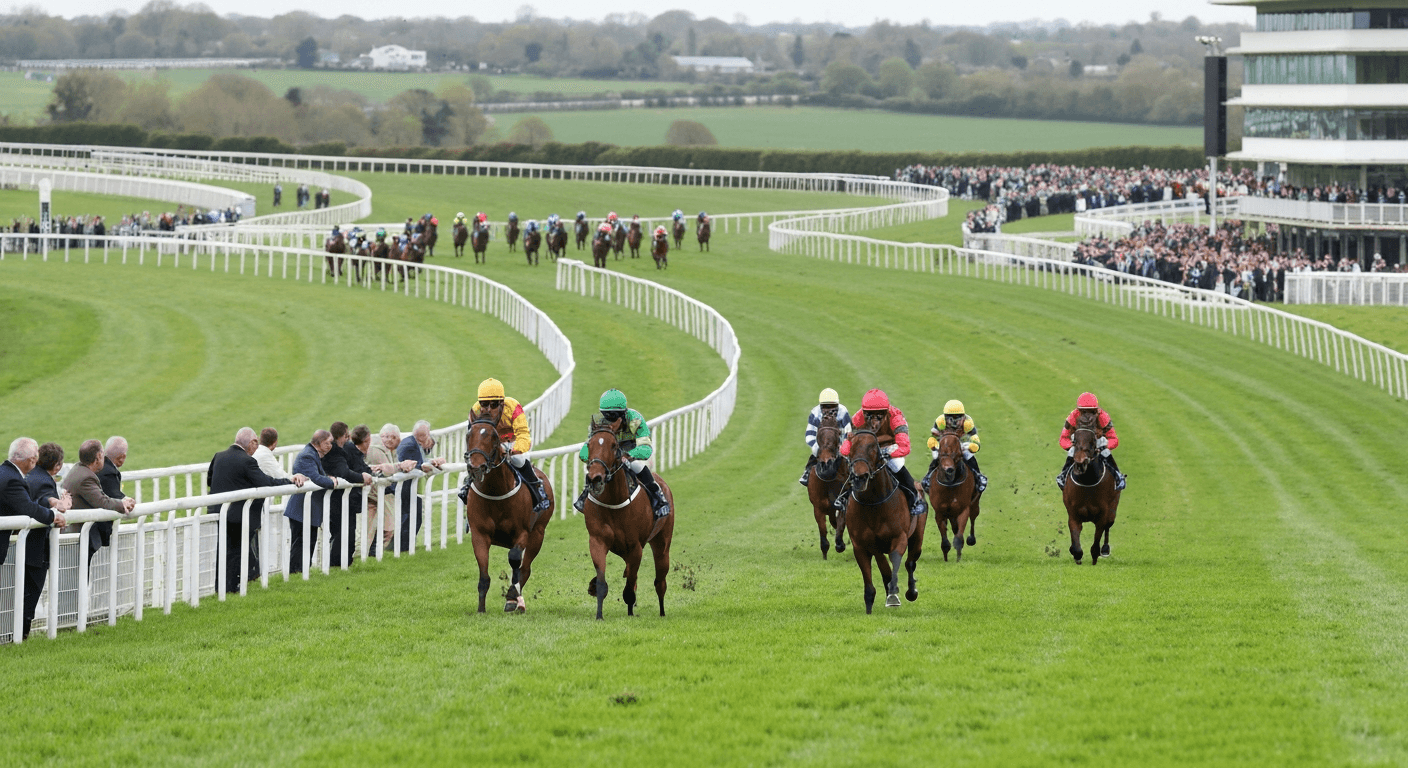
The Big Days at Naas, A Guide to the Key Meetings
A guide to Naas Racecourse's key meetings, the Lawlor's Grade 1, Royal Ascot trials, the Ballyhane Stakes and the year-round dual-code calendar.
Read moreNaas Racecourse: The Complete Guide
Naas (Co. Kildare) in full: the dual-code Classic-trials track and home of the Grade 1 Lawlor's of Naas Novice Hurdle, three times Racecourse of the Year, the key meetings and their winners, tickets, travel and how to visit.
Read more
The History of Naas
From a Civil War-era field in Co. Kildare to Ireland's nursery of champions, the story of Naas Racecourse, its track, its horses and its people.
Read morePhotos on this page are used under Creative Commons licences. Titles, sources and licence links for each one are on our image credits page.
Research the field with the AI Race Predictor
Our model publishes calibrated win-probability estimates for UK races — a second opinion to understand a race, not tips. It's open about its record: it doesn't beat the market, and we show exactly how it does.
Work it out & learn the basics
Gamble Responsibly
Gambling should be entertaining and not seen as a way to make money. Never bet more than you can afford to lose. If you or someone you know has a gambling problem, help and support is available.