
Founder & Editor · Last reviewed 2026-07-13
Racing under the Tipperary name is a fairly recent thing, but the sport on this patch of Munster goes back much further. The first recorded race meeting associated with the course took place at Barronstown, south of the present site, on 27 March 1848. The track you can visit today, beside Limerick Junction station, opened in September 1916 and was known as Limerick Junction Racecourse for seventy years. It only became Tipperary Racecourse in 1986.
That change of name is a useful way into the story, because the place has always been defined as much by where it sits as by what it is called. Limerick Junction is a railway interchange, and the course grew up right next to it. It is the only racecourse in Ireland sitting immediately beside a train station, and for generations that has shaped who came and how.
The other thread running through the history is Ballydoyle. Tipperary is the nearest racecourse to Aidan O'Brien's training operation, and that proximity has turned the track into a proving ground. Champions in the making have tended to have their first competitive run here before the wider world caught up with them. High Chaparral and Hawk Wing, two of the best colts of their generation, both broke their maidens at Tipperary as juveniles in 2001.
This article traces the course from those early races through to the track as it stands today, still staging Flat and National Hunt racing across the summer and into October.
From Barronstown to Limerick Junction
The documented history of racing in this corner of County Tipperary begins with a meeting at Barronstown, a site south of where the course now stands, on 27 March 1848. That is the first recorded fixture tied to what would become Tipperary Racecourse. The early record is thin, and it is worth keeping the two locations separate: the racing that started at Barronstown is not the same ground as the modern track.
A New Course at Limerick Junction
The course as it exists today is a twentieth-century creation. A consortium led by T Gardiner Wallis established a new course at Limerick Junction, which opened in September 1916. Among those in attendance at the opening were the trainers Senator JJ Parkinson, Stephen Grehan and Charles Moore, names that placed the new venture squarely within the Irish training establishment of the day.
The choice of site was deliberate and practical. Limerick Junction is a railway interchange, the meeting point for trains from Limerick, Dublin, Cork, Waterford, Tralee and Ennis. Building the course immediately beside the station gave racegoers a way in that no other Irish track could match. It remains the only racecourse in Ireland located next to a railway station, and the platform is a short walk from the enclosures.
Limerick Junction Becomes Tipperary
For seventy years the track carried the name of the station beside it. It was Limerick Junction Racecourse until 1986, when it was renamed Tipperary Racecourse, aligning it with the county it has always sat in. The course is one of three in County Tipperary, alongside Clonmel and Thurles.
Ownership today rests with Horse Racing Ireland, and the track has grown into a dual-code venue staging both Flat and National Hunt racing. The full shape of the modern operation, and the redevelopment now under way, is covered in the Tipperary Today section below. What matters for the origins is the through-line: from a first recorded meeting in 1848, to a purpose-built course beside the junction in 1916, to the Tipperary name it has carried since 1986.
The Signature Races Take Shape
Tipperary's identity as a racing venue was built less by a founding charter than by the races it gathered over time. Three fixtures in particular have come to define the calendar: the Concorde Stakes on the Flat, the Fairy Bridge Stakes for fillies and mares, and the Istabraq Hurdle over jumps.
The Concorde Stakes
The Concorde Stakes is the track's flagship Flat race, run over 7 furlongs and 100 yards in early October on the Super Sunday card and sponsored by Coolmore Stud. It did not start life at Tipperary. The race was formerly held at Phoenix Park over one mile, transferred to Tipperary in 1991, and moved to its early-October slot in 1995. It was staged at Cork in 1999 and 2000 before settling back at Tipperary.
Its grade has changed too, and the current position matters. The Concorde was a Group 3 up to and including 2022, then downgraded to Listed for 2023, and it has remained a Listed race in 2024 and 2025. Describing it as a Group 3 in the present tense is out of date.
The Fairy Bridge Stakes
The Fairy Bridge Stakes, run over 7f 100y in August and also sponsored by Coolmore Stud, is confined to fillies and mares. It was established in 2003 at Listed level and promoted to Group 3 in 2012, a grade it still holds. The race is named after Fairy Bridge, the influential broodmare who was the dam of Sadler's Wells.
The Istabraq Hurdle
Over jumps, the track's most notable race is the Istabraq Hurdle, a Grade 2 over two miles on Super Sunday. It was formerly the Tipperary Hurdle and was renamed in 2014 to honour Istabraq, the triple Champion Hurdler who won the first three runnings in 1997, 1998 and 1999.
Milestones at a Glance
| Year | Milestone |
|---|---|
| 1848 | First recorded meeting associated with the course, at Barronstown |
| 1916 | New course opens at Limerick Junction (September) |
| 1986 | Renamed from Limerick Junction to Tipperary Racecourse |
| 1991 | Concorde Stakes transferred to Tipperary from Phoenix Park |
| 1995 | Concorde Stakes moved to its early-October slot |
| 1997 | Istabraq wins the first of three straight runnings of the Tipperary Hurdle |
| 2003 | Fairy Bridge Stakes established at Listed level |
| 2012 | Fairy Bridge Stakes promoted to Group 3 |
| 2014 | Tipperary Hurdle renamed the Istabraq Hurdle |
| 2023 | Concorde Stakes downgraded from Group 3 to Listed |
The Champions Who Started Here
Tipperary's place in the record is unusual. It is not a track that hosts many of the biggest wins in a champion's career. Its distinction is the opposite: it is where a lot of champions were first seen. Because it is the nearest racecourse to Ballydoyle, Aidan O'Brien has long used it to give promising juveniles their first competitive run, and several went on to become Group and Grade 1 horses. The wins that made those horses famous came elsewhere; what happened at Tipperary was the start.
High Chaparral
High Chaparral is the standout example. On his racecourse debut, at Punchestown on 30 September 2001, he was beaten a short head by Hot Trotter. Roughly a week later he broke his maiden at Tipperary, winning by two and a half lengths. That was the last run before he stepped up to Group 1 company and won the Racing Post Trophy at Doncaster.
Everything after that belongs to other tracks. He went on to a career of 13 starts for 10 wins, earning US$5,331,231 and taking six Group and Grade 1 races, including the Epsom Derby and two runnings of the Breeders' Cup Turf. Those are not Tipperary results. What Tipperary can claim is the maiden win that launched him.
Hawk Wing
Hawk Wing, foaled the same year and also trained by Aidan O'Brien, has a still cleaner Tipperary connection. He made a winning racecourse debut at the track on 24 May 2001, taking a two-year-old maiden over seven furlongs on good to firm ground. Ridden by Mick Kinane, he went off the 2/7 favourite and won by a short head from Smuggler's Song in a field of ten.
He too became a champion away from here. Hawk Wing won three Group 1 races and is best remembered for an eleven-length demolition in the 2003 Lockinge Stakes, a performance rated among the very best over a mile in years. He was also runner-up to his stablemate High Chaparral in the 2002 Epsom Derby, the pair finishing well clear of the field. None of that was at Tipperary, but the winning start was.
The Wider Launch Pad
High Chaparral and Hawk Wing are not the only names. Dylan Thomas, Yesterday, Bushranger and Heatseeker all made their racing debuts at the course. The verified thread is consistent: promising Ballydoyle juveniles trying the track first, then moving up in class elsewhere.
One horse is remembered here for a different reason. Istabraq, one of the greatest modern hurdlers, did not begin his career at Tipperary, but the track's Grade 2 Super Sunday hurdle carries his name, a nod to the three straight runnings he won at the course in the late 1990s.
The Trainers and Riders
The people who have shaped Tipperary's record split neatly between the Flat and the jumps, and between the horsemen next door at Ballydoyle and the trainers who have made particular races their own.
The Flat Trainers
Aidan O'Brien dominates as the leading Flat trainer at the course, posting a high strike rate with the Ballydoyle runners he sends the short distance to Limerick Junction. That local advantage is the single biggest factor in the modern Flat record here.
The Concorde Stakes, though, belongs to Dermot Weld. He is the outstanding trainer in the race with eleven wins, a run stretching from Iron Leader in 1983 through Kings River in 1985 and 1986, Executive Perk in 1989, Rami in 1992, Two-Twenty-Two in 1998, Tarry Flynn in 1999, and on to Emulous in 2010, Anam Allta in 2011, Yellow Rosebud in 2012 and Big Break in 2013. In the Fairy Bridge Stakes the leading trainers are Jim Bolger and Joseph O'Brien, each with four wins.
The Jockeys
Michael Kinane is the leading rider in the Concorde Stakes with five wins, aboard Kings River in both 1985 and 1986, Executive Perk in 1989, Rami in 1992 and Eastern Appeal in 2007. In the Fairy Bridge Stakes, Kevin Manning, Pat Smullen and Declan McDonogh have each ridden three winners.
Among the current generation on the Flat, Colin Keane and Billy Lee have been the leading riders at the track.
Over the Jumps
The National Hunt record has a different cast. In recent seasons Willie Mullins has posted the best trainer strike rate at Tipperary, with Henry de Bromhead also prominent. In the saddle, Rachael Blackmore and Paul Townend have been the leading jump jockeys at the course. It is a roster that mirrors the balance of power in Irish jump racing more widely, brought to a track that stages jumps and Flat side by side across its season.
The Record Book
Tipperary's record book comes with a caveat. A full published set of all-time course records by distance, and of marquee-race track records, is not readily available, so this section stays with what is confirmed rather than quoting numbers that cannot be stood up. Where a figure is genuinely published, it is given; where it is not, that is said plainly.
Race Times
Individual race times are published in results. The 2025 Concorde Stakes was won by Deepone in 1 minute 42.99 seconds over 7f 100y on heavy ground, ridden by Billy Lee for Paddy Twomey. That is a going-dependent result rather than a standing course record, and it should be read as such.
Leading Records in the Feature Races
The most reliable statistics attach to the two black-type Flat races. In the Concorde Stakes, Dermot Weld leads the trainers with eleven wins and Michael Kinane leads the jockeys with five. Three horses have won the Concorde twice.
| Record | Holder | Detail |
|---|---|---|
| Leading Concorde trainer | Dermot Weld | 11 wins |
| Leading Concorde jockey | Michael Kinane | 5 wins |
| Dual Concorde winners | Kings River; Wizard King; Yulong Gold Fairy | 1985/86; 1996/97; 2018/19 |
| Leading Fairy Bridge horse | Tested | Back-to-back, 2014 and 2015 |
| Fairy Bridge leading trainers | Jim Bolger; Joseph O'Brien | 4 wins each |
| All-time course-record times | n/a | Not published; treat as thin |
A Note on Betting Angles
These records are historical description, not a betting steer. Tipperary is a fast, flat speed track that has tended to favour prominently ridden horses, and on the straight five-furlong course high draws are favoured when the going is soft. That is form context, nothing more. Over any length of time, backing favourites loses money to starting price, and no system or favourite is profitable in the long run.
What Tipperary Means
Tipperary's character comes from its setting and its calendar rather than from grand architecture. It is a rural track, picturesque and low-key, and part of its charm is how ordinary the surroundings can feel. It is not unknown for a local farmer to be working the centre of the course on a raceday, which tells you plenty about the sort of place it is.
Super Sunday
The seasonal highlight is Super Sunday, the mixed card held on the first Sunday of October. It is the biggest crowd of the Tipperary year, and it has a genuine claim to being unique in Irish racing: it is the only meeting in the country to stage Graded jumps races and a black-type Flat race on the same day. The card carries the Concorde Stakes alongside the Grade 2 Istabraq Hurdle and further graded National Hunt races, with live entertainment afterwards. For one afternoon the track does something no other Irish course attempts, putting the two codes shoulder to shoulder.
Beside the Junction
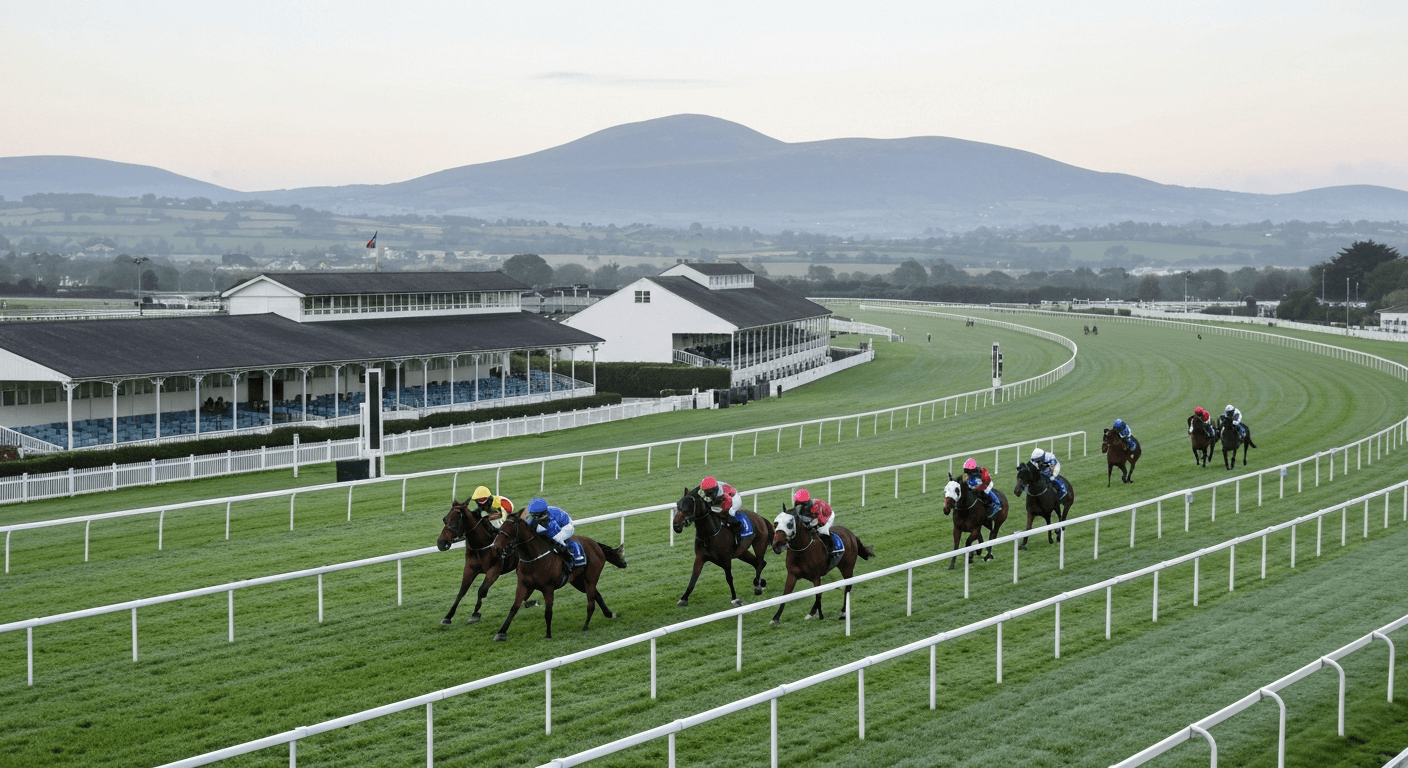
The other defining feature is the railway. Limerick Junction station sits right beside the enclosures, the only such arrangement in Irish racing, and it has always shaped the experience of getting to and from the races. The parade ring, the grandstands and the finish are grouped together on the stands side, and the Restaurant on the first floor of the Limerick Stand looks out over the parade ring and home straight, with the Silvermine Mountains beyond.
A County of Racing
Tipperary is one of three racecourses in County Tipperary, along with Clonmel and Thurles, which gives the county an unusually strong racing identity for its size. The day itself is relaxed. There is no strict dress code, and smart wear suitable for the weather is all that is encouraged across the enclosures.
Tipperary Today
Tipperary today is a Horse Racing Ireland course. It is owned by HRI and run through HRI Racecourses Ltd, the same operating arm that manages Leopardstown, Navan and Fairyhouse. That places it firmly within the state-backed side of Irish racing rather than in private hands.
Governance and People
The current racecourse manager is Andrew Hogan, and the committee chairman is Maurice Moloney. Above them, Suzanne Eade is the chief executive of Horse Racing Ireland. It is a conventional structure for an HRI-operated track, with day-to-day running at the course reporting up into the national body.
The Racing Calendar
The track stages around 11 to 12 fixtures between April and October, more than half of them evening meetings. That summer-and-autumn rhythm, built on evening and Sunday cards, is central to how Tipperary works now. It is a dual-code venue throughout, mixing Flat and National Hunt racing, and the season builds towards Super Sunday in early October.
The All-Weather Development
The most significant recent change is still in progress. An all-weather track development is under way at the venue, with Horse Racing Ireland reporting strong progress and racecourse manager Andrew Hogan commenting on the works. The full detail of the timeline and cost is not yet publicly confirmed, so it would be wrong to put firm figures on either. What is clear is the direction: Tipperary is being developed as an all-weather as well as a turf venue, which would extend its role in the Irish programme.
Watching and Visiting
Tipperary racing is broadcast on Sky Sports Racing under its media-rights arrangement, so the fixtures reach a national audience whether or not the crowds travel. For the track as it stands now, including the layout, the enclosures, tickets and how to plan a day, the Tipperary Racecourse complete guide is the place to start.
Frequently Asked Questions
Share this article
More about this racecourse
All tipperary guides
Tipperary Racecourse: The Complete Guide
Tipperary Racecourse, the dual-code Munster track beside Limerick Junction, home of Concorde Stakes and High Chaparral, plus tickets, travel and how to visit.
Read more
Concorde Stakes Day at Tipperary: The Complete Guide
Concorde Stakes Day at Tipperary, the early-October Super Sunday card headed by the black-type Concorde Stakes over 7f, with the roll of honour, the day and how to watch.
Read more
High Chaparral at Tipperary: The Complete Story
How High Chaparral broke his maiden at Tipperary, the nearest track to Ballydoyle, before winning two Derbys and two Breeders' Cup Turfs.
Read moreGamble Responsibly
Gambling should be entertaining and not seen as a way to make money. Never bet more than you can afford to lose. If you or someone you know has a gambling problem, help and support is available.