
Founder & Editor · Last reviewed 2026-06-29
Stand at the rail near the finish on Irish Derby day and the ground itself tells you why this place matters. The word Curragh comes from the Irish Cuirreach, meaning "place of the running horse", and for the best part of three centuries horses have done exactly that across this open plain of Co. Kildare, roughly 30 miles south-west of Dublin. The first recorded race here dates to 1727, the first official meeting is variously placed around 1741, and the racing has never really stopped since.
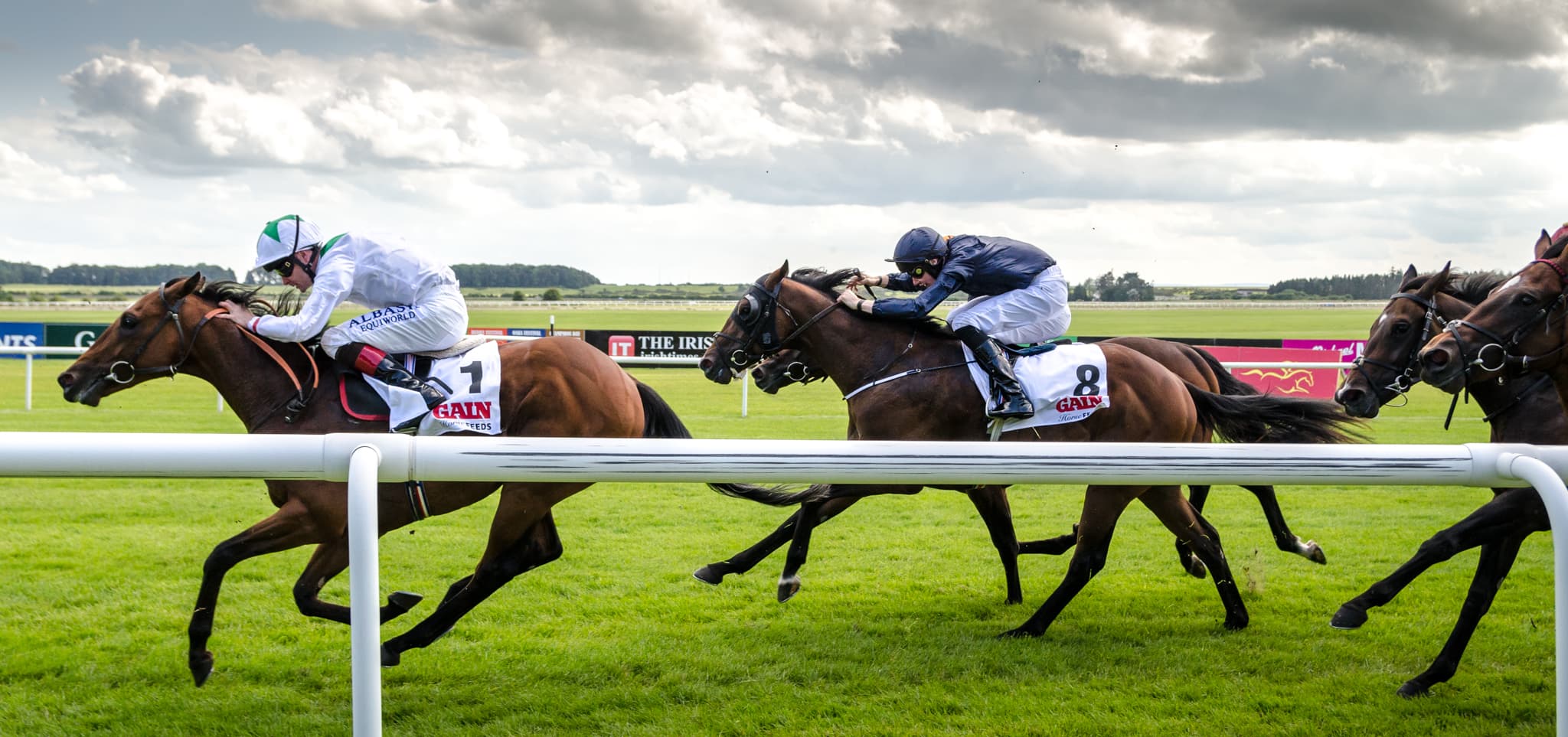
This is the headquarters of Irish Flat racing, the home of all five Irish Classics, and a course widely regarded as one of the fairest in the world. The circuit is a right-handed horseshoe of about two miles with no sharp bends and a three-furlong run-in that rises slightly to a testing uphill finish, a layout that rewards strong, galloping, classic types rather than nippy speed merchants. Around it sit roughly 1,500 acres of training grounds, more than 70 miles of turf gallops and eight all-weather surfaces, the nursery that has produced much of Irish racing's global success.
The history that follows is long and unusually well documented: an ancient common turned into a racecourse by Act of Parliament, a Derby that predates the modern Irish state, a roll-call of horses from Nijinsky and Shergar to Galileo and Kyprios, and an 81-million-euro rebuild that gave the plain a controversial new grandstand named after one of its oldest patrons. Some of it is myth, some of it is fact, and the two have been tangled together on this plain for a very long time. What follows sticks to the record.
This guide covers racing on the ancient plain, the Curragh of Kildare Act 1868, the home of the Irish Classics, the legendary horses and the legendary people, the modern era and the 2019 redevelopment, and answers to common questions.
Racing on the Ancient Plain
Long before anyone kept a formal record, the Curragh plain was already a place of legend. Irish mythology links it to Fionn MacCumhaill and the Fianna at the nearby Hill of Allen, to chariot racing in the third century, and to the story of St Brigid, whose cloak is said to have spread to cover the entire Curragh. None of that can be dated with any confidence, but the through-line is consistent: this open, springy turf has been associated with horses, speed and contest for as long as anyone has been telling stories about it.
The documented record begins to firm up in the eighteenth century. The first recorded race on the plain took place in 1727, though racing here certainly predates that, and the first official meeting is variously dated to around 1741. By then the plain was already establishing itself as the natural gathering point for Irish racing, helped enormously by the founding of the Turf Club.
The Turf Club makes its home
The Turf Club was founded in Kildare in the 1760s, and it made the Curragh its home. From there it grew into the governing body of Irish racing, the institution that wrote and enforced the rules of the sport across the country. Having the regulator headquartered on the same plain as the racing gave the Curragh an authority no other Irish course could match, and that link between the place and the governance of the sport has never been broken. Today the Turf Club, in the form of the Irish Horseracing Regulatory Board, is one of the three voting blocks that own the modern racecourse company.
A plain that did more than race
The Curragh was never solely a racecourse, and that shaped its history in unexpected ways. The 1903 Gordon Bennett Cup motor race ran through the Curragh, the first international motor race held in what was then the United Kingdom, and motor and motorcycle racing continued on the plains into the 1950s and 1960s. The plain also had a military and wartime dimension: on 2 January 1941 the Curragh was bombed by the Luftwaffe, causing slight damage. Even the railways came: the Curragh Mainline opened in 1846, and a dedicated Curragh Racecourse branch station opened in 1875 and served racegoers until it closed in 1977.
What ties all of this together is the simple fact of the common: a vast, open, unenclosed stretch of grassland held in shared use. That very openness, so useful for racing, training, motor sport and the army alike, was also the thing that needed settling in law before the Curragh could become the permanent home of Irish racing. That settlement came in 1868.
The Curragh of Kildare Act 1868
The Curragh's status as a common created a genuine legal problem. Grazing rights, racing, training and other uses all overlapped on the same unenclosed ground, and by the middle of the nineteenth century those competing claims needed resolving if the plain was to be preserved for horse racing and training. The answer came not from a racing authority but from Parliament.
A commission was set up in the mid-1860s to examine the rights over the Curragh, and it reported in 1868. That report led directly to the Curragh of Kildare Act 1868 (31 and 32 Vict. c. 60), the law that settled the rights of common pasture and preserved the Curragh for horse racing and training. It is one of the few racecourses in the world whose use is underwritten by a dedicated Act of Parliament, and that legal foundation is a large part of why the plain survives intact today rather than having been carved up and enclosed like so much common land elsewhere.
A sequence of Acts
The 1868 Act was not the last word. A second commission led to a further statute, the Curragh of Kildare Act 1870, which dealt specifically with sheep-grazing rights, balancing the agricultural use of the plain against its role as a racing and training ground. The legal framework was then overhauled almost a century later: the Curragh of Kildare Act 1961 repealed the 1868 Act and transferred ranger duties to the Department of Defence, reflecting the army's long presence on the plain.
The practical effect of this sequence of laws was to lock in the Curragh's dual character. The plain remains an open common, grazed and protected, while a defined area within it is reserved for racing and the vast gallops that surround the course. Today that protection runs deeper still: the Curragh is safeguarded under the National Monuments Act and designated as a Special Area of Conservation, layering modern environmental and heritage protection on top of the nineteenth-century settlement.
Why it mattered for the racing
Without the 1868 Act, the Curragh that exists now would be unthinkable. The roughly 1,500 acres of training grounds, the more than 70 miles of turf gallops, the 12 or so miles of peat gallops and the all-weather surfaces all depend on having a large, legally secured, unbuilt expanse of grassland in private and public hands working together. The Act did not create the racing, which was already well over a century old by 1868. What it did was guarantee the racing a permanent home, and in doing so it allowed the Curragh to become the undisputed headquarters of the Irish turf rather than just the best of several competing venues.
The Home of the Irish Classics
If one thing defines the Curragh above all else, it is the Classics. All five Irish Classics are run here, and the course markets itself, with justification, as the Home of the Irish Classics. The story of how that programme came together spans the better part of a century, and it begins with the Derby.
The Irish Derby
The first modern Irish Derby was run in 1866, created by three noblemen: the 3rd Earl of Howth, the 3rd Marquess of Drogheda and the 3rd Earl of Charlemont. It was originally run over 1m6f3y, a longer trip than today's mile and a half. There had been earlier attempts at a Derby on the plain, the O'Darby Stakes of 1817 to 1824 and the Curragh Derby of 1848, but both were short-lived, and it is the 1866 race that became permanent. For decades it was a domestic affair. That changed in 1962, when Joe McGrath linked the race to the Irish Hospitals' Sweepstake to create the Irish Sweeps Derby, transforming it into a major international event and a genuine rival to its Epsom cousin.
The race today is a Group 1 for three-year-old colts and fillies over 1m4f, run in late June or early July as the centrepiece of the Irish Derby Festival and sponsored by Dubai Duty Free. In 2024, 2025 and 2026 it carried prize money of 1,250,000 euro, with 725,000 euro to the winner, making it one of the richest races in the Irish calendar.
Building the rest of the programme
The other four Classics arrived in a cluster either side of the First World War. The Irish Oaks came first in 1895, for three-year-old fillies, and was extended to its modern 1m4f trip in 1915. The Irish St Leger also dates from 1915, run over 1m6f; unlike its English equivalent it was opened to older horses in 1983 and permits geldings, which has given it a distinctive character as a true staying championship. The Irish 2,000 Guineas followed in 1921 and the Irish 1,000 Guineas in 1922, both run over a mile in May, completing the set.
With all five Classics on one course, the Curragh could stage its own Triple Crown: the Irish 2,000 Guineas, Irish Derby and Irish St Leger. Only two horses have ever achieved it. Museum was the first, in 1935, and Windsor Slipper the second, in 1942. No horse has done it since, a measure of how hard it is to combine top-class speed over a mile with the stamina to win over 1m6f in the same season.
Eleven at the top table
The modern Curragh stages 11 Group 1 races in all. Alongside the five Classics sit the Tattersalls Gold Cup (1m2½f, May), which began life in 1962 as the Ballymoss Stakes and was promoted to Group 1 in 1999; the Pretty Polly Stakes (1m2f, June, Group 1 since 2004); the Phoenix Stakes (6f, August), traditionally Europe's first two-year-old Group 1 of the year, which moved to the Curragh from Phoenix Park in 2002; the Moyglare Stud Stakes (7f, September); the Vincent O'Brien National Stakes (7f, September), which dates back to 1849 and was renamed for the great trainer in 2009; and the Flying Five Stakes (5f, September), the sprint that only reached Group 1 in 2018. Together they make the Curragh one of the densest concentrations of top-level Flat racing anywhere in Europe.
The Legendary Horses
A racecourse is remembered through its horses, and the Curragh's roll-call is as good as any on earth. What follows sticks strictly to races actually won on the plain, because the Curragh's history is dotted with horses whose greatest days came elsewhere and are often misremembered as Curragh wins.
The Derby greats
Nijinsky won the 1970 Irish Derby, run that year as the Irish Sweeps Derby, in the same season he completed the English Triple Crown. Eleven years later Shergar, carrying the colours of the Aga Khan, won the 1981 Irish Derby in the middle of the campaign that made him one of the most famous racehorses of the twentieth century. Earlier still, Ballymoss had taken the 1957 Irish Derby and lent his name to the Ballymoss Stakes, the 1962 race that grew into today's Tattersalls Gold Cup.
The modern era belongs in large part to Ballydoyle. Galileo won the 2001 Irish Derby for Aidan O'Brien before retiring to become one of the most influential stallions the breed has known. His sire Montjeu had already left his own Curragh mark, winning the 1999 Irish Derby and then the 2000 Tattersalls Gold Cup. And Sinndar, trained by John Oxx for the Aga Khan, did it across two seasons: the 1999 Vincent O'Brien National Stakes as a juvenile, then the 2000 Irish Derby. His Irish Champion Stakes win, often lumped in with these, was at Leopardstown, not the Curragh.
The dual-purpose star and the misremembered ones
El Gran Senor is one of the Curragh's most complete stories, with a near-faultless local record: the 1983 National Stakes and 1983 Railway Stakes as a two-year-old, the 1984 Gladness Stakes in which he beat the future champion sire Sadler's Wells, and the 1984 Irish Derby. Sadler's Wells himself won the 1983 Beresford Stakes and the 1984 Irish 2,000 Guineas at the Curragh, though his 1984 Phoenix Champion Stakes win came at Phoenix Park rather than here.
Then there is Sea The Stars, whose Curragh record surprises people. As a two-year-old in 2008 he was beaten on his debut, finishing fourth in a 7f maiden, the only defeat of his career, before winning the Group 2 Beresford Stakes over a mile that September under Mick Kinane. Every one of his six Group 1 wins as a three-year-old in 2009 came elsewhere; he never won a Curragh Group 1 at all.
The stayers and the fillies
The Irish St Leger has been the stage for some remarkable feats of durability. Vintage Crop, trained by Dermot Weld, won it in both 1993 and 1994 before becoming the first European-trained winner of the Melbourne Cup. Vinnie Roe, also for Weld and ridden by Pat Smullen, then set the horse record with four straight wins from 2001 to 2004. Yeats added the 2007 St Leger the year after the first of his four Ascot Gold Cups, and more recently Kyprios won the race for Aidan O'Brien and Ryan Moore in 2022 and again in 2024, beaten only by injury in between.
Among the fillies, Ridgewood Pearl took the 1995 Irish 1,000 Guineas for John Oxx, and Alpha Centauri announced herself by winning the 2018 Irish 1,000 Guineas at 12/1 for Jessica Harrington. Minding won the 2015 Moyglare Stud Stakes and the 2016 Pretty Polly Stakes here, though her Guineas win was at Newmarket, not the Curragh, where she was actually beaten a head by Jet Setting in 2016. As for Pretty Polly, the brilliant 1901-foaled filly the Group 1 is named after: she was Irish-bred but British-trained, and there is no record of her ever racing on the plain at all. The race simply honours her.
The Legendary People
Behind the horses stand the people, and at the Curragh a handful of names recur across the record books with a frequency that borders on monopoly.
The trainers
No figure dominates the Curragh like Aidan O'Brien. From his Ballydoyle base he has won the Irish Derby 18 times, including four in a row from 2023 to 2026 and a remarkable seven straight from 2006. His tally across the other Classics is just as imposing: 13 Irish 2,000 Guineas, 12 Irish 1,000 Guineas and eight Irish Oaks, the last of those figures having passed Sir Michael Stoute's six in 2023. Add 11 Moyglare Stud Stakes, 17 Phoenix Stakes, five Irish St Legers and a leading haul in the Tattersalls Gold Cup, and the scale becomes clear. Over one recent three-season window he saddled 86 winners from 467 Curragh runners, a strike rate of about 18 per cent.
He did not come from nowhere. Vincent O'Brien (a different O'Brien) won nine Irish St Legers and is the man the National Stakes was renamed for in 2009. Dermot Weld matched that with nine Irish St Legers of his own, the stable of Vintage Crop, Vinnie Roe, Voleuse de Coeurs and Search For A Song, and he has taken the Irish 1,000 Guineas with the likes of Homeless Songs and Tahiyra. John Oxx trained Sinndar and Ridgewood Pearl and later handled Sea The Stars, and the Prendergast family, Paddy Prendergast above all, held a historic record in the Classics and the National Stakes.
The current generation is deep. Jim Bolger, who won the 2021 Irish 2,000 Guineas with Mac Swiney, developed Teofilo, New Approach and Dawn Approach. Joseph O'Brien, Aidan's son, has trained an Irish Derby winner in Latrobe (2018) as well as Al Riffa and Scorthy Champ. Ger Lyons struck with Siskin in the 2020 Irish 2,000 Guineas and Babouche in the 2024 Phoenix, Jessica Harrington with Alpha Centauri, Discoveries and Lucky Vega, and Adrian Murray has won the Phoenix Stakes twice, with Bucanero Fuerte in 2023 and Power Blue in 2025.
The jockeys
The riders' records reach back across the same long span. Morny Wing set the historic marks with six Irish Derbies and seven Irish St Legers. Lester Piggott rode his share of Curragh winners, and Michael "Mick" Kinane built a formidable local CV with five Phoenix Stakes and six Tattersalls Gold Cups alongside his Classic successes. Johnny Murtagh won six Irish Oaks, Christy Roche was a fixture in the big two-year-old races, and Pat Smullen partnered Vinnie Roe through all four of his St Legers. In the modern weighing room Ryan Moore has won the last four Irish Derbies from 2023 to 2026, with multiple Oaks and Gold Cups besides, while Colin Keane (Westover's 2022 Derby, Babouche), Seamie Heffernan and Donnacha O'Brien have all left their names on the honours boards.
The owners
The ownership story is dominated by two great forces. The Coolmore partners, Sue and John Magnier, Michael Tabor and Derrick Smith, sit atop several of the Classics; Tabor is the leading Irish Derby owner and Sue Magnier the leading owner in several of the fillies' races. The other is the Aga Khan, owner of Shergar, Sinndar, Harzand and Alpha Centauri, and, as we will see, both the namesake and a founding investor in the modern grandstand. Around them gather Godolphin (Hurricane Lane, Native Trail), Moyglare Stud as both long-term race sponsor and owner, JP McManus, Juddmonte (Enable, Bluestocking) and Shadwell and Derrinstown, the interests of Sheikh Hamdan. Many of these same names appear again, in a different role, in the financing of the 2019 rebuild.
The Modern Era and the 2019 Redevelopment
For all its history, the Curragh that racegoers see today is largely a creation of the last decade. In October 2015 a new company, Curragh Racecourse Limited, was formed to own and run the course, and shortly afterwards the plain became the site of the largest capital project Irish racing has ever undertaken.
A new ownership structure
The modern course is owned through three voting blocks, each holding a third of the voting shares: Horse Racing Ireland, the Turf Club in its regulatory guise, and a group of founding private investors. Those private backers each contributed five million euro, and the list reads like a who's who of the sport: Coolmore Stud (John Magnier), Godolphin (Sheikh Mohammed), the Aga Khan, Moyglare Stud and JP McManus, later joined by Derrinstown Stud (Sheikh Hamdan), Juddmonte Farms and David Power, co-founder of Paddy Power. HRI holds roughly a 35 per cent economic share. The company is chaired by Pádraig McManus, a Kildare native and former chief executive of the ESB, and run by chief executive Brian Kavanagh, who took up the role in November 2021 after 20 years leading HRI and an earlier spell as the Curragh's general manager from 1994 to 1999.
The 2017 to 2019 redevelopment
The rebuild ran from 2017 to 2019 and centred on a completely new grandstand designed by the architects Grimshaw. The original budget, announced in 2015, was around 65 million euro. It rose to 72.3 million euro at tender, and the final cost came in higher still: HRI's Brian Kavanagh put it at 81.2 million euro, almost 25 per cent more than first projected, while the Oireachtas record cites 81.5 million euro. Both figures belong on the record. HRI's own contribution was about 36 million euro, described at the launch as roughly 40 per cent of the total, comprising a 12.5 million euro grant plus shareholding, with the balance coming from the private investors.
The new stand was named the Aga Khan Stand and officially opened on 26 May 2019, during the Guineas Festival weekend, by Taoiseach Leo Varadkar and the Aga Khan himself. Designed to hold around 6,000 people across four levels beneath a dramatic 7,000 square metre cantilevered roof, it was the centrepiece of a masterplan built to handle a crowd flux of up to 30,000 across the wider grounds.
Teething problems and criticism
The opening was not entirely smooth. Within days the Irish Times reported a "whistling" noise coming from the vast roof in winds of around 30 km/h; chairman Pádraig McManus said the noise was not intentional and was being monitored by an acoustic engineer. The parade ring had to be enlarged at an extra cost of 500,000 euro, expanding it to over 180 square metres. The historic Queen's Room, built in 1853 and once host to Queen Victoria in 1861, was carefully dismantled and reassembled to overlook the new parade ring, a deliberate bridge between the old Curragh and the new. Beyond the building itself, the venue drew persistent criticism over low attendances and an "elitist" feel set against its 30,000 capacity, a tension the course has continued to manage.
The Curragh now
What has not changed is the racing. The Curragh stages around 23 to 24 race days a year from mid-March to early November, and in 2026 it broke fresh ground by hosting Ireland's first-ever Good Friday meeting on 3 April as part of a two-year trial. The plain remains the headquarters of the Irish turf: 11 Group 1 races, all five Classics, the great training grounds rolling away on every side, and the same uphill finish that has been sorting out the best from the rest for the best part of 300 years. The grandstand is new. The plain, and what it is for, is very old indeed.
Frequently Asked Questions
Share this article
More about this racecourse
All curragh guides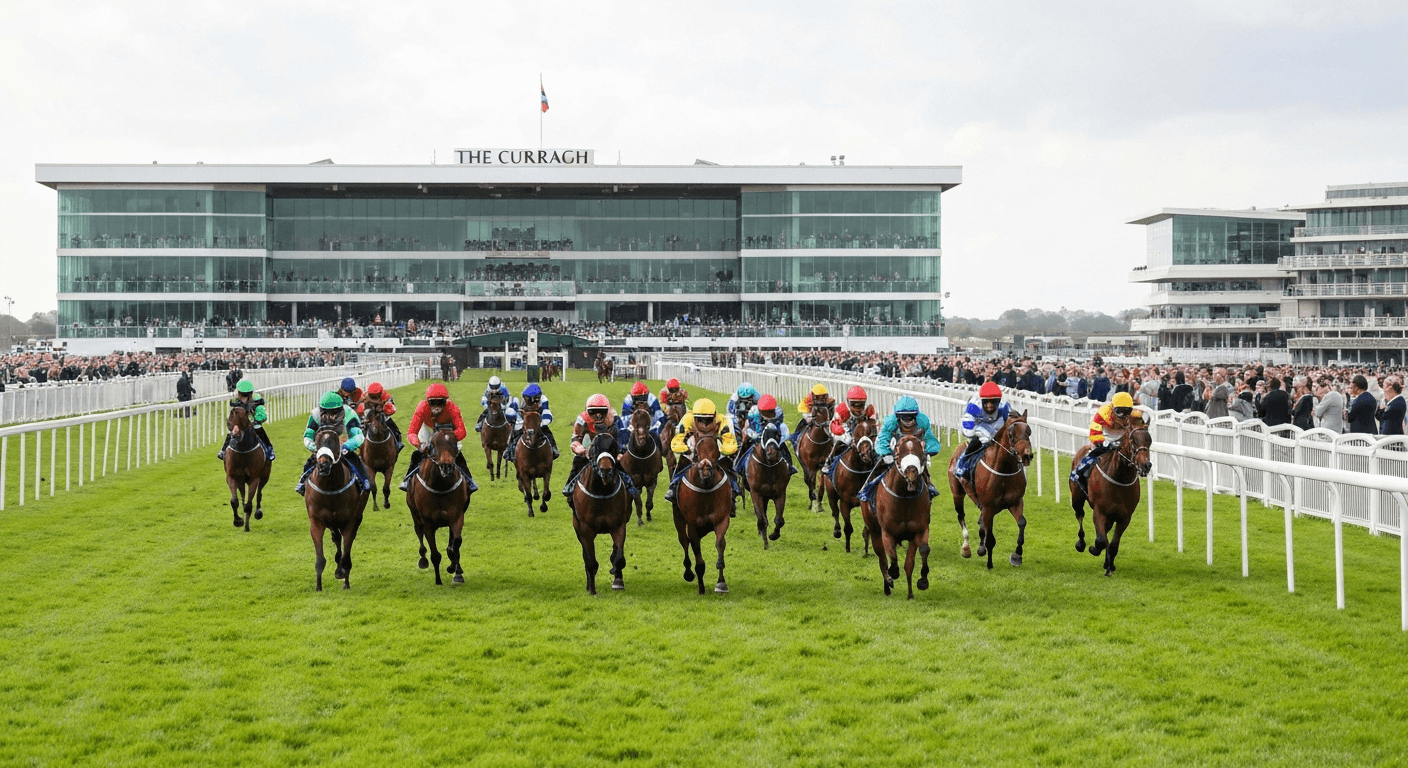
The Irish Derby: Race Guide
A full guide to the Irish Derby at the Curragh: the Group 1, its history from 1866, its great winners and its place in the Classic season.
Read moreA Day at the Curragh: Visitor Guide
How to plan a day at the Curragh: getting there, the Aga Khan Stand, food and bars, the best festivals, what to wear and first-visit tips.
Read moreBetting at the Curragh: A Course Guide
How the Curragh's galloping, stamina-testing layout shapes betting, with the verified going, draw, trainer and favourite form figures, framed honestly.
Read moreBetting offers for Irish Derby Festival
Gamble Responsibly
Gambling should be entertaining and not seen as a way to make money. Never bet more than you can afford to lose. If you or someone you know has a gambling problem, help and support is available.