
Founder & Editor · Last reviewed 2026-06-29
On the last Sunday of June, the Curragh stops being a stretch of windswept Kildare plain and becomes the centre of the European racing year. The word itself comes from the Irish Cuirreach, "place of the running horse", and on Irish Derby day the name earns its keep. A field of the season's best three-year-olds is sent out over a mile and a half of wide, galloping turf, up a finishing straight that rises slightly underfoot, in front of the great cantilevered roof of the Aga Khan Stand. The race that follows is the oldest and grandest of Ireland's five Classics, and for many trainers it is the one they most want to win.
The Irish Derby is run at the Curragh because the Curragh is where it has always been run. This is the headquarters of Irish Flat racing, ringed by roughly 1,500 acres of training grounds, more than 70 miles of turf gallops and the all-weather strips where so many champions are made before they ever see a racecourse. The course is widely regarded as one of the fairest in the world: a right-handed horseshoe of about two miles with no sharp bends and a three-furlong run-in that tests a horse's stamina honestly. It is a track built for strong, galloping, classic types, and the Irish Derby is the race that demands them.
What makes the day matter is partly the prize, which now stands at 1,250,000 euro, and partly the calibre of horse it has gathered over the years. Nijinsky, Shergar, Galileo, Montjeu: names that ring far beyond Ireland have their place on the Irish Derby roll of honour. This guide walks through the race as it is run today, how it grew from nineteenth-century beginnings into an international fixture, the champions who have defined it, and where it sits within the Classic season and the three-day festival the Curragh now builds around it. It does not offer tips or predictions. Like every race, the Irish Derby rewards reading the form rather than trusting a system, and the favourite, however well backed, does not always oblige.
This guide covers the race itself, its history from nineteenth-century beginnings, its great winners, its place in the Classic season and what it is like watching the Irish Derby in person, before answering some common questions.
Where to Bet
Place your bets with a trusted, licensed bookmaker.

Promo code BETFRED50. New customers only. Register, deposit with a Debit Card, and place a first bet of £10+ at Evens (2.0)+ on Sports, to be settled within 7 days, to get £30 in Sports Free Bets and £20 in Bet Builder Free Bets within 24 hours of settlement. 7-day expiry. Eligibility & payment exclusions apply. Full T&Cs apply. Take Time to Think. BeGambleAware.org. 18+. Full T&Cs.

Promo code R30. New UK customers only, 18+. Register, deposit £10 or more, then place a £10 single cash bet at odds of 1/2 (1.5) or greater on any sports market (excluding Virtuals). Once the qualifying bet settles you get £30 in Free Bets (3 x £10) — the qualifying bet can win or lose. Free Bets are valid on any sports market excluding Virtuals, expire in 7 days, are non-withdrawable and must be used in full. Excluded deposit methods apply (including PayPal, Apple Pay, Skrill and NETELLER). Named bets such as Lucky 15 do not qualify. If you cash out the qualifying bet, or it is voided, you are no longer eligible for the offer. Ends 31.12.26. Full T&Cs apply. Please gamble responsibly. BeGambleAware.org. 18+. Full T&Cs.

Promo code BET40GET20. New UK customers, 18+. Register with the code and place a first bet of £40 or more at Evens (2.0) or greater. Receive 2 × £10 free bets: the first credited automatically once the qualifying bet settles, the second 24 hours later. Free bets must be placed at minimum odds of 4/1 (5.0), expire 24 hours after credit, and the free-bet stake is not returned with winnings. Debit card deposits only. Take Time to Think. BeGambleAware.org. 18+. T&Cs apply. Full T&Cs.

50% of your first-day net losses refunded as a free bet, capped at £25. New UK customers aged 18+ only. To qualify, deposit and place a first bet of £10 or more on any sport at minimum odds of evens (2.00), then place at least two further bets on different events, each worth at least 50% of your largest bet, all at evens (2.00) or greater. Losses are counted from your first settled bet until 23:59 the same day. Place a qualifying £10+ bet and you are guaranteed at least a £5 free bet. Bets placed at SP, void bets, cashed-out bets and bets struck with free bets do not count towards the offer. The free bet is credited the day after your qualifying bets settle and must be used within 7 days, after which it expires. It can be used at odds from 1/4 (1.25) up to 250/1 on singles and straight accumulators, but not on Trixie, Patent or Yankee style multiples. Free-bet stake is not returned with winnings. One offer per person, household, address, IP address and device. E-wallet deposits may not qualify, so check the cashier before depositing. Customers registered with GAMSTOP cannot claim. KYC identity verification must be completed before the free bet is credited. Take Time to Think. BeGambleAware.org. 18+. T&Cs apply. Full T&Cs.

New customers, 18+. Choose the sports bonus at sign-up, make a first deposit and receive a 100% bonus up to £50 in your Sports Bonus balance. To convert the bonus to cash, wager it 10x within 30 days. Single bets below Evens (2.00) do not qualify; accumulators do not qualify if any selection is below 1/2 (1.50). Virtual Sports, voided, cancelled, drawn, cashed-out and free-bet wagers do not count towards wagering. Only the first settled bet per event counts. Withdrawing before the wagering requirement is met forfeits the bonus balance including bonus winnings. Real-money funds are used before bonus funds. Deposits via Skrill or Neteller are not eligible. Not valid in conjunction with other promotions. Odds, bet and payment limits apply. 10bet general and promotion T&Cs apply. BeGambleAware.org. 18+. Full T&Cs.

New customers in Great Britain and Republic of Ireland, 18+. Place a £10 fixed-odds qualifying bet at minimum odds of 1/2 (1.50) — single or each-way (only the win part counts), pre-event or in-play, not cashed out early, within 28 days of opening the account. Receive up to £60 in bonuses credited over three days: 3 × £10 fixed-odds free bets (the first on settlement, then 24 and 48 hours later) plus 3 × £5 Total Goals FOOTBALL spread bets, 3 × £5 racing Winning Favourites spread bets and a £1 racing Race Index spread bet (the spread bets need a full spread-betting account). Free-bet stakes not returned with winnings; free bets valid 28 days from issue. IMPORTANT: the £5 credits are SPREAD bets — sports spread betting carries the risk that losses can exceed your stake. Sports spread-betting customers do not have Financial Ombudsman or FSCS recourse. Take Time to Think. BeGambleAware.org. 18+. T&Cs apply. Full T&Cs.

Promo code WELCOME15, entered under My Bonuses after registering. New UK customers, 18+. Place a first qualifying bet of at least £10 from your cash balance at odds of evens (2.0) or greater within 7 days of opening the account. Once the qualifying bet fully settles you receive £15 in free bets, credited as 3 x £5 tokens with set uses: one £5 accumulator free bet (minimum 4 legs, each leg at 2/5 or bigger), one £5 sports free bet (any market at evens or bigger) and one £5 Sub Cover free bet (selected football player markets at evens or bigger). Free-bet stakes are not returned with winnings. Free bets expire 7 days after they are credited. Void, cashed-out and partially cashed-out bets do not qualify. One offer per customer. Confirm the current terms on BetGoodwin's own welcome-offer page before claiming. Take Time to Think. BeGambleAware.org. 18+. T&Cs apply. Full T&Cs.

New UK customers, 18+. Minimum deposit £10. Place a £10 qualifying single at minimum odds of 1/2 (1.50), settled within 14 days. Receive £30 in free bets (stake not returned), split £20 for sportsbook use (2 x £10) and £10 for Bet Builder only (2 x £5); Bet Builder does not cover horse racing. Free bets must be accepted within 7 days and expire 7 days after acceptance. No promo code required. Best Odds Guaranteed on UK & Irish racing, subject to having staked over £25 in the previous seven days. Operated by LiveScore Betting and Gaming (Gibraltar) Ltd, UKGC 56859. Confirm the current terms on LiveScore Bet's own promotions page before claiming. Take Time to Think. BeGambleAware.org. 18+. T&Cs apply. Full T&Cs.
18+. BeGambleAware.org
The Race: A Group 1 Over a Mile and a Half
The Irish Derby is a Group 1 contest run over one mile and four furlongs, which is 2,414 metres, and it is open to three-year-old colts and fillies. As a Classic it comes around only once in a horse's life, at the precise age when the best middle-distance performers of a generation are thrown together over what has always been the championship trip.
A mile and a half is the traditional Derby distance for a reason. It is long enough to demand genuine, proven stamina, yet short enough that a top horse still needs a turn of foot to settle matters in the closing stages. At the Curragh that test is sharpened by the track itself. The Derby course is the inner of the two right-handed horseshoes, with the sharpest turns into the home straight coming off the mile-and-a-half and mile-and-six-furlong starts, and a low draw is generally an advantage there because of the turning. Once into the three-furlong run-in the ground rises slightly uphill, so a horse that has been ridden too freely early can find the line coming towards it. This is a galloping, stamina-testing course that flatters strong, well-balanced types and exposes the merely quick.
The conditions reward a particular kind of profile. Betting trends compiled on the race show that every one of the last ten winners had at least four prior Flat runs, so this is rarely a contest won by a lightly raced improver who has only had a couple of starts. The draw matters too: nine of the last ten winners came from stall seven or higher, with eight and nine especially well represented. No filly has won the race in twenty years, which tells you how thoroughly the colts have dominated the modern renewals.
Favourites are well respected and frequently win, but the market is not a guarantee. In 2019 Sovereign struck at 33/1, a reminder that a Classic field of this quality can still produce a long-priced winner and that backing the head of the market over time is no route to profit.
| Detail | The Irish Derby |
|---|---|
| Grade | Group 1 |
| Distance | 1m4f (2,414 m) |
| Age | Three-year-olds |
| Course | Curragh, Co. Kildare |
| When | Late June / early July |
| Prize money (2024 to 2026) | 1,250,000 euro, winner 725,000 euro |
| Established | 1866 |
| Sponsor | Dubai Duty Free |
From 1817 to the Sweeps Derby
The modern Irish Derby was first run in 1866, which makes it the oldest of Ireland's five Classics and one of the longest-established races in the country. It was the creation of three noblemen, the 3rd Earl of Howth, the 3rd Marquess of Drogheda and the 3rd Earl of Charlemont, who set it up as Ireland's answer to the Epsom Derby. The first running was staged over a mile, six furlongs and three yards, a notably longer trip than the mile and a half the race settles at today.
It did not come from nowhere. The Curragh had hosted Derby-style races before, but they had not lasted: the O'Darby Stakes ran only from 1817 to 1824, and a Curragh Derby appeared briefly in 1848. Racing on the plain itself goes back much further. The first recorded race was held in 1727, the first official meeting is variously dated to 1741, and the land was eventually protected for racing and training by the Curragh of Kildare Act 1868, which settled the rights of common pasture across the plain. The Turf Club, founded in Kildare in the 1760s, had already made the Curragh its home and become the governing body of Irish racing.
For its first century the Irish Derby was an important national race rather than an international one. That changed decisively in 1962, when Joe McGrath linked the race to the Irish Hospitals' Sweepstake and relaunched it as the Irish Sweeps Derby. The injection of sweepstake money turned it overnight into one of the richest and most prestigious races in Europe, and the field strength rose to match. Some of the greatest horses on the Irish Derby roll of honour, run under the Sweeps Derby banner, date from the years that followed.
The course around the race has been transformed too. Between 2017 and 2019 the Curragh underwent Irish racing's largest-ever capital project, a redevelopment whose final cost was put at 81.2 million euro by Horse Racing Ireland. The centrepiece was a new grandstand, the Aga Khan Stand, designed by the architects Grimshaw for around 6,000 people across four levels and officially opened on 26 May 2019 during the Guineas weekend. The work was not without its hiccups. The dramatic 7,000-square-metre cantilevered roof produced a "whistling" noise in moderate winds, monitored by an acoustic engineer, and the parade ring had to be enlarged at an extra cost of 500,000 euro. The result is a Classic with Victorian roots run against a thoroughly twenty-first-century backdrop.
The Great Winners
No race tells you more about itself than its roll of honour, and the Irish Derby's is a list of horses who shaped the breed.
The line stretches back to Orby, who in 1907 completed the first Epsom-Curragh Derby double, joining the two great Classics in a single season for the first time. Half a century later came Ballymoss, winner of the 1957 Irish Derby and good enough that the Tattersalls Gold Cup, run at the Curragh today, began life in 1962 as the Ballymoss Stakes in his honour. Santa Claus won in 1964, and then came the run of post-war champions that the Sweeps Derby money helped attract.
Nijinsky took the 1970 renewal, run as the Irish Sweeps Derby, in the middle of the season in which he became the last horse to win the English Triple Crown. The 1970s rolled on through The Minstrel in 1977, Shirley Heights in 1978 and Troy in 1979. Then, in 1981, came perhaps the most famous winner of all. Shergar, carrying the colours of the Aga Khan, had won the Epsom Derby by a record margin and confirmed himself at the Curragh as one of the outstanding middle-distance horses of the century.
The names kept coming. El Gran Senor completed a brilliant Curragh juvenile and Classic record by taking the 1984 Irish Derby, having already won the 1983 National Stakes, the 1983 Railway Stakes and the 1984 Gladness Stakes at the same track. Generous won in 1991 and Commander In Chief in 1993. The Coolmore and Ballydoyle era then produced a sequence of horses who became significant stallions: Montjeu in 1999, Sinndar in 2000 for John Oxx and the Aga Khan, and above all Galileo in 2001, who went on to become one of the most influential sires in the world. High Chaparral followed in 2002, Camelot in 2012 and Australia in 2014. Between them these horses turned the Irish Derby into a race that the very best three-year-old colts in Europe were expected to contest, and the form it threw up regularly shaped the rest of the season.
The Aidan O'Brien era
The modern history of the race is, to a remarkable degree, the history of one stable. Aidan O'Brien leads all trainers with eighteen Irish Derby wins, a tally that includes seven in a row from 2006 and four straight from 2023 to 2026. His recent winners read like a procession: Santiago (2020, ridden by Seamie Heffernan), Auguste Rodin (2023), Los Angeles (2024), Lambourn (2025) and Benvenuto Cellini (2026). Ryan Moore has partnered the last four of those, winning the race in each year from 2023 to 2026.
The 2026 running showed the stable's dominance at its most complete. Benvenuto Cellini, sent off the 7/4 favourite under Moore, led home an O'Brien one-two-three from Christmas Day and Pierre Bonnard, in a winning time of 2:28.33. It was O'Brien's eighteenth Irish Derby and the ninth time he had saddled the first three home.
The records around the race underline how exceptional that is. Before the modern run, the jockey Morny Wing had set the long-standing benchmark with six Irish Derby winners. Among owners, Michael Tabor of the Coolmore partnership leads the way. Only two renewals in the recent sequence escaped O'Brien: 2021, when Hurricane Lane, trained by Charlie Appleby for Godolphin and ridden by William Buick, won at 4/1, and 2022, when Westover struck for Ralph Beckett and Colin Keane at 11/8 joint-favourite. Those exceptions only sharpen the picture of how thoroughly one yard has owned the race.
Its Place in the Classic Season and the Derby Festival
The Irish Derby is the third of Ireland's five Classics to be run each year, and it sits at the heart of the European middle-distance season. The Irish racing calendar opens in May with the two Guineas, both run over a mile at the Curragh during the Tattersalls Irish Guineas Festival: the Irish 2,000 Guineas for colts and fillies, and the Irish 1,000 Guineas for fillies. The Derby follows over a mile and a half in late June, the Irish Oaks completes the staying Classic picture for fillies in July, and the Irish St Leger, uniquely open to older horses since 1983, closes the set over a mile and six furlongs in September. All five are run at the Curragh, which is why the course calls itself the home of the Irish Classics.
For the best three-year-old colts in training, the Irish Derby is a natural next step rather than a stand-alone target. Horses arrive in Kildare in late June with their spring campaigns behind them, often having run in or won the Epsom Derby itself a few weeks earlier, and the race frequently confirms or overturns the form lines drawn at Epsom and Chantilly. Orby's 1907 Epsom-Curragh double set the template, and the link between the two Derbys has been one of the defining threads of the race ever since. Benvenuto Cellini's 2026 win carried an extra twist, the colt having been controversially ruled a non-runner at Epsom before going on to take the Irish equivalent.
The Dubai Duty Free Irish Derby Festival
The race no longer stands alone on its Sunday. The Curragh now builds a three-day festival around it, and in 2026 the Dubai Duty Free Irish Derby Festival ran across Friday 26, Saturday 27 and Sunday 28 June.
Friday opens the festival, with the Corinthian Challenge run in aid of the Irish Injured Jockeys Fund and music from The Whistlin' Donkeys. Saturday is built around the Group 1 Paddy Power Pretty Polly Stakes, the prestigious mile-and-a-quarter event for fillies and mares, supported by the Group 3 Anglesey Stakes and the Group 2 Airlie Stud Stakes, with The K Club Most Stylish Racegoer competition adding to the occasion. Sunday is Derby day itself, the big race going off at 16:10, with the Listed Jebel Ali Dash Stakes and supporting handicaps on the card and The Tumbling Paddies closing the festival. A weekend ticket covering all three days was priced at 70 euro in 2026, with under-18s admitted free alongside a paying adult.
Watching the Irish Derby
Derby Sunday at the Curragh is a day out as much as a race meeting, and the crowd is part of it. In 2026 the Sunday drew an attendance of 11,323, with the full three-day festival bringing 24,651 through the gates. The course sits on the Curragh Plains near Newbridge in Co. Kildare, roughly 30 miles south-west of Dublin, and getting there is straightforward. By road, the route runs from the M50 to the N7 and on to the M7, with free car parking on site. By rail, mainline trains from Heuston Station in Dublin, as well as from Cork, Limerick, Galway and Waterford, reach Kildare town and Newbridge, where a free shuttle bus runs on race days timed to the train arrivals.
If you are there in person, the two places to be are the rail near the finish and the parade ring, where the anticipation builds as the runners walk round before the off. The redeveloped course is built around the four-level Aga Khan Stand. The lower levels hold a café, food court, bars and Tote facilities, while the upper levels carry bars, restaurants and hospitality suites. The historic Queen's Room, first built in 1853 and once host to Queen Victoria, was dismantled and reassembled during the redevelopment and now overlooks the new parade ring. Among the named bars, Lilywhites Lounge is billed as possibly the best bar in Irish racing, with views over the track.
For racegoers travelling in, Kildare town offers plenty to fill a weekend. The Irish National Stud and Japanese Gardens at Tully sit close by, Kildare Village is a short hop for the shops, and luxury at The K Club in Straffan and hotels in Newbridge, Naas and Kildare town give the festival crowd somewhere to base themselves.
When watching the race unfold, keep the shape of the Curragh in mind. The field swings into that three-furlong run-in and then has to come up the slight rise to the line, so a horse travelling strongly through the closing stages is worth more here than one flattered by an easy lead. Watch how the winner is placed too: the better-drawn horses, in the higher stalls, have tended to come out on top, and the proven, battle-hardened types with several runs behind them have a far stronger record than the lightly raced.
A final word on the betting, because the Irish Derby attracts plenty of it. Favourites are well respected and win often, but this is a Group 1 capable of throwing up a Sovereign at 33/1, and following the market blindly is no path to profit. Treat the form, the draw and the trip as the things to read, and treat any system, model or favourite as fallible. Enjoy the race for what it is: the oldest and best of Ireland's Classics, run on one of the fairest courses in the world.
Frequently Asked Questions
Share this article
More about this racecourse
All curragh guides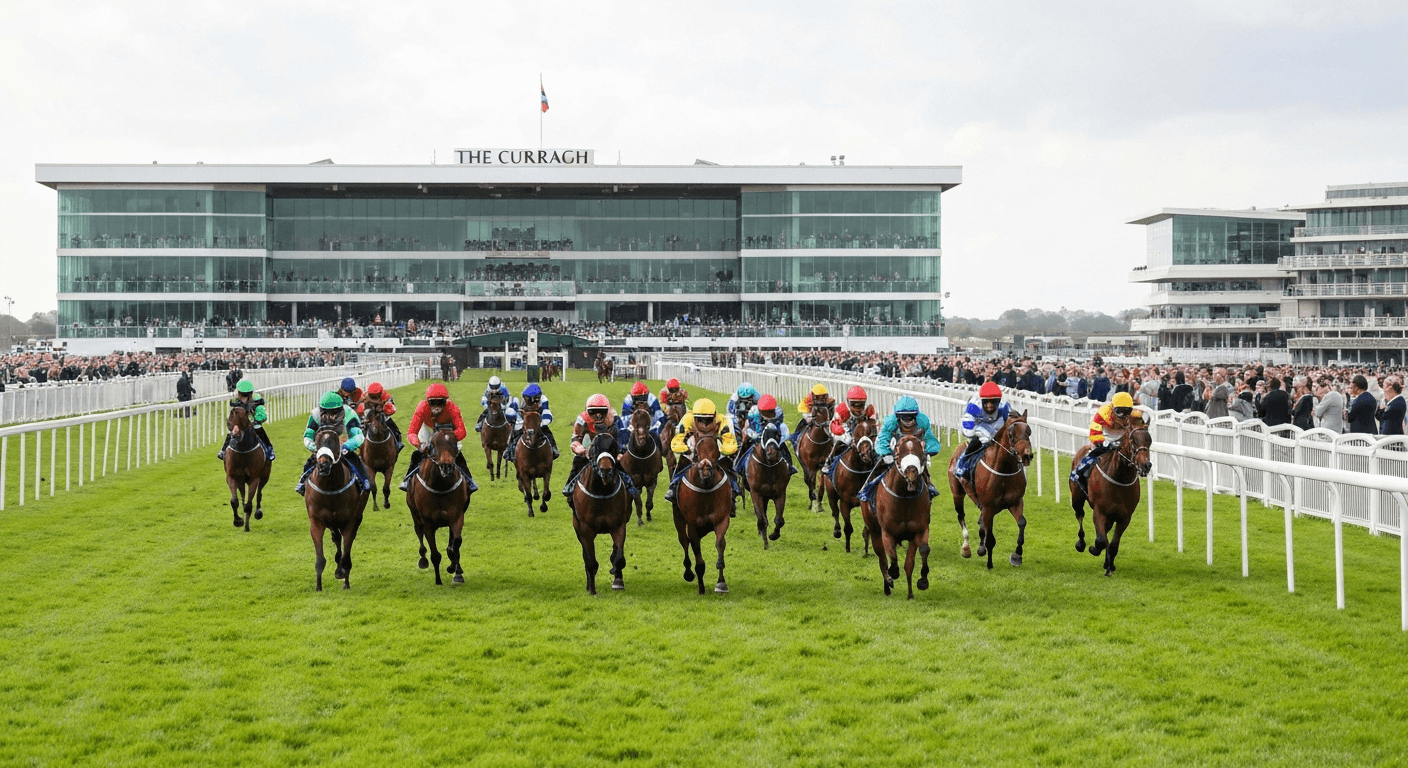
A Day at the Curragh: Visitor Guide
How to plan a day at the Curragh: getting there, the Aga Khan Stand, food and bars, the best festivals, what to wear and first-visit tips.
Read moreBetting at the Curragh: A Course Guide
How the Curragh's galloping, stamina-testing layout shapes betting, with the verified going, draw, trainer and favourite form figures, framed honestly.
Read moreThe Curragh: The Complete Guide
The home of the Irish Classics in Co. Kildare, in full: the galloping track and course map, all 11 Group 1s with their winners, the records, the festivals day by day, tickets, travel, venue hire and how to visit.
Read moreResearch the field with the AI Race Predictor
Our model publishes calibrated win-probability estimates for UK races — a second opinion to understand a race, not tips. It's open about its record: it doesn't beat the market, and we show exactly how it does.
Betting offers for Irish Derby Festival
Work it out & learn the basics
Gamble Responsibly
Gambling should be entertaining and not seen as a way to make money. Never bet more than you can afford to lose. If you or someone you know has a gambling problem, help and support is available.