
Founder & Editor · Last reviewed 2026-06-29
The race that crowns the autumn
On the second Saturday of September, when the Flat season has run most of its course and the big middle-distance horses have spent a summer measuring themselves against each other, they all come to the same place to settle it. Leopardstown, in the south Dublin suburb of Foxrock, hands over its main day of the year to a single race, and for the few minutes it takes to run, the question that has hung over the season has a chance of being answered: who is the best horse in Europe at a mile and a quarter?
That race is the Irish Champion Stakes. It is run over 1m2f on a wide, left-handed turf oval, it is a Group 1, and it is worth €1,250,000, which makes it one of the richer prizes in Irish racing. It is also the centrepiece of the Irish Champions Festival, the September showpiece that splits its two days between Leopardstown and the Curragh, and Leopardstown gets the first of them.
What gives the Champion Stakes its weight is not just the money. A mile and a quarter is the proving ground where the season's Classic generation, the colts that ran in the Derby and the Guineas, meet the older milers and middle-distance horses that have been hardened by a year of Group 1 company. Three-year-olds carry less weight than their elders, so the race throws the rising stars against the established names on terms that genuinely test both. The result is a roll of honour that reads like a list of the best of their eras, and a race that has more than once been the day a great horse confirmed it was great.
Leopardstown is unusual in that it is a dual-code track of the highest order, staging top jumps racing in winter as well as Group 1 Flat in autumn. But while the Christmas Festival and the Dublin Racing Festival belong to the jumpers, this one Saturday in September belongs entirely to the Flat, and to its single most important race. This guide covers what the Irish Champion Stakes is, how it came to be, the horses that have defined it, and how to watch it.
This guide covers the race itself over its mile and a quarter, its history from the McGrath Memorial to the modern Group 1, the great winners who have defined it, its place in the Irish Champions Festival, how to go about watching it at Leopardstown, and answers to common questions.
Where to Bet
Place your bets with a trusted, licensed bookmaker.

Promo code BETFRED50. New customers only. Register, deposit with a Debit Card, and place a first bet of £10+ at Evens (2.0)+ on Sports, to be settled within 7 days, to get £30 in Sports Free Bets and £20 in Bet Builder Free Bets within 24 hours of settlement. 7-day expiry. Eligibility & payment exclusions apply. Full T&Cs apply. Take Time to Think. BeGambleAware.org. 18+. Full T&Cs.

Promo code R30. New UK customers only, 18+. Register, deposit £10 or more, then place a £10 single cash bet at odds of 1/2 (1.5) or greater on any sports market (excluding Virtuals). Once the qualifying bet settles you get £30 in Free Bets (3 x £10) — the qualifying bet can win or lose. Free Bets are valid on any sports market excluding Virtuals, expire in 7 days, are non-withdrawable and must be used in full. Excluded deposit methods apply (including PayPal, Apple Pay, Skrill and NETELLER). Named bets such as Lucky 15 do not qualify. If you cash out the qualifying bet, or it is voided, you are no longer eligible for the offer. Ends 31.12.26. Full T&Cs apply. Please gamble responsibly. BeGambleAware.org. 18+. Full T&Cs.

Promo code BET40GET20. New UK customers, 18+. Register with the code and place a first bet of £40 or more at Evens (2.0) or greater. Receive 2 × £10 free bets: the first credited automatically once the qualifying bet settles, the second 24 hours later. Free bets must be placed at minimum odds of 4/1 (5.0), expire 24 hours after credit, and the free-bet stake is not returned with winnings. Debit card deposits only. Take Time to Think. BeGambleAware.org. 18+. T&Cs apply. Full T&Cs.

50% of your first-day net losses refunded as a free bet, capped at £25. New UK customers aged 18+ only. To qualify, deposit and place a first bet of £10 or more on any sport at minimum odds of evens (2.00), then place at least two further bets on different events, each worth at least 50% of your largest bet, all at evens (2.00) or greater. Losses are counted from your first settled bet until 23:59 the same day. Place a qualifying £10+ bet and you are guaranteed at least a £5 free bet. Bets placed at SP, void bets, cashed-out bets and bets struck with free bets do not count towards the offer. The free bet is credited the day after your qualifying bets settle and must be used within 7 days, after which it expires. It can be used at odds from 1/4 (1.25) up to 250/1 on singles and straight accumulators, but not on Trixie, Patent or Yankee style multiples. Free-bet stake is not returned with winnings. One offer per person, household, address, IP address and device. E-wallet deposits may not qualify, so check the cashier before depositing. Customers registered with GAMSTOP cannot claim. KYC identity verification must be completed before the free bet is credited. Take Time to Think. BeGambleAware.org. 18+. T&Cs apply. Full T&Cs.

New customers, 18+. Choose the sports bonus at sign-up, make a first deposit and receive a 100% bonus up to £50 in your Sports Bonus balance. To convert the bonus to cash, wager it 10x within 30 days. Single bets below Evens (2.00) do not qualify; accumulators do not qualify if any selection is below 1/2 (1.50). Virtual Sports, voided, cancelled, drawn, cashed-out and free-bet wagers do not count towards wagering. Only the first settled bet per event counts. Withdrawing before the wagering requirement is met forfeits the bonus balance including bonus winnings. Real-money funds are used before bonus funds. Deposits via Skrill or Neteller are not eligible. Not valid in conjunction with other promotions. Odds, bet and payment limits apply. 10bet general and promotion T&Cs apply. BeGambleAware.org. 18+. Full T&Cs.

New customers in Great Britain and Republic of Ireland, 18+. Place a £10 fixed-odds qualifying bet at minimum odds of 1/2 (1.50) — single or each-way (only the win part counts), pre-event or in-play, not cashed out early, within 28 days of opening the account. Receive up to £60 in bonuses credited over three days: 3 × £10 fixed-odds free bets (the first on settlement, then 24 and 48 hours later) plus 3 × £5 Total Goals FOOTBALL spread bets, 3 × £5 racing Winning Favourites spread bets and a £1 racing Race Index spread bet (the spread bets need a full spread-betting account). Free-bet stakes not returned with winnings; free bets valid 28 days from issue. IMPORTANT: the £5 credits are SPREAD bets — sports spread betting carries the risk that losses can exceed your stake. Sports spread-betting customers do not have Financial Ombudsman or FSCS recourse. Take Time to Think. BeGambleAware.org. 18+. T&Cs apply. Full T&Cs.

Promo code WELCOME15, entered under My Bonuses after registering. New UK customers, 18+. Place a first qualifying bet of at least £10 from your cash balance at odds of evens (2.0) or greater within 7 days of opening the account. Once the qualifying bet fully settles you receive £15 in free bets, credited as 3 x £5 tokens with set uses: one £5 accumulator free bet (minimum 4 legs, each leg at 2/5 or bigger), one £5 sports free bet (any market at evens or bigger) and one £5 Sub Cover free bet (selected football player markets at evens or bigger). Free-bet stakes are not returned with winnings. Free bets expire 7 days after they are credited. Void, cashed-out and partially cashed-out bets do not qualify. One offer per customer. Confirm the current terms on BetGoodwin's own welcome-offer page before claiming. Take Time to Think. BeGambleAware.org. 18+. T&Cs apply. Full T&Cs.

New UK customers, 18+. Minimum deposit £10. Place a £10 qualifying single at minimum odds of 1/2 (1.50), settled within 14 days. Receive £30 in free bets (stake not returned), split £20 for sportsbook use (2 x £10) and £10 for Bet Builder only (2 x £5); Bet Builder does not cover horse racing. Free bets must be accepted within 7 days and expire 7 days after acceptance. No promo code required. Best Odds Guaranteed on UK & Irish racing, subject to having staked over £25 in the previous seven days. Operated by LiveScore Betting and Gaming (Gibraltar) Ltd, UKGC 56859. Confirm the current terms on LiveScore Bet's own promotions page before claiming. Take Time to Think. BeGambleAware.org. 18+. T&Cs apply. Full T&Cs.
18+. BeGambleAware.org
The race itself: a Group 1 over a mile and a quarter
The Irish Champion Stakes is a Group 1 contest run over a mile and a quarter, 1m2f, which is 2,012 metres. It is open to three-year-olds and upwards, colts, geldings, fillies and mares all allowed in, and it is run in September as the feature of the first day of the Irish Champions Festival at Leopardstown. Its full sponsored name in recent seasons has been the Royal Bahrain Irish Champion Stakes.
A weight-for-age championship
The race is run on weight-for-age terms, which is the way the sport handicaps for maturity rather than for ability. In 2025 the conditions had three-year-olds carrying 9st 3lb and older horses 9st 9lb, with a 3lb allowance for fillies and mares. That six-pound gap between the generations matters: it is the mechanism that lets a brilliant Classic-generation colt take on battle-hardened older horses and have a fair shot at beating them. It is no coincidence that some of the most famous runnings have gone to outstanding three-year-olds making the step up against their elders.
Why a mile and a quarter
A mile and a quarter sits in the middle of the Flat's distance range, and that is precisely what gives the trip its prestige. It is short enough to demand genuine speed and long enough to demand that a horse stays, so it rewards the complete middle-distance performer rather than a specialist at either end. Across a European season the leading milers, the Derby and Guineas horses, and the older Group 1 performers all converge on races at around this distance, and the Champion Stakes is where many of them meet at the back end of the year.
The track underneath it
The shape of Leopardstown shapes the race. It is a left-handed turf oval of roughly a mile and three-quarters, built in the 1880s and modelled on Sandown Park, the main difference being that Sandown is right-handed. The full course guide covers that layout in more detail. The run-in from the final bend to the winning post is about three furlongs, and it rises gently all the way. The course is described by At The Races as deceptively stiff, a longer and harder finish than it looks, with the pace often picking up a good way from home. The practical effect is that the Irish Champion Stakes is rarely a fluke. It is a galloping test up a stiff straight, the kind of race in which the best horse usually gets the chance to prove it, and hard-luck stories are uncommon.
Since 2009 the race has formed part of the Breeders' Cup Challenge series, which means the winner earns an automatic invitation to the Breeders' Cup Turf, tying this September Saturday in Dublin into the international autumn programme.
From McGrath Memorial to the Royal Bahrain
For a race that now sits among the most valuable in Ireland, the Irish Champion Stakes has a fairly short and slightly nomadic history. It was first run in 1976, which makes it a good deal younger than the great Classics, and it has not always been run at Leopardstown.
A memorial that became a championship
The race began life in 1976 as the Joe McGrath Memorial Stakes. It was named for Joe McGrath, who lived from 1887 to 1966 and was the founder of the Irish Hospitals' Sweepstake, one of the most significant figures in twentieth-century Irish racing administration and breeding. From the start it was conceived as a top-class mile-and-a-quarter contest, and its early roll of honour set the tone: Sadler's Wells, who would go on to become one of the most influential stallions in the world, won it in 1984.
The Phoenix Park years
The race did not stay put. Between 1984 and 1990 it was run at Phoenix Park, on the other side of Dublin, under the name the Phoenix Champion Stakes. Triptych won it there in 1987 and Carroll House in 1989. When Phoenix Park closed after the 1990 season, several of its important races needed new homes, and the Champion Stakes came back to Leopardstown in 1991 under its present name, the Irish Champion Stakes. Suave Dancer won that first renewal of the restored race.
Settling into the modern era
From 1991 the race grew steadily in stature, drawing a stream of the best European middle-distance horses through the 1990s and 2000s: Pilsudski in 1997, Daylami in 1999, Giant's Causeway in 2000, Fantastic Light in 2001, High Chaparral in 2003. In 2009 it was brought into the Breeders' Cup Challenge series, formally linking it to the international autumn calendar. Its sponsorship has changed over the years, and in recent seasons it has run as the Royal Bahrain Irish Champion Stakes.
The other piece of the modern story is administrative. Leopardstown itself was acquired by the Horse Racing Board of Ireland in 1967, and the track is now owned and operated by Horse Racing Ireland. The longer story of the track runs back to the 1880s. From 2014 Leopardstown began hosting the Saturday of what was then Irish Champions Weekend, later renamed the Irish Champions Festival, with the Curragh taking the Sunday. The Champion Stakes became the anchor of that opening day, and that is the form in which it runs today: an early-autumn Group 1 that turns a south Dublin Saturday into one of the biggest days in the Irish Flat year.
The great winners
A race is really the sum of the horses that have won it, and the Irish Champion Stakes has been won by some of the very best.
Sea The Stars, 2009
If one renewal stands above the rest it is 2009, when Sea The Stars came to Leopardstown. Trained by John Oxx and ridden by Michael Kinane, he won the Irish Champion Stakes as the fifth leg of an unbeaten six-from-six Group 1 campaign at three. That season he won the 2000 Guineas, the Derby, the Eclipse, the Juddmonte International, the Irish Champion and then the Prix de l'Arc de Triomphe, a sequence widely regarded as one of the greatest single seasons any middle-distance horse has ever produced. There was a neat symmetry to his Leopardstown win, too: he had won a maiden at the same course in August 2008, so the track saw both his beginning and one of his finest hours.
The dual winners
Only two horses have won the race twice. Dylan Thomas, trained by Aidan O'Brien, won it back to back in 2006 and 2007. Then, more than a decade later, Magical did the same, winning in 2019 under Ryan Moore and again in 2020 under Seamie Heffernan, both for Aidan O'Brien. In a race this competitive, getting your head in front once is hard enough; doing it twice puts a horse in very select company.
Stars across the decades
The list runs deep. Giant's Causeway won in 2000. New Approach took the 2008 renewal a year before Sea The Stars. Golden Horn won in 2015, and Almanzor, one of the best of his generation in Europe, won in 2016. Roaring Lion won in 2018, Auguste Rodin in 2023, and St Mark's Basilica in 2021. Older milers and middle-distance horses such as Daylami, Fantastic Light, High Chaparral, Pilsudski and So You Think all have their names on the trophy, alongside Snow Fairy, who won in 2012.
The most recent winners keep the standard up: Luxembourg in 2022 and Delacroix in 2025, both for Aidan O'Brien, with Economics, trained by William Haggas and ridden by Tom Marquand, breaking the Ballydoyle run in 2024.
The people who own the record
Behind the horses are two dominant figures. Aidan O'Brien is comfortably the most successful trainer in the race's history with 13 wins, and at one stage he had won six of the seven most recent runnings, a level of control over a top Group 1 that is rare anywhere in the sport. Among jockeys, Michael Kinane holds the record with seven wins, on Carroll House in 1989, Cezanne in 1994, Pilsudski in 1997, Giant's Causeway in 2000, High Chaparral in 2003, Azamour in 2004 and, fittingly, Sea The Stars in 2009.
One footnote is worth keeping for anyone who thinks favourites are a sure thing. Across the last 20 renewals, 12 went to the favourite, which tells you the best horse often does win, but it also leaves eight that did not. The biggest-priced winner in that span was Decorated Knight, who landed the 2017 running at 25/1 for trainer Roger Charlton and jockey Andrea Atzeni. Even in a race designed to find the best horse, the market is beaten more often than people remember, and over time backing the favourite does not turn a profit.
Its place in the Irish Champions Festival
The Irish Champion Stakes does not run in isolation. It is the headline act of the Irish Champions Festival, a two-day showpiece that the Flat season builds towards in early autumn.
A festival across two tracks
The festival splits its two days between two courses. Leopardstown stages Day 1 on the Saturday, with the Curragh taking Day 2 on the Sunday. In 2026 those days fall on Saturday 12 September and Sunday 13 September. Across the weekend there is over €5m in prize money and six Group 1 races, and the festival is now in its thirteenth year, having grown out of the old Irish Champions Weekend that Leopardstown began hosting in 2014.
Day 1 at Leopardstown
The Champion Stakes leads a nine-race card at Leopardstown, with five Group races on the day. The strongest supporting act is the Group 1 Coolmore America 'Justify' Matron Stakes over a mile, for three-year-old and older fillies and mares, a race that transferred to Leopardstown from the Curragh in 2002 and has been won by the likes of Tahiyra, trained by Dermot Weld, in 2023, and Fallen Angel in 2025.
The card has been getting stronger still. The Golden Fleece Stakes, run as a juvenile contest, was upgraded to Group 1 status for 2026, and its distance was extended from a mile to nine furlongs, giving Leopardstown a third Flat Group 1. Below that sit the Group 2 Solonaway Stakes over a mile and the Group 2 KPMG Champions Juvenile Stakes, a race for two-year-olds that has itself been earmarked for promotion. Add a Group 3, a Listed race and some valuable Premier handicaps, and the result is one of the deepest single cards in the Irish calendar.
The Sunday at the Curragh
The festival's second day is no lesser affair. The Curragh stages four Group 1s on the Sunday, headed by the Comer Group International Irish St Leger, the final Irish Classic of the season, alongside the Moyglare Stud Stakes, the Goffs Vincent O'Brien National Stakes and the Derrinstown Stud Flying Five Stakes.
Where it sits in the year
For Leopardstown, this September Saturday is the high point of a Flat season that runs roughly from April to October, taking in spring Classic trials and a run of summer Thursday-evening Group cards. It also sits at the opposite pole of the racing year from the track's jumps showpieces, the Christmas Festival over four days at the end of December and the Dublin Racing Festival in late January or early February. Leopardstown is one of the few courses anywhere that can put on a Group 1 of this stature on the Flat and a string of Grade 1 jumps races in winter, and the Irish Champion Stakes is the brightest jewel on the Flat side of that ledger.
Watching the Irish Champion Stakes
Irish Champion Stakes day is one of the most accessible big days in racing, partly because Leopardstown sits so close to Dublin. The course is in Foxrock, about 8km, or five miles, south of the city centre, in the Dún Laoghaire-Rathdown area, with the Eircode D18 C9V6.
Getting there
The simplest public-transport route is the Luas Green Line, the light rail that runs from St Stephen's Green out to Sandyford in around 20 minutes. The course is about a ten-minute walk from Sandyford, and on racedays there is a complimentary shuttle bus from the Luas stop to the gates. If you are driving, the best approach is J15 off the M50, and parking in Car Park G helps you avoid congestion on the Leopardstown Road. Parking is free for all racegoers, with a free shuttle from the car parks, and there are bus options too, including Dublin Bus route 114 to and from Blackrock DART, which stops at the main gate. From Dublin Airport the course is roughly an hour away.
On the day
Leopardstown has a relaxed dress code: smart casual is recommended, and while dressing up is encouraged, there are no strict requirements. The two main ticket options for the big festival days are General Admission, which gives grandstand and course-wide access, and Premium Level, a reserved third-floor grandstand seat with access to exclusive bars and lounges. Tickets can be booked online or bought on the day, and printed at home. Hospitality includes Molly Malones at the Pavilion, a buffet overlooking the final bend with its own viewing lawn, and the 1888 Restaurant on the second floor, looking out over the parade ring.
The course itself has been heavily modernised. A redevelopment programme worth around €20m, carried out in phases through to 2016 and 2017, brought new restaurants, bars, a new saddling area and weigh-room and a second entrance, with officials aiming to host up to around 20,000 spectators comfortably on a given day. On Champion Stakes day in 2001 the course drew around 20,000 people, and big festival days still pull strong crowds.
A word on the betting
The Irish Champion Stakes attracts plenty of interest in the betting markets, and the temptation on a championship day is to assume the best horse, and therefore the favourite, will simply win. The record shows it often does: 12 of the last 20 winners were favourites. But it also shows the favourite was beaten eight times, including by a 25/1 winner in 2017, and over the long run backing favourites does not produce a profit. The honest way to enjoy the race is to treat a bet as part of the day out, not as a way to make money. Whatever the result, watching a field of the best mile-and-a-quarter horses in Europe come up that stiff Leopardstown straight is the real draw.
Frequently Asked Questions
Share this article
More about this racecourse
All leopardstown guides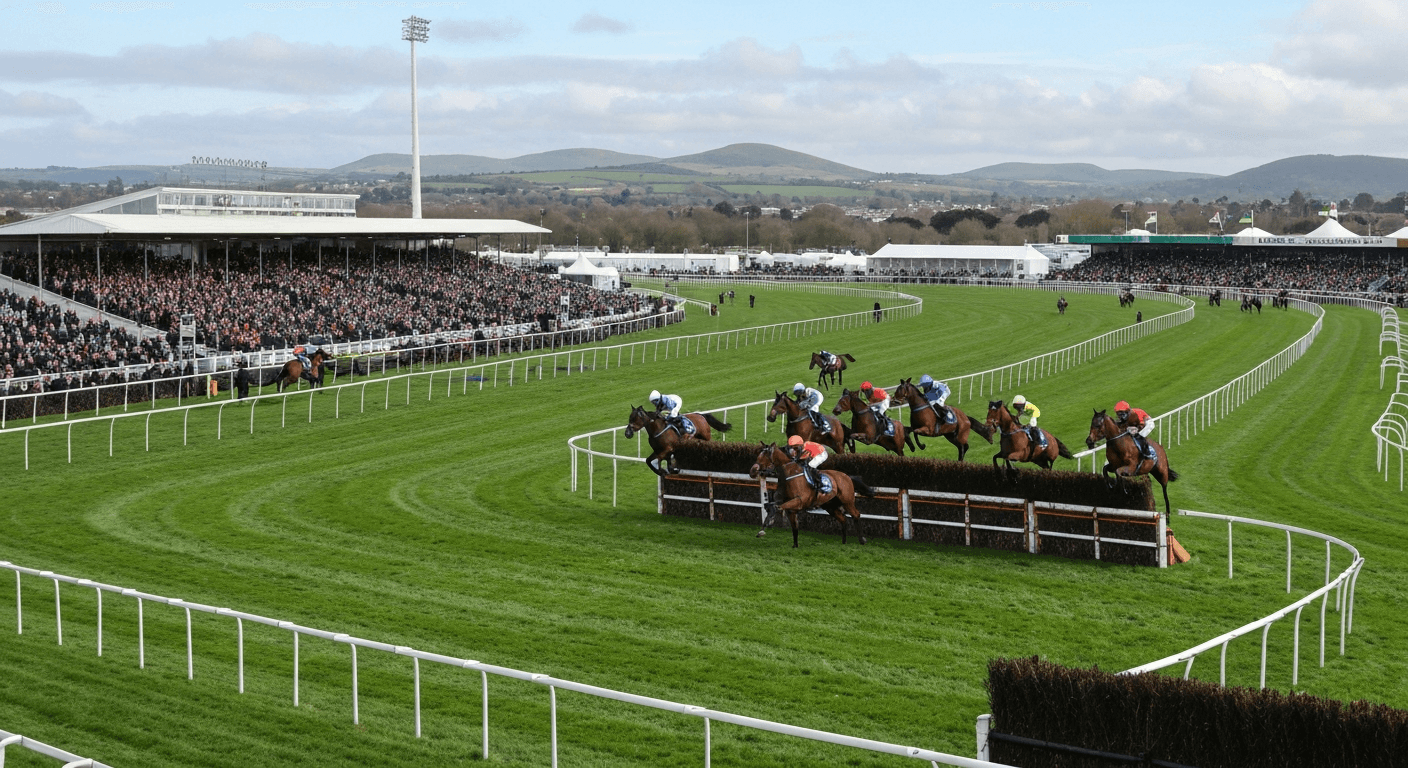
A Day at Leopardstown: Visitor Guide
Plan a day at Leopardstown, Dublin's dual-code racecourse: getting there by Luas, the stands, food and bars, the big festivals and first-visit tips.
Read more
The Dublin Racing Festival: A Complete Guide
A complete guide to Leopardstown's Dublin Racing Festival: eight Grade 1s across one early-February weekend, the key Cheltenham trial, and how to go.
Read more
The Irish Champions Festival: A Complete Guide
A complete guide to the Irish Champions Festival: Leopardstown then the Curragh, six Group 1s including the Irish Champion Stakes, and how to go.
Read moreResearch the field with the AI Race Predictor
Our model publishes calibrated win-probability estimates for UK races — a second opinion to understand a race, not tips. It's open about its record: it doesn't beat the market, and we show exactly how it does.
Work it out & learn the basics
Gamble Responsibly
Gambling should be entertaining and not seen as a way to make money. Never bet more than you can afford to lose. If you or someone you know has a gambling problem, help and support is available.