StableBet
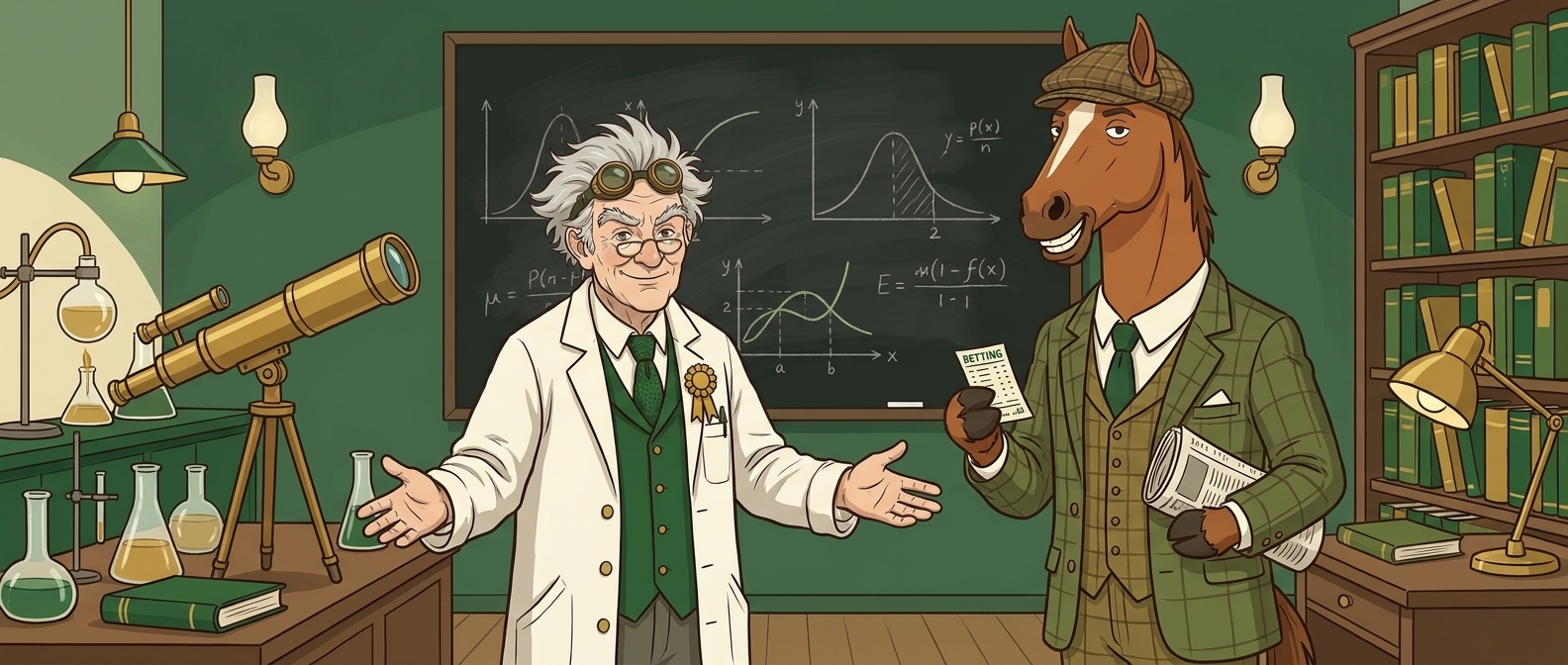
Professor Furlong and Pascal at the AI Lab
THE AI LAB
LAB NOTES · LAB NOTES

Is There Any Point Backing a Big Price?

A 100/1 shot wins about 1 in 391 runs. Its price implies about one in a hundred and forty-three. That is the widest gap between promise and delivery anywhere on a racecard.

We measured it across 218,437 British runners. Horses priced at 100/1 and longer won 0.3% of the time against an implied 0.7%. Backing all of them lost 62.7% of stakes.

Compare that with the other end. Odds-on shots lost 2.5%, and horses between evens and 2/1 lost 5.8%.

The pattern has a name, the favourite-longshot bias, and it is one of the oldest findings in betting research. It is also one of the few that has held up everywhere anyone has looked.

Down the market, band by band

Price bandImplied chanceActually winsLost per pound
Odds-on2.5%
Evens to 2/15.8%
10/1 to 13/16.9%16.5%
20/1 to 32/14.1%3.1%23.8%
100/1 and up0.7%0.3%62.7%

Read down the last column. The cost of a bet roughly quadruples between the front of the market and 20/1, and doubles again beyond that.

Two forces produce it. Most money goes on the front of the market, so those prices have to stay sharp or punters go elsewhere. And a long price is worth more to a punter than its arithmetic value, because a small stake returning a large sum is genuinely enjoyable in a way that a 1/2 shot is not. Bookmakers price that enjoyment in.

There is a full treatment of this on our deep page, how often does a 100/1 horse win, with the breakdown by race code.

Two different questions

There is a question about value and a question about enjoyment, and the answers point opposite ways.

On value the long shots are the worst bet available. Backing 10/1-plus outsiders each-way returns -30.12%, and backing the outsider of the field to win returns -34.77%. Nothing else we test is that bad.

On enjoyment they are the best thing on the card. A pound at 66/1 buys several minutes of genuine hope and a story if it lands. Nobody has ever come back from the races talking about the odds-on winner they backed.

We are not going to tell you which of those matters more, because that is a decision about what you want from an afternoon rather than a question with a right answer.

What we will say is that the two should not be confused. A big price is not secretly good value because it might come in. It is a worse bet than a short one, reliably, and it is bought for a different reason.

If you want to see what a big price is actually claiming about a horse, what chance that price is really giving turns it into a percentage.

A word on all of this

None of these pages is a tip, and none describes a way to win. They describe what betting costs, which is a different and more reliable subject. If your betting has stopped being fun, BeGambleAware has free, confidential help, and the National Gambling Helpline is on 0808 8020 133.

Common questions

How often does a 100/1 shot win?

About 1 in 391 runs, or 0.3% of the time, measured across 218,437 British runners. The price implies 0.7%.

Are long shots ever value?

As a class, no. Every band above about 10/1 loses more than the bands below it, and the losses widen as the price lengthens.

What is the favourite-longshot bias?

The tendency for short-priced horses to be better value than long-priced ones. It shows up clearly in our data and has been found in most betting markets studied.

Why do bookmakers price long shots so meanly?

Because they can. Little money is at stake on them, few people compare prices on a 66/1 shot, and a big price carries value to a punter beyond its arithmetic worth.

Should I never back an outsider?

That is a choice about what you want from a bet. If you want the best of the available prices, back short ones. If you want the possibility of a story, the outsider costs you more for it and you should know how much.

Every figure here is pulled live from our data and nothing beats the bookmaker's margin. For whether anyone holds a real edge, see our track record. 18+, please bet responsibly.

More from Lab Notes