
StableBet
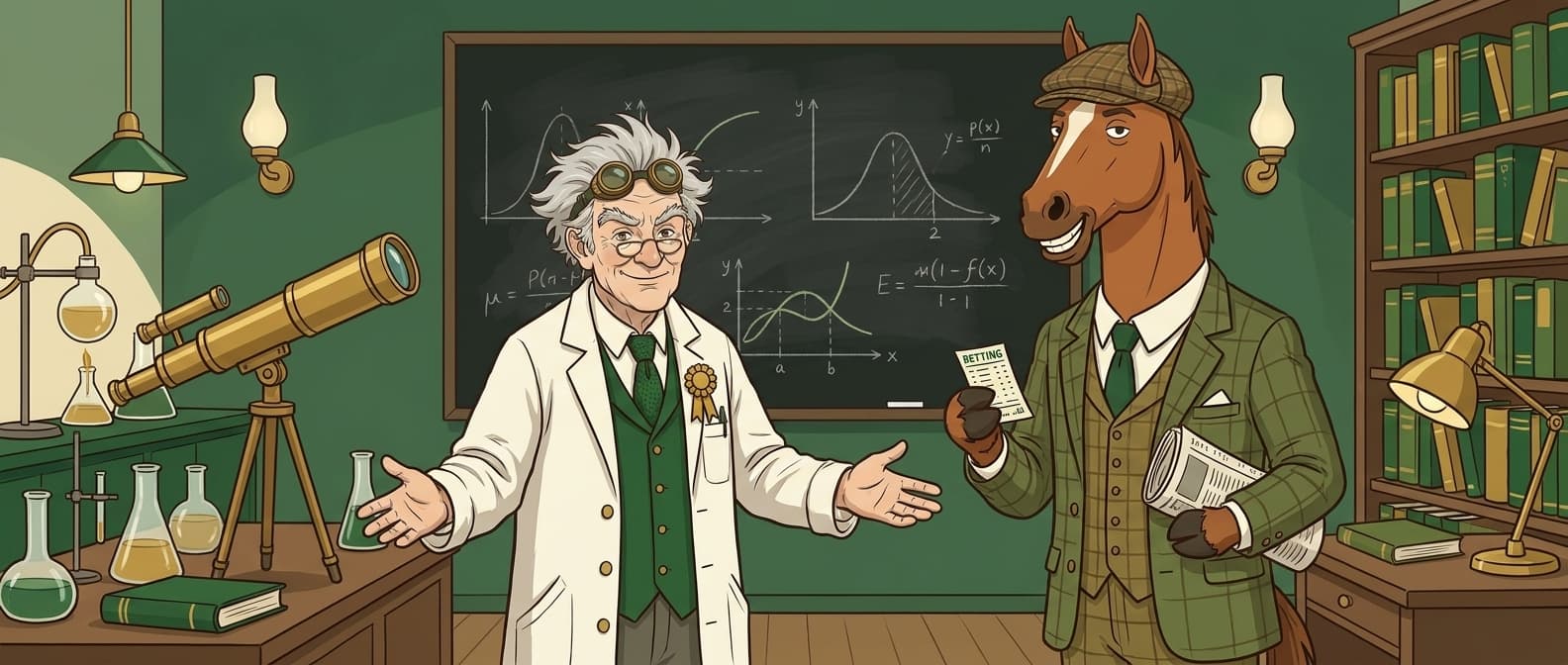
Professor Furlong and Pascal at the AI Lab
THE AI LAB
LAB NOTES · LAB NOTES

If I Put a Tenner on at 2/1, What Do I Get Back?

Thirty pounds. Twenty of that is winnings, and your original tenner comes back on top of it.

That last part is where the confusion usually sits. A winning bet returns your stake as well as your profit, so 2/1 about a tenner pays thirty pounds into your account rather than twenty. If the horse loses, the tenner is gone and nothing comes back.

We are starting the month here on purpose. Everything else we publish about prices and what betting costs assumes you can turn a price into money in your head. Plenty of people cannot, and say so quite happily, because the app has always done it for them. The app is not wrong. It is that never seeing the sum makes it very hard to tell a good price from a poor one.

So here is the sum, in both formats you will meet, with a table you can check against your own slip.

Fractions: what you win, then what you staked

A fractional price has two numbers. The left one is what you win. The right one is what you have to stake to win it.

At 2/1 you win two pounds for every one staked. At 7/2 you win seven pounds for every two staked. At 4/5, an odds-on price, you win four pounds for every five staked.

Then add the stake back. That is the whole calculation:

(stake divided by the right number, times the left number) plus your stake.

A tenner at 7/2: ten divided by two is five, five times seven is the profit, and the tenner comes back on top of it.

Decimals: the answer without the extra step

A decimal price already includes your stake, which is why exchanges and many apps use it. Multiply and you are done. A tenner at a decimal price of three returns three tenners.

To convert a fraction to a decimal, divide the left by the right and add one. So 7/2 becomes three and a half plus one. To go the other way, take one off the decimal and turn what is left into a fraction.

Neither format is better than the other. Decimals are easier for sums. Fractions are what you will hear said out loud at a track.

The same tenner, at every kind of price

PriceDecimalProfit on £10.00Total back
1/21.50£5.00£15.00
4/51.80£8.00£18.00
Evens2.00£10.00£20.00
6/42.50£15.00£25.00
2/13.00£20.00£30.00
7/24.50£35.00£45.00
6/17.00£60.00£70.00
12/113.00£120.00£130.00
33/134.00£330.00£340.00
100/1101.00£1,000.00£1,010.00

The gap between profit and total return is your stake, in every row. Decimal prices already include it; fractional prices do not.

Two things fall out of that table.

The gap between profit and total return is your stake, in every single row. And evens is the hinge: below it you are risking more than you stand to win, above it the other way round. An odds-on shot asks you to put up more than you can win, which is why a good run of them going in can still leave you behind.

If you would rather not do the arithmetic at all, our odds converter handles it both ways.

The price is also a prediction

A price is not only a payout. It is the bookmaker saying how likely they think the horse is to win, written as money.

Turn the decimal upside down and you get that chance. An evens shot is one divided by two, or a half. A 2/1 shot is one in three. A 12/1 shot is about one in thirteen. So when someone offers you 12/1, they are telling you they make it roughly a one-in-thirteen chance.

Here is the part worth carrying with you. We checked every price against what actually happened across 218,437 British runners, and each one wins slightly less often than its price implies. A 12/1 shot comes in 6.9% of the time. A 100/1 shot wins 1 in 391 runs.

That shortfall is not a failure of judgement by the bookmaker. It is their charge for taking the bet, and it sits inside every price on the board. It also grows as the price lengthens, which is why very long shots are the worst value on the card even though they feel like the cheapest bit of fun.

Tomorrow we take that apart properly, read as a percentage rather than a payout.

Research, not tips. Nothing here is a selection, and no price is a good bet on its own.

Common questions

If you win a bet, do you get your stake back?

Yes. A winning win-only bet returns your stake plus your profit. At 2/1 a tenner returns thirty pounds, made up of twenty in profit and your stake back. If the bet loses, nothing comes back.

What does 7/2 pay on a tenner?

Divide the stake by two, multiply by seven, then add the stake back. The table above works it out for every common price.

Is a decimal price better than a fractional one?

Neither is better. They are the same number written differently. Decimals include your stake; fractions show profit only.

What does evens mean?

You win the same amount you stake. In decimals it is two, and your stake comes back on top.

What is odds-on?

A price shorter than evens, where you risk more than you stand to win. Backing odds-on favourites as a policy has lost -5.23% of stakes across our sample.

Does the bookmaker take a commission on top?

Not on a standard fixed-odds bet. Their charge is already inside the price you were shown, which is why every price wins a little less often than it says. Betting exchanges work differently and do take a commission on winnings.

Every figure here is pulled live from our data and nothing beats the bookmaker's margin. For whether anyone holds a real edge, see our track record. 18+, please bet responsibly.

More from Lab Notes