
StableBet
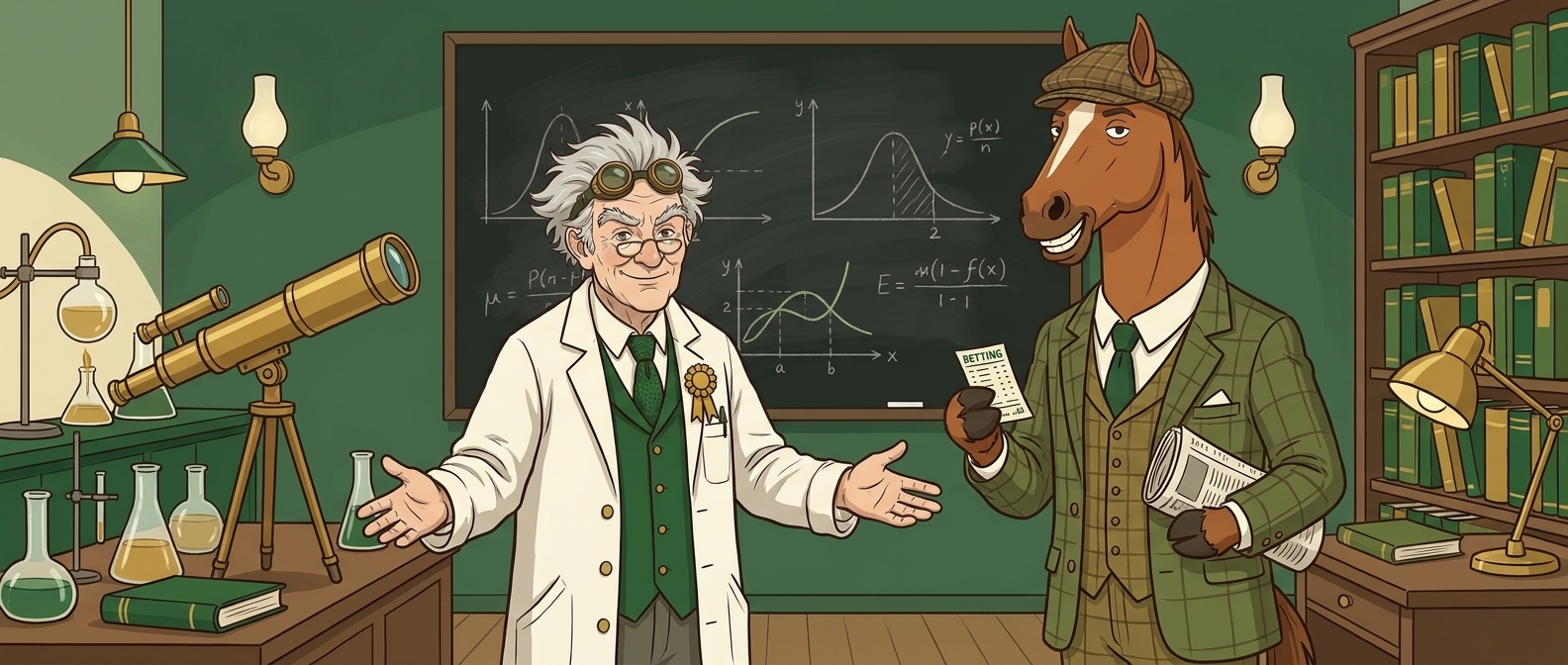
Professor Furlong and Pascal at the AI Lab
THE AI LAB
LAB NOTES · LAB NOTES

How Often Would I Need to Win Just to Break Even?

Divide one by the decimal price. That is your break-even strike rate, and it is the same sum we used to turn a price into a chance.

At 2/1, a decimal of three, you need to win one time in three. At 4/1 you need one in five. At evens you need one in two. Win more often than that and you are ahead. Win less often and you are behind, however good the horses looked.

The useful part is what happens when you compare that number with reality. The price tells you what you need. The results tell you what people actually get. The gap between the two is the bookmaker's charge, expressed as a strike rate rather than a percentage, and for a lot of people that is the version that finally lands.

What you need, against what actually happens

The strike rate you need at any price is one divided by the decimal, which is the same sum that turns a price into a chance. So the "price implied" column below is also your break-even rate: hit it and you finish level.

Price (SP)RunnersActually wonPrice impliedReturn to SP
Odds-on (under evens)4,32761.2%62.6%−2.5%
Evens-2/124,75732.4%34.4%−5.8%
3/1-4/132,32619.2%21.3%−9.8%
5/1-6/124,72613.5%15.0%−9.9%
7/1-9/127,3149.7%11.2%−13.5%
10/1-13/123,5786.9%8.3%−16.5%
14/1-19/121,7784.9%6.0%−18.6%
20/1-32/123,0573.1%4.1%−23.8%
33/1-49/113,1001.9%2.7%−30.9%
50/1-65/15,2991.0%2.0%−50.0%
66/1-99/17,2340.8%1.4%−45.0%
100/1+10,9410.3%0.7%−62.7%

Read across each row. At the short end the two middle columns are close, which is why that part of the market is nearest to break-even before costs. At the long end they separate sharply.

The "actually won" column is not our opinion. It is what happened.

Why the gap is so hard to close

The shortfall at the short end of the market is small. That is precisely what makes it dangerous, because it is invisible over an afternoon and inescapable over a year.

Consider what closing it would take. Backing favourites wins 35% and returns -8.91%. To break even you would need to lift that strike rate by a few points in a hundred, permanently, against a market that has already read the same form you have.

Our own model is a reasonable test of how hard that is. It prices every runner in every British and Irish race, its top pick wins 24.3% of the time, and across 9,647 races it has returned −13.9%. It is a competent judge that has not closed the gap.

Nothing in that is a reason to stop having a bet. It is a reason to know which number you are actually chasing, because "pick more winners" is much vaguer, and much less achievable, than it sounds.

Tomorrow: whether any of this matters if you only bet a fiver twice a year.

A word on all of this

None of these pages is a tip, and none describes a way to win. They describe what betting costs, which is a different and more reliable subject. If your betting has stopped being fun, BeGambleAware has free, confidential help, and the National Gambling Helpline is on 0808 8020 133.

Common questions

What strike rate do I need to break even?

One divided by the decimal price. Mixed prices need the same sum weighted across your bets.

Is break-even the same as making a profit?

No, break-even is the point where you finish level. Anything above it is profit, and every approach we have tested over 29,286 races has finished below it.

Does a higher strike rate mean I am doing better?

Not on its own. Backing odds-on shots produces a high strike rate and has still returned -5.23%. Strike rate only means something next to the prices you took.

Which prices come closest to break-even?

The short end. The long end is furthest away by a distance.

Would best odds guaranteed close the gap?

It helps, since it pays the bigger of your price and the starting price. It is a real improvement rather than a solution, and it does not change the structure of the book.

Every figure here is pulled live from our data and nothing beats the bookmaker's margin. For whether anyone holds a real edge, see our track record. 18+, please bet responsibly.

More from Lab Notes